


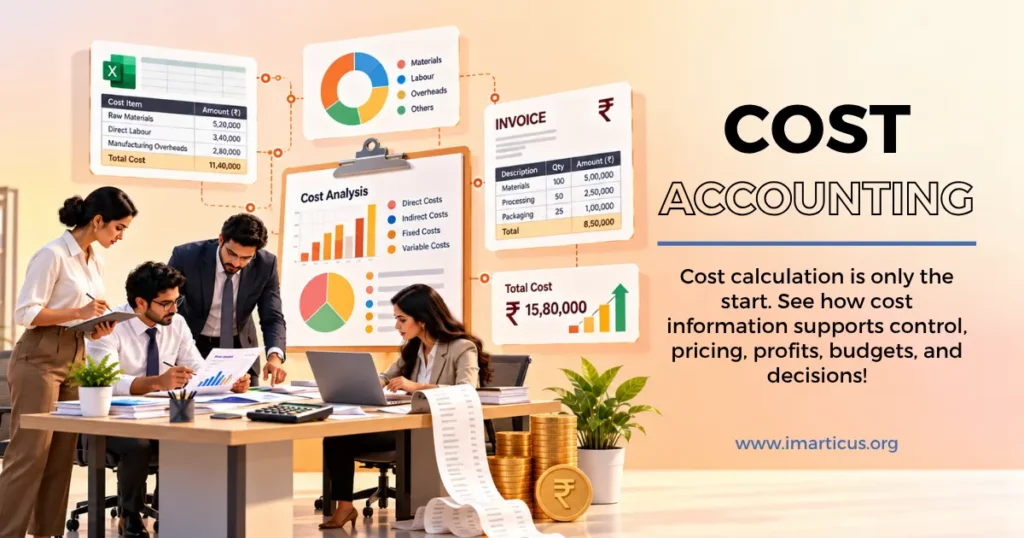
Cost accounting is the process of finding out what it costs to make a product or provide a service. It covers direct costs such as materials and labour, along with indirect costs such as factory overheads. It puts a figure on what it actually takes to make a product or deliver a service. You can use it to break down material, labour and overhead costs, work out a product’s cost, check margins and spot areas where money is being lost.
Cost sheets, standard costing, process costing, activity-based costing and cost accounting standards all sit within the subject. It also has a different purpose from financial accounting and management accounting. For anyone studying finance, the value is simple: you learn to read costs closely enough to make sense of the numbers behind a business.
A business can stay busy all month and still end up with a weak margin. Orders may be coming in. Sales may look healthy. At the same time, material has become dearer or a job is taking longer to finish. A product may also be using more factory time than expected.
The final accounts will show the effect on profit. You still need a closer view to find where that pressure came from. Cost accounting gives you that view. It follows the money going into a product, service, job or process.
This subject also sits close to management accounting. If you want to take these ideas further, a CMA Course can help you study cost management alongside planning, performance and finance decisions. Imarticus Learning offers a US CMA pathway for learners who want to build that wider finance base.
Don’t Let Our Best Advice Get Buried
Add Imarticus as a Preferred Source — see more of what we publish, every time you search.

What Is Cost Accounting?
If you are asking what is cost accounting, start with the work it does. It gathers cost data, sorts it and helps you understand how much something has really cost the business. Take a small bakery. A cake sells for ₹900. You can see that price straight away. Working out the cost takes a little more effort.
There is flour, cream and packaging. Someone has to bake and decorate the cake. Electricity is used. The kitchen has rent and cleaning costs. Some of these expenses belong directly to the cake. Others support everything the bakery sells.
A useful cost accounting definition should cover both the calculation and its purpose. It is a way to identify, classify and study costs so that a business can plan spending, review margins and make sound decisions. You can define cost accounting more simply too. It tells you where money was used and what that spending produced.
The cost accounting meaning becomes much clearer when a number changes. Suppose that cake cost ₹520 last month. This month it costs ₹590. The increase is ₹70. You now need to find out where it came from. Cream may have become dearer. More ingredients may have been wasted. The baker may have taken extra time. Power costs may have moved up. Each answer leads somewhere different.
That is the meaning of cost accounting in normal business use. You are reading what sits behind the number. For an exam or interview, another cost accounting definition can be useful. It is an internal accounting system used to measure and analyse the cost of products, services and activities. If you need to define cost accounting in one line, that wording keeps the answer clear.
One more way to understand the cost accounting meaning is to think about cause. A cost figure tells you how much was spent. Looking into the cause tells you what needs attention. That is also why the meaning of cost accounting reaches well beyond bookkeeping. The figures support pricing, budgets, product decisions and cost control.
For students weighing their next move in finance, the CMA can raise practical questions around career scope, earning potential, exam effort and the kind of roles it can lead to. A closer look at these factors can help you judge whether the qualification fits your career plans.
Understanding The Cost Concept In Accounting
The cost concept in accounting starts with a basic question. What resource did you use to produce the result? That result could be a meal in a restaurant. It could be a hotel room, a delivery or a finished product in a factory. Once you know what you are measuring, the costs around it become easier to sort.
The cost concept in accounting also considers how each expense behaves. Some costs rise when output rises. Some remain fairly stable for a period. Some belong clearly to one product. Others are shared by many products. The table below puts the common groups into simple language.
| Cost Type | What It Means | Simple Example |
| Direct cost | You can trace the expense to one product, service or job quite easily. | Timber used to make one table. |
| Indirect cost | The expense supports several activities and needs a reasonable allocation. | Security for an entire factory. |
| Fixed cost | The total stays fairly stable within a normal level of activity. | Monthly rent for a shop. |
| Variable cost | The total usually moves as output or activity changes. | Packaging used for every item sold. |
| Sunk cost | The money has already been spent and cannot be recovered through a later choice. | A research fee that has already been paid. |
| Opportunity cost | It reflects the benefit given up when you choose one option over another. | Using spare space for storage instead of renting it out. |
One expense may fit more than one group. Factory rent can be fixed and indirect. Raw material can be direct and variable. The label depends on what you are trying to understand.
Also Read: How hard is the CMA difficulty compared with CA?
Objectives Of Cost Accounting
The objectives of cost accounting become easier to understand when you turn them into normal business questions.
- What did this item cost?
- Why did that cost rise?
- Is the selling price still sensible?
- Which product is using more resources?
Those questions lead to a few practical uses.
- Cost ascertainment helps you work out the full cost of a product, service, job or process before you judge its margin.
- Cost control lets you compare planned spending with actual spending and find areas where usage has moved beyond expectation.
- Pricing support gives you a firmer cost base before you set a new price or review one already in use.
- Profit analysis helps you see which products or services still earn a sound return after the relevant costs have been included.
- Budgeting gives teams a clearer base for planning future spending and checking actual results against the agreed plan.
These are the main objectives of cost accounting in day-to-day use. They also explain the importance of cost accounting once a business has several products, teams or branches. A company may show a healthy overall profit while one product line is losing margin month after month. The importance of cost accounting becomes very practical in that situation because you can look below the company total.
Scope Of Cost Accounting
The scope of cost accounting begins with good source data. Direct expenses can often be traced quickly. Shared costs need a sensible basis before they can be assigned. After that, the same information can support budgets, stock valuation, cost control, margin checks and performance reviews.
A production team may study waste. Finance may compare actual spending with the budget. Management may review margins before changing a price. This wider scope of cost accounting makes the subject useful throughout the year. You do not need to wait for the annual accounts before looking at a cost problem.
Nature Of Cost Accounting
The nature of cost accounting is detailed and mostly internal. You can study one product without analysing the whole company. You can look at one branch or process as well.
A hotel may track the cost of an occupied room. A delivery company may use cost per kilometre. A clinic may want the cost of one procedure. That helps explain the nature of cost accounting. The report can change with the work because every manager does not need the same view.
Also Read: What is the CMA full form in accounting?
Elements Of Cost
Once the basic cost groups are clear, you can build the total in stages. I find this much easier to follow than starting with one large expense figure. You can see where each part comes from and where a change has happened. The table below covers the main elements that normally appear in a cost statement.
| Element | What It Covers | Simple Example |
| Direct material | Material that becomes part of the output and can be traced to it. | Fabric used to make a shirt. |
| Direct labour | Labour linked directly with producing the item or delivering the service. | A tailor stitching a specific garment. |
| Direct expenses | Other expenses that can be linked clearly with one job or output. | A design fee paid only for one customer order. |
| Factory overhead | Shared production costs that cannot be traced neatly to one unit. | Lighting across the entire production floor. |
| Administration overhead | Relevant office costs that support the organisation or production work. | Salaries for support staff serving several teams. |
| Selling and distribution overhead | Costs linked with selling, storing or delivering finished goods. | Warehouse rent and delivery charges. |
Once the elements are separated, a rise is easier to investigate. If labour has moved sharply, you know where to look. If factory overhead has grown, you can study the expenses inside that group.
Also Read: How can I practise the CMA question paper effectively?
Cost Sheet Format In Cost Accounting
The cost sheet format in cost accounting brings the full cost build up together. Direct expenses come first. Overheads are then added in stages until you reach the cost of sales. A small furniture example makes this much easier to read. Assume a unit makes 1,000 stools during the month.
| Particular | How It Is Built | Amount |
| Direct material | Timber, fittings and other traceable material | ₹2,50,000 |
| Direct labour | Wages linked directly with production | ₹1,20,000 |
| Direct expenses | Other traceable production expenses | ₹30,000 |
| Prime cost | Direct material + direct labour + direct expenses | ₹4,00,000 |
| Factory overhead | Shared production expenses | ₹80,000 |
| Factory cost | Prime cost + factory overhead | ₹4,80,000 |
| Administration overhead | Relevant administration cost | ₹40,000 |
| Cost of production | Factory cost + administration overhead | ₹5,20,000 |
| Selling and distribution overhead | Selling, storage and delivery cost | ₹30,000 |
| Cost of sales | Cost of production + selling and distribution overhead | ₹5,50,000 |
The business made 1,000 stools and spent ₹5,50,000 to produce and sell them. That gives a cost of ₹550 per stool before profit. You now have a figure that can be used in a pricing discussion. If the stool sells for ₹600, there is very little room. At a selling price of ₹900, the position is quite different. This is why the cost sheet format in cost accounting is worth learning early. It lets you see how the final cost has been built instead of dealing with one unexplained total.
Types Of Cost Accounting
The types of cost accounting make more sense when you connect each method with the problem it helps you solve. You may want to compare expected cost with actual cost. You may want to see how profit changes with volume. You may need a better way to deal with overhead. The main approaches include the following.
- Standard costing compares an expected cost with the actual result so you can study changes in material, labour or overhead.
- Marginal costing focuses on variable cost and contribution so you can examine how changes in volume or price affect profit.
- Activity-based costing links overhead to activities and cost drivers when broad allocations hide how resources are being used.
- Absorption costing includes fixed and variable production costs when you work out the full cost attached to finished output.
- Target costing begins with the expected market price and desired profit before you work back to an acceptable cost.
These types of cost accounting can be used for different purposes inside the same business. A manufacturer may use one method to value output and another when studying a short-term decision.
Process Costing In Cost Accounting
Process costing in cost accounting suits production that runs continuously and produces similar units. Cement, paint, paper and food processing are good examples. Treating every bag, tin or bottle as a separate job would create a lot of work without adding much useful information.
Under process costing in cost accounting, expenses are collected for each stage. The cost of that stage is then spread across the output. Partly finished units can make the calculation more detailed. Normal loss and abnormal loss also need attention in some industries. The accounting becomes much easier once you understand how the product actually moves through production.
Methods Of Costing
Costing methods usually follow the way the work itself is done. A custom order needs a different method from continuous production. That is why the production process matters before you choose the costing method.
- Job costing suits work that can be identified separately. A custom furniture order is a simple example.
- Batch costing groups similar units together. Contract costing is suited to large projects. Service costing may use measures such as room nights or passenger kilometres.
The method should make sense for the output you are trying to measure.
Also Read: What is the CMA pass percentage in India?
Cost Accounting Standards
Cost accounting standards give businesses a common approach to areas where judgement is involved. Capacity is one example. Overhead treatment is another. The method used in these areas can change the amount assigned to a product.
Key Areas Covered By Cost Accounting Standards
The standards cover specific parts of cost measurement where consistency matters. Here are some of the main areas you will come across:
| Cost Area | What It Covers | Why It Matters |
| Classification of Cost | How different costs are grouped and classified | Gives a consistent base for cost analysis |
| Capacity Determination | How capacity is assessed and measured | Affects overhead allocation and cost per unit |
| Material Cost | Treatment and measurement of material costs | Helps arrive at a reliable material cost |
| Employee Cost | Costs related to employee services | Brings labour costs into the total cost calculation |
| Overheads | Production and other indirect costs | Helps assign indirect costs more consistently |
| Inventory Valuation | Measurement of inventory cost | Supports consistent valuation of stock |
These areas matter because even small differences in cost treatment can affect product costs, margins and internal reports. The standards give you a more consistent basis for making those calculations.
Interesting Insight → In India, the Cost Accounting Standards Board of the Institute of Cost Accountants of India publishes standards and supporting guidance. The current cost accounting standards cover areas including classification of cost, capacity, material cost, employee cost, overheads and inventory valuation. (Source)
Advantages Of Cost Accounting
The advantages of cost accounting are easiest to see when a business has a problem to investigate. Suppose sales have grown for three months while profit has barely moved.
- Material may now cost more.
- Overtime may have increased.
- One product may be taking longer to make.
- Delivery costs may also have risen.
One of the advantages of cost accounting is that you can separate those movements. You get somewhere useful to start instead of treating the higher expense as one large total. The same records can help with pricing, stock control and budgets. Their value still depends on good data. A detailed report built on weak figures will not help much.
Limitations Of Cost Accounting
The limitations of cost accounting matter because some figures depend on judgement. Shared overhead gives a good example. Say a warehouse serves five product lines. The warehouse cost has to be divided between them somehow. You might use floor space, stock volume or another suitable measure. A different basis can produce a different product cost.
The limitations of cost accounting also include the time and cost needed to maintain the system. Very detailed models can become difficult to update. Poor source data can also make the final answer misleading. I would always look at the method behind a figure before treating that figure as precise.
Also Read: Who is eligible for CMA campus placements?
Difference Between Cost Accounting And Financial Accounting
The difference between cost accounting and financial accounting becomes clearer when you look at the people using the information. Financial accounts give you the wider position of the organisation. Internal cost reports can go much further into one job, product, branch or process. The table below covers the main points.
| Area | Cost Accounting | Financial Accounting |
| Main purpose | Studies costs, margins and efficiency inside the business. | Reports the overall financial position and performance of the business. |
| Main users | Managers and internal teams use the information for planning and control. | Management and external users rely on formal financial statements. |
| Level of detail | Can focus on a product, service, job, branch or process. | Usually presents results for the organisation as a whole. |
| Timing | Can be prepared whenever management needs the information. | Follows formal reporting periods and reporting requirements. |
| Rules | Internal reports can follow methods suited to management needs. | Reports follow the accounting rules and standards that apply to the entity. |
| Main focus | Looks at cost behaviour, allocation, control and product margins. | Looks at income, expenses, assets, liabilities, equity and cash flow. |
The difference between cost accounting and financial accounting can also be seen when profit falls. The financial statements tell you that the result changed. Detailed cost records can help you trace the product, process or expense that needs attention.
Also Read: When are the CMA exam dates for 2026?
Difference Between Cost Accounting And Management Accounting
The difference between cost accounting and management accounting is mostly about how wide the information goes.
- Cost accounting concentrates on products, services and activities.
- Management accounting can place those numbers beside budgets, forecasts, cash flow and operating information.
The difference between cost accounting and management accounting becomes easy to see in a production choice. Suppose a product gives a contribution of ₹300 per unit. That is useful. Management may still need to look at demand, available capacity and cash flow before deciding how much to produce. The cost figure is part of that decision.
Cost And Management Accounting
Cost and management accounting sit close together because managers use cost data in wider business choices. Consider a make or buy decision. You may start by comparing the internal production cost with a supplier quote. You also need to think about spare capacity, quality and delivery risk.
That is how cost and management accounting connect. Detailed cost information gives you a base for the decision. The wider management view brings in the other factors that matter.
Interesting Insight → There is useful career context here as well. IMA says it has more than 120,000 members worldwide and describes the CMA as its global management accounting credential. That reach helps explain why cost, planning and performance skills appear across many finance roles.
Important Cost Accounting Formulas
You do not need to memorise every formula at once. I would begin with the calculations that show how a basic cost is built. The rest becomes much easier once those are familiar.
| Formula | Calculation | What It Tells You |
| Prime cost | Direct material + direct labour + direct expenses | Shows the direct cost attached to production. |
| Factory cost | Prime cost + factory overhead | Shows the cost up to the factory stage. |
| Cost of production | Factory cost + relevant administration overhead | Shows the cost of completed output. |
| Contribution | Sales revenue minus variable cost | Shows what remains for fixed costs and profit. |
| Break-even units | Fixed cost ÷ contribution per unit | Shows the volume needed to cover fixed costs. |
| Cost per unit | Total relevant cost ÷ units produced | Shows the average cost attached to each unit. |
The arithmetic is usually the easier part. A wrong classification or poor overhead basis can still produce a neat answer. That is why the inputs deserve as much attention as the formula.
How Cost Accounting Fits Modern Finance Work
Software can now collect stock movement, labour hours and production information very quickly. That saves time. It also means finance teams can spot changes earlier. Cost accounting still needs judgement. If material usage rises, you need to know whether production also increased.
If labour cost rises, you need to see whether wage rates changed or staff worked more hours. A system can calculate a variance in seconds. You still need to decide what caused that variance and whether action is needed. That ability to read the number matters in modern finance work.
Choosing between the two CMA papers often comes down to the syllabus you are more comfortable with, the level of calculation involved and how much preparation time you can give each attempt. A clear comparison can help you decide which paper to take first and how to structure your preparation.
Why Imarticus Learning For Your US CMA
If you are starting from scratch, I would keep the learning order simple. Start with cost types. Then learn how a cost sheet works. Move into costing methods after that. Once those ideas feel comfortable, variance analysis and decision tools become easier. Structured study can help when you want to take the subject further. That gives topics such as planning, cost and performance a business setting alongside exam preparation.
Learning Cost Accounting For A Finance Career
If you are putting time and money into the US CMA, the course should give you something useful beyond exam notes. Imarticus brings KPMG in India into the programme, which is one of its strongest differentiators.
- KPMG-curated study material and 23 business case studies, with the cases evaluated by KPMG practitioners.
- 12 live sessions every year with KPMG practitioners, along with monthly finance webinars.
- KPMG internship opportunity for eligible top performers, based on the criteria stated by Imarticus.
- Joint Imarticus and KPMG certification after completing the programme and clearing the IMA CMA exams.
- IMA Gold Learning Partner status for CMA preparation.
- Surgent-powered CMA preparation, including adaptive practice, mocks and a 24/7 AI tutor.
- 50% money-back guarantee for eligible students who meet the stated requirements and do not pass.
- Pre-placement bootcamp covering CV building, interview coaching and soft skills, with assured interview opportunities stated by Imarticus.
For someone choosing a CMA Course, the KPMG-linked learning, case work and internship route are the points worth looking at closely.
FAQs About Cost Accounting
Whether you are revising the basics or working through practical costing problems, these quick answers clear up frequently asked questions around cost accounting and its methods, uses, formulas, and relevance in business.
What Do You Mean By Cost Accounting?
Cost accounting means identifying and studying costs linked with products, services or activities. It helps you see where resources are being used and supports pricing, budgets, control and internal decisions.
What Are The Four Types Of Cost Accounting?
The four common types are standard, marginal, activity-based, and absorption costing. Cost accounting uses each for a different purpose. Imarticus Learning covers cost management within its US CMA learning pathway.
What Are Examples Of Cost Accounting?
The examples of cost accounting include reparing a cost sheet, tracking factory overhead and checking labour variance. This method turns these figures into useful decision support. Imarticus Learning connects these topics with wider management finance learning.
What Is The ABC Method Of Costing?
The ABC Method of Costing means activity-based costing. It assigns overhead through activities and cost drivers. Cost accounting can use ABC when broad allocations hide resource use. Imarticus Learning covers related cost management topics within its CMA preparation.
How Can I Learn Cost Accounting?
You can learn cost accounting in this order: start with cost types, cost sheets and costing methods before moving into variance analysis. Cost accounting becomes easier with regular problem practice. Imarticus Learning offers a structured US CMA pathway for deeper study.
What Is Standard Cost Accounting?
Standard cost accounting sets an expected cost for material, labour or overhead and compares it with the actual figure. The difference is called a variance. Imarticus Learning covers related planning and performance topics through its CMA programme.
What Is The Formula For Cost Accounting?
Cost accounting uses several formulas rather than one universal formula. A basic one is direct material + direct labour + direct expenses = prime cost. Relevant overheads are then added as the cost is built.
Who Was The Father Of Cost Accounting?
J. Lee Nicholson is often called the father of cost accounting in United States accounting history. The title is not universal. The American Accounting Association records Nicholson as an important pioneer in the field.
What Cost Accounting Means For Your Career
The numbers matter, but knowing what to do with them matters more. A rising material cost, idle capacity or an unexpected overhead can change the way a business looks at its margins. That is why cost accounting remains useful well beyond an exam or a cost sheet.
You now have the basics covered, from the cost concept in accounting and costing methods to process costing, cost accounting standards and the difference between cost and management accounting. The next step is getting comfortable with those numbers in real finance situations.
For students taking that step through the US CMA route, the CMA Course at Imarticus Learning includes KPMG-linked case studies, practitioner sessions and structured exam preparation. It gives you a way to build on the costing concepts covered here while working towards a recognised finance qualification.
Liked This? Follow Us Where You Already Search.
Preferred Sources is Google’s built-in follow button — no app, no login, just more Imarticus in your results.