


I still remember when a CA Final student asked me if an AI tool could be trusted with a tax audit query. My honest answer was no, not fully. Most general AI chatbots were not trained on Indian accounting standards, the Companies Act, or ICAI’s guidance notes.
Why would ICAI build its own AI platform instead of pointing its 400,000-plus members to ChatGPT? The answer comes down to trust. The answer comes down to trust. A generic chatbot pulls from a mix of global internet text. That may work for a first draft email. It is riskier when the question involves a specific Section, Standard, or GST notification in India.
If you are a member trying to speed up tax research, this tool can save time. Students can also use it to revise faster. But it is important to know how CA GPT works and where human review is still needed. And if you are also mapping out where your career goes after CA, browsing Imarticus Learning’s finance courses is a good parallel step, since AI fluency and a global credential tend to open doors together rather than separately.
Did You Know?Within weeks of its rollout, over 30,000 ICAI members had already used CA GPT.ICAI backed the launch with a dedicated three-day, eighteen-hour AI certificate course for members.
Don’t Let Our Best Advice Get Buried
Add Imarticus as a Preferred Source — see more of what we publish, every time you search.

What Is CA GPT?
Before getting into the tool itself, it helps to have the basics of the profession in view. A Chartered Accountant, or CA, is a finance professional certified by the Institute of Chartered Accountants of India. CAs work across accounting, auditing, taxation, and financial compliance. It is one of India’s most rigorous finance qualifications. If you want the fuller picture of the course levels and career path, our what is CA guide covers that in detail.
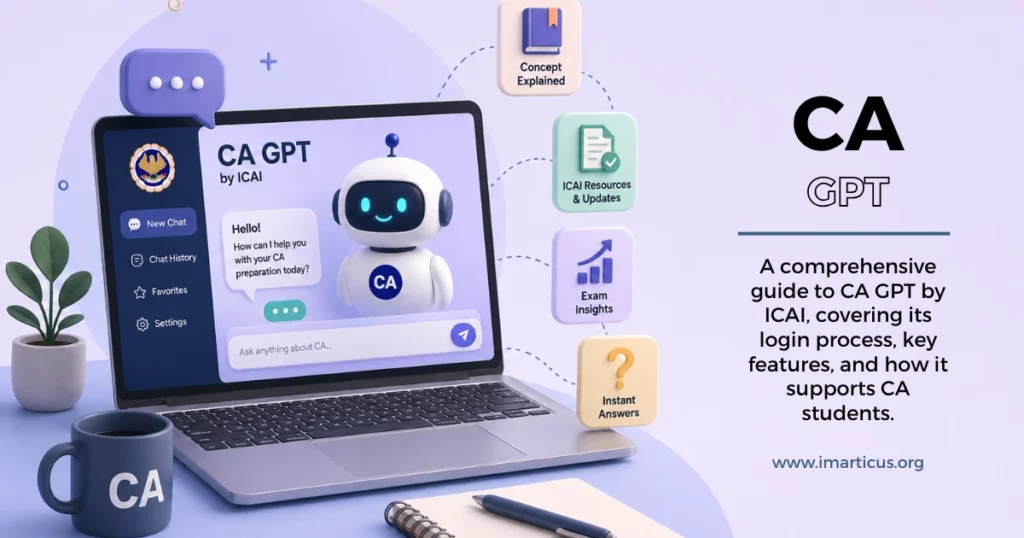
CA GPT is an AI platform built by the Institute of Chartered Accountants of India (ICAI) in partnership with OpenAI. It gives members, students, and firms a conversational way to access ICAI’s knowledge base. I think of it less as a single chatbot and more as a locked reference library that happens to talk back. It launched on July 1, 2024, on CA Day, as part of ICAI’s Diamond Jubilee celebrations marking 75 years of the profession. The easiest way to understand CA GPT is to look at how it is built, not just what it does.
How is CA GPT Different From A Regular Chatbot?
- Fenced, not open. It stays within ICAI’s own data rather than pulling from the open internet, which is what makes it more dependable for Indian statutory questions.
- Trained on decades of ICAI material. Accounting standards, auditing standards, direct and indirect tax content, and other regulatory publications feed the model, not random web pages.
- Built as a family of assistants. Logging in at ai.icai.org/cagpt does not open one generic chatbot. It opens a menu of GPTs, each tied to a specific ICAI committee, such as Direct Taxes, GST and Indirect Taxes, or Accounting Standards.
I always tell students this last point first, because it changes how you should use the tool. You are not asking one assistant everything. You are picking the right specialist for the question in front of you.
Also Read: The Role of Accountants in a Digital Transformation
CA GPT For CA Foundation, Intermediate And Final Students
Roughly two weeks after the professional version launched, ICAI introduced a dedicated CA Student GPT on July 16, 2024, during its AI Innovation Summit, timed to coincide with Global AI Appreciation Day. This version is built specifically around the needs of students preparing for Foundation, Intermediate, and Final level exams.
The student experience includes:
- Syllabus-aligned modules customised to the current ICAI curriculum and past examination patterns.
- Instant access to study materials and suggested answers without waiting for a faculty response.
- Concept breakdowns for tricky topics, particularly useful for standards-heavy subjects like accounting and taxation.
- Real-time query resolution, which matters most during late-night revision sessions before an exam.
Reported usage data suggests that CA Final and Intermediate students make up most of the daily activity. This shows how useful the platform has become for exam preparation. If you are a second-time attemptee or coming from a non-commerce background, a tool like this can genuinely help close conceptual gaps between classes. Still, CA GPT should supplement ICAI’s official study material and mock test papers. It should not replace them. The exam is based on the Institute’s prescribed content and Suggested Answers.
Also Read: CA vs CFA: Choosing the Right Path for Your Finance Career
ICAI Has Built An AI Tool For The Profession
Accounting and audit work in India relies on many statutes, standards, circulars, and notifications. These rules can change often. Searching PDFs for a specific clause can be slow. General AI chatbots can also be unreliable here. Their training mixes global information with Indian rules, which can lead to confident but incorrect answers.
Here is what pushed ICAI toward building its own tool instead of pointing members to public AI chatbots:
- Constant regulatory change. GST rates, TDS provisions, Ind AS amendments, and CARO requirements can all shift in the same week, and members need a faster way to track them.
- A large member base already experimenting with AI. The platform has crossed 400,000 members with access and over 70,000 active daily users, and ICAI President Ranjeet Kumar Agarwal has described it as already transforming how members work in accounting, auditing, and taxation.
- Built-in financial analysis. The platform integrates annual report data from more than 5,000 listed companies, letting practitioners benchmark and analyse without manually pulling numbers from dozens of filings. It’s part of a broader shift in how AI is reshaping finance work more generally.
I read that adoption speed as a signal of genuine pent-up demand rather than a marketing push. Members were already trying to use AI for research, and ICAI decided to give them a version trained on the right material instead of leaving that gap to be filled by tools with no Indian context.
CA GPT Login Process For Members And Students
Access to CA GPT is restricted to verified ICAI members, students, and foreign members, which is part of how the Institute keeps the tool tied to genuine SSP (Self Service Portal) records. The login flow differs slightly depending on who you are.
How Different Users Log In
| User Type | Login Requirement | Verification Method |
| Indian ICAI Members | 6-digit Membership Number | OTP sent to SSP-registered mobile number |
| CA Students (Foundation, Intermediate, Final) | Student Registration Number and Date of Birth | Direct login, with SSO via Aadhaar or DigiLocker also available |
| Foreign Members | SSP-registered email ID and Date of Birth | Email-based authentication when mobile OTP is unavailable |
Once you have your credentials sorted, the actual steps are simple:
- Visit ai.icai.org/cagpt, or scan the QR code shared on ICAI’s official channels.
- Choose Member Login or Student Login depending on your category.
- Enter your credentials and complete the OTP or date of birth verification.
- Once authenticated, pick the specialised GPT module relevant to your query from the home screen.
Pro Tip:Update your mobile number on the SSP portal before logging in, since the OTP goes only to the registered number.New users need to activate their SSP account with ICAI first before CA GPT will accept a login.
Specialised GPT Modules Inside CA GPT
This is where CA GPT genuinely earns its reputation as more than a rebranded chatbot. Instead of one general assistant, ICAI has rolled out a growing library of subject-specific GPTs, each grounded in the relevant committee’s own material. I count more than 20 core modules as of the latest updates, with the number of tools and sub-tools closer to 70 once annual report analysers and calculators are included.
Core CA GPT Modules And Their Focus Areas
| Module | Primary Focus |
| Accounting Standards Board GPT | Interpretation and application of ICAI accounting standards |
| Auditing and Assurance Standards Board GPT | Guidance on Standards on Auditing and assurance procedures |
| Direct Taxes Committee GPT | Income tax computation, TDS provisions, and direct tax queries |
| GST and Indirect Taxes Committee GPT | GST compliance, ITC rules, and indirect tax interpretation |
| Corporate Laws and Corporate Governance GPT | Companies Act 2013 and governance-related queries |
| Board of Internal Audit and Management Accounting GPT | Internal audit procedures and management accounting concepts |
| Insolvency and Valuation Standards GPT | IBC procedures and valuation methodology |
| Members and Students Services GPT | Institute services, registration, and general support queries |
| Peer Review GPT | Guidance through the peer review process |
| Sustainability Reporting Standards GPT | ESG and sustainability disclosure requirements |
Each of these is built around a system prompt and knowledge base tuned to that specific committee’s official material, which is why the answers tend to cite the actual Standard, Section, or notification rather than a generic explanation. ICAI has also extended this model internationally, with modules like the UAE VAT GPT and UAE Corporate Tax GPT for members working with Gulf clients. I have seen this play out differently depending on who is asking:
- A Foundation student who kept getting answers pitched too high on the general Student GPT found things clicked once she stuck to basic accounting fundamentals queries instead of jumping straight to standards.
- An Intermediate friend preparing for Ind AS 116 lease accounting got the exact standard-by-standard breakdown from the Accounting Standards Board GPT, which would otherwise have meant piecing information together from three different PDFs.
- A CA Final student I know, mid-articleship, used the GST and Indirect Taxes Committee GPT to double-check an ITC eligibility question on a client’s mixed-use property before it went to his manager, and the citation to the actual circular saved him from raising a query that would have looked half-researched.
Also Read: CA vs ACCA: Which Qualification Fits Your Career Better
CA GPT For Direct Tax And GST Work
Two of the most heavily used modules on the platform are the Direct Taxes Committee GPT and the GST and Indirect Taxes Committee GPT. Tax work is exactly the kind of high-volume, precedent-heavy research where a domain-trained assistant saves real time.
What Each Tax Module Handles
| Module | Typical Queries |
| Direct Taxes Committee GPT | Income tax computation, TDS applicability, capital gains treatment, Finance Act updates |
| GST and Indirect Taxes Committee GPT | GST compliance, input tax credit eligibility, GSTR reconciliation logic, notification interpretation |
I have seen several CA firms use CA GPT alongside their tax audit workflow, particularly for Form 3CD related work:
- Related party disclosures, which need to be cross-checked against multiple schedules quickly.
- Clause 44 GST reporting, where the breakdown of expenditure needs to match GST return data.
- Loan reporting requirements, covering both receipt and repayment thresholds.
- MSME vendor classification checks, which affect disclosure and payment timeline compliance.
A general AI chatbot trained on global internet text may default to US or UK tax logic unless you specify India explicitly, with no guarantee of citing the correct Indian section. CA GPT’s tax modules are built on ICAI material, so references to Sections and CBIC circulars are more likely to reflect current Indian law. Even so, tax law changes fast, and I would not treat any AI tool as a replacement for checking the latest circular yourself before finalising a client position.
CA GPT Versus ChatGPT And Other General AI Tools
A question I get asked often is whether students and professionals still need general tools like ChatGPT once CA GPT is available. The honest answer is that both have a place, and the two are built for different jobs.
CA GPT Versus General-Purpose AI Chatbots
| Aspect | CA GPT | ChatGPT / General Chatbots |
| Training data grounded in ICAI’s standards, acts, and publications | ✓ | ✗ (broad internet text) |
| Access restricted to verified ICAI members and students | ✓ | ✗ (open to the public) |
| Reliable on Indian statutes without manual verification | ✓ | ✗ (variable, often needs checking) |
| Free tier available | ✓ (daily prompt limit) | ✓ |
| Paid tier for higher usage | ✓ | ✓ |
| Best for Indian accounting, audit, tax, and CA exam queries | ✓ | ✗ |
| Best for general drafting, brainstorming, and non-domain research | ✗ | ✓ |
In practice, I see many CA firms use both together. CA GPT tends to win for standards-grounded, India-specific questions, such as asking what SA 315 requires for fraud risk assessment. General AI chatbots remain useful for tasks like drafting a client email or brainstorming an audit approach in plain language. Neither tool should be your final word on a technical position. I always cross-check against the primary statute, standard, or notification before anything goes into a signed report or a client deliverable.
Pricing And Free Access On CA GPT
CA GPT is free to use for verified ICAI members and students, which is one of the reasons adoption has grown so quickly across the profession. Free access comes with a daily prompt limit designed to keep the platform usable at scale, and that limit has been raised since launch as the platform matured.
For firms or individual practitioners who need higher volume access, such as those running frequent annual report analysis, a paid tier is available that removes the daily cap and, in some configurations, adds API access for firm-level integration. For most students and individual members using CA GPT for research or exam prep, the free tier covers regular use comfortably.
Accessing CA GPT On Mobile Devices
CA GPT is a web-based platform that works on any modern browser without a separate download.
- No dedicated app store listing. ICAI’s official route has consistently been the ai.icai.org portal, so treat any “CA GPT APK” download claims with caution.
- Progressive web app (PWA) available. This lets you add a home screen shortcut that behaves much like a native app.
- Good for quick lookups on the go, such as checking a Standard on Auditing reference between client meetings.
- Desktop still works best for longer sessions involving annual report uploads or detailed tax computations.
Accuracy, Limitations And Data Privacy On CA GPT
It is worth being candid about where CA GPT is still maturing, because that context matters for how you use it. ICAI itself has described the platform as being in a beta and continuous improvement phase, with response quality being refined based on user feedback. The Institute’s own manuals note that responses are meant for information and education purposes and should not be treated as a substitute for professional advice specific to your situation.
- Verify before you rely. Even though CA GPT is grounded in ICAI’s own material, it can still produce inaccuracies on niche or heavily litigated tax questions. Cross-check anything material against the primary Act, Standard, or circular before it goes into client work, an approach Audit and Taxation also stresses.
- Avoid uploading sensitive client data. Because the platform runs on third-party AI infrastructure, ICAI recommends against entering confidential client financials or personally identifiable information directly into queries. It is the same tension we cover in Data Privacy and Innovation: How to Balance Ethics with Progress.
- Daily limits apply. The free tier’s prompt cap means you should plan research-heavy sessions rather than assume unlimited back and forth.
- It is not a legal opinion. For anything that could affect a filing position or a signed report, treat CA GPT’s output as a starting point for research, not a final answer.
This caution is not unique to CA GPT. Any AI tool, general-purpose or domain-specific, carries some risk of a confidently worded but incorrect answer. The advantage of a tool like CA GPT is that it narrows the surface area for that risk by staying within a curated, India-specific knowledge base, but it does not remove the need for a qualified professional to review the output.
Also Read: CMA vs CA: Comparing the Two Accounting Career Paths
Practical Use Cases CAs Are Already Running On CA GPT
Beyond simple question-and-answer sessions, practitioners have found several concrete ways to put CA GPT to work in day-to-day practice.
Common CA GPT Use Cases In Practice
| Use Case | What It Helps With |
| Annual report and financial analysis | Benchmarking ratios against sector peers, summarising MD&A sections, flagging year-on-year revenue or margin changes |
| Tax audit support | 3CD related party disclosures, Clause 44 GST breakdowns, loan reporting, MSME vendor classification |
| Standards and law lookups | Grounded answers with the applicable Section, Standard, or Ind AS reference, instead of searching PDFs |
| Exam revision for students | Concept clarification, past paper guidance, and quick doubt resolution outside class hours |
I see AI is not replacing the judgement-based parts of accounting and audit work here, but it is compressing the time spent on research, first drafts, and data lookups. That shift is exactly why building AI fluency alongside your core qualification is becoming a genuine career advantage.
Building A Career Beyond CA Alone
Passing the CA exams and getting comfortable with tools like CA GPT is a strong foundation, but the profession is also globalising fast. Many Chartered Accountants pair their CA qualification with an internationally recognised credential to widen their career options beyond domestic compliance roles.
Common Qualification Pairings For CAs
| Additional Credential | Typical Career Direction |
| ACCA | Global corporate finance and IFRS reporting roles |
| CFA | Investment research, portfolio management, and equity analysis |
| US CMA | Management accounting and cost leadership roles in multinationals |
| US CPA | Roles requiring US GAAP expertise and cross-border audit work |
- CA plus ACCA tends to make IFRS fluency easier, since ACCA’s curriculum is built around global reporting standards rather than domestic ones alone. Read more in our CA vs ACCA comparison.
- CA plus CFA is a common route for professionals aiming at investment management or equity research, where valuation and portfolio theory matter more than statutory compliance. See how the two stack up in CA vs CFA.
- CA plus US CMA suits professionals drawn to internal decision support and cost leadership inside large organisations. Our CMA vs CA guide breaks this down further.
- CA plus US CPA works well for professionals eyeing US-facing audit or reporting roles. Compare the two in CPA vs CA.
None of these additional credentials is a requirement, and plenty of successful CAs build strong careers on the CA qualification alone. But if your goal involves multinational firms, global markets, or cross-border advisory work, I would spend an evening comparing these qualifications against your CA base before picking the next one to pursue.
Why Choose Imarticus Learning For Your Finance Courses
Choosing the right learning partner for that next credential matters as much as choosing which credential to pursue. Imarticus Learning structures its finance courses around real job readiness rather than theory alone, which is particularly useful once you are already working and need training that respects your time. If you are exploring which credential fits best alongside your CA, browsing Imarticus Learning’s finance courses is a good place to compare programs side by side before committing.
- Approved Prep Provider for Global Credentials: Official prep partner status for major international finance and accounting qualifications, keeping course content aligned with global exam frameworks.
- Curriculum Built with Industry Leaders: Select programs are developed in knowledge partnership with global firms, giving learners exposure to real-world financial modelling tools and industry practices.
- Strong Placement Network: A wide base of hiring partners connects learners to roles across banking, Big 4 firms, and financial institutions.
- Practical, Case Study Driven Learning: Programs are built around hands-on projects and applied tools rather than lecture-only formats.
- Modern Tools and Applied AI Training: Coursework includes exposure to analytics tools and applied AI applications, which is directly relevant given how fast AI is being woven into accounting and finance work.
FAQs About CA GPT
Whenever I bring up CA GPT with members or students, the same handful of frequently asked questions come up almost every time. Here are clear, practical answers to help you decide how to use the tool.
Is CA GPT free for ICAI members and students?
Yes. CA GPT is free to use for verified ICAI members, students, and foreign members, with a daily prompt limit on the free tier. A paid tier with higher usage limits is available for firms or individuals who need heavier daily access. Imarticus Learning’s finance courses can help you build on the analytical skills you practice using tools like this.
How do I log in to CA GPT?
Visit ai.icai.org/cagpt and choose Member Login or Student Login. Members verify using their 6-digit Membership Number and an OTP sent to their SSP-registered mobile number, while students log in with their Student Registration Number and date of birth. I recommend keeping your SSP details updated well before an exam season or a busy filing period.
Is CA GPT suitable for CA students preparing for exams?
Yes. The dedicated CA Student GPT, launched separately for Foundation, Intermediate, and Final level students, offers syllabus-aligned study support and concept clarification. It works best as a supplement to ICAI’s official study material rather than a replacement for it.
Can CA GPT help with GST and indirect tax queries?
Yes. The GST and Indirect Taxes Committee GPT is one of the platform’s dedicated modules, built specifically to handle GST compliance questions, input tax credit eligibility, and interpretation of indirect tax notifications.
Is CA GPT accurate enough for professional use?
CA GPT is grounded in ICAI’s own standards and publications, which makes it more reliable than a general AI chatbot for Indian statutory questions. ICAI itself notes the platform is still being refined, so I would verify anything that will influence a client filing or a signed report against the primary Act, Standard, or notification.
Is there a CA GPT app for mobile devices?
There is no separate app store download. ICAI has rolled out a progressive web app experience so the mobile browser version behaves more like a native app, but the official access route remains ai.icai.org/cagpt.
Can CA GPT analyse annual reports?
Yes. The platform includes access to data from thousands of listed companies, which lets users benchmark financial ratios, review management discussion sections, and spotyear-on-yearr performance trends without manually pulling each filing.
Making The Most Of CA GPT In Your CA Journey
Coming back to where I started, the honest answer to that CA Final student’s question today would be different from what I would have said a couple of years ago. CA GPT has genuinely closed a real gap by grounding an AI assistant in ICAI’s own standards, tax material, and exam content, which makes it a far safer starting point for Indian statutory research than a general chatbot.
Whether you are a member handling a tax audit, a student revising for the next attempt, or a firm exploring how AI fits into daily workflows, the tool is worth building into your routine, provided you keep verifying anything that carries real professional weight. The bigger lesson goes beyond CA GPT itself. AI fluency is becoming as important to a modern CA’s toolkit as knowing the Companies Act or the latest Finance Act amendments.
If you are also thinking about where your career goes from here, whether that means pairing your CA with a global credential like ACCA, CFA, US CMA, or US CPA, exploring Imarticus Learning’s finance courses is a practical next step to figure out which path fits your goals best.
Liked This? Follow Us Where You Already Search.
Preferred Sources is Google’s built-in follow button — no app, no login, just more Imarticus in your results.