


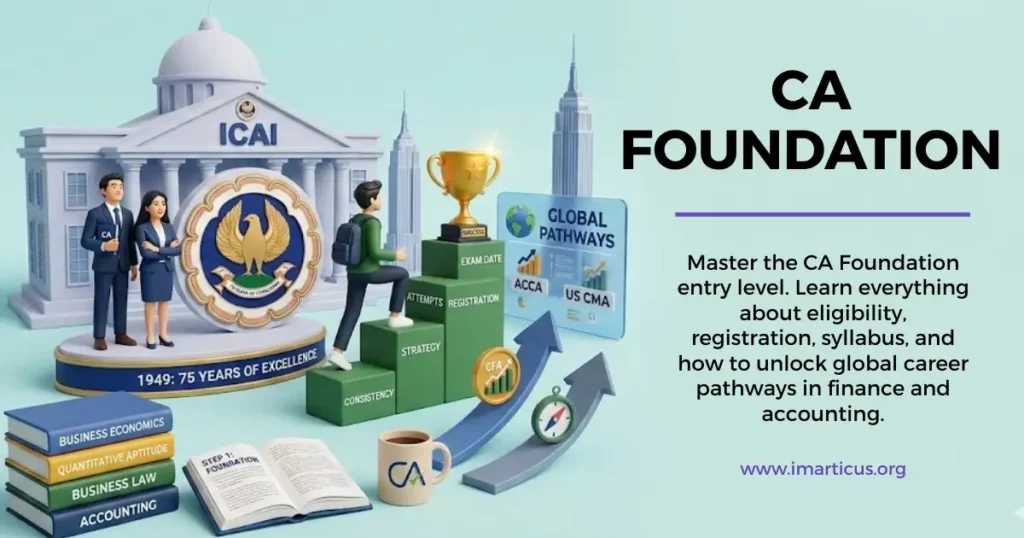
Every year, somewhere between board exams and result day, thousands of students open Google and type three words – “how to become a CA.” The search leads them to the CA Foundation. And that is usually where the clarity stops.
CA Foundation is the entry point to one of the most respected professional designations in the country – Chartered Accountancy. But most students who start preparing for it do not fully understand what they are actually signing up for. Here is something worth knowing before you begin: CA is a long game. Alongside the CA route, a growing number of students today are also exploring modern Finance Courses that build specialised skills in investment banking, global accounting, and financial analysis – giving themselves more options as the industry evolves.
This guide covers it all – ICAI registration, eligibility, syllabus, study material, RTP and MTP strategy, pass percentage trends, result process, and what the career looks like on the other side-just everything you actually need to know before you start.
Did You Know?
1,39,876 candidates appeared for CA Intermediate across 576 centres in India and abroad – showing the CA journey attracts massive participation in 2026. (Source: ICAI)
Don’t Let Our Best Advice Get Buried
Add Imarticus as a Preferred Source — see more of what we publish, every time you search.

What Is CA Foundation?
CA Foundation is the entry-level examination that a student must clear before they can move further on the path to becoming a Chartered Accountant in India. It is conducted by the Institute of Chartered Accountants of India (ICAI) – the apex regulatory body for the accounting profession in the country.
The CA journey has three stages – Foundation, Intermediate, and Final – and mine started exactly where yours will. At the Foundation level. It felt overwhelming at first, not going to lie. But the four subjects actually make sense once you understand why they are there:
- Accounting – The basics of how businesses record, track, and report their finances
- Business Law – An introduction to the legal framework that governs how companies operate
- Mathematics & Statistics – The quantitative foundation that sharpens your analytical thinking
- Economics – How markets, businesses, and economies function at a broader level
Looking back, these subjects did more than just get me through an exam. They built the base that everything in Intermediate and Final stood on. The Foundation program does not leave you guessing either – it tells you what to study, when to study, and how to approach preparation. That structure is genuinely helpful in the beginning, especially when everything feels new and a little too much at once.
Difference Between CA Foundation, Intermediate, And Final
Here is something I think every student deserves to know before they begin – CA is a three-level program, not a single exam. Each stage builds on the one before it and demands more of your time, effort, and patience. Let me walk you through it.
| Level | Basic Accounting, Law, Maths, Economics | Advanced Accounting, Audit, Taxation, Costing | Advanced FR, SFM, Direct & Indirect Tax |
| CA Foundation | ✅ | ❌ | ❌ |
| CA Intermediate | ✅ | ✅ | ❌ |
| CA Final | ✅ | ✅ | ✅ |
Looking at this table, one thing became very clear to me – Foundation is just the beginning, not the finish line. Clearing it feels like a win, and it absolutely should. But the moment you pass, the real journey kicks in. I am saying this because the students who go in with their eyes open are the ones who actually make it through.
Who Should Pursue The CA Foundation?
Anyone who has passed Class 12 and is serious about building something in accounting & finance, audit & taxation, or corporate advisory. Commerce students are usually the first to sign up. But CA Foundation is not a commerce-only club. Science and arts students register every year and clear it too. The syllabus does not walk in assuming you already know accounting. It starts from scratch and builds you up.
If you are someone who likes numbers, enjoys figuring out how businesses actually work, and wants a qualification that holds weight – not just in India but globally – then the CA Foundation is a step worth taking seriously. It will not be easy. But the right preparation makes it very doable.
Also Read: What is CA and its Career Scope?
CA Foundation Syllabus
The CA Foundation syllabus under the new ICAI scheme is built around four core papers. The total marks are 400; each paper carries 100 marks. To pass, you need a minimum of 40% in each paper and 50% aggregate across all four papers.
Paper 1 – CA Foundation Accounts
If there is one paper that sets the tone for everything after, it is this one. Accounting is not a subject you clear and forget – it follows you through Intermediate, Final, and into your career. Get it right here, and every stage after becomes easier. Here is what it covers:
- Theoretical Framework – Understanding what accounting actually is, why it exists, and the principles it runs on. Before you touch a single journal entry, you need to understand the logic behind it.
- Accounting Process – Journal entries, ledgers, trial balance, and financial statements. This is the core of the paper and where most of your marks will come from.
- Bank Reconciliation Statement – Matching your books with the bank’s records. Sounds simple, but it trips up more students than you would expect.
- Inventories – How stock is valued and recorded, and why it matters to a business’s financial picture.
- Depreciation – How assets lose value over time and how that is accounted for. Expect this to show up in the exam every single time.
- Bills of Exchange – A topic many students underestimate. Give it proper time, and it becomes straightforward.
- Final Accounts – Bringing everything together into a complete picture of a business’s financial health.
The honest truth about Paper 1 is this – if you understand it, you do not just pass the exam. You build a foundation that carries you through every stage of CA that comes after.
Paper 2 – Business Law CA Foundation
Business Law is the paper that most students either underestimate or overcomplicate. It is neither a paper you can ignore nor one that requires you to memorise every section of every Act. What it actually requires is something simpler – understanding how the law thinks, and then applying that thinking to practical situations. Here is what Paper 2 covers:
- Indian Contract Act, 1872 – The backbone of this paper. Covers offer, acceptance, consideration, void agreements, breach, and remedies. Almost every exam has a significant chunk from here.
- Sale of Goods Act, 1930 – How goods are bought and sold legally, what counts as a valid sale, and what happens when things go wrong between buyer and seller.
- Indian Partnership Act, 1932 – The legal structure of partnerships, rights and duties of partners, and how partnerships are formed, changed, and dissolved.
- Limited Liability Partnership Act, 2008 – A more modern structure that combines elements of a company and a partnership. Increasingly relevant in today’s business world.
- Companies Act, 2013 – An introduction to how companies are formed, classified, and governed. You will go much deeper into this at the Intermediate level, but the Foundation gives you the base.
The students who do well in Paper 2 are usually the ones who read the law like a story rather than a textbook. Every Act exists because something in the real world needed a rule. Once you understand why a law exists, remembering what it says becomes a lot easier.
Paper 3 – Quantitative Aptitude
Paper 3 covers three distinct sections, and each one needs a different approach. I went in thinking it was just a math paper and came out realising it was testing something much deeper – how you think through a problem, not just whether you can solve it. Treat all three sections the same way in preparation, and at least one of them will hit you harder than expected.
- Business Mathematics – Ratios, percentages, interest, equations. Once you see how directly it connects to real business situations, it starts to feel less like math and more like common sense with numbers.
- Logical Reasoning – This one cannot be crammed. Only sitting down and solving problems repeatedly will prepare you for it. Practice is the only way in.
- Statistics – Concept first, formula second. I have seen students memorise every formula and still struggle because they never understood what the numbers were actually saying.
The good news is that this paper is largely scoring if you put in consistent practice. Most students who struggle with Paper 3 do not have a math problem – they have a preparation problem. They leave it too late or treat it as secondary. Give it dedicated time early, and it becomes one of your stronger papers by exam day.
Paper 4 – Business Economics
Business Economics is the paper that surprises most students – usually in a good way. Coming in, many expect it to be dry theory and complicated graphs. What they find instead is a subject that actually explains how the world around them works, why prices rise. How businesses make decisions. What drives a country’s economy? Once you see it that way, it stops feeling like a subject and starts feeling like common sense with structure. Here is what Paper 4 covers:
- Introduction to Business Economics – What economics is, how it connects to business decision-making, and the core concepts that run through the entire paper.
- Theory of Demand and Supply – How prices are determined, what makes demand go up or down, and how markets find their balance. This is one of the most important topics in the paper.
- Theory of Production and Cost – How businesses decide how much to produce, what it costs them, and where the most efficient point of production lies.
- Price Determination in Different Markets – This one genuinely changed how I looked at businesses. From perfect competition to monopoly, you start understanding why prices are what they are and how market structure drives everything behind the scenes.
- Business Cycles – The economy does not move in a straight line, and this topic explains exactly why. The ups, the downs, what triggers them, and how ordinary businesses and people end up feeling the impact.
- Meaning and Scope of National Income – You hear GDP thrown around everywhere. This is where you actually learn what it means, how it is calculated, and why those numbers matter more than most people realise.
- Public Finance – This topic made me see the government differently. How it earns, how it spends, where taxation fits in, and what public expenditure actually does to an economy.
- Money Market – Money does not just sit still. This topic walks you through how it moves, what role banks play, and how financial institutions keep the whole system functioning.
- International Trade – Why do countries not just produce everything themselves? This topic answers that question and gives you a clear picture of how global commerce actually works and who benefits from it.
The honest thing to say about Paper 4 is that it rewards curiosity. If you read the news, follow what is happening in the economy, and connect what you study to what you see around you, this paper becomes one of your most enjoyable ones. And enjoyable papers, more often than not, are the ones you score well in.
Interesting Insight: CA Foundation exam had a 19.23% pass rate with 21,099 out of 1,09,694 candidates passing (Male: 20.13%/11,523 and Female: 18.26%/9,576) in 2026. (Source: ICAI)
CA Foundation Eligibility, Exam Dates, and Exam Pattern
Before diving into preparation, there are things every student should have complete clarity on – eligibility, exam dates, and the exam pattern. Getting these basics right from the start saves a lot of confusion down the road.
CA Foundation Eligibility Criteria
Every year, students talk themselves out of registering before they have even checked if they are eligible. Someone who took a gap year and thinks they have missed their chance. Most of the time, they are wrong.
ICAI has kept the entry bar deliberately open. Your stream, your percentage, and your age are not the deciding factors here – your commitment is.
| Criteria | Details |
| Minimum Qualification | Passed or appearing in Class 12 from any recognised Central or State Board |
| Minimum Percentage | No minimum percentage required |
| Commerce Students | Eligible |
| Science Students | Eligible – syllabus starts from basics, no prior commerce knowledge needed |
| Arts Students | Eligible – same criteria as all other streams |
| Early Registration | Allowed after Class 10 on a provisional basis |
| Age Limit | No upper age limit – gap year students and career changers can apply |
| Number of Attempts | No fixed limit within the registration validity period |
| Registration Validity | Four years from the date of registration |
| Revalidation | Available if the four-year validity period expires |
| Exam Form Requirement | Class 12 result must be available, or the exam must be appearing at the time of form filling |
One thing worth saying clearly – the eligibility bar for CA Foundation is intentionally kept open. ICAI does not want your stream, your percentage, or your age to be the reason you do not try. What you do after you register is entirely up to you.
CA Foundation Exam Dates
One of the first things worth figuring out when you decide to register is which session you are aiming for. ICAI conducts the CA Foundation exam three times a year. Each session has its own registration deadline, exam form window, and result timeline.
| Session | Exam Month | Result Month |
| January | Second week of January | Early March |
| May/June | Third week of May | Early July |
| September | Late September | Around November |
The session you target should depend on when you registered and how much preparation time you genuinely have at hand. There is no shortage of sessions – three a year means you are never too far from the next opportunity. Stay on top of the deadlines, give yourself enough runway to study properly, and always verify dates directly on icai.org rather than relying on secondhand information.
CA Foundation Exam Pattern
Understanding the exam pattern before you start preparing changes how you approach each paper. It is not just about studying hard – it is about knowing exactly what the passing bar looks like and making sure no single paper lets you down.
| Criterion | Requirement |
| Total Marks | 400 (100 per paper) |
| Minimum Per Paper | 40 marks (40%) |
| Aggregate Minimum | 200 marks (50%) |
| Pass with Distinction | 70% aggregate or above (280+ marks) |
The rule that catches most students off guard is the per-paper minimum. Scoring well in three papers does not save you if the fourth falls below 40. Every paper has to cross that line independently – there is no averaging your way out of a weak subject.
CA Foundation Registration Process
CA Foundation registration happens entirely online through the ICAI Self-Service Portal (SSP) at icaiexam.icai.org. There is no physical form or in-person submission required for the initial registration process.
ICAI keeps registration open throughout the year, but there is a critical deadline: you must complete your registration at least four months before the first day of the exam month you wish to appear in. This four-month study period is mandatory.
Step-by-Step CA Foundation Registration
Here is exactly how the process works, without any confusion:
- Visit the official ICAI portal: icaiexam.icai.org
- Generate an OTP using your registered mobile number or email address
- Log in and select “Foundation Course Registration”
- Fill in your personal details – the system auto-fetches some information
- Upload the required documents (see below)
- Pay the registration fee online via net banking, debit/credit card, or UPI
- Download and save the acknowledgement receipt
After submission, ICAI processes your registration. If everything is in order, you will receive a registration number, which you will need for all future interactions with the Institute.
Documents Required for Registration
Before filling out the registration form, make sure every document is ready and scanned properly. It sounds like a small thing, but it genuinely makes the process smoother. The last thing you want is to get halfway through registration and realise something is missing or not in the right format. Here is everything you will need:
| Document | Details |
| Class 10 Marksheet / Pass Certificate | For identity and educational proof |
| Class 12 Marksheet or Admit Card | Marksheet if passed; Admit Card if appearing |
| Coloured Passport-Size Photograph | Recent, clear, against a light background |
| Signature on White Paper | Scanned, within specified file size |
| Proof of Nationality | Required for foreign students only |
| Special Category Certificate | If applicable (J&K, NE states) |
One thing I would strongly suggest – do not rush the scanning part. Blurry uploads, wrong file formats, and oversized documents are the most common reasons registrations get held up or delayed. Go through each document carefully, check the file size limits mentioned on the ICAI portal, and make sure everything is clear and legible before you hit submit. It takes an extra fifteen minutes, but it saves you days of follow-up.
Common Registration Mistakes Students Make
Having spoken to several CA aspirants over the years, these are the mistakes that come up again and again:
- Uploading documents in incorrect file formats or sizes
- Entering a name or date of birth that does not exactly match the Class 10 records
- Missing the four-month cutoff deadline and losing an attempt
- Not saving the payment receipt (always keep it)
- Assuming registration automatically enrols them for the exam – it does not; a separate exam form must be filled out each session
CA Foundation Registration Validity
Before registering, it helps to know exactly what you are paying for and what the registration actually covers. A lot of students focus only on the registration fee and miss the finer details – like the exam form fee that comes later, or the four-month study period that determines which exam session you can actually appear for. Here is a clear breakdown:
| Particular | Details |
| Registration Fee (Indian Students) | ₹9,000 (inclusive of study material) |
| Registration Fee (J&K / NE States) | ₹2,250 (75% concession) |
| Registration Fee (Foreign Students) | USD 700 approximately |
| Exam Form Fee (Indian Centres) | ₹1,500 per attempt |
| Late Exam Form Fee | ₹600 additional |
| Registration Validity | 4 years |
| Official Website | icai.org / icaiexam.icai.org |
| Mandatory Study Period | 4 months before exam month |
A few things worth paying attention to before hitting the register button. The fees are straightforward, but the dates are where most students slip up. Missing the registration window by even a few days can push you back by an entire exam cycle – and that is months of waiting that could have been avoided.
CA Foundation Study Material and Books
The good news is that you do not need a shelf full of books to clear the CA Foundation. The right material, used consistently, is more than enough. The mistake most students make is collecting too many resources and ending up confused about which one to follow. Here is a simpler way to think about it.
Official ICAI CA Foundation Study Material
ICAI provides official study material (commonly called “modules”) as part of the registration package. These are dispatched to students after registration via the Content Delivery System (CDS) – either as physical books or accessible digitally on the ICAI BOS (Board of Studies) Knowledge Portal.
The ICAI module is the primary and most authoritative resource for CA Foundation preparation. It is written specifically to the syllabus and exam expectations. Everything else – coaching notes, reference books, video lectures – should supplement the module, not replace it.
How to Use ICAI CA Foundation Modules Effectively
The ICAI module is dense – there is no way around that. But there is a reading strategy that works, and once you follow it consistently, the material becomes far more manageable than it first appears:
- First pass: Read the chapter for understanding, not memorisation
- Mark sections that feel unclear or unfamiliar
- Solve all practice questions at the end of the chapter before moving on
- Return to marked sections after two days and re-read them
Never read the module passively. Always have a pen in hand to underline, annotate, or summarise in the margin – because active reading is what separates students who retain the content from those who simply get through it.
Best CA Foundation Books for Each Subject
Choosing the right books can make a significant difference in how well you understand and retain each subject. While the ICAI Study Material should always be your primary resource, the right reference book alongside it can fill gaps, offer alternate explanations, and sharpen your exam technique.
| Subject | ICAI Module | Popular Reference | Best For |
| Paper 1 – Accounting | ICAI Study Material Vol. 1 & 2 | R.L. Gupta & Radhaswamy, NCERT Accountancy (basics) | Conceptual clarity and practice |
| Paper 2 – Business Law | ICAI Study Material | Bare Acts (for advanced reading) | Answer structure and legal accuracy |
| Paper 3 – Quantitative Aptitude | ICAI Study Material | ICAI Practice Manual | Problem-solving and speed |
| Paper 4 – Business Economics | ICAI Study Material | T.R. Jain, NCERT Microeconomics and Macroeconomics | Concept building and quick revision |
A word of caution – do not fall into the trap of collecting too many books. More resources rarely mean better preparation. Pick one reference per subject, exhaust it fully, and always come back to the ICAI module as your final authority before the exam.
Also Read: How Can ICAI Shape Your CA Career
Career Opportunities After CA
A qualified Chartered Accountant has one of the widest career spectrums in the Indian professional landscape. Opportunities span across industries, roles, and even geographies – making CA one of the few qualifications that never limits you to a single path but instead opens several doors at once.
- Public Practice: Audit, taxation, and financial reporting as a practising CA
- Corporate Finance: CFO offices, financial planning and analysis, treasury
- Investment Banking: Deal origination, valuation, mergers and acquisitions
- Consulting: Big Four firms, advisory practices
- Government and Regulatory: SEBI, RBI, government audit services
- Entrepreneurship: Finance professionals starting their own practice or advisory firm
According to ICAI data, qualified CAs are among the highest-placed professionals in India’s finance sector, with starting packages at large firms ranging from ₹7 lakh to ₹25 lakh per annum, depending on specialisation and city.
Why Investment Banking Is One of the Strongest Paths a CA Can Take
Investment banking has emerged as one of the most sought-after career paths for CA graduates in recent years. Here is why a CA is uniquely positioned to thrive in this field:
- The skill match is almost perfect: Financial statement analysis, valuation, taxation, and deal structuring – everything CA training covers – is exactly what investment banking demands on day one.
- The work is high-impact: CAs in investment banking work on mergers and acquisitions, equity and debt capital markets, and corporate advisory mandates at the highest level.
- CA training builds the right mindset: Three years of CA training quietly develops the kind of rigorous, sceptical, detail-oriented thinking that investment banking actively looks for.
- Top firms recruit CAs directly: Goldman Sachs, JP Morgan, Morgan Stanley, and the Big Four’s transaction advisory divisions place CAs at associate levels that MBA graduates take considerably longer to reach.
- The financial reward is significant: Investment banking offers strong compensation alongside genuinely high-impact work at the centre of India’s growing deal economy.
Skills Students Build During CA Preparation
The CA Foundation stage builds more than academic knowledge. Students who go through this process develop:
- Financial literacy and comfort with numbers
- Analytical thinking – especially through the quantitative aptitude paper
- Structured communication – through law and accounting answer writing
- Time management and self-discipline – through the study period itself
These are not soft-skill buzzwords. They are measurable capabilities that translate directly into professional performance.
The right finance career often comes down to where analytical skills, business strategy, and high-impact opportunities meet. Investment banking continues attracting ambitious finance aspirants for exactly that reason.
Global Finance Certifications Beyond Traditional CA Pathways
If you are at the CA Foundation stage or just cleared it, you are at an interesting crossroads. You have a strong academic interest in finance and a clear work ethic. The question some of you are quietly asking – and that I want to address directly – is: are there other paths worth knowing about?
| Certification | Best For | Key Highlight |
| ACCA (Association of Chartered Certified Accountants) | International finance, audit, and accounting | Recognised across 180 countries, ICAI and ACCA have a formal Mutual Recognition Agreement with exemptions for eligible professionals |
| US CMA (Certified Management Accountant) | Corporate finance, FP&A, and senior management roles | Two-part exam; IMA reports CMAs globally earn significantly higher than non-certified peers |
| US CPA (Certified Public Accountant) | Careers in the US or with US-headquartered firms | Four-part exam; requires both educational qualifications and work experience |
| CFA (Chartered Financial Analyst) | Investment banking, equity research, and asset management | Considered the gold standard for investment analysis, over 170,000 CFA Charterholders globally |
Each certification leads to different career opportunities in finance, accounting, consulting, and investment roles. The right choice depends on your long-term career goals, interests, and preferred industry specialisation.
Why Choose Imarticus Learning for Finance Courses
Students today are not just looking for certifications. They are looking for career clarity, practical industry exposure, and strong placement support alongside their learning journey. That is where Imarticus Learning stands out for Finance Courses exploring global career pathways in accounting, investment banking, financial analysis, and corporate finance. What makes Imarticus Learning notable is its industry-focused approach:
- Finance programs are designed with industry relevance and practical application.
- Courses aligned with global finance and accounting career pathways.
- Partnerships with leading industry organisations and experts.
- Hands-on learning through case studies, projects, and real-world scenarios.
- Career services support, including interview preparation and placement assistance.
- Mentorship from experienced finance professionals and domain experts.
- Programs covering investment banking, financial analysis, accounting, and global finance certifications.
For students exploring opportunities beyond traditional career routes, having structured industry guidance and career-oriented training can make the transition into the finance industry significantly more effective.
FAQ For CA Foundation
Preparing for the CA Foundation can be overwhelming. Here are some frequently asked questions to make your path clearer and simpler.
What Is The CA Foundation Pass Percentage?
The CA Foundation pass percentage changes with every exam attempt and depends on overall student performance. ICAI releases the official pass percentage along with the results. It gives students an idea of the exam’s difficulty and helps in setting realistic preparation goals.
What Is RTP In CA Foundation?
RTP CA Foundation stands for Revision Test Papers issued by ICAI before every exam attempt. RTPs help students understand important topics, amendments, and exam patterns. They are designed to improve exam readiness and identify areas that need more focus.
What is the CA Foundation MTP?
CA Foundation MTP refers to Mock Test Papers released by ICAI to help students practice under exam-like conditions before the actual examination. Solving MTPs allows students to manage time effectively and boosts confidence for the main exam.
What Can Students Do After CA Foundation?
After clearing the CA Foundation, students move to the CA Intermediate level and continue their journey toward becoming a Chartered Accountant. Many finance aspirants also explore global certifications such as ACCA, CPA, CMA, and CFA depending on their career goals. Imarticus Learning helps students by providing expert guidance, specialized courses, and mentorship for global finance certifications, ensuring a smooth transition and structured career growth.
Are CA Foundation PYQ Papers Important?
Yes, CA Foundation PYQ (previous year question) papers are extremely important because they help students understand question patterns, difficulty levels, and frequently tested topics. Practicing PYQs can significantly enhance problem-solving speed and exam confidence.
Is CA Foundation Difficult For Beginners?
CA Foundation can feel challenging initially, especially for students new to accounting or mathematics. However, consistent preparation, practice, and conceptual clarity can help students clear the exam successfully. With dedication and a structured study plan, even beginners can achieve high scores.
What Is A CA Foundation Course?
The CA Foundation course is the entry-level stage of the Chartered Accountancy program conducted by ICAI. It introduces students to accounting, business law, economics, and quantitative aptitude after Class 12. The course lays a strong foundation for advanced CA studies and professional competence.
How Can I Complete CA Foundation Registration Online?
Students can complete CA Foundation registration online through the ICAI SSP portal by filling out the application form, uploading documents, and paying the required registration fees. Once registered, students receive access to study materials, notifications, and exam updates directly from ICAI.
Take the Next Step Toward a Finance Career
The CA Foundation is more than just an entrance exam. It is the beginning of a professional journey that builds discipline, financial expertise, analytical thinking, and long-term career opportunities. From understanding the CA Foundation syllabus and registration process to choosing the right study material and preparation strategy, every step plays an important role in shaping your success.
What matters most is consistency. Students who stay patient, practise regularly, and build strong conceptual clarity are usually the ones who perform well in the long run. Whether your goal is to become a Chartered Accountant, move into investment banking, corporate finance, consulting, or explore global certifications like ACCA, CPA, CMA, or CFA, the CA Foundation gives you a strong starting point.
The finance industry is evolving rapidly, and students today have more opportunities than ever before. The key is to build the right foundation early, stay informed about industry pathways, and choose learning opportunities that align with your long-term career goals. If you want to strengthen your finance career journey beyond academics, Finance Courses by Imarticus Learning offer industry-aligned learning pathways.
Liked This? Follow Us Where You Already Search.
Preferred Sources is Google’s built-in follow button — no app, no login, just more Imarticus in your results.