


Last updated on June 4th, 2026 at 12:53 pm
The moment students finish their Class 10 exams, one question starts following them everywhere: “Which stream are you taking?” For many, commerce becomes one of the top options, but nobody actually explained what is commerce.
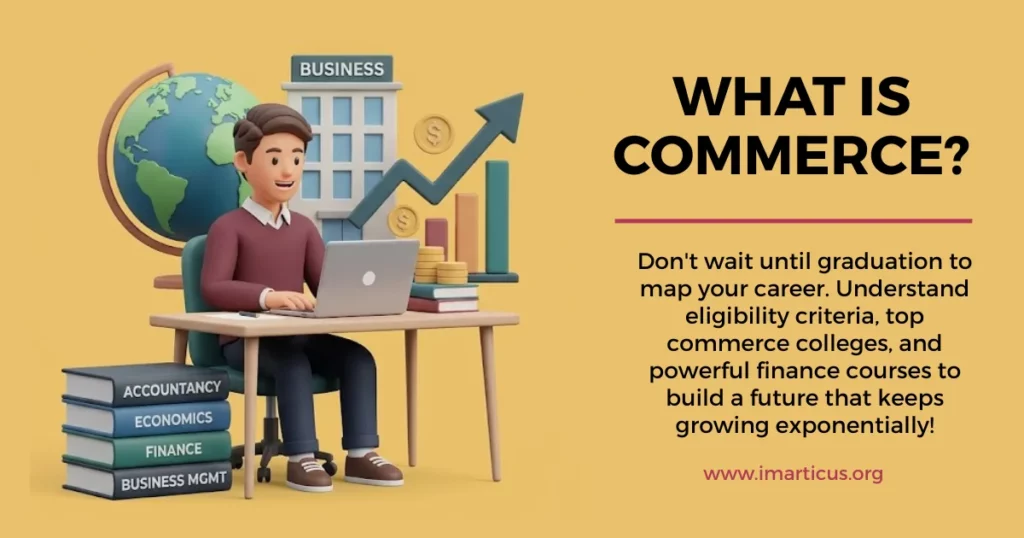
Commerce isn’t just about becoming a CA or sitting behind an accounts ledger. It is genuinely one of the most flexible, high-earning, and future-proof academic streams in India today. From accounting and business management to banking, investing, marketing, and entrepreneurship, commerce opens doors to a range of career paths across industries.
Today, students are also exploring modern Finance Courses to build specialised skills and improve career opportunities in the finance industry.
In this guide, I will cover everything worth knowing – what commerce actually is, the subjects you study, whether maths is necessary, the best courses after Class 12, top colleges, and the careers and salaries that come with a commerce background.
Don’t Let Our Best Advice Get Buried
Add Imarticus as a Preferred Source — see more of what we publish, every time you search.

Did You Know?
Skills like financial analysis, taxation, accounting, and business analytics are among the most in-demand commerce skills globally. (Source: World Economic Forum)
What Is Commerce?
Nobody told me how wide commerce actually was before I picked it. From a small shop maintaining its daily accounts to massive global stock markets operating across continents – everything falls under the umbrella of commerce.
What surprised me most when I first got into it was how broad it actually is. Every time a company files its taxes, a bank approves a loan, an investor picks a stock, or a brand launches a new campaign – someone with a commerce background is involved somewhere in that process. It is one of those fields that quietly runs the world.
Main Areas Covered in Commerce
Here’s what nobody tells you before you pick commerce: it’s not one thing. It’s accounting, economics, finance, business, taxation, and marketing – all connected. I had to live it to understand it.
- Accountancy: It is the foundation of every business – recording, classifying, and reporting financial transactions. Without proper accounts, no organisation can track where its money is going or make smart decisions.
- Finance: Stock markets, investments, risk management, wealth creation – this area opened up a completely different side of commerce. It also connects directly to careers in banking, investment firms, and financial planning, which made it feel very real and career-relevant.
- Economics: Understanding demand, supply, inflation, GDP, and international trade showed me how both businesses and entire governments make their financial decisions. It gives you a framework for understanding why prices rise, why recessions happen, and how policies affect everyday life.
- Business Management: Leadership, planning, strategy, operations – it covers all of it. I found this area especially useful for understanding entrepreneurship and the kind of strategic thinking that MBA programs focus on.
- Marketing: The psychology behind why people buy, how campaigns are designed, and how digital platforms are used to grow businesses – it all started making sense. In today’s world, a strong marketing strategy can genuinely make or break a business.
- Taxation: Taxation was the subject I least expected to find useful – and ended up valuing the most. Direct taxes, GST, compliance rules – these are things every business in India deals with, whether they like it or not. It is not exciting, but ignoring it is simply not an option in the real world.
- Banking: Understanding loans, credit systems, the role of the RBI, and how money moves through the economy gave me a complete picture of how the financial system actually operates daily.
What Is Commerce Stream?
What is commerce stream exactly? The commerce stream is one of three main academic streams available to students in India after Class 10 – the other two being Science and Arts (Humanities). It is a two-year program (Classes 11 and 12) that specialises in business-related subjects and lays the groundwork for professional courses in finance, accounting, law, management, and economics.
Who Should Choose Commerce?
Honestly? Commerce suits a much wider range of students than people realise. You don’t need to be a maths wizard. You don’t need to have a business family background. Here’s a practical checklist. Choose commerce if you:
- Find yourself curious about how businesses make money and grow
- Like understanding the “why” behind economic events in the news
- Are interested in careers in banking, finance, law, consulting, or marketing
- Want professional credentials like CA, ACCA, CFA, CPA, CMA, FRM, or CS
- Are comfortable with logical thinking and structured problem-solving
- Don’t want to spend years on physics or chemistry derivations (and that’s completely fine)
Skills You Need to Succeed in Commerce
The good news: most of these skills aren’t born skills – they’re built through the course itself.
| Skill | Why It Matters in Commerce |
| Analytical thinking | You’ll need to read financial statements and draw conclusions |
| Numerical ability | Not advanced maths – but comfort with numbers is essential |
| Communication | Finance professionals pitch, negotiate, and report daily |
| Business understanding | Commerce theory maps directly to real-world decisions |
| Problem solving | Taxation, auditing, and strategy all demand structured solutions |
| Attention to detail | A ₹1 error in accounts can cascade into serious compliance issues |
Developing these skills is key to a successful commerce career.
Is Commerce Difficult?
Let me be straight with you: commerce isn’t “easy.” But it’s not supposed to be. The difficulty is different from science – there are fewer derivations and more concepts, fewer formulas and more frameworks.
Accountancy requires precision and practice. Economics demands conceptual clarity. Business Studies involves a lot of reading and understanding rather than pure memory. If you’re willing to stay consistent – not study in bursts, but genuinely engage with the material – commerce is extremely manageable.
The students who struggle with commerce usually struggle with one thing: they don’t practise accountancy problems regularly enough, and then papers like accounts feel harder than they should. Sort that out early, and you’ll be fine.
Interesting Insight: Global companies today actively hire commerce graduates with specialised finance certification qualifications. (Source: ACCA Global)
Commerce Subjects in Class 11 and 12
This is where things get practical. Let me walk you through exactly what you’ll study – both in Class 11 and Class 12 – and what each commerce subject actually prepares you for.
| Mandatory Subjects | Optional Subjects |
| Accountancy | Mathematics |
| Business Studies | Informatics Practices |
| Economics | Physical Education |
| English | Entrepreneurship |
Along with the mandatory subjects, students can choose optional subjects to align with their interests and career goals, helping them build a strong foundation for higher studies in commerce.
Mathematics (Optional but Recommended)
Commerce maths covers calculus, linear programming, probability, and statistics. It’s a different syllabus from the science stream. I’ll say this: if you have even moderate comfort with maths, take it. It dramatically expands your career options – including CA, CFA, actuarial science, and data analytics roles in finance.
Informatics Practices (Alternative to Maths)
If maths genuinely isn’t your thing, Informatics Practices is a valid alternative. It covers database concepts, networking basics, and computer applications. It’s becoming more relevant in the age of fintech and business analytics.
Entrepreneurship (Optional)
This is an underrated subject. If you’re even slightly inclined toward building something yourself – a startup, a freelance career, a family business – this subject gives you frameworks for idea generation, business planning, and risk assessment.
12th Commerce Subjects Explained
Class 12 goes deeper into each subject and introduces more advanced applications.
| Subject | What’s New in Class 12 | Career Relevance |
| Accountancy | Partnership accounts, company accounts, cash flow statements | CA, CMA, Accounting roles |
| Business Studies | Management functions, marketing, consumer protection, and financial management | MBA, BBA, Entrepreneurship |
| Economics | Macroeconomics – national income, money, banking, government budget, balance of payments | Economics careers, UPSC, Banking |
| Mathematics | Integration, probability, linear programming | CA, CFA, Actuarial, Data Analytics |
The Class 12 board exam in commerce carries enormous weight – not just for college admissions, but also for eligibility into professional CA and CMA courses. Score well here, and multiple doors open simultaneously.
Can You Take Commerce Without Maths?
Yes, absolutely – and it has a broader scope than most people acknowledge. What is commerce without maths? It is still entirely valid and opens up a strong career path. You simply need to make deliberate, informed choices about where you go next:
| Career Path | Degree/Course | What You Can Achieve |
| BCom | 3-year degree | Accounting, banking, and finance foundation |
| BBA | 3-year degree | Management, HR, marketing leadership |
| Law (BA LLB / BBA LLB) | 5-year integrated | Corporate law, taxation, and finance law |
| Digital Marketing | Degree + certifications | Brand strategy, performance marketing |
| Human Resources | BBA/BCom + MBA-HR | HR business partnering, talent management |
| Banking | BCom + JAIIB/CAIIB | Bank PO, relationship manager, credit roles |
| Company Secretary (CS) | ICSI program | Corporate governance, legal compliance |
The CS route in particular is powerful – and maths is not required. Every listed company in India is legally required to have a qualified Company Secretary, which creates a consistent, stable demand for this credential.
Commerce vs Science vs Arts – Which Stream Is Better?
This is the most heated debate in every Class 10 board result week. Here’s my honest, data-driven take – not the “all streams are great” diplomatic non-answer you usually get.
| Factor | Commerce | Science | Arts (Humanities) |
| Core subjects | Accountancy, Economics, Business Studies, Maths (optional) | Physics, Chemistry, Biology/CS, Maths | History, Political Science, Geography, Sociology, Literature |
| Difficulty level | Moderate – concept-heavy, practice-driven | High – formula and derivation intensive | Variable – reading and analytical writing intensive |
| Career flexibility | Very high – finance, law, marketing, consulting, tech | High – engineering, medicine, research, tech | Moderate – civil services, journalism, academia, law |
| Salary potential | High – especially with CA, CFA, MBA, and investment banking | Very high – especially with IIT + tech/medicine | Moderate at entry level, high with UPSC/journalism |
| Time to first job | 3-5 years (degree), faster with professional certs | 5-7 years (engineering/medicine) | 3-5 years (degree + PG) |
| Entrepreneurship scope | Excellent – business and finance literacy built in | Good – tech startups | Moderate |
| Global career options | Excellent – ACCA, CFA, CPA are globally recognised | Excellent – engineering and medicine are globally valued | Limited but available through law and academia |
Commerce is the most career-specific stream among the three. It doesn’t give you the prestige of a JEE rank, but it gives you something arguably more valuable: practical, employable skills from Year 1. The CA, ACCA, and CFA Course that commerce students can pursue are globally respected in a way that a generic BCom alone isn’t – but those credentials start here, with the commerce stream.
List of Courses After 12th Commerce
Students often assume BCom is the only path after Class 12 Commerce. That’s one of the most common and costly misconceptions I see. Commerce actually opens multiple professional and degree opportunities – some that lead to international roles, others that can be started right after your board exams.
Degree Courses After 12th Commerce
Finishing Class 12 is just the starting point. Commerce gives you more options than most people realise – finance, management, economics, technology – the choice is wide. What matters is picking a course that aligns with where you actually want to go, not just what everyone around you is doing.
| Course | Full Form | Best For |
| BCom General | Bachelor of Commerce | Accounting, finance foundation |
| BCom Hons | Bachelor of Commerce (Honours) | Deep finance and accounting focus |
| BBA | Bachelor of Business Administration | Management, marketing, HR |
| BA Economics | Bachelor of Arts in Economics | Economic analysis, policy, banking |
| BMS | Bachelor of Management Studies | Business operations, strategy |
| BAF | Bachelor of Accounting and Finance | Advanced accounting and finance |
| BCA | Bachelor of Computer Applications | Tech + business intersection |
These courses provide a strong foundation for various career paths, from accounting and finance to business management and technology-driven roles, helping students prepare for both jobs and higher studies.
Professional Courses After 12th Commerce
These are the credentials that separate a commerce graduate from a commerce professional. The salary gap between a degree-holder and a certification-holder in finance is not marginal – it’s significant and compounds over a career.
| Certification | Issuing Body | Typical Duration | Maths Needed? | Avg. Salary (India) |
| CA | ICAI | 4-5 years | Yes | ₹7-30 LPA (fresher to mid) |
| CS | ICSI | 3-4 years | No | ₹4-20 LPA |
| CMA | IMA | 3-4 years | Yes | ₹5-18 LPA |
| ACCA | ACCA Global (UK) | 2-3 years | Preferred, not required | ₹6-25 LPA India; ₹50 LPA+ abroad |
| CFA | CFA Institute (USA) | 3-4 years | Yes | ₹8-35 LPA |
| CPA | AICPA (USA) | 1.5-2 years | Yes | ₹10-40 LPA |
Pursuing these professional certifications can significantly boost career prospects, offering higher salaries, global opportunities, and specialised expertise beyond a regular commerce degree.
Also Read: Career-Focused Courses After 12th Commerce
What You Need to Know About BCom
BCom equips students with practical and theoretical knowledge in business, finance, and economics, preparing them for diverse career paths and professional growth.
What Is BCom?
When someone asks, ‘What is BCom in commerce?’, it is a three-year undergraduate degree program designed to give students a broad, systematic understanding of what is commerce, accounting, economics, business law, and finance. It is the most common first degree pursued by Class 12 Commerce students in India.
BCom is offered in two primary formats – BCom General (broader, more diverse subjects) and BCom Honours (deeper dive into specific areas like accounting or finance). The Honours version is more rigorous and generally preferred by employers and for further education.
BCom Eligibility
To enrol in a BCom program, students must meet certain academic and eligibility criteria.
| Requirement | Details |
| Minimum qualification | Class 12 pass in any stream (Commerce preferred) |
| Minimum marks | 45-60% (varies by college and category) |
| Entrance exam | CUET (for Delhi University and other central universities); some state colleges have direct merit-based admission |
| Age limit | No upper age limit, typically |
| Maths requirement | Not mandatory at most colleges, though preferred for Hons programs |
These requirements ensure that students have the basic knowledge and skills to succeed in commerce studies.
BCom Specialisations
Modern BCom programs have moved well beyond the generic degree. Specialisations available in 2026 include:
| Specialisation | Best Career Path |
| BCom in Accounting and Finance | CA, CMA, Audit, CFO track |
| BCom in Banking and Insurance | Banking sector, insurance management |
| BCom in Computer Applications | Fintech, IT-finance hybrid roles |
| BCom in Marketing | Brand management, digital marketing |
| BCom in Taxation | Tax consultancy, GST compliance |
| BCom in International Business | Global trade, forex, export-import |
| BCom in Investment Management | Portfolio management, mutual funds |
These BCom specialisations allow students to focus on their area of interest, gain relevant skills, and prepare for specific career paths in finance, marketing, banking, audit & taxation, and international business. A standalone BCom degree remains a strong foundation, but many students today prefer programs that combine academic learning with practical industry credentials from the beginning.
ArivuPro One is an all-in-one integrated learning path of a BCom degree with internationally recognised professional accounting, finance, taxation, risk management and business certifications.
ArivuPro One translates this model in a way that fits into your specific academic path: unlike conventional degree programs, ArivuPro One integrates industry-oriented certifications right along with the degrees, so you will graduate not only with qualifications but also with applicable skills which commerce and finance careers require today.
The integrated program was built for students interested in more robust career opportunities and to learn the skills needed as an extensive industry continues shifting, but by excluding post-graduation certifications.
Career Options After 12th Commerce
Commerce doesn’t just give you subjects – it opens career pathways that span some of the most intellectually demanding and financially rewarding roles in the Indian economy. Let me break these down honestly, with current salary data. Best career options after 12th commerce with salary:
| Job Role | Starting Salary | Growth Outlook |
| Chartered Accountant (CA) | ₹7-12 LPA | Very High |
| Investment Banker | ₹9-15 LPA | High |
| Financial Analyst | ₹5-8 LPA | High |
| Business Analyst | ₹4-7 LPA | Very High |
| Company Secretary (CS) | ₹4-8 LPA | High |
| Marketing Manager | ₹5-9 LPA | High |
| Actuary | ₹6-10 LPA | Very High |
| Accountant / Senior Accountant | ₹3-5 LPA | Moderate |
| Tax Consultant | ₹3-6 LPA | High |
(Source: AmbitionBox)
These career options highlight the diverse opportunities available after 12th commerce, ranging from financial accounting to marketing and analytics. Choosing the right path depends on your interests, skills, and long-term career goals.
Not every BCom graduate ends up in the same place. Some settle for entry-level roles while others land high-paying finance careers – the difference comes down to what they did right after Class 12 or graduation.
Best Commerce Colleges in India
Choosing the right college isn’t just about reputation – it’s about what the college actually gives you: curriculum quality, placement network, certification pathways, and alumni connections. Top government commerce colleges in India:
| College | City | NIRF Rank (2024) | Annual Fees | Average CTC |
| Shri Ram College of Commerce (SRCC) | Delhi | 6 | ₹30,000 | ₹8-12 LPA |
| Lady Shri Ram College (LSR) | Delhi | 2 | ₹28,000 | ₹7-10 LPA |
| Hindu College | Delhi | 5 | ₹15,000 | ₹6-9 LPA |
| Hansraj College | Delhi | 4 | ₹12,000 | ₹5-8 LPA |
| Loyola College | Chennai | Top 20 | ₹35,000 | ₹5-8 LPA |
| Presidency College | Kolkata | Top 15 | ₹10,000 | ₹4-7 LPA |
| Fergusson College | Pune | Top 40 | ₹20,000 | ₹4-6 LPA |
These colleges offer excellent commerce programs with strong curricula, placement support, and professional exposure.
Top Private Commerce Colleges in India:
If I were choosing a private commerce college, I’d look at factors like fees, placement opportunities, and unique strengths that align with my career goals. Here are some of the top options in India:
| College | City | Annual Fees | Average CTC | Key Strength |
| Christ University | Bengaluru | ₹90,000 | ₹5-8 LPA | ACCA and CPA integration |
| Narsee Monjee College of Commerce & Economics | Mumbai | ₹60,000 | ₹6-9 LPA | Finance placement depth |
| St. Xavier’s College | Mumbai | ₹25,000 | ₹5-7 LPA | Legacy and alumni network |
| Symbiosis College of Arts and Commerce | Pune | ₹75,000 | ₹5-8 LPA | Live industry projects |
| St. Joseph’s College of Commerce | Bengaluru | ₹40,000 | ₹5-7 LPA | ACCA integration |
| Amity University | Noida | ₹1,20,000 | ₹4-7 LPA | International curriculum |
Attending these colleges can give me practical experience, access to top recruiters, and the skills needed to excel in my chosen commerce career.
Picking the wrong course after commerce can cost you years. The right one can completely change where your career goes – and how much you earn doing it.
Why Imarticus Learning Makes Sense If You Are Considering Finance
When you begin exploring careers in finance, it becomes clear that only certain paths lead to high-paying, long-term roles. The Finance Course at Imarticus Learning stands out because it combines practical skills, industry exposure, and global relevance from day one.
- Courses designed with input from finance professionals to ensure practical relevance.
- Access to programs like CFA, CPA, CMA, FRM, and ACCA to boost career mobility.
- 600+ hours of guided learning with recorded sessions for self-paced study.
- Pursue your finance certification alongside your degree to save time.
- Strong placement support connecting you to top finance roles after key levels.
- Study material and structured guidance to prepare efficiently for exams.
Choosing the right finance course after 12th commerce is only part of the decision. Selecting a program that offers strong industry exposure, certification pathways, and placement support, like Imarticus Learning, ensures a career-ready start in finance.
FAQ About What Is Commerce
Understanding what is commerce career paths and professional finance courses becomes much easier when students have clear answers to common frequently asked questions. This FAQ section addresses key concerns to help you make informed decisions after 12th commerce.
Can Commerce Students Study Abroad?
Yes, and commerce is one of the better streams for international opportunities. ACCA, CFA, and CPA certifications are globally recognised and accepted across the UK, USA, Canada, Australia, and the Middle East. Many commerce students pursue their Master’s abroad in Finance, Accounting, or Business Analytics.
What Mistakes Should Commerce Students Avoid When Choosing Their Career Path?
The biggest one is waiting until after graduation to think about CA or ACCA certification, which saves years. Another common mistake is ignoring Maths in Class 11 and 12, which then limits options later.
Can A Commerce Student Become A Data Analyst?
Yes, and this is becoming increasingly common. Commerce students who pick up Excel, SQL, Python basics, and tools like Power BI are entering data and business analytics roles in finance, banking, and consulting. A BCom or BBA combined with a data analytics certification is a strong combination today.
What Is The Scope Of Commerce After 12th?
The scope is very broad. Commerce graduates go on to become Chartered Accountants, Investment Bankers, Financial Analysts, Company Secretaries, Tax Consultants, Marketing Managers, and more. With the right certifications, international career opportunities also open up significantly.
Which Subjects Should I Focus On In Class 11-12 For Finance Careers?
Focus on Accountancy, Economics, Mathematics (optional but recommended), and Business Studies. These subjects build the foundation for finance courses and professional certifications.
What Skills Are Required To Succeed In Commerce Careers?
Analytical thinking, numerical ability, communication, problem-solving, business understanding, and attention to detail are critical. Imarticus Learning offers industry-aligned finance courses with practical training and global certifications.
How To Choose The Right Course After 12th Commerce?
Consider your interests, career goals, and skill set. If you enjoy numbers and finance, choose BCom with a Finance Course or CA. For management or marketing, BBA or BMS is suitable. Certifications boost career potential.
Is Bcom Or BBA Better For Future Job Prospects?
BCom is ideal for accounting and finance careers, while BBA focuses on management, marketing, and HR roles. Pairing with a professional Finance Course increases job opportunities.
The Right Finance Course Changes Everything
Commerce is a stream that rewards those who take it seriously. What begins as Accountancy and Economics in Class 11 gradually builds into a way of thinking about money, business, and opportunity that carries through your entire career.
The students who do well are not necessarily the brightest – they are the ones who start early, stay consistent, and make smart choices about certifications alongside their degree. A degree alone rarely sets you apart. What does is pairing it with a professional certification that the industry actually values? Commerce does not just prepare you for a job. Done right, it prepares you for a career that keeps growing.
If finance is the path you are considering, Imarticus Learning offers industry-aligned Finance Courses built around globally recognised certifications like CFA, CPA, CMA, and ACCA.
Liked This? Follow Us Where You Already Search.
Preferred Sources is Google’s built-in follow button — no app, no login, just more Imarticus in your results.