


Last updated on June 19th, 2026 at 05:16 pm
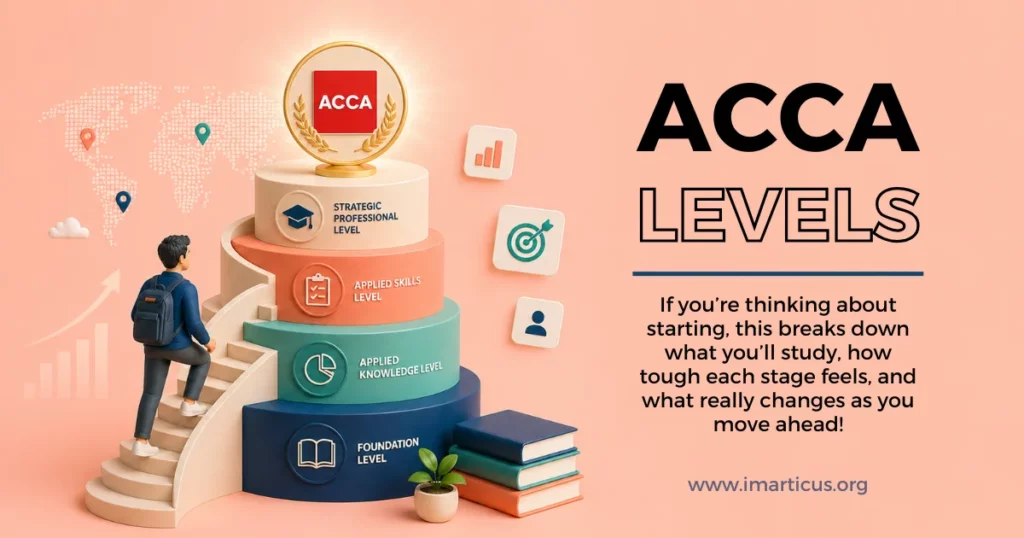
If you are planning to build a career in finance, the first thing that usually comes up is how structured the journey really is. That is where an ACCA Certification starts to make sense. It is not a random set of exams. The ACCA Levels are designed like a ladder where each step prepares you for the next one, without overwhelming you from day one.
When I break down ACCA Levels for someone new, I like to compare it to learning how to manage money in real life. You first understand where money comes from, then how to use it well, and later how to grow it. The course follows a similar rhythm. It starts simple, builds steadily, and then expects you to think like someone who can handle real financial decisions.
What Are ACCA Levels?
If you have ever searched what is ACCA, you would have noticed that the structure is always mentioned early. That is because the ACCA qualification level is built around clear stages, and each stage serves a purpose.
Considering ACCA?
Get personalized guidance on your ACCA journey—eligibility, exam roadmap, and career outcomes in a 15-minute call with our expert counsellor.
No commitment required • 200+ students counselled this month
ACCA Levels are divided into three main parts, along with an entry route for beginners who need extra grounding. These ACCA exam levels are not just academic layers. They reflect how skills grow in real workplaces. You start by understanding, then move to applying, and finally reach a stage where you make decisions.
Don’t Let Our Best Advice Get Buried
Add Imarticus as a Preferred Source — see more of what we publish, every time you search.

To make this easy to picture, think of it like learning to cook. At first, you follow recipes step by step. Later, you will understand why ingredients work together. Eventually, you create your own dishes. That is exactly how ACCA levels and courses are structured.
How Many Levels Does ACCA Have?
This is usually one of the first questions that comes up. How many levels are there in ACCA? The answer is straightforward, but the impact of that structure is what matters more. There are three main ACCA exam levels, supported by a foundation route for those who are new to accounting. Each level focuses on a different skill set, and together they form a complete learning journey.
Overview Of ACCA Exam Levels
| Level | Papers | Focus | Skill Outcome | Stage Purpose |
| Applied Knowledge | 3 | Basics | Concept clarity | Build foundation |
| Applied Skills | 6 | Application | Practical ability | Handle real tasks |
| Strategic Professional | 4 | Strategy | Decision making | Lead financial roles |
| Foundation Level | Varies | Entry support | Basic understanding | Prepare beginners |
| Ethics Module | 1 | Behaviour | Professional judgement | Workplace readiness |
When you look at this table, the structure feels logical. The ACCA qualification level is not just about passing exams. It is about becoming someone who can work with numbers, interpret them, and use them to guide decisions. This also answers how many levels does ACCA have in a practical sense. It is not just three steps. It is a progression where each level prepares you for real work situations.
ACCA Levels And Subjects
Now comes the part that most students care about. What exactly will you study? Understanding ACCA levels and the ACCA subject list helps you see what your day-to-day preparation will look like.
Applied Knowledge Level (ACCA Level 1)
This is where the journey begins for most students. The ACCA knowledge level focuses on building a strong base. It introduces you to how businesses operate and how financial information is recorded. The ACCA Level 1 syllabus is simple to follow if you stay consistent. It is not about memorising complex theories. It is about understanding how things work in a clear and practical way.
ACCA Knowledge Level Papers
| Paper Code | Subject | What You Learn | Real Life Use | Difficulty |
| F1 (BT) | Business And Technology | How organisations work | Understanding company structure | Easy |
| F2 (MA) | Management Accounting | Cost and budgeting basics | Managing expenses | Easy to Moderate |
| F3 (FA) | Financial Accounting | Recording transactions | Maintaining accounts | Moderate |
| Foundation Prep | Entry Modules | Basics of accounting | Preparation stage | Easy |
| Ethics Intro | Professional Basics | Behaviour in finance roles | Workplace conduct | Easy |
The ACCA knowledge level papers are designed to make you comfortable with numbers. Once you complete this stage, you begin to see how financial data connects to everyday business decisions. After this, many students start exploring ACCA entry-level jobs or internships. Even basic roles help you understand how concepts are used outside books.
Applied Skills Level (ACCA Level 2)
Once you move to ACCA Level 2, things begin to feel more real. This stage focuses on applying what you have learned. The ACCA skills level subjects are more detailed and require practice. You are no longer just learning concepts. You are using them to solve problems.
ACCA Skill Level Papers
| Paper Code | Subject | Core Skill | Application Area | Challenge Level |
| LW | Law | Legal understanding | Business compliance | Moderate |
| PM | Performance Management | Analysis | Business performance | Moderate |
| TX | Taxation | Tax rules | Filing and planning | Moderate to High |
| FR | Financial Reporting | Reporting | Financial statements | High |
| AA | Audit | Verification | Audit processes | High |
The ACCA skill level papers require more attention. You will deal with scenarios where answers are not always direct. This is where many students start noticing the ACCA difficulty level increasing. It is also the stage where career options begin to expand. Students start aiming for better roles and even consider ACCA entry-level jobs in Dubai due to wider exposure.
Strategic Professional Level (ACCA Level 3)
The final stage is where everything comes together. The ACCA professional level focuses on decision-making. You are expected to think beyond numbers and understand the bigger picture. The ACCA professional level papers are not about right or wrong answers alone. They are about how well you can analyse a situation.
ACCA Professional Level Papers
| Paper Code | Subject | Focus | Real World Role | Complexity |
| SBL | Strategic Business Leader | Leadership | Business decisions | High |
| SBR | Strategic Reporting | Advanced reporting | Financial strategy | High |
| AFM | Financial Management | Investments | Managing funds | High |
| APM | Performance | Strategy | Business growth | High |
| AAA | Audit | Advanced audit | Risk evaluation | High |
The ACCA professional level is where you start thinking like someone who can guide a company. By this stage, your understanding is not limited to numbers. It includes strategy and judgement. This is also where discussions around ACCA Level 2 salary versus final stage roles become relevant. The difference is noticeable because the responsibility changes significantly.
Now that you’ve seen how ACCA levels are structured, explore how questions evolve across these levels through actual ACCA sample papers.
DOWNLOAD HERE: ACCA Exam Papers
ACCA Exam Fees By Level
Once the structure feels clear, the next thing that usually comes up is cost. The ACCA exam is not a one-time payment. It is spread across levels, and that actually works in your favour if you plan it right. You pay as you move forward, which makes the journey easier to manage.
What matters here is not just the amount, but when you register. The same paper can cost more or less depending on timing. So when you look at ACCA Levels from a financial angle, planning becomes just as important as studying.
| Level | Fee Type | Approx Range (GBP) | What It Covers | Key Insight |
| Applied Knowledge | Per Paper | 98 to 120 | Basic papers | Lowest cost stage |
| Applied Skills | Per Paper | 123 to 165 | Core subjects | Bulk of total cost |
| Strategic Professional | Per Paper | 180 to 210 | Advanced papers | Higher per paper |
| Ethics Module | One Time | Around 79 | Professional skills | Mandatory completion |
| Registration | Annual | Around 120 | Student status | Needed every year |
The ACCA skills level exam fee usually takes up the largest portion because there are more papers in this stage. The ACCA professional level exam fees are higher per paper, but there are fewer exams, so the overall balance works out. After seeing this, most students realise that spreading attempts wisely can help control total spending across ACCA levels and courses.
ACCA Fees Based On Exam Timing
ACCA course fees are also influenced by when you book your exam. This is where many students lose money without realising it.
| Booking Type | Fee Range | Who It Suits | Impact On Budget | Practical Advice |
| Early Entry | Lowest | Planned students | Saves money | Book well in advance |
| Standard Entry | Moderate | Most students | Balanced cost | Safe option |
| Late Entry | Highest | Last-minute attempts | Expensive | Avoid when possible |
| Rescheduling | Extra Cost | Changes in plan | Adds to total | Plan carefully |
| Exemptions | Varies | Prior qualifications | Reduces papers | Check eligibility early |
The ACCA P Level exam fee becomes more noticeable when booked late. Many students end up paying more simply due to delayed decisions. Once you understand this system, managing ACCA fees becomes easier. It is less about spending and more about timing.
ACCA Difficulty Level: Which Stage Feels Toughest?
This is a question almost everyone asks at some point. The ACCA difficulty level does not suddenly jump. It grows gradually, which makes it easier to adapt if you stay consistent. At the ACCA knowledge level, the focus is on understanding. Most topics feel straightforward if you give them time. The challenge here is not complexity but building a strong base.
When you move into the ACCA skills level, things begin to shift. Questions become longer and more practical. You are expected to apply what you know. This is where many students feel the first real challenge. At the ACCA professional level, the nature of difficulty changes again. It is no longer about solving questions step by step. It is about analysing situations and making decisions.
| Level | Nature Of Questions | Student Experience | Common Challenge | Preparation Focus |
| Applied Knowledge | Direct | Comfortable start | Understanding basics | Clear concepts |
| Applied Skills | Scenario Based | Noticeable jump | Application | Practice |
| Strategic Professional | Analytical | Advanced stage | Decision making | Interpretation |
| Ethics Module | Practical | Balanced | Judgement | Case understanding |
| Foundation Level | Introductory | Easy entry | Familiarity | Basics |
The shift from ACCA Level 1 to ACCA Level 2 is where most students pause and reassess their approach. It is not about difficulty alone. It is about adapting your study method. Once you recognise this pattern, the journey feels less unpredictable. You start preparing for the type of challenge instead of reacting to it.
Best Order To Complete ACCA Levels
Even though the structure is defined, the order in which you attempt papers can make a difference. The right sequence can reduce pressure and improve retention. Many students follow a simple path without thinking about strategy. A small adjustment in order can make preparation smoother.
| Stage | Paper Order | Reason | Benefit | Outcome |
| Knowledge Level | F1 → F2 → F3 | Logical flow | Builds basics | Strong foundation |
| Skills Level | LW → PM → TX → FR → AA | Balanced mix | Avoids overload | Better retention |
| Professional Level | SBL → SBR → Options | Core first | Clarity in concepts | Strong finish |
| Ethics Module | Midway | Practical link | Improves judgement | Better answers |
| Final Revision | End | Consolidation | Reduces mistakes | Higher scores |
This approach aligns naturally with how ACCA levels and subjects are structured. It avoids confusion and helps maintain a steady rhythm. After following a clear order, preparation starts to feel organised instead of scattered.
Simple Study Approach That Works
A study plan does not need to be complicated. What matters is consistency and clarity. The ACCA syllabus is wide, but it becomes manageable with a steady routine.
- Focus on one subject at a time so your attention stays clear and your understanding builds gradually without confusion.
- Practice questions regularly because applying concepts helps you remember them better than just reading theory.
- Set fixed study hours each day so your routine stays stable and avoids last-minute pressure before exams.
- Revise older topics every week so you do not lose track of earlier sections while moving forward.
- Take mock tests often so you understand exam patterns and improve your time management under pressure.
Once you follow a simple routine like this, studying becomes less stressful. It feels more like a habit than a task.
Career Opportunities After Each ACCA Level
One of the reasons ACCA Levels attract so many students is the flexibility they offer in terms of career growth. You do not have to wait until the final stage to start working. Each level opens different opportunities.
Jobs After ACCA Level 1
At this stage, your knowledge is basic but useful. You can handle entry-level responsibilities for ACCA jobs and start gaining exposure.
| Role | Work Area | Typical Task | Learning Scope | Growth |
| Accounts Assistant | Accounting | Data entry | Basic accounting | Entry level |
| Junior Executive | Finance | Record keeping | Reporting basics | Early growth |
| Billing Executive | Operations | Invoice handling | Process work | Stable role |
| Audit Trainee | Audit | Support tasks | Audit basics | Learning role |
| Intern | Finance | Assistance | Exposure | Foundation |
These ACCA level 1 jobs help you understand how theory connects to real work.
Jobs After ACCA Level 2
With ACCA Level 2, your role becomes more active. You are expected to handle tasks independently and contribute to decision-making.
| Role | Work Area | Responsibility | Skill Use | Growth |
| Financial Analyst | Finance | Data analysis | Interpretation | High |
| Tax Consultant | Tax | Tax planning | Compliance | Specialised |
| Audit Associate | Audit | Audit execution | Risk analysis | Strong |
| Cost Accountant | Costing | Budgeting | Cost control | Valuable |
| Risk Analyst | Risk | Risk review | Evaluation | Expanding |
The ACCA level 2 salary is higher because your contribution increases. Many students also start exploring global roles at this stage.
Jobs After ACCA Level 3
At the final stage, your profile changes significantly. You move towards roles that involve strategy and leadership.
| Role | Work Area | Responsibility | Impact | Scope |
| Finance Manager | Corporate | Financial planning | High | Leadership |
| Investment Analyst | Finance | Investment decisions | Strategic | Global |
| Audit Manager | Audit | Audit oversight | Critical | Senior |
| Consultant | Advisory | Business advice | High value | Diverse |
| Senior Accountant | Finance | Reporting | Core | Stable |
After completing the ACCA professional level, opportunities expand globally. This is also where many consider roles abroad, including ACCA entry-level jobs in Dubai that offer attractive compensation.
ACCA Levels Timeline: How Long Does It Take?
Once you understand the ACCA course details and the effort involved, the next natural question is time. Most students do not want to rush, but they also do not want the journey to stretch endlessly. The timeline for ACCA Levels depends on how you pace your attempts and how consistent you stay.
There is no single fixed duration. Some complete faster, some take longer, and both paths can work well. What matters is whether your schedule fits your daily routine and energy levels.
| Stage | Minimum Time | Average Time | What Slows It Down | What Speeds It Up |
| Applied Knowledge | 3 to 6 months | 6 to 9 months | Irregular study | Daily consistency |
| Applied Skills | 6 to 9 months | 12 to 18 months | Too many papers together | Balanced attempts |
| Strategic Professional | 6 to 9 months | Around 12 months | Lack of revision | Strong practice |
| Ethics Module | 1 to 2 months | 2 to 3 months | Delays in the attempt | Early completion |
| Full Journey | 15 months | 2 to 3 years | Gaps between exams | Planned schedule |
This shows that ACCA levels and courses allow flexibility, but that flexibility needs structure. If you pause too often, the timeline stretches. If you stay steady, it feels much shorter. After looking at this, most students realise that a simple weekly routine matters more than long study hours.
What Affects Your Timeline The Most
Time is not only about how fast you study. It is also about how you manage your routine and decisions.
- Attempting too many ACCA skill level papers together can slow you down because fatigue builds up quickly.
- Taking long gaps between ACCA exam breaks your rhythm and makes revision harder than expected.
- Starting preparation early for ACCA professional level papers reduces last-minute pressure significantly.
- Managing work along with studies can extend your timeline slightly, but it gives you a practical understanding.
- Staying consistent with small daily targets helps you move steadily through ACCA exam levels without stress.
Once you recognise these patterns, planning becomes easier. You stop guessing and start working with a clear direction.
How To Plan Your ACCA Levels Smartly
A good plan removes confusion. Without a plan, even simple tasks can feel heavy. The idea is not to make a complex schedule but to create something you can follow every day.
Practical Planning Approach
| Approach | How It Works | Best For | Result |
| Fast Track | Multiple papers per attempt | Full-time students | Quick finish |
| Balanced Plan | 2 to 3 papers | Most learners | Steady progress |
| Work + Study | 1 to 2 papers | Working professionals | Real experience |
| Revision First | Extra prep time | Repeat attempts | Better accuracy |
| Mixed Plan | Flexible combination | Changing schedules | Adaptable pace |
The right approach depends on your situation. Some prefer speed, others prefer stability. Both can lead to success if followed properly. After choosing your approach, everything starts to feel more organised. You know what to do next without second-guessing yourself.
Common Mistakes That Slow Down Progress
Even with a clear plan, small mistakes can create delays. Being aware of them early can save time and effort later.
- Trying to finish all ACCA level 2 papers in one go often leads to burnout and weak understanding.
- Ignoring revision while moving ahead causes gaps that become harder to fix later.
- Postponing difficult ACCA professional level subjects creates pressure near the end.
- Not practising enough questions affects performance even if the concepts are clear.
- Underestimating ACCA difficulty level can lead to poor planning and rushed preparation.
Avoiding these mistakes makes your journey smoother. It also helps you stay confident as you move through ACCA Levels.
FAQs On ACCA Levels
Before starting, it helps to clear a few common doubts. These frequently asked questions often come up when students plan their path.
How Many Levels Are In ACCA?
ACCA Levels include three main stages along with an optional foundation route for beginners. This structure defines the ACCA qualification level clearly and helps students understand how many levels does ACCA have before starting preparation with the right plan.
What Is F1, F2, And F3 In ACCA?
These are the first three ACCA Level 1 papers under the ACCA knowledge level papers. They focus on business, management accounting, and financial accounting, forming the base of ACCA exam levels and preparing students for higher stages.
What Are The 13 Papers Of ACCA?
The ACCA Levels include 13 papers across knowledge, skills, and ACCA professional level papers. This structure ensures gradual learning and helps students move step by step through ACCA levels and subjects without confusion.
What Is ACCA Level 3 Called?
The final stage in ACCA Levels is called the Strategic Professional level. This ACCA professional level focuses on decision-making, leadership, and advanced concepts that prepare students for senior roles in finance.
How Long Does It Take To Generally Complete ACCA Levels?
ACCA Levels usually take around two to three years, depending on your pace and exam attempts. The duration can vary based on how you manage ACCA levels and courses along with your daily routine and preparation style.
How Hard Are ACCA Level 2 Papers?
ACCA Levels become more challenging at the ACCA skills level, where application-based questions are common. ACCA Level 2 requires consistent practice and understanding, especially across ACCA skills level subjects.
How Hard Are ACCA Level 1 Papers (F1-F3)?
ACCA Levels begin with ACCA Level 1 papers, which are considered manageable if studied consistently. The ACCA Level 1 syllabus focuses on the basics, making it easier for beginners to build a strong foundation.
Start Strong With ACCA Levels
By this point, ACCA Levels should feel far less confusing and far more structured. What once looked like a long list of papers now starts to resemble a clear path. Each stage has a purpose, and each one builds on the last in a way that actually makes sense when you step back and look at the bigger picture.
What matters now is not just understanding the structure, but deciding how you want to approach it. Some prefer to move fast, others take a steady route alongside college or work. Both paths can work well, as long as you stay consistent and keep your focus on understanding rather than rushing through.
It also helps to remember that the journey is not only about clearing exams. The way ACCA Levels are designed, you begin to think differently as you move ahead. You start noticing how financial decisions work in real businesses, how risks are evaluated, and how numbers tell a story beyond just calculations.
This is where having the right support can quietly make a difference. A structured approach, access to the right study material, and guidance that keeps things simple can take away a lot of the uncertainty. Many students today choose to prepare for the ACCA Course with Imarticus Learning because it brings together clarity, consistency, and practical exposure in one place without making the process feel overwhelming.
If you take one thing away from this, let it be this. The journey becomes easier when you understand it early and plan it well. Once you have that clarity, the rest is about showing up consistently and moving forward, one level at a time.
Liked This? Follow Us Where You Already Search.
Preferred Sources is Google’s built-in follow button — no app, no login, just more Imarticus in your results.
