How to Delete Duplicate Rows in SQL? Detailed Guide With Syntax And Examples

Last Updated on 1 day ago by Imarticus Learning

Keeping data right is very important for all databases. When we have copies, it can cause problems and use more space. To help with this, we will learn how to delete duplicate rows in SQL. We’ll start with simple ways and work up to complicated ones. 

We’ll explore a range of techniques, from the fundamental DISTINCT keyword to utilizing advanced Common Table Expressions (CTEs) in conjunction with the ROW_NUMBER() function. This will make you adapt at using SQL and keep your data clean and efficient in no time! 

Delete duplicate rows in SQL

In SQL, deleting duplicate rows means putting off entries from a table comprising equal information primarily based on specific criteria. Duplicate rows can occur for diverse reasons, including data entry mistakes, integrations from different assets, or incomplete deduplication methods. 

Deleting duplicates facilitates:

  • Improve data integrity: By eliminating redundant data, you make sure that the tables are correctly filled with data and constant.
  • Save storage space: Duplicate rows occupy needless garage space, and getting rid of them can optimize database performance.
  • Enhance data analysis: Duplicate rows can skew statistics evaluation consequences. Removing them results in more correct and dependable insights.

How to delete duplicate rows in SQL using sample data

Here’s how testing makes it clear to see how duplicate rows take-out works in SQL:

Sample data

Let’s consider a table named Customers with the following columns:

CustomerID Name Email
1 John Doe john.doe@email.com
2 Jane Smith jane.smith@email.com
3 Mike Jones mike.jones@email.com
4 John Doe john.doe@email.com (duplicate)

This table has the same row twice for John Doe. We can take an example like this to show how various SQL ways find and delete duplicate rows. 

Delete duplicate rows in SQL using Group

Using GROUP BY and HAVING clauses is a strong method to remove repeated rows in SQL. You select columns to group the data and then use the HAVING clause to filter the groups. It helps find rows with the same values in specific columns.

Here’s how it works:

  • Group By: You choose which columns to group the data by. This puts rows with the same values in those columns into categories.
  • HAVING Clause: This filters the groups made by GROUP BY. You can use COUNT(*) inside HAVING to find groups with more than one row (copies).

How to delete duplicate rows in SQL with Group By and Having

To do this, follow the steps mentioned here.

Step 1. Find duplicate rules: Decide which columns show a duplicate in your data. For example, in a list of customers, duplicates can be found by matching Name and Email together.

Step 2. Build the DELETE Query: This is the basic format:

DELETE FROM your_table_name

WHERE your_table_name.column_name_1 IN (

  SELECT column_name_1

  FROM your_table_name

  GROUP BY column_name_1, column_name_2 (columns for duplicate check)

  HAVING COUNT(*) > 1

);

Example

Consider a table named Products with columns ProductCode, ProductName, and Price. We want to delete duplicate products based on ProductCode and Price.

DELETE FROM Products

WHERE Products.ProductCode IN (

  SELECT ProductCode

  FROM Products

  GROUP BY ProductCode, Price

  HAVING COUNT(*) > 1

);

Result: This query will put things together by ProductCode and Price. The part saying HAVING COUNT(*) > 1 shows sets with the same products and prices. The DELETE statement then takes away rows with codes that are the same as these found duplicates.

Fetching and Identifying the duplicate rows

It’s crucial to identify them accurately before knowing how to remove duplicates in SQL. Data science professionals often use SQL’s functionalities like querying and filtering to pinpoint these duplicate entries. Here are some methods to fetch and identify duplicate rows:

1. Using GROUP BY and COUNT(*)

This is a common approach that uses both grouping and aggregate functions. The idea is to group rows based on the columns that define duplicates. 

Use COUNT(*) to determine the number of rows in each group. Groups with a count greater than 1 indicate duplicates.

Syntax

SELECT column_name_1, column_name_2, …, COUNT(*) AS row_count

FROM your_table_name

GROUP BY column_name_1, column_name_2, …;

2. Using DISTINCT and Self-Join

The SQL remove duplicates option is a very handy way to handle your data. This method utilizes DISTINCT to fetch unique combinations and a self-join to compare rows. Use SELECT DISTINCT on the columns defining duplicates to get unique combinations. Later on, perform a self-join on the table itself, matching these unique combinations with the original table.

Syntax

SELECT t1*.

FROM (SELECT DISTINCT column_name_1, column_name_2, … FROM your_table_name) AS unique_data

INNER JOIN your_table_name AS t1 ON (unique_data.column_name_1 = t1.column_name_1 AND …)

WHERE unique_data.column_name_1 = t1.column_name_1 AND …;

3. Using ROW_NUMBER()

This method assigns a row number within groups defined by duplicate criteria, allowing you to identify duplicates based on their order.

Syntax

SELECT *, ROW_NUMBER() OVER (PARTITION BY column_name_1, column_name_2, … ORDER BY column_name_3) AS row_num

FROM your_table_name;

How do you choose the right method?

The right way depends on your needs and table size. Using GROUP BY and COUNT(*) is good for most cases. If you know how to remove duplicates in SQL, you might as well learn when to use which method.

If you have complicated copies or need to filter based on order, you could try ROW_NUMBER(). If you want to see all the copies, using self-join can help.

Delete duplicate rows in SQL with an intermediate table

The “Intermediate table” way is good for doing away with the same rows in SQL. You use another table to keep the different info, and then swap it with the first table. For example, in a table called Customers with CustomerID, Name, and Email, with the same data.

Steps

  1. Create Intermediate Table: CREATE TABLE Customers_Temp LIKE Customers;
  2. Insert Distinct Rows: INSERT INTO Customers_Temp
  3. SELECT DISTINCT CustomerID, Name, Email
  4. FROM Customers;
  5. (Optional) Drop Original Table: DROP TABLE Customers;
  6. Rename Intermediate Table: ALTER TABLE Customers_Temp RENAME TO Customers;

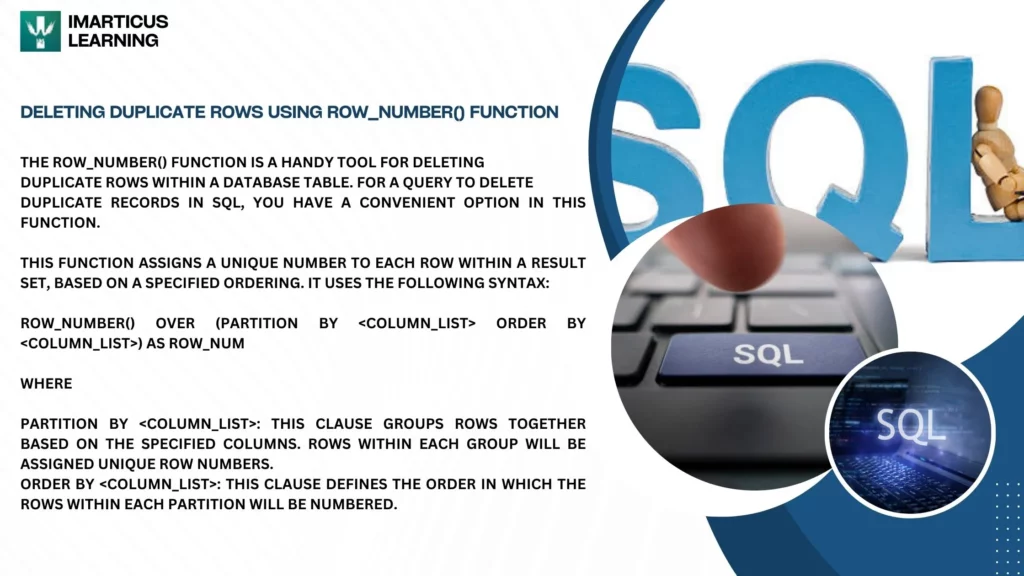
Deleting duplicate rows in SQL using ROW_NUMBER() function

The ROW_NUMBER() function is a handy tool for deleting duplicate rows within a database table. For a query to delete duplicate records in SQL, you have a convenient option in this function.

This function assigns a unique number to each row within a result set, based on a specified ordering. It uses the following syntax:

ROW_NUMBER() OVER (PARTITION BY <column_list> ORDER BY <column_list>) AS row_num

where

  • PARTITION BY <column_list>: This clause groups rows together based on the specified columns. Rows within each group will be assigned unique row numbers.
  • ORDER BY <column_list>: This clause defines the order in which the rows within each partition will be numbered.

Example

Suppose you have a table named Customers with columns customer_id, name, and email. You want to delete duplicate customer entries based on name and email. Here’s the query:

WITH cte AS (

  SELECT *, ROW_NUMBER() OVER (PARTITION BY name, email ORDER BY customer_id) AS row_num

  FROM Customers

)

DELETE FROM cte

WHERE row_num > 1;

Result: This query first creates a CTE named cte. It assigns a row number (row_num) to each row in the Customers table. The partitioning is done by name and email, and the ordering is based on customer_id. Then, the DELETE statement removes rows from the CTE where row_num is greater than 1, eliminating duplicates.
 

Deleting duplicate rows using ROW_NUMBER() function

Delete duplicate rows in SQL using Common Table Expressions (CTE)

Common Table Expressions (CTEs) offer a powerful way to delete duplicate rows from your database tables. Here’s how you can use CTEs with the ROW_NUMBER() function for this task:

Step 1. Define the CTE

  • The CTE identifies the duplicate rows. Here, you’ll use the ROW_NUMBER() function to assign a unique sequential number to each row.
  • The PARTITION BY clause groups rows together based on specific columns. Only rows within the same group will compete for unique numbering.
  • The ORDER BY clause defines the order in which rows within each group are numbered.

Step 2. Filter and delete

After creating the CTE, you can use the DELETE statement to target the CTE alias.

Within the DELETE statement, you’ll filter for rows where the ROW_NUMBER() (often aliased as row_num) is greater than 1. This effectively removes duplicates while keeping the first occurrence of each unique combination.

How to Delete duplicate rows in SQL using CTE

While procedures are a great way to encapsulate logic, removing duplicates with CTEs is typically done within a single SQL statement. However, here’s how you could potentially create a procedure using CTEs as an example:

Step 1. Procedure creation

   CREATE PROCEDURE RemoveDuplicates (

@tableName VARCHAR(50),  -- Name of the table to process

       @columnList VARCHAR(200) -- Comma-separated list of columns for duplicate check

   )

   AS

   BEGIN

       -- Implement the logic here

   END;

Step 2. Logic within the procedure (using CTE)

   DECLARE @cteName VARCHAR(50);  — To store dynamic CTE name

SET @cteName = 'cte_' + @tableName;  -- Generate unique CTE name

   WITH (@cteName) AS (  -- Define CTE dynamically

       SELECT *,

              ROW_NUMBER() OVER (PARTITION BY @columnList ORDER BY some_column) AS row_num

       FROM @tableName

   )

   DELETE FROM @cteName  -- Delete from CTE

   WHERE row_num > 1;

   END;

Rank function to SQL delete duplicate rows

The RANK() function in SQL can be a great tool for deleting duplicate rows from a table. The function assigns a ranking number to each row within a result set, considering a specified ordering. Similar to ROW_NUMBER(), it uses the following syntax:

RANK() OVER (PARTITION BY <column_list> ORDER BY <column_list>) AS rank_num

where

  • PARTITION BY <column_list>: This clause groups rows together based on the specified columns. Rows within each group will receive ranks.
  • ORDER BY <column_list>: This one defines the order in which the rows within each partition will be ranked.

Steps for Deleting duplicate rows in SQL with RANK

The steps are explained here:

Step 1. Identify duplicates: The RANK() function assigns the same rank to rows with identical values in the PARTITION BY columns.

Step 2. Delete ranked duplicates: We can leverage a CTE to isolate the duplicates and then delete them based on the rank.

Example for RANK function

Suppose you have a table named Products with columns for product_id, name, and color. You want to remove duplicate rows in SQL by targeting the product entries based on name and color. Here’s the query:

WITH cte AS (

  SELECT *, RANK() OVER (PARTITION BY name, color ORDER BY product_id) AS rank_num

  FROM Products

)

DELETE FROM cte

WHERE rank_num > 1;

Result: This query first creates a CTE named cte. It assigns a rank_num to each row in the Products table. The partitioning is done by name and color, and the ordering is based on product_id. Rows with the same name and color will receive the same rank_num. 

Then, the DELETE statement removes rows from the CTE where rank_num is greater than 1, eliminating duplicate entries.

Final Thoughts

Duplicate rows in your database can cause wasted space and skewed analysis. This article enables you to delete duplicate rows in SQL effectively. We explored methods like GROUP BY with HAVING for basic tasks, and advanced techniques with ROW_NUMBER() and CTEs.

Choosing the right method depends on your table size and needs. For a data-driven approach to managing your databases, consider Imarticus’s Postgraduate Program in Data Science Analytics. This data science course equips you with the skills to wrangle, analyze, and visualize data, making you an expert in data management. Register instantly!

Revolutionising Supply Chains: Exploring Advanced Strategies in Digital Supply Chain Management

Last Updated on 2 years ago by Imarticus Learning

In today’s rapidly evolving business landscape, traditional strategies in supply chain management are no longer sufficient to meet the demands of modern consumers and markets. The advent of digital technologies has ushered in a new era of supply chain management, characterised by increased efficiency, agility, and innovation. In this comprehensive guide, we delve into the realm of digital strategies in supply chain management and explore the advanced tactics and tools driving transformation in the field of operations and supply chain management.

Digital Supply Chain Management Course

The Advanced Certification Program in Digital Supply Chain Management in association with E&ICT Academy, IIT Guwahati, offers professionals a unique opportunity to gain in-depth knowledge and expertise in leveraging digital technologies to optimise supply chain operations. This supply chain management course is designed to equip participants with the skills and insights needed to navigate the complexities of today’s digital landscape, the program covers a wide range of topics, including digitization of the functions of supply chain management, data analytics, blockchain technology, Internet of Things (IoT), artificial intelligence (AI), and more.

What Is Supply Chain Digital Transformation? 

Supply chain digital transformation leverages the transformative power of digital solutions to become more agile and competitive in the marketplace as part of digital resilience. This includes accessing previously fragmented and siled real-time data from suppliers and consumers, making it accessible through innovative technologies.

This process enables businesses to make data-driven decisions while optimising all aspects of their operations and supply chain management.

Advanced analytics tools, artificial intelligence (AI), and robotic process automation (RPA) are examples of digital transformation strategies in supply chain management.

Benefits of Digital Supply Chain Transformation

Digital transformation strategies in supply chain management offer a myriad of benefits for organisations seeking to modernise their operations and stay competitive in today’s dynamic business environment. Here are some key advantages of embracing digital supply chain transformation:

  • Enhanced Efficiency and Productivity: By integrating digital technologies into supply chain processes, organisations can automate repetitive tasks, streamline workflows, and eliminate manual errors. This results in improved operational efficiency, reduced lead times, and increased productivity across the entire supply chain network.
  • Real-Time Visibility and Transparency: Digital supply chain solutions provide real-time visibility into inventory levels, shipments, and production processes. This enhanced visibility enables organisations to track the movement of goods, identify potential bottlenecks or disruptions, and make data-driven decisions to optimise performance.
  • Agile and Responsive Operations: Digital supply chain transformation enables organisations to respond quickly to changes in customer demand, market trends, and supply chain disruptions. By leveraging advanced analytics and predictive modelling, organisations can forecast demand more accurately, adjust production schedules in real-time, and optimise inventory levels to meet customer needs efficiently.
  • Improved Collaboration and Communication: Digital supply chain technologies facilitate seamless collaboration and communication between internal teams, external partners, and suppliers. Cloud-based platforms, collaboration tools, and shared data repositories enable stakeholders to exchange information, share insights, and collaborate on decision-making, fostering a culture of transparency and collaboration across the supply chain ecosystem.
  • Enhanced Customer Experience: Digital transformation strategies in supply chain management enables organisations to deliver superior customer experiences by providing faster, more reliable, and personalised services. By optimising supply chain processes, organisations can reduce order fulfilment times, minimise stockouts, and enhance order accuracy, leading to increased customer satisfaction and loyalty.
  • Cost Savings and Waste Reduction: By optimising strategies in supply chain management and reducing inefficiencies, digital supply chain transformation can help organisations achieve significant cost savings and waste reduction. By minimising excess inventory, reducing transportation costs, and optimising warehouse operations, organisations can improve their bottom line while minimising their environmental impact.

digital supply chain management course

Best Practices for Digital Supply Chain

Best practices for digitization in the functions of supply chain management are essential for organisations looking to optimise their operations, enhance efficiency, and stay competitive in today’s rapidly evolving business landscape. Here are some important best practices to consider when implementing digital strategies in supply chain management:

  • Embrace Data-Driven Decision-Making: Leverage advanced analytics, machine learning, and predictive modelling techniques to analyse large volumes of data and gain actionable insights into supply chain performance. By harnessing the power of data, organisations can make informed decisions, identify trends and patterns, and proactively address issues before they escalate.
  • Invest in Integrated Technologies: Implement integrated supply chain management systems that connect various functions, processes, and stakeholders across the supply chain network. By integrating technologies such as ERP (Enterprise Resource Planning), CRM (Customer Relationship Management), SCM (Supply Chain Management), and IoT (Internet of Things), organisations can achieve end-to-end visibility, collaboration, and synchronization of supply chain activities.
  • Focus on Customer-Centricity: Align strategies in supply chain management with customer needs and preferences to deliver superior customer experiences. Utilise customer data, feedback, and market insights to tailor products, services, and delivery options to meet customer expectations. By prioritising customer-centricity, organisations can build loyalty, drive repeat business, and gain a competitive edge in the marketplace.
  • Implement Agile and Flexible Processes: Adopt agile methodologies and flexible processes to respond quickly to changing market dynamics, customer demands, and supply chain disruptions. Embrace strategies in supply chain management such as lean manufacturing, just-in-time inventory management, and agile project management to minimise waste, optimise resources, and improve responsiveness.
  • Strengthen Supplier Relationships: Cultivate strong partnerships and collaborative relationships with suppliers, vendors, and third-party logistics providers. Establish clear communication channels, share information transparently, and work together to identify opportunities for process improvement, cost reduction, and innovation. By fostering trust and collaboration, organisations can build resilient supply chains capable of weathering disruptions and driving mutual success.
  • Ensure Cybersecurity and Data Protection: Safeguard sensitive supply chain data, intellectual property, and customer information from cyber threats and data breaches. Implement robust cybersecurity measures, encryption protocols, and access controls to protect digital assets and mitigate security risks. Educate employees, partners, and vendors about cybersecurity best practices and foster a culture of vigilance and compliance.
  • Continuously Monitor and Evaluate Performance: Regularly monitor Key Performance Indicators (KPIs), metrics, and benchmarks to assess supply chain performance, identify areas for improvement, and track progress towards strategic objectives. Utilise dashboards, scorecards, and analytics tools to visualise data, measure performance against targets, and drive continuous improvement initiatives.

Conclusion

Digital supply chain management represents a paradigm shift in the way organisations design, operate and optimise their strategies in supply chain management processes. By embracing digital supply chain management strategies and leveraging advanced technologies, organisations can unlock new opportunities for efficiency, innovation, and growth.

The Advanced Certification Program In Digital Supply Chain Management in association with E&ICT Academy, IIT Guwahati, offered by Imarticus Learning, is designed to equip professionals with the skills and insights needed to thrive in today’s digital economy. Take the next step towards revolutionising your strategies in supply chain management and future-proofing your career by enrolling in this supply chain management course today. Embark on a transformative journey towards mastering the art of digital supply chain management. Unlock new career opportunities and stay ahead of the curve in today’s rapidly evolving business landscape.

7 Benefits of Certificate Program in General Management

Last Updated on 2 years ago by Imarticus Learning

Welcome to a world where management is more than just a phrase and can propel you to the peak of success, inquisitive brains, and ambitious business whizzes! 

Expertly navigating a commercial empire, formulating tactics that intimidate rivals, and motivating teams to aim high. If this sight makes your heart race, hang onto your hats because we’re about to delve into the glittering world of the “Certificate Program in General Management” — a fast-tracked route to making your professional goals a reality.

The General Management program isn’t just a course; it’s your backstage ticket to the biggest songs of the business world, from deciphering the hidden language of economics to releasing your inner leadership maestro. Therefore, fasten your seatbelt as we travel through seven dazzling advantages that will make you want to seize the certificate and embark on an unmatched achievement adventure. 

Let’s explore the perks of General Management Certificate Training!

Key responsibilities of a General Manager

Okay, before we roll into the juicy stuff, let’s chat about what these general manager folks are all about. They’re like the grand captains of a business ship – steering it, setting targets, making things tick, managing cash and stuff, cheering on teams, fixing hiccups, and giving customers high-fives for good service. These GMs need a whole toolbox of skills: talking well, thinking on the fly, solving problems like champs, cooking fresh ideas, and more.

Ever wondered what it takes to wear the General Manager’s crown? Prepare to be dazzled by these modern-day magicians’ intricate dance of duties. From masterminding strategies to soothing workplace storms, here’s your VIP pass to the world of a General Manager’s key responsibilities – the magic behind the title!

  • Dream Weaver: General Managers don’t just dream; they orchestrate symphonies of success. They set goals that make the competition sweat and craft visions that light up boardrooms.
  • Strategy Sorcerer: If strategy were a potion, General Managers would be the master alchemists. They whip up plans that navigate the business through stormy seas and lead it toward treasure-filled horizons. 
  • Finance Whisperer: Numbers don’t lie, but they do tell stories. General Managers decode these tales, making budget decisions that keep the ship afloat and steer it toward profitable shores. 
  • Marketing Maestro: General Managers are the ultimate storytellers, using marketing spells to enchant customers and create a buzz that echoes across markets far and wide. 
  • Team Dynamo: Ever seen a well-oiled machine? That’s what General Managers do with their teams – they inspire, motivate, and ensure everyone’s in harmony, working towards the grand vision. 
  • Problem-Beater Extraordinaire: When problems arise, General Managers don’t flinch; they leap into action, armed with analytical swords and creative shields to conquer challenges and keep the show going. 
  • Customer Champion: General Managers know the key to treasure is customer satisfaction. They build bridges of trust, ensuring every customer leaves with a smile and keeps returning for more. 

So there you have it – the magical medley of roles that make General Managers the rockstars of the business realm. From weaving dreams to conquering challenges, they don’t just manage; they conjure success. 

What are the Benefits of a Certificate Program in General Management?

Here are some of the Benefits of General Management training program for Professionals:

  • Become a Biz Whiz:

 You’ll groove on all aspects of running biz – like the big strategy dance, reading financial crystal balls, nailing down marketing masterplans, acing the operations game, making people happy at work, and more. It’s like getting the whole playbook.

  • Master the Art of Bossing:

 Get ready to don the boss cape. You’ll learn to lead like a rock star, pass the task baton like a pro, pep-talk and inspire like a champion, deal with workplace showdowns, and even give and take feedback like a champ. 

  • The Brainy Side:

 Sharpen those smarts. Dive deep into biz puzzles – analyzing what’s up inside and outside, spotting golden chances and danger flags, cooking strategy plans, and tracking how they do. Tools and tricks for making top-notch decisions? You’ll know them all.

  • Fix-It Power:

 Problem-solving superhero, anyone? With this gig, you’ll learn how to whip up data sorcery, mix numbers and stories for insights, crack the riddles behind troubles, cook up solutions, measure if they worked, and even do tech magic for it all.

  • Innovation Highs:

Learn to whip up new concepts, brainstorm like a boss, test if your ideas got a mojo, scale up the winners, and make innovation your middle name. Plus, spread that creativity sparks in your work gang.

  • Rub Elbows Everywhere:

Get social, people! You’ll hang with other work ninjas from different corners of the job universe. Meet rockstar profs who know their stuff inside and out. Swap tricks, tales, problems, fixes, and even phone numbers. It’s like a pro party!

  • Boss Moves Incoming:

 Ready to rock the career stage? This certificate can jazz up your resume with skills. You’ll score cred from bosses, coworkers, customers, and rival companies. Up your paycheck game, zoom up that job ladder, and be a top job pick.

What’s Next After the Course Fiesta?

Now, what’s cooking on the career menu after this jam-packed course? As you stride confidently across the threshold of the General Management Online Certificate program, you are not just acquiring a certificate but unlocking a treasure trove of career possibilities that shimmer like gems in a vast desert of opportunities.

Imagine yourself as a modern-day alchemist equipped with the elixir of knowledge in General Management. As you step out into the professional arena, you become a conductor of change, orchestrating symphonies of efficiency and innovation. The corporate world becomes your canvas, and you wield the brush of strategy, painting the future with strokes of brilliance.

Your newfound prowess in General Management transforms you into a navigator, steering organizations through the turbulent waters of uncertainty. Like a captain of a majestic ship, you guide your team towards new horizons, harnessing the winds of collaboration and the currents of effective decision-making.

Picture yourself as an architect of success, constructing bridges between departments and forging alliances between people. With the Executive Certificate Program in General Management as your cornerstone, you build towering structures of organizational harmony supported by the pillars of leadership and vision. Your blueprint for success becomes a model admired by all who pass through its doors.

From the corridors of executive boardrooms to the bustling crossroads of project management, your certification opens previously hidden doors. You are not merely a candidate for a job; you are a coveted asset, a gemstone employers seek to embed in the crown of their company’s achievements.

As you journey further, your General Management certification propels you into the stratosphere of entrepreneurship. Armed with a deep understanding of market dynamics and a flair for innovation, you become a trailblazer, creating new avenues and setting trends others eagerly follow.

Think of yourself as a conductor leading an orchestra of growth, each member playing their role to create a harmonious melody of success. Your certification is the baton you wield, guiding the collective efforts towards a crescendo of achievement.

In the realm of possibilities after completing the General Management Certification program, you’re not just an applicant – you’re a contender, a protagonist in a narrative of achievement, and a visionary sculptor of your destiny. The corporate stage is yours to command, and the spotlight of success eagerly awaits your command. So, step forward with your certification as your sword and your dreams as your wings, for the world of General Management is yours to conquer.

Depending on your deal – experience, school smarts, what gets your heart racing – you could dive into roles like:

  • Captain of All Things (General Manager)
  • Big Boss of a Corner (Business Unit Manager)
  • Chief of a Department Party (Department Manager)
  • Project Pro (Project Manager)
  • Master of Making Things Go Smooth (Operations Manager)
  • Head Honcho of Selling (Marketing Manager)
  • Money Magician (Finance Manager)
  • HR Hero (Human Resource Manager)
  • Product Prodigy (Product Manager)
  • Program Prowler (Program Manager)
  • Consultant Extraordinaire (Consultant)
  • Idea Machine (Entrepreneur)

And guess what? It’s a career buffet – from making things to caring for people, tech wonders to nonprofit vibes, you pick your flavor!

So, Wrapping It Up

Summing it all in a neat package – the general management certificate gig is like a golden ticket for the boss-hungry. It’s like unlocking the biz kingdom – the A to Z on all things biz, unleashing your inner leader, smashing problems to bits, expanding your work gang, and firing up your career rockets. 

In partnership with IIMA, Imarticus Learning proudly provides the General Management Program (GMP), the program’s flagship that has been carefully developed and regionalized. This transformational experience aims to strengthen participants’ managerial knowledge so they can comfortably take on senior general management jobs as they advance. 

Imarticus Learning, in collaboration with IIMA, offers a curriculum that explores the timeless essence of management via immersive case studies and the guidance of seasoned faculty members, all while being guided by the values of top-notch education. These experts impart a degree of understanding to the unequaled learning process, establishing a foundation based on unshakeable information.

If you’re feeling the buzz, dive into the general management training scene. Snoop around for legit places that offer this gig. See what other folks say about it online – past students and their victory dances. 

Frequently Asked Questions (FAQs)

  1. What is a Certificate Program in General Management?

A Certificate Program in General Management is a professional training course that aims to equip individuals with in-depth knowledge and skills in various areas of management. It typically includes topics like leadership, strategic planning, finance, marketing, and operations.

  1. Who should consider enrolling in a General Management Certificate Program?

This program is suitable for current managers looking to improve their skills, professionals aspiring to advance to management positions, and entrepreneurs seeking to effectively manage their businesses.

  1. What are the key benefits of a Certificate Program in General Management?

Skill Enhancement: Improve your skills by learning in-depth information in crucial management domains, including strategic thinking, operational efficiency, and leadership.

Career Growth: Boost your credentials to raise your chances of getting hired for higher-paying jobs and promotions.

Opportunities for Networking: Make connections with colleagues, educators, and business leaders to grow your professional network.

Flexibility: A lot of programs allow you to combine your studies with your job and personal obligations by offering part-time, online, or hybrid choices.

Practical Application: Gain knowledge by applying management theories to real-world scenarios through interactive workshops, case studies, and projects.

  1. How does a Certificate Program in General Management differ from an MBA?

A certificate program is typically shorter and more focused on practical skills than an MBA, even though both offer excellent management education. It also commonly requires less time and money to complete. A more comprehensive, in-depth academic and theoretical approach to company management is usually provided by an MBA.

  1. Are there any prerequisites for enrolling in a Certificate Program in General Management?

While particular requirements can vary, most programs demand a bachelor’s degree along with some professional experience. In place of a degree, certain programs may instead accept applicants with a significant amount of job experience.

  1. What kind of job opportunities can I expect after completing the program?

Graduates can work in a variety of leadership jobs in a variety of industries, including project manager, operations manager, business analyst, and marketing manager. Your curriculum will give you adaptable abilities that you can use in a variety of business environments.

  1. How do I choose the right Certificate Program in General Management?

Take into account factors including the institution’s standing, the course material, the delivery method (online or in-person), the credentials of the instructors, networking possibilities, and the success of the alumni. Imarticus Learning’s General Management Program (GMP), in association with the prestigious IIM A, is designed to enhance the managerial capabilities of the participants who desire to take on general management responsibilities in the future. For seasoned managers ready to reignite their careers.

  1. How does this program help in developing leadership skills?

Courses on decision-making, team management, communication techniques, and leadership theories are commonly included in the curriculum. Effective leadership skills are also fostered by practical tasks and projects, which aid in applying these ideas in real-world situations.