

All About IIM L Finance Courses: Everything You Need To Know

Finance is the fuel for any business that helps to manage the flow of funds properly. The only person who can excel in financial management is a qualified finance professional. If you want to qualify in this category, you should get the desired degree if you do not have a certificate from a reputed institute. IIM Lucknow is one of the reputed institutes which offers a wide range of course options in the finance domain.

Here is the required information about finance courses in IIM L as per your requirement.

Best Finance Program at IIM Lucknow

Undergrads always consider a career in finance to be a challenge. However, the reality is different – because every successful business operation seeks honest and knowledgeable financial hands to control the show. Financial analysts, for example, are in high demand in technically driven businesses where digitization and modernization require a meaningful churning of numbers and the creation of business rules that sustain business operations.

If you are a graduate, a professional working in the finance domain with at least 2 years of work experience, you have a bright career with advanced management programs in financial services and capital markets certificate courses.

This course will offer you a rank in the management cadre in finance, and traditionally very few people will get it. Selected diploma holders with significant work experience may also have the opportunity to explore investment banking, capital markets, and risk and fintech domains.

The course is designed to be a leading-edge curriculum that benefits professionals with basic financial knowledge and skills. The program includes skill development in key and industry-demanding domains. Topics include corporate finance, risk management, and compliance, fintech, capital markets, valuation, and equity research that transform mid-level professionals into expert-level industry leaders.

In addition to subject matter skills, the curriculum features include abstract case studies in the industry. In addition to hands-on projects, regular evaluations, hackathons, and personalized Capstone projects add credits to your PGDM In Finance Management. Credential A-list opens the way to explore your career in finance and consulting firms as well as new businesses looking for financial management. 

Learning Options at IIM Lucknow

For new graduates in finance-related subjects, IIM Lucknow offers Certificate and PG Diploma courses, such as Diploma In Finance Management to help you build your credentials on your profile.

A certification program, for example, an investment banking operation managed by Euronext Group will add stars to your employability in corporate banking. Similarly, the PG program in Banking and Wealth Management gives you huge benefits in investment banking and finance houses.

Young aspirants with a basic degree can advance their careers in specialized fields as per the urgent needs of today’s market. Students can quickly upgrade themselves as financial analysis and credit risk and compliance experts. IIM Lucknow offers several programs in this line, including:

  • Financial Analysis with KPMG and
  • Credit Risk and UnderWriting with Moody’s Analytics.

In addition, professional programs for senior professionals and executives who specialize in their domain skills are also sponsored at IIM and related organizations. They include:

  • SP Jain Professional Certificate in FinTech
  • IIM Lucknow AMP in Financial Services and Capital Market
  • IIM Calcutta Executive program in investment banking and capital market

Why an IIM Lucknow Course?

There are plenty of options for basic management professionals in finance disciplines working in non-financial industries to resume career advancement.

As one of the top-tier institutes, IIM Lucknow is also AMBA and AACSB accredited. Students always benefit from on-campus infrastructure, facilities, and networking with professors. With a successful history of conducting path-breaking management programs over the last 35 years and frequent webinar recognition, IIM L has a lot to offer.

What are the responsibilities of a certified supply chain analyst ?

Supply chain analysts are the backbone of every organization. They take care of all logistics, from managing inventory to ensuring that products get to the right place at the right time.

Supply chain analysts are in charge of ensuring that products and services get to their destination on time. They also ensure that these items are handled with care, which means they have to work closely with suppliers. Supply chain analysts need to be responsible for everything from knowing how much inventory is required at each location to ensuring the correct product arrives at the right store. 

Who is a Supply Chain Analyst?

A supply chain analyst works for a company to improve its bottom line by looking at the complete picture of its operations. A certified supply chain analyst will understand how all aspects of production and distribution affect profitability and how operational changes can be made to increase profits. It is imperative to explore what a supply chain analyst does and what responsibilities they have to answer the question “what are the responsibilities of a certified supply chain analyst?” Becoming a supply chain analyst is an excellent way to enter the field of business. 

best supply chain management and analytics coursesKey roles and responsibilities of a Supply Chain Analyst:

  • Work with the management team to identify areas for improvement and implement changes 
  • Analyze data, ensure that processes are efficient, monitor product flow (location of goods), inventory levels, etc. 
  • Collaborate with other departments within an organization to achieve common goals. This may include working closely with the supply chain managers to determine how best to allocate resources based on production schedules or shipping deadlines; understanding facility layout to avoid making it difficult or inefficient for employees; ensuring worker safety by analyzing equipment effectiveness and ergonomics. 
  • Supply chain analysts are responsible for keeping track of all aspects of how goods are created, transported, sold, and delivered. They make sure that businesses have everything they need before it becomes necessary to order more. These professionals need to keep up with new technological advances to be prepared for what comes next in business.

Grow and Transform with Imarticus Learning:

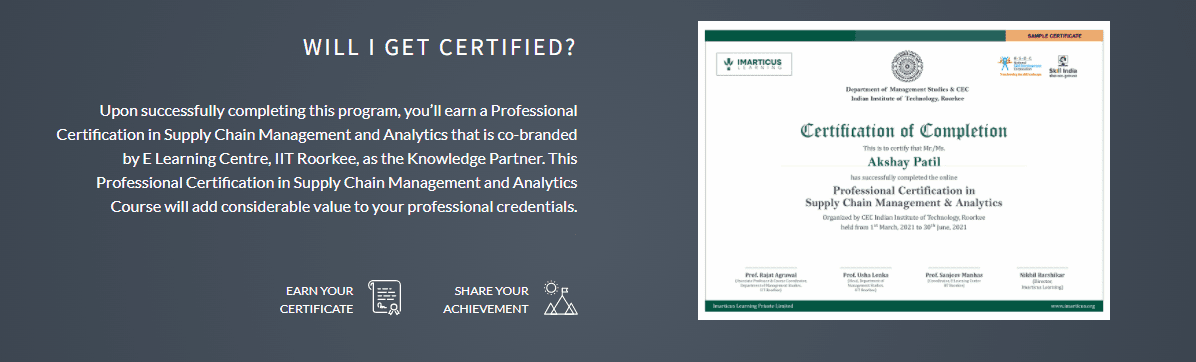
Future-proof your career with the new-age curriculum with the supply chain analyst course offered by Imarticus Learning. The Certification Course is designed with DoMS and E-learning Centre, IIT Roorkee & industry leaders to provide a cutting-edge experience to candidates who wish to enter the operations & supply chain industry.

Supply Chain Analytics enables management to make data-driven decisions at strategic, operational, & tactical levels. This certification prepares you for high-demand job roles such as Demand Planner, Data Scientist, Supply Planner, and Supply and Operations Planner.

Supply Chain Management Online Course USPs:

  • The six-month program is uniquely designed by IIT faculty & industry leaders.
  • With the ever-increasing trend of e-commerce, the amount of movement of goods has been ever-increasing. The program prepares you to gain from this opportunity.
  • Learn from one of the best faculties in India through live online sessions and discussions.
  • Solve complex real-industry problems demanding a thorough understanding of concepts, mastery over a skill, and understanding the business context. 
  • Boost your resume and stand out with these real-world SCM projects.

Quantum Algorithms for Cybersecurity PG course in 2022

Quantum computing focuses on the creation of computer-based technology that relies on quantum-theoretical concepts. Understanding how energy and matter behave at the subatomic level is explained by quantum theory. For specialized computations, quantum computing makes use of many bits in a computation. An algorithm that works on a genuine quantum computation model is called a quantum algorithm. 

Quantum computing is founded on the principles of quantum physics. There are two types of bits in classical computing: ones and zeros. The fundamental unit of quantum information, the qubit or quantum bit, is a two-state device that physically realizes the quantum binary bit. Qubits may be either 0 or 1 or in superposition. Quantum computing is one of the key topics taught in cybersecurity and information security training.

Quantum Algorithms 

Although there are a lot of quantum algorithms used in quantum computing, the following two are basic algorithms used in quantum computing.

 Gauss Sum Estimation

Exponentially increasing sums are known as Gauss sums. These sums can only be estimated using a well-known classical approach that requires exponential time. A classical method for estimating Gauss sums would entail an efficient classical approach for calculating logarithms. Quantum computers are able to do polynomial-precision calculations in polynomial varying times for Gauss sums. 

Quantum Estimation Phase

It’s possible to calculate the eigenphase of the unitary gate’s eigenvector using a quantum phase estimation technique that takes into account the eigenvector’s quantum state and access to the gate.

Quantum Computing and Quantum Algorithms in Cyber Security

Quantum Computing and Quantum Algorithms have key advantages over the traditional methods used in cybersecurity. A few are mentioned below:

  • Creation of Quantum Keys: The function of cryptography depends on the creation of quantum random numbers. As pseudo-random number generators do not generate absolute random numbers, they may be subject to assault. Absolute random numbers are generated using quantum random number generators, which use quantum mechanics to accomplish so. 
  • Asymmetrical key distribution in quantum-secure communications: Using cryptographic keys to encrypt and decrypt data being transferred over a channel is the foundation of secure communication. Encryption keys may be exchanged in a totally secure manner using Quantum Key Distribution(QKD), which uses characteristics of quantum physics to detect the presence of a third party inside the communication channel. 
  • Quantum Algorithms to identify Novel Cyberattacks: Quantum algorithms have the potential to speed up machine learning algorithms by orders of magnitude while also using less time and energy. As a result, better algorithms for detecting and countering new forms of cyberattack may be developed.

Conclusion:

In order to assist applicants in preparing for a wide variety of security certification exams, these cyber security classes have been developed to cover all levels. Using an ‘Industrial Training’ model, Imarticus Learning has helped more than 35,000 people to advance their careers since 2012.


Your wait for cyber security training courses is over as Imarticus has partnered with EC-Council for the Post Graduate Program in Cybersecurity to teach quantum computing and all other cybersecurity subjects in a time frame of just 6 months, making you a Certified Cyber Security Professional. This comprehensive course on cybersecurity offers students incomparable benefits along with a guaranteed job assurance offer.