Bring ideas to life, drive economic growth and expand human welfare with AI courses

AI courses are a great way to bring your ideas to life and expand human welfare. With AI, you can create new products or services that improve the quality of people’s lives. You can also use AI to automate processes and tasks that used to be done by humans.

It can help businesses save money and increase efficiency. In addition, AI can help researchers solve complex problems and discover new cures for diseases. By taking an AI course, you will have the skills needed to make a difference in the world! 

What is AI, and how will it change the world economy?

The future of AI is so bright we have to wear shades. That’s because the impact of artificial intelligence on economic growth promises to be enormous and far-reaching. The Mckinsey & Company reports that “by 2030, AI could deliver an additional global output of around $13 trillion – or about 16% higher cumulative GDP compared to today.”

That’s a pretty staggering number, and it underscores the importance of getting up to speed on AI for personal and professional reasons. And that’s where our new AI courses come in! They cover all aspects of AI, from its history and development to the latest applications. 

How can AI courses help people learn new skills and advance their careers?

AI can increase business efficiency by automating menial tasks and improving decision-making. By taking AI courses, businesses can learn how to use these tools to improve their productivity. In addition, as artificial intelligence becomes more widespread, employees who are familiar with its workings will be in high demand.

By teaching them how to use AI in everyday activities, AI courses can also help people improve their lives. For example, an AI course may teach students how to identify and correct errors when they see them or create a chatbot that can intelligently respond to questions.

The benefits of artificial intelligence for human welfare

Artificial intelligence is a new technology that many industries have adopted to increase efficiency and creativity. For example, AI can help us make better financial decisions, improve our health and safety at work, predict the future of weather on Earth, or even what we should do in case of an emergency. Many studies have been done on AI to determine how it can benefit different areas of our lives. 

Discover AI Certification with Imarticus Learning

This Artificial Intelligence certification will provide students with a solid foundation in the practical applications of data science by teaching them how to apply their knowledge to solve real-world issues.
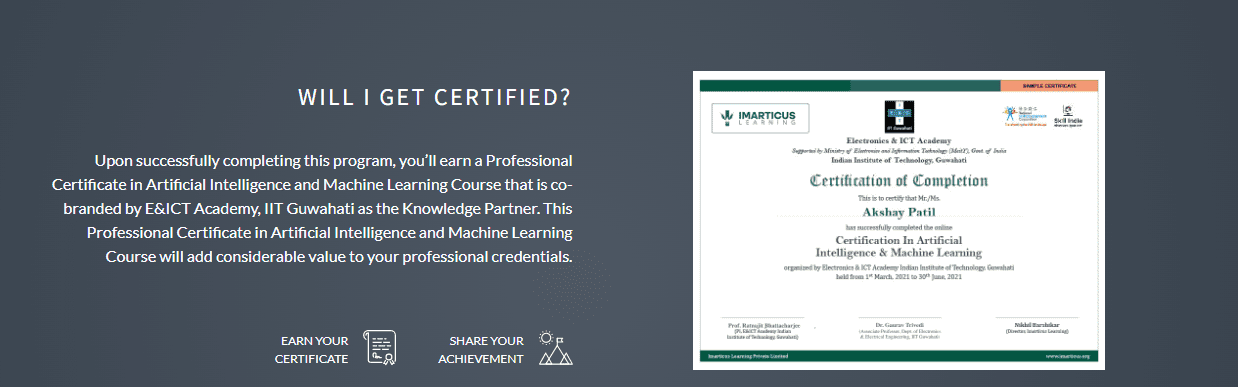
best artificial intelligence courses by E&ICT Academy, IIT GuwahatiThis program is for recent graduates and early-career professionals interested in advancing their careers in Data Science and Analytics, the most in-demand job skill.

Course Benefits for Learners:

  • Participate in 25 in-class real-world projects and case studies from corporate partners to gain machine learning capabilities.
  • This IIT AIML course will teach students the principles of data analytics and machine learning and expose them to several prominent tools used by professionals today.
  • Impress employers and demonstrate talents with an AIML course recognized by India’s most prestigious academic collaborations.


How a machine learning course will transform your resume in 2022?

An artificial intelligence (AI) technology that trains computers to learn and better itself based on experience without being explicitly designed is termed Machine learning (ML). It is a set of computer programs trained to retrieve and use data. Machine learning enables computers to observe the data and provide a result without any human intervention or observation.

Machine Learning with Python

AI is the machine intelligence that leads to the practical solution to the problem, and machine learning takes AI technologies a step further by employing algorithms to examine data, learn, and make intelligent conclusions. 

For AIML, the program developers use the programming language python because it has many libraries and frameworks to make coding easy, and it also saves time.

Thus, machine learning is all about application, and if you know python, you can grasp machine learning fast. To implement anything, you should know how to code it.

Machine Learning Course

At Imarticus, we offer you an extensive program to become a data scientist, data analyst, machine learning engineer, or AI engineer, and, by becoming analytics, you can build machines and systems that will react as humans do.

In the Data analytics certification, we will teach the technique to create a machine learning model that will accurately work to give suitable and best outcomes. We will develop your analytical abilities to choose the correct algorithm as per the model compatibility and your requirement.

The first requirement of a machine learning model is data collection and its interpretation. Therefore, at Imarticus, we give you the knowledge of data manipulation, analysis, and visualization. 

As analytics, you learn to extract ideas from your team, choose proper tools, use a machine learning framework, and stay up to date with the latest development. 

The key responsibilities of analytics are:

  • Collect data, study, and then convert it into data science prototypes
  • Research for the appropriate machine learning tools and algorithm
  • Build a machine learning application that will meet the industry requirement
  • Choose the correct data and the visualization methods
  • Perform machine learning tests
  • Execute statistical analysis from the test results.
  • Set the model for accurate results

Machine Learning Resume

Your resume is your introduction and first impression for recruiters, but writing perfect codes and preparing a good model may not get you your dream job. You have to delve deeper.

Furthermore, if you want to survive in the job market, you should not only have the skills, but you should also know how to endorse these skills to your name. Furthermore, you should have an exceptional and organized resume. Hence, you must include the following points in your resume:

  • You are a certified machine learning engineer
  • Briefly mention your projects and your contribution
  • Describe your work experience in one-liner points
  • List down every information in reverse chronological format
  • Prepare a summary of your resume while highlighting your contributions

 Machine learning has a promising future, and these professionals are high in demand. At Imarticus, we know this so, the expert mentors will give you a practical understanding of AIML. They will help you to develop skills to unlock lucrative career opportunities. 

A Complete Guide On How To Approach A Machine Learning Problem For Beginners!

As beginners in machine learning, you will want to have questions answered to common problems. Questions like how to approach, how to start, which algorithm fits best, and so on.

Common problems in machine learning for beginners

Here, we will help you resolve those problems by answering common questions:

Where can you use machine learning?

You can use machine learning for problems when:

  • Automation is involved
  • Learning from data is needed
  • An estimated outcome is required
  • Need to understand pattern like user sentiments and developing recommendation systems
  • Object required to identify or detect an entity

How to solve machine learning problems?

Here are steps to solve problems in machine learning:

  • Read data from JSON and CSV
  • Identify dependent and independent variables
  • Find out if there are missing values in the data or if it is categorical
  • Apply pre-processing data methods if there are missing data to bring it in a go to go format
  • Split data in groups for testing and training for concerned purposes
  • Spilt data and fit into a suitable model and move on validating the model
  • Change parameters in the model if needed and keep up the testing
  • An optional step is to switch algorithms to get different answers to the same problem and weigh the accuracies for a better understanding – this explains the accuracy paradox
  • Visualize the results to understand where the data is headed and to explain better while representing it

What algorithm should you use?

You need to understand what labelling is to answer this. Labels are the values we need to make an estimate. This represents the Y variable, also known as the dependent variable.

Here is a small example to help you understand this:

if

dependent_variable_exists==True:

supervised learning()

else:

unsupervised learning()

Machine Learning CourseWhile you’re learning from a machine learning course, you will understand that your supervision and training refers to supervised learning. This means that the results need to be compared by a frame. The frame here is the dependent variable. However, there is no reference for frame under unsupervised learning, which is why the name.

It is time to figure out how algorithms are served. However, it is essential to note that this is a generalized approach. The situations can differ, and so will be the usage of algorithms:

  • Numeric data for linear regression
  • Logistic regression when the variable is binary
  • Multiple category classification through a linear discriminant approach
  • Decision Tree, Naive Bayes, KNN, and Ensembles for regression and classification

Machine Learning Course

As you grow in your machine learning career, you will learn how to take random XG boost, forest, Adaboost, among other algorithms for ensembles. You can try these for both regression and classification.

Ensembles, as the name goes, refer to a group of at least two classifiers or regressors. Moreover, it doesn’t matter if it is the same or if working towards the same goals.

Building visualizations

Here are some of the things to remember when visualizing reports:

  • You can show class clustering with a scatter plot
  • Avoid scatter plot if there are several data points
  • Class comparisons can be explained through histogram
  • Creating pie charts help comparative breakdown
  • Line charts can help analyze reports with frequent deviations like stocks

If a scatter plot has too many data points, it will look clumsy. It will not be a presentable representation to show stakeholders. In such cases, you should use scatter charts.

Final thoughts

These points will help a beginner in machine learning career to become more aware of how to solve problems. You now know the essential things to do and things to avoid to get accurate results.

Developing digital health care solutions with an artificial intelligence and machine learning course

In the current times, digitization is seen in every sector, and healthcare organizations are not far behind. Artificial intelligence with machine learning and algorithms is the newest aspect of the technological developments that can help to automate various processes.

If you are interested in implementing AI in healthcare, you can opt for Imarticus Learning’s artificial intelligence and machine learning course. The course includes relevant use of technology across industries, including healthcare. 

How to Implement Artificial Intelligence and Machine Learning in Healthcare? 

Artificial intelligence has various roles in the healthcare industry. If you choose to get an artificial intelligence certification, you will learn more about the following aspects. 


  • Prediction of Treatments


Artificial intelligence and machine learning can be implemented for the accurate analysis of patient information. AI solutions can analyse medical conditions and help doctors arrive at accurate treatment plans that will be beneficial to the patients. While reviewing all medical information is necessary for correct diagnosis, doing so manually increases workload and may even lead to errors. Artificial intelligence and machine learning can automate specific processes and ensure error-free treatment plans. 


  • Improvement of Workflow


From the IT infrastructure in healthcare organizations to diagnostic tasks, workflows can be automated and optimized. This will improve business processes and ensure better outcomes. All organizational tasks will be seamless and less time-consuming. 


  • Detection of Anomalies


Most healthcare organizations include digital databases and rely on workflow automation. While AI can assist in automation, it can also monitor the entire system. Failure of systems in any industry leads to loss, however, in the healthcare industry, anomalies can lead to loss of lives and not just revenue. Therefore, it is important to use artificial intelligence and machine learning tools to detect gaps within the system so that professionals can take better precautions. 


  • Introduction of Opportunities for Clinical Trials


While artificial intelligence solutions are capable of predicting treatment plans through a thorough analysis of symptoms, they can also assist in clinical trials. Artificial intelligence can be used to determine if certain patients are suitable candidates for trials. Such solutions can also help doctors predict patient responses to trials. AI and machine learning create space for safer clinical trials by ensuring that patients can withstand treatments. 

How Can Imarticus Learning’s Al ML Course Prepare You for a Career in Healthcare? 

If you wish to enter the healthcare sector and work in the digitization of healthcare solutions, then Imarticus Learning’s Certification in Artificial Intelligence & Machine Learning is a great option. Our course is in collaboration with E&ICT Academy and IIT Guwahati. So, you will have access to lectures and curricula designed by renowned academicians and industry professionals.

At Imarticus Learning, we ensure that the IIT AI ML course prepares students for a long and rewarding career in data science and machine learning engineering. You will be attending live sessions for eight hours every week and we encourage you to interact with all teachers and peers. Imarticus Learning creates opportunities for students to network and hones their soft skills while preparing for work in the industry.

To ensure hands-on experience, we offer twenty-five projects that are based on real business issues and more than one hundred assignments. 

The certificate course in artificial intelligence and machine learning at Imarticus Learning is ideal for students who have completed graduation in computer science, engineering, statistics, mathematics, science, or economics. If you have a minimum of 50%, you can enroll in our program and receive education and industry training from experts.

Vectors are over, hashes are the future of artificial intelligence

AI (artificial intelligence) aims to have computers capable of thinking independently. We are getting closer to achieving that goal, but there are some obstacles in the way. One problem is how computers understand language and communicate with humans. This blog post will discuss how hashes are the future of Artificial Intelligence.

What are vectors and hashes, and how do they differ?

Vectors are a mathematical structure that represents multiple values as a single entity. You can use Vectors in artificial intelligence for matrix multiplication and deep learning tasks. On the other hand, Hashes are a data structure that can store an object’s key-value pairs. You can use hashes in computer science for caching and data mining tasks.

Vectors are better for tasks that require large amounts of data, while hashes are better for jobs that require a small amount of data. For example, vectors are used in deep learning because they can handle a lot of data. Hashes are used in data mining because they can take a small amount of data.

Why are hashes becoming more popular in the world of AI development?

You can use them to teach computers about the environment around them. It’s easy for machines to see what something looks like, but it is much more difficult for them to understand how that object will act in specific scenarios without prior experience. It means hashes can provide a foundation of knowledge that AI systems can understand.

Most importantly, hashes offer a way to understand how the world works without requiring large amounts of data. It is essential because it takes multiple datasets to train neural networks for AI development, and those can be difficult to obtain in some cases.

How can hashes be used to improve the accuracy and efficiency of AI systems?

One way hashes can improve the accuracy and efficiency of AI systems is by reducing the number of dimensions in a vector space. In other words, hashes can help reduce the complexity of data while still preserving its information content. Additionally, you can use hashes as a form of error detection and correction. Incorporating checksums into hash algorithms makes it possible to detect and correct data errors without recomputing the hash.

It can be beneficial for large datasets that are difficult to process in their entirety. Finally, you can use hashes as a form of compression. By representing data as a series of hashes, it is possible to reduce the size of the data while still retaining its information content.

Explore and Learn AI with Imarticus Learning

The Artificial Intelligence certification program collaborates with the E&ICT Academy, IIT Guwahati, and industry professionals to deliver the most satisfactory learning experience for aspiring Artificial Intelligence and Machine Learning students. This curriculum will prepare students for a data scientist, Data Analyst, Machine Learning Engineer, and AI Engineer.

Course Benefits For Learners:

  • This Artificial Intelligence course will help students improve their Artificial Intelligence basic abilities.
  • Students can now take advantage of an Expert Mentorship program to learn about Artificial Intelligence and Machine Learning in a practical setting.
  • This course will assist students in gaining access to attractive professional prospects in the disciplines of Artificial Intelligence and Machine Learning.

What is Supervised learning?

Supervised Learning is a machine learning method that makes predictions based on input data. It’s one of the most popular methods for predictive analytics because you can use it to make accurate predictions and analyze trends in the data. This blog post will discuss supervised Learning and how it can help you improve your business!

What do you mean by supervised Learning?

In simple terms, it is a standard machine learning algorithm that uses labeled training data to predict the output. Supervised Learning applies predictive modeling techniques on large datasets/data streams to find patterns and relationships between features, which you can use for building accurate models.

Supervised learning algorithms are a common way to make predictions when there is data on both the input and output sides. The algorithm will learn to map the input variables to the desired output variable by using a training set of example data. You can use supervised learning algorithms in various industries and applications. 

How does it work?

Supervised Learning is an algorithm that can learn from data with answers labeled correctly. The algorithm consists of training data with several input values (x) and the corresponding desired output value (y). It then predicts the output for new inputs.

You can use supervised learning algorithms for a wide range of tasks, such as:

  • Classification: Determining the type of object an image contains, such as a cat or a dog.
  • Regression: Predicting a value, such as the price of a house or the number of calories in food.
  • Clustering: Grouping data into clusters based on similarities.

There are many different supervised learning algorithms, each with strengths and weaknesses. Popular ones include linear regression, logistic regression, support vector machines, and neural networks. Choosing the correct algorithm for your task is essential for achieving good results.

Why should you use supervised Learning to train your models?

Supervised Learning is a machine-learning method that enables us to obtain the parameters of an algorithm from labeled training data. We have a set of input and output pairs with known labels. The goal is to learn from these examples to correctly map new inputs onto their correct outputs when given previously unseen instances.

The most common example of a supervised learning problem is the classification task that labels our data with more classes. In this case, samples typically get drawn from labeled training sets, and each label corresponds to a class (or multiple disjoint classes). The critical point is that tags associated with different inputs must be read-only (immutable).

Discover AIML certification with Imarticus Learning

This Machine learning course will give students a solid grounding in the practical applications of data science by teaching them how to use these skills to solve real-world problems. This program is for graduates and early-career professionals who want to further their careers in Data Science and Analytics, the most in-demand job skill.

Course Benefit For Learner: 

  • Learn machine learning skills by participating in 25 in-class real-world projects and case studies from business partners. 
  • This machine learning course will provide students with a strong understanding of data analytics and machine learning fundamentals and introduce some popular tools used by professionals today. 
  • Impress employers & showcase skills with AIML course recognized by India’s prestigious academic collaborations.
Here’s how to create your own plagiarism checker with the help of python and machine learning

Although plagiarism is not a legal concept, the general idea behind it is rather simple. It is about unethically taking credit for someone else’s work. However, plagiarism is considered dishonest and might lead to a penalty. 

It is possible for coders to build their plagiarism checker in Python with the help of Machine Learning. Thus, it is advisable to undertake a python course to get a comprehensive idea about this programming language. 

Here, you will get an idea of creating your own plagiarism checker. Once finished, individuals can check students’ assessments to compare them with each other.  

Python Is Perfect for AI and Machine Learning

Pre-requisites

To develop this plagiarism checker, individuals will need knowledge in python and machine learning techniques like cosine similarity and word2vec.

Apart from these, developers must have sci-kit-learn installed on their devices. Hence, if anyone is not comfortable with these concepts, then they can opt for an artificial intelligence and machine learning course

Installation    

How to Analyse Text 

It is not unknown that computers only understand binary codes. So, before computation on textual data, converting text to numbers is mandatory. 

Embedding Words  

Word embedding is the process of converting texts into an array of numerical. Here, the in-built feature of sci-kit-learn will come into play. The conversion of textual data into an array of numbers follows algorithms, representing words as a position in space. 

How to recognize the similarities between the two documents? 

Here, the basic concept of dot product can be used to check the similarity between two texts by computing the cosine similarity between two vectors. 

Now, individuals need to use two sample text files to check the model. Make sure to keep these files in the same directory with the extension of .txt.

Here is a look at the project directory – 

Now, here is a look at how to build the plagiarism checker 

  • Firstly, import all necessary modules. 

Firstly, use OS Module for text files, in loading paths, and then use TfidfVectorizer for word embedding and cosine similarity to check plagiarism. 

  • Use List Comprehension for reading files. 

Here, use the idea of list comprehension for loading all path text files of the project directory as shown –

  • Use the Lambda function to compute stability and to vectorize. 

In this case, use two lambda functions, one for converting to array from text and the next one to compute the similarity between two texts. 

  • Now, vectorize textual data. 

Add this below line to vectorize files.

  • Create a function to compute similarity 

Below is the primary function to compute the similarities between two texts.

  • Final code

During compilations of the above concept, an individual will get this below script to detect plagiarism.

  • Output 

After running the above in app.py, the outcome will look as – 

But, before you create this plagiarism checker, you might need to enroll for a python course or an artificial intelligence and machine learning course, as this programming needs concepts from python and machine learning. 

But, if you are willing to take programming as a career, a machine learning certification might be ideal for you. Nevertheless, to create a plagiarism checker of your own, make sure to use the steps mentioned above to detect similarities between the two files. 

Level 1
Copyscape Premium Verification 100% passed
Grammarly Premium Score 95
Readability Score 41.5
Primary Keyword Usage Done
Secondary Keyword Usage Done
Highest Word Density  To – 5.17%
Data/Statistics Validation Date 15/12/21
Level 2
YOAST SEO Plugin Analysis 5 Green, 2 Red
Call-to-action Tone Integration NA
LSI Keyword Usage NA
Level 3
Google Featured Snippet Optimization NA
Content Camouflaging NA
Voice Search Optimization NA
Generic Text Filtration Done
Content Shelf-life NA

Tips and tricks in AI/ML with python to avoid data leakage

Data science has emerged as an essential field of work and study in recent times. Thus, a machine learning course can help interested candidates learn more and land lucrative jobs. However, it is also essential to protect data to ensure proper automation.

Now, beginner courses in machine learning and artificial intelligence only teach students to split data or feed the relevant training data to the classifier. But Imarticus Learning’s AI/ML program helps gain the necessary in-depth knowledge. 

Best Ways to Avoid Data Leakage when Using AI/ML with Python

A Python certification from a reputable institute can help one gain proper insight and learn the tricks of using AI or ML with Python. This will enable interested candidates to know about real-world data processing and help them prevent data leakage.

Following are some tips that advanced courses like an artificial intelligence course by E&ICT Academy, IIT Guwahati will teach students. 

  • No Data Preprocessing Before Train-Test Split

There will be a preprocessing method fitted on the complete dataset at times. But one should not use it before the train-test split. If this method transforms the train or test data, it can cause some problems. This will happen because the information obtained from the train set will move on to the test set after data preprocessing. 

  • Use Transform on Train and Test Sets

It is essential to understand where one can use Transform and where one needs to use fit_transform. While one can use Transform on both the train set and the test set, fit_transform cannot be used for a test set. Therefore, it is wise to choose to Transform for a test set and fit_transform for a train set. 

  • Use Pickle and Joblib Methods

The Python Pickle module serializes and deserializes an object structure. However, the Pickle module may not work if the structure is extensive with several numpy arrays. This is when one needs to use the Joblib method. The Joblib tools help to implement lightweight pipelining and transparent disk-caching. 

Following are a few more tricks that help in automation and accurate data analytics when using AI/ML with Python.

  • Utilize MAE score when working on any categorical data. It will help determine the algorithms’ efficiency as the most efficient one will have the lowest case score. 
  • Utilize available heat maps to understand which features can lead to leakage. 
  • When using a Support Vector Machine (SVM), it is crucial to scale the data and ensure that the kernel cache size is adequate. One can regularise and use shrinking parameters to avoid extended training times. 
  • With K-Means and K-Nearest Neighbour algorithms, one should use a good search engine and base all data points on similarities. The K-value should be chosen through the Elbow method, and it should be relevant. 

Learn AI/ML with Python 

A Python certification will be beneficial for those who wish to pursue a career in data science and analytics. However, it is best to choose a course that will offer advanced training. Imarticus Learning’s Certification in Artificial Intelligence & Machine Learning includes various recent and relevant topics. Apart from using AI/ML with Python, students will also get to work on business projects and use AI Deep Learning methods.

The course curriculum is industry-oriented and developed by IIT Guwahati and the E&ICT Academy. Students can interact with industry leaders, build their skills in AI and Ml through this machine learning course. This course is ideal for understanding the real-world challenges in data science and how AI/ML with Python can help provide solutions. 

The IIT artificial intelligence course from Imarticus Learning helps students become data scientists who excel in their fields of interest. The course offers holistic education in data science through live lectures and real business projects. It is therefore crucial for a rewarding job in the industry. 

Steps to create a dashboard in Tableau

If you are having trouble with the excel sheets and finding it hard to create complex formulas to deal with the data, the Data Visualisation tools such as Tableau are here for the rescue! It can help use unmanageable data into beautifully crafted interactive dashboards. Those who have Tableau certification are hot properties in the Data Analysis and Data Science fields. 

Tableau is easy to use, works faster, and is also easy to set up. The tool is available in both paid and free versions. Knowing how to operate this will be an added advantage while doing any Artificial Intelligence and Machine Learning course

Getting this software and creating a dashboard is required to get a simplified version of the raw data that you are dealing with. SO, here are the steps to create a dashboard in tableau. 

Step #1 Creating a dashboard

Download and install the Tableau software to start the process. Once it is set up, open it and click on the ‘New Dashboard’ button to create a fresh one. Give an appropriate name to this dashboard so that it is easy to identify.

Step #2 Adding sheets to the board

The next step is to bring in the excel sheets with the data that you need to work on. Drag the required sheet onto the dashboard space. Alternatively, you can also select the most relevant data from a sheet, instead of the whole sheet. 

Step #3 Add additional sheet(s)

Tableau dashboard allows adding as many sheets as required for the data analysis. The additional sheets may be added in the relevant space and can process the data on all or selected sheets, as required.  

Step #4 Customization

The next step is where you customize or filter the data as per the requirement to create an interactive dashboard. Choosing layouts, adding images or texts, navigation to move from one data to another set, etc can be done at this stage. 

Step #5 View and share the data

Once all the customization is complete, view the data in full-screen mode and see if any changes are needed. Once satisfied, you can share the dashboard with others for review and discussion. 

Why is Tableau important?

Tableau is a data simplifying tool that helps manage a vast data resource. It can easily blend with AI to make faster and smarter decisions regarding the data. It also assists in integrating the data to work directly with various models of Machine Learning. Having a Tableau certification will be an asset, especially one pursuing an IIT Artificial Intelligence course or an Artificial Intelligence and Machine Learning course. Integrating the results of data interpretation decisions made using AI and ML into visualized data using Tableau helps people understand it better. 

best artificial intelligence courses by E&ICT Academy, IIT GuwahatiTableau opens a way for qualifying and quantifying the data while also identifying any particular pattern with the missing data. It is one of the robust tools that is required while implementing the machine learning models or solutions so that the business side can also understand and visualize the analysis or predictions. 

Conclusion

While the top-rated Artificial Intelligence course by E&ICT Academy, IIT Guwahati can develop a qualified and faster data analyst, the Tableau tool helps them be smarter. The drag and drop spaces on the Tableau dashboard allow you to investigate and relate the data with the intended outcome. It can work with multiple external data resources, not just the excel sheets. In other words, a single dashboard can combine data from various sources. Here, the visualization is possible with the help of charts, graphs, maps, tables, and some advanced methods.   

best Artificial Intelligence courses by E&ICT Academy, IIT Guwahati

How long term modeling of our future energy system can be mapped with artificial intelligence and machine learning

Today, technology and sustainability are the main axes of development. To secure the planet and continue the growth of industry, we are engaged in a global energy transition. Most countries have become aware that measures must be taken to address a problem that, if not curbed, will have catastrophic consequences for the environment and, of course, for human beings themselves.

However, such a transformation requires the support of technology and, because of the enormous amount of data, artificial intelligence and machine learning courses are the basis to ensure the advancement of the energy sector. At Imarticus you can join the postgraduate program in data analytics & machine learning (AIML).

Technology as a tool

Changing the energy paradigm of the last century will be an arduous and complicated task. That is why new technologies have a lot to say as tools to facilitate evolution. The Internet of Things, machine learning, artificial intelligence, and Big Data will be key to making the processes of change as effective as possible. Massive data analysis must become a fundamental pillar for transforming how energy is generated, transmitted, and distributed.

Artificial Intelligence allows us to handle enormous quantities and analyze them logically and reasonably. About energy, in particular, we have data on meteorology, health, or the behavior of the people involved in the system: who generates electricity, who transports and distributes it, and who consumes it.

Data that, when properly analyzed, can provide a tailor-made understanding of the sector. The development and implementation of intelligent systems must not only facilitate the massive introduction of alternative energy sources but will also have the task of achieving rationalized storage of this energy, as well as providing greater flexibility for the demand, i.e. the people who use it.

Three levels of analytics can be applied: descriptive, to know what information is available and where to apply intelligence, predictive analytics, to anticipate production or demand, and prescriptive analytics. With the data, we work on predicting production, including renewable energies and demand, with the implementation of smart meters. In addition, technical and non-technical incidents, such as energy fraud, are detected. All of this is aimed at optimising the energy model, with the resulting economic and environmental benefits. We will see a huge take-off in the number of professionals who will choose to pursue a machine learning career.

Tools for the consumer

In this scenario, smart meters and internet-enabled sensors will be commonplace, which will improve our energy use while at the same time making it possible to bring costs in line with what each individual actually consumes.

Thus, machine learning will automate processes, while artificial intelligence will make it possible for devices to work automatically and learn from consumers’ habits. This will also be possible on a large scale, so that the operation of future solar or wind power plants, to give just two examples, will be more effective in a shorter space of time.

In this respect, we should note that although everyone is involved in the energy transition and awareness must start in every household, the technology will be geared towards people having little to do in terms of reducing consumption and costs.

Artificial intelligence-based models and predictions facilitate and will continue to be a major advantage in mapping energy systems. What is most surprising is that this is just one of the many applications of these technologies. If you want to contribute to the change, you can sign up for AI and ML courses by E&ICT Academy, IIT Guwahati.