
What Every Beginner Should Know About ISDA Agreements

A junior trader at a Mumbai investment firm once entered a derivatives trade without fully grasping the legal terms outlined in their ISDA agreement. When markets moved against them, the firm couldn’t unwind the position smoothly due to a clause they’d overlooked. 

The result? 

A multi-crore loss, avoidable, had they known what they were signing.

If you’re venturing into derivatives, whether in trading, operations, or legal, you can’t afford to misunderstand the ISDA framework. Your contracts aren’t just paperwork—they’re risk shields. This post gives you the clarity you need to confidently read and interpret the structure and terms of ISDA agreements.

Why ISDA Exists—and Why It Matters to You?

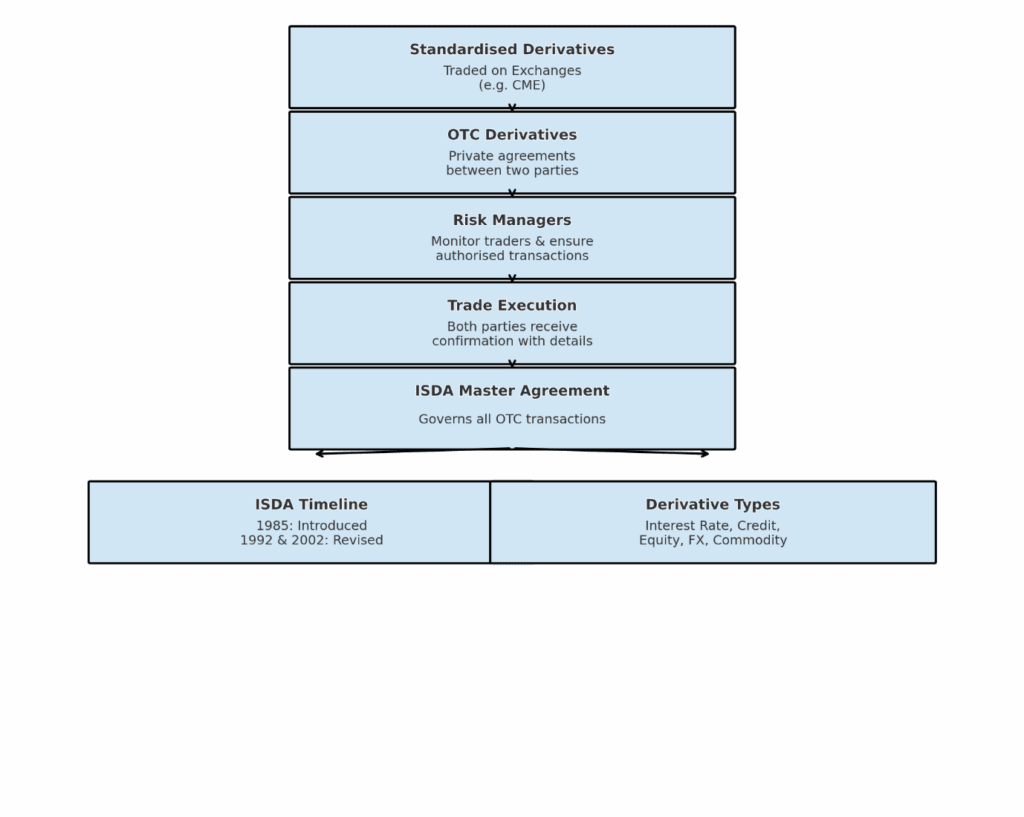
The International Swaps and Derivatives Association introduced the ISDA Master Agreement in the 1980s to standardise over-the-counter (OTC) derivatives trading. 

This framework includes the master agreement itself, a schedule, trade confirmations, definition booklets, and credit support documentation.

Today, the ISDA agreement is the go-to framework used by banks, hedge funds, insurance firms, and even sovereign entities. It governs relationships in swaps, forwards, options, and credit derivatives. If you joined investment banking courses, chances are this is one of the first legal documents you’ll study in derivatives training.
isda agreement

The original ISDA Master Agreement was introduced in 1985 to bring consistency to OTC derivatives documentation.

Types of Derivatives Covered Under ISDA Agreements

  • Interest rate derivatives
    Interest rate swaps, caps, floors, swaptions
  • Credit derivatives
    Credit default swaps
  • Equity derivatives
    Equity swaps, options, forwards
  • Foreign exchange derivatives
    Currency swaps, forwards, options
  • Commodity derivatives
    Commodity swaps, options, forwards

You don’t need to be a lawyer to understand the ISDA agreement—you just need the right roadmap.

Breaking Down the ISDA Agreement: Key Components

Let’s break down the ISDA agreement structure into core components:

1. ISDA Master Agreement (Single Contract Philosophy)

This is the backbone. It standardises terms like netting, termination events, and payment flows. It treats all transactions under one legal umbrella.

2. Schedule to the Master Agreement

This section lets parties customise clauses based on their preferences. Think of it as a ‘personalisation layer’ for risk appetite, tax considerations, or jurisdictional nuances.

3. Credit Support Annex (CSA)

The CSA governs collateral. It decides who posts margin, when, and in what form—vital for reducing counterparty risk.

4. Confirmations

Each trade has a confirmation stating the economic terms. Even if dozens of trades happen, they all fall under the single ISDA Master Agreement.

ISDA Agreement Example:

A bank and a power utility enter into an interest rate swap. The Master Agreement outlines the legal groundwork. The CSA details how collateral is exchanged based on market movements. Confirmations lock in the trade specifics. If the utility defaults, the Master Agreement governs how you can calculate losses.

You’ll come across terms like “cross-default,” “close-out netting,” and “force majeure.” Each has financial consequences if misinterpreted.

How to Interpret an ISDA Agreement in Practice

If you’re just starting out, here’s a practical guide:

Step 1: Identify Parties and Governing Law

This is usually found in the opening paragraph and the Schedule. In India, many agreements fall under English law due to global best practices.

Step 2: Understand Netting Provisions

These help determine how losses and gains across multiple trades are offset during termination.

Step 3: Check Credit Support Terms

Look at threshold amounts, eligible collateral types, and margin frequency.

Step 4: Review Termination Events

Events like bankruptcy, merger, or regulatory changes can trigger early termination. Each clause outlines how parties unwind positions.

Step 5: Study ISDA Agreement Example Templates

Online repositories or regulatory sites often provide anonymised templates. Use them as a reference to familiarise yourself with industry norms.

From Theory to Trade Desk

Many professionals treat the ISDA Master Agreement as a legal checkbox. However, the difference between a well-negotiated clause and a standard one could mean a loss buffer or a lawsuit. If you’re prepping for front-office or middle-office roles, now is the time to move from passive reading to active application.

  • Start reading real agreements. 
  • Dissect clauses. 
  • Ask your seniors how these documents played out in crisis scenarios. 

This isn’t about rote learning—it’s about strategic thinking.

 ISDA Agreement Key Elements at a Glance

ComponentPurpose / Function
Master AgreementDefines overarching legal terms for all trades
ScheduleCustomises general terms for specific counterparties
CSAOutlines collateral requirements, thresholds, and margin rules
ConfirmationsCaptures specific trade details under the master contract
Termination ProvisionsSets events and rules for early closure and valuation

Launch Your Finance Career with the Certified Investment Banking Operations Professional (CIBOP™) Programme

Imarticus Learning’s Certified Investment Banking Operations Professional (CIBOP™) programme is a career-defining choice for finance graduates with up to three years of work experience. 

Recognised as the Best Education Provider in Finance at the 30th Elets World Education Summit 2024, this investment banking course has shaped countless careers over the past decade by combining job-assured outcomes with practical, industry-aligned learning.

Through practical hands-on training delivered by experienced teaching faculty, Imarticus Learning provides students with an interactive educational movement. This investment banking course focuses intensively on skills necessary for operational roles at securities institutions, wealth management, and asset management organisations. 

Students develop an understanding of the industry dynamics through a combination of case studies, classroom exercises, projects, and interactive puzzles, which reveal how it operates. The 100% job assurance model stands as Imarticus’ differentiating factor. An integral component of this programme is at least seven exclusive meetings that connect students with premier investment banking companies. 

Students enrol in comprehensive career support activities combined with technical education at Imarticus learning, which includes soft skills instruction, along with curriculum vitae creation assistance and practice interview preparation to maximise their readiness for employment.

Enrol in the Certified Investment Banking Operations Professional (CIBOP™) programme by Imarticus Learning today and secure your future in the world of investment banking.

FAQs

Q1. What is an ISDA agreement used for?
It standardises the legal terms for over-the-counter derivatives between two parties.

Q2. How is the ISDA agreement structure organised?
It typically includes a Master Agreement, Schedule, CSA, and trade confirmations.

Q3. Can you share an ISDA agreement example?
Yes. A standard interest rate swap between a bank and corporate borrower would fall under a signed ISDA Master Agreement, with specific terms customised in the Schedule.

Q4. What does a Credit Support Annexe do?
It outlines collateral arrangements between counterparties to manage credit risk.

Q5. Is ISDA only for banks?
No. Hedge funds, corporates, insurance firms, and even government bodies use it.

Q6. Do all trades require a new agreement?
No. Once an ISDA Master Agreement is in place, you can add individual trades via confirmations.
Unlock the Secrets of ISDA Agreement in OTC Derivatives Trading

The financial term “OTC derivatives” directs people to high-level investment banking processes and complicated financial markets. Understanding this complex financial system is crucial for all individuals who need to start their career in finance, including those taking investment banking courses. 

So, what is OTC derivatives, and why is it so crucial in the world of finance?

In this blog, we’ll dive deep into the OTC trade lifecycle and the pivotal role that ISDA agreements play in ensuring that these transactions are secure and enforceable.

What is OTC derivatives?

OTC derivatives are financial agreements that connect participants who trade outside Indian exchanges, including NSE and BSE. OTC derivative contracts adapt their specifications to match individual business requirements rather than the standardised format used in exchange-traded derivative products.

Over-the-counter (OTC) trading, also known as off-exchange or pink sheet trading, takes place directly between two parties without the oversight of an exchange.

The OTC Trade Lifecycle: From Deal to Settlement

OTC trade lifecycle functions as a direct interpersonal process between trading entities who bypass exchange institutions to complete their deals.

The deal-making process becomes more specific due to OTC trading; however, the process needs thorough planning and organisation.

The steps in an OTC trade operate as follows:

1. Trade Initiation

The OTC derivative trade lifecycle launches when two parties verify their agreement to execute this type of derivative trade. The parties, which usually consist of institutional investors or banks, confirm all trade elements like assets, value, termination terms and additional specifications besides underlying conditions. 

As financial institutions act as mediators in most situations, they confirm that both trading parties possess enough funding to support their contractual agreements.

2. Confirmation and Documentation

The summary of commercial terms requires agreement between both parties, who now need to create a formal contract. The ISDA agreement provides the necessary framework during this process. 

An OTC derivatives agreement between parties requires the standardised ISDA (International Swaps and Derivatives Association) Master Agreement to establish their trading relationship. An agreement that contains details about payment terms indexes settlement decisions along with methods to manage possible default or dispute cases.

Both parties gain legal protection through the ISDA agreement, which acts as their foundation. A typical contract exists to establish expectations between parties, although this specific agreement surpasses the complexity levels of typical professional agreements. 

Understanding the complex details found within this agreement remains essential for all students taking investment banking courses as well as financial institution employees who want to understand OTC derivative operations.

3. Risk Management and Collateralisation

At this point, both traders evaluate the potential dangers associated with their transactions. A negotiation can occur where one party requests securities as collateral to reduce potential default by the counterparty.

During the global financial crisis of 2008, OTC derivatives became a direct cause of systemic financial instability because they were not properly controlled. Parties who apply collateralisation techniques throughout trade processes minimise defaults and create a pleasant experience for everyone.

4. Trade Execution and Monitoring

After risk management and terms definition, the execution of trades begins. But it doesn’t stop there. 

  • Trade monitoring must be ongoing from start to finish throughout its operating life. 
  • Derivatives are worth following market conditions because market rate changes and commodity price movement can modify their stated value.
  • OTC markets require traders to monitor each trade for months up to multiple years until its final settlement takes place. 

Some might find this aspect a bit daunting, especially as market conditions shift unpredictably, but it is also where much of the excitement in investment banking courses lies—dealing with real-time fluctuations and making split-second decisions.

5. Settlement

After the provided period, known as the maturity date, the contract resulting in the trade completes its settlement procedure. The transaction occurs after the approval of both parties involved, which leads to the exchange of agreed financial goods. 

The settlement method depends on the derivative variety between cash settlements and physical deliveries. Following settlement, both parties can terminate the trade to initiate the following business transaction.

Stage Description
1. Trade Initiation Two parties (e.g., banks or investors) agree on trade terms like assets, value, and conditions, ensuring sufficient funds for the transaction.
2. Confirmation and Documentation The parties agree on terms and create a formal contract using the ISDA Master Agreement, which outlines payment, settlement, and dispute management.
3. Risk Management and Collateralisation Both parties assess risks and may agree to use collateral to reduce default risk. This step helps prevent instability, as seen in the 2008 financial crisis.
4. Trade Execution and Monitoring After defining terms and managing risks, the trade gets executed and continuously monitored for market fluctuations, which may affect the trade’s value.
5. Settlement After the maturity date, both parties exchange financial goods via cash settlement or physical delivery, completing the trade.

The Critical Role of ISDA Agreements

The ISDA agreement plays a vital role in the OTC trade lifecycle. The contract serves as its primary organisational component through clear term definitions that provide protection during disputes.

The ISDA Master Agreement, issued by the International Swaps and Derivatives Association, is the most widely used master service agreement for OTC derivatives transactions globally.

The agreement determines the payment calculation methods in addition to default protocol and termination terms. Complex trades such as OTC derivatives would become similar to house construction without a blueprint if parties lacked this standard framework.

One of the most important sections of an ISDA agreement is the Credit Support Annex (CSA). The document details the entire process of collateral management during the trade lifespan. Both parties protect themselves against failed contractual obligations through the CSA agreement.

Why Understanding ISDA Agreements is Crucial for Investment Banking Courses

The market requires more than market intelligence since investment banking demands a thorough comprehension of its driving mechanisms. 

  • The ISDA agreement and the OTC trade lifecycle are two such mechanisms. 
  • For anyone pursuing investment banking roles, knowledge about these concepts needs to be absolute. 
  • Studying an investment banking course will show you the process of executing such trades and provide training for analysing corresponding risks. 
  • The world of finances goes beyond numerical operations because it consists of how well you can manage agreements by building relationships while possessing the capability to handle uncertain market movements.

As you venture further into your journey within the world of finance, remember that understanding the OTC trade lifecycle and the ISDA agreement is more than just academic knowledge. The process requires mastery of skills that help people operate in genuine financial market settings.

Whether you’re interested in investment banking courses or working directly in financial institutions, mastering these concepts is a key differentiator. Understand the trade lifecycle together with financial law frameworks to gain superiority in the OTC derivatives market.

Transform Your Career with the Certified Investment Banking Operations Professional (CIBOP™) Course

The world of investment banking is open to finance graduates who possess 0-3 years of work experience. Success becomes attainable through the Certified Investment Banking Operations Professional (CIBOP™) course designed at Imarticus Learning. With a placement rate of 85%, graduates of this course secure roles with salaries of up to 9 LPA.

The professional course at our institution has educated finance specialists for ten years through flexible durations, which range from three months to six months. Industry professionals created this CIBOP course to deliver fundamental skills essential for outperforming other candidates in investment banking competition. Through this programme, you will understand practical business situations, which will help you stand out from other candidates in your industry.

Choosing a career path will match your future professional goals depending on market-based Industry needs. The 30th Elets World Education Summit 2024 named Imarticus Learning as the Best Education Provider in Finance while the institution focuses on delivering students’ experience beyond their certification needs.

Join Imarticus Learning’s CIBOP™ course and unlock the door to new career opportunities!

FAQ

  • What is an ISDA Agreement, and why is it important in OTC derivatives trading?

The derivatives market utilises standard contracts known as ISDA (International Swaps and Derivatives Association) Agreements. This contract establishes trade conditions to handle business risks while ensuring legal definition for OTC derivative market activities.

  • What is OTC derivatives, and how do they work?

Two different parties conduct OTC derivative trades through direct agreements without participation in formal exchanges. These products exist as specific versions that traders use to protect their financial interests in the markets for speculation or risk management.

  • How does the OTC trade lifecycle work from initiation to settlement?

The OTC trade lifecycle refers to the series of steps involved in an over-the-counter trade. The workflow for OTC derivatives consists of trade initiation followed by execution until capture and enrichment steps which are then verified and settled to complete the deal process.

  • Why are investment banking courses important for understanding OTC derivatives?

Investment banking courses teach the complexities of OTC derivatives, including their structure, risks, and lifecycle. Professional financial understanding of these instruments allows personnel to make better decisions for their portfolio management and transaction execution.

  • What functions do investment bankers fulfil within the OTC derivatives markets?

Financial markets experience influence from OTC derivatives through their ability to create specific risk management tools. The lack of exchange trade poses systemic risks to OTC derivatives unless their management remains under proper control.