Feeling stuck in a finance job that doesn’t challenge you? Want more than spreadsheets and month-end reports? You’re not alone. Many finance professionals in India are realising the gap between what they do now and where they want to be.
That’s where the FRM certification comes in. This isn’t just another line on your CV; it’s a ticket to high-stakes roles, real strategy, and international credibility. This blog walks you through why FRM matters, what it gives back, and how it opens serious financial risk career opportunities.
What Makes FRM Certification So Relevant Today?
If you’re in finance and aiming for roles beyond accounting and reporting, you need a better skill set. FRM certification fills that space. It teaches you how to manage risk, make better decisions, and understand what influences markets and business value.
The Financial Risk Manager is a professional designation issued by GARP that is considered equivalent to a Master’s degree. It stands as one of the leading certifications for financial risk professionals, alongside the PRM offered by the Professional Risk Managers’ International Association.
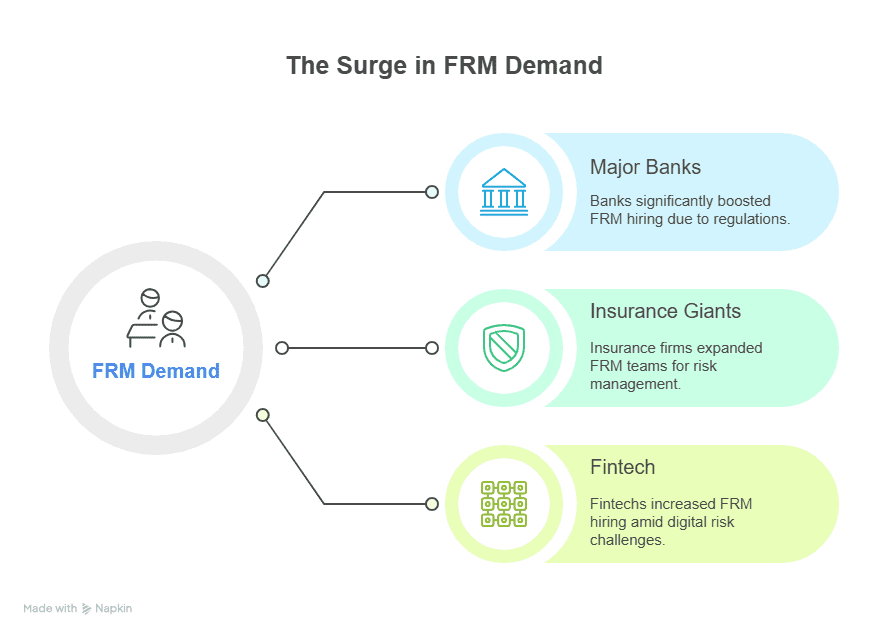
In India, financial institutions now focus more on risk than ever. Banks, insurance firms, and fintech companies need people who can evaluate credit, operational, and market risks. The traditional MBA doesn’t fully prepare you for this. However, advanced risk management training under FRM does.
With growing attention on financial compliance, even CFOs look for support from FRM holders. The reason? FRM-certified professionals don’t just point out risks; they give context and direction. That’s strategy.
How FRM Opens Financial Risk Career Opportunities in India
Risk isn’t just a buzzword anymore. It’s a department. A career path. And FRM makes it accessible.
In India, firms are building entire teams around risk. These aren’t side jobs. They’re core business units. Having an FRM certification gets you noticed. Roles like risk analyst, compliance manager, credit risk consultant, and even chief risk officer are all possible.
The FRM Part I pass rate typically averages around 44%, while the Part II pass rate remains steady at about 56%. GARP doesn’t publish a fixed passing score. Instead, it applies a relative scoring system, comparing your performance with that of other candidates taking the same exam. You don’t need a perfect score, just a better result than most.
It also helps that international companies outsourcing financial services to India trust the FRM syllabus. If you want a job at a global investment bank or a major audit firm, this certificate signals you’ve got what they’re looking for.
FRM global recognition is high. Companies like HSBC, JP Morgan, and BlackRock know it well.
The Skill Gap: Why Advanced Risk Management Training Matters
Most finance grads know how to prepare reports, balance sheets, or ledgers. But when asked what could go wrong with an investment, they guess. That’s where training comes in.
FRM doesn’t just test definitions. It teaches methods. How to model risk. How to read trends. How to question assumptions. This is the kind of practical knowledge that helps you stand out in interviews. You’re showing them how you think, and that’s leadership material.
How FRM Certification Drives Risk Analyst Career Growth
Let’s break it down with a quick comparison:
Position
With FRM Certification
Without FRM Certification
Entry-Level Analyst
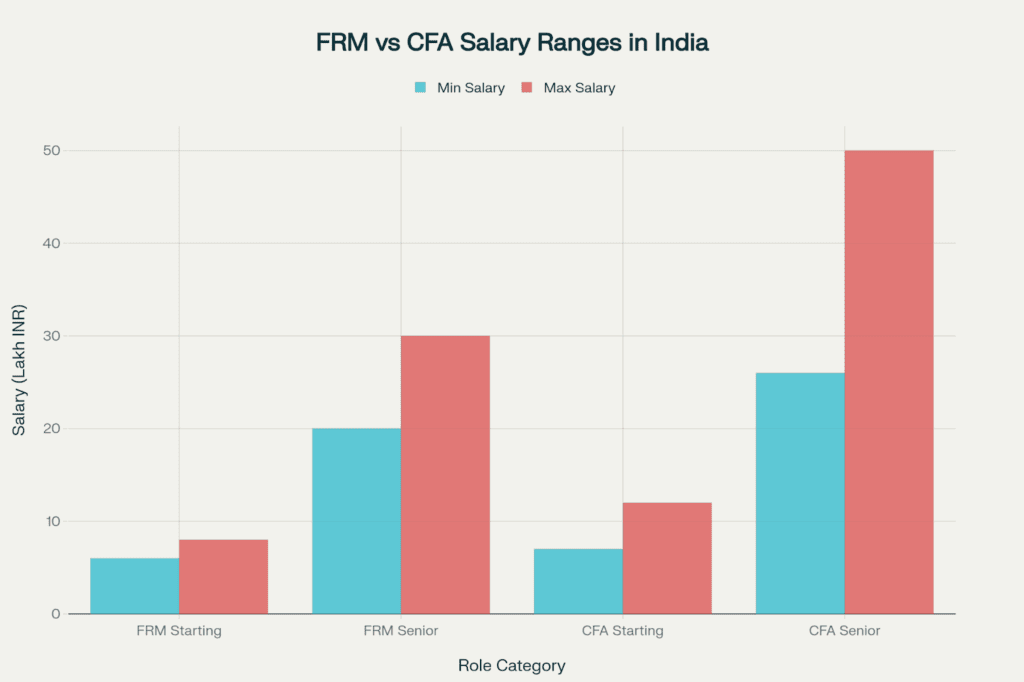
₹6–8 LPA
₹4–5 LPA
Mid-Level Risk Manager
₹15–22 LPA
₹10–14 LPA
Senior Risk Strategist
₹30–45 LPA
₹20–28 LPA
Promotion Timeline
Faster (1–2 years)
Slower (3–5 years)
This difference is clear across banking, insurance, consulting, and even startups. Risk is part of every finance job now, and those who understand it get ahead.
Also, once you’re certified, you’re part of a global network. Hiring managers trust the badge. And the conversations you have during interviews or meetings change. You’re seen as an expert, not just another candidate.
Why FRM Global Recognition Makes a Difference
Let’s not ignore the obvious, certifications are only as strong as their brand. And FRM holds weight.
Unlike many domestic finance courses, FRM is well respected by employers in India, the UK, the US, Singapore, and the Middle East. So if you want to work overseas or with MNCs, it becomes your asset.
It shows you’ve studied global risk frameworks, not just local ones. That’s useful whether you’re advising on derivatives, setting limits, or reporting to regulators.
The brand alone gives you more responses on LinkedIn and more calls from HR. Simple but true.
The Role of FRM in Finance Leadership Certifications
A manager who only knows how to approve a budget. Modern finance heads need to see around corners.
That’s where risk strategy plays a role. FRM teaches you that risk is not about avoiding loss. It’s about making smart decisions with full information.
So, it’s no surprise that CFOs, COOs, and Directors increasingly come from risk backgrounds. FRM is no longer seen as a niche. It’s seen as essential.
If you plan to lead someday, this is the kind of training that gives you the thinking, not just the title.
FRM Certification Journey: What to Expect
Getting finance leadership certifications isn’t easy, but it’s worth it.
Two levels of exams
Topics include market risk, credit risk, liquidity risk, operational risk, and ethics.
Global pass rates between 40–50%
Flexible study paths (self-study, coaching)
Practical examples, real business cases
It takes 1–2 years if you stay consistent. But most people say it changed their thinking completely.
It’s not just about the test. It’s about how you see risk, growth, and finance differently after going through it.
Master Financial Risk Management with the Globally Respected FRM® Certification
At Imarticus Learning, we help you master the FRM® curriculum with industry-focused, expert-led training. Whether aiming for a role in investment banking, risk strategy, or corporate finance, this programme equips you with the knowledge, confidence, and exam-ready skills to succeed.
With our FRM course,
Understand core principles of financial risk management
Develop real-world problem-solving skills
Gain access to global-level resources trusted by professionals
Get the support and structure needed to pass with confidence
Build a finance career that spans across 190 countries
Join a global network of 90,000+ certified FRM professionals
Work in finance, investments, and risk management
Unlock high-impact roles at Big Four firms and top MNCs
Apply for the FRM® course at Imarticus Learning and take control of your future in finance.
FAQ
What financial risk career opportunities open up after FRM? You can apply for roles like risk analyst, compliance manager, or credit risk consultant in both Indian and international firms.
How does advanced risk management training under FRM help me? It builds your skills in credit risk, market trends, and real-time risk control, which makes you more useful and respected at work.
Is FRM global recognition really that strong? Yes, firms across the world trust it. That means more interviews, better responses from HR, and stronger CV performance.
What’s the risk analyst career growth with FRM? Growth is quicker. You earn more, move faster, and can even reach leadership in risk teams.
Is FRM a finance leadership certification? Yes. It’s not just for analysts. Even directors and CFOs pursue FRM for deeper strategy training.
Can I clear FRM while working full-time? Yes. It’s built for working professionals. Just plan well and study regularly.
Do Indian firms hire FRM holders? Absolutely. From ICICI to global firms like KPMG, the demand is steady.
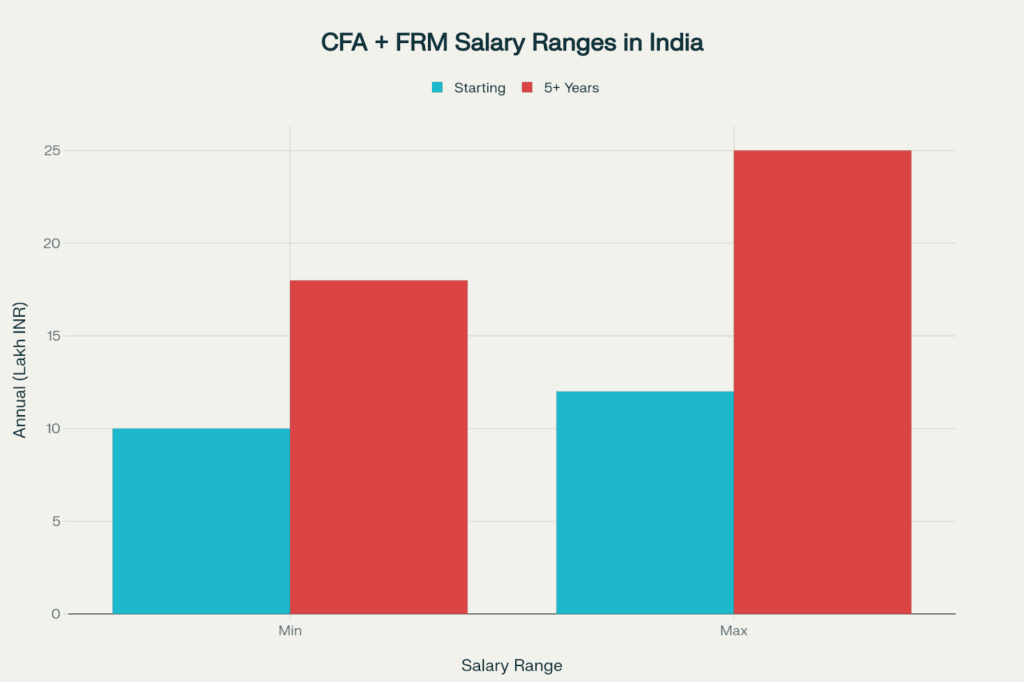
Does FRM replace a CFA or MBA? No, but it can boost your profile alongside them, especially if you’re focused on risk and strategy.
Conclusion
The Indian finance space is evolving fast. And the people leading the change are not just number crunchers, Financial risk career opportunities, they’re risk thinkers.
FRM certification gives you the edge. It proves you are ready for bigger decisions, higher roles, and global conversations.
Are you struggling to stand out in finance roles amid tightening regulations and market turbulence?
Markets are becoming increasingly volatile, and regulation is ramping up, and those working in traditional areas of finance no longer pass muster. You should have sharper tools, and they should demonstrate that you can manage complex risk. A Financial Risk Management course teaches you to do just that.
It develops what international employers need and prepares you to take up leadership positions with ease in the specialised world. Designed for those who want to work in investment banks, multinational companies, or strategic finance teams, this course will put you on the correct path.
Why You Should Consider a Financial Risk Management Course
Financial risk management means protecting a firm’s economic value by actively managing its exposure to financial risks, mainly credit and market risks, along with certain types of operational risk.
A Financial risk management course equips you with a deep understanding of market, credit, & operational risks. You learn to measure risk with real data, create models, and recommend actions. Employers look for expertise that reduces losses and ensures compliance.
When you invest time, you see FRM certification benefits in your resume.
It shows you can handle complexity. It helps you stand out from others.
It opens career opportunities in risk management. You gain finance risk analysis skills that pay off across sectors.
You earn a well‑recognised credential that signals your ability.
Many risk professionals report noticeable income progression after certification.
They grow into roles such as risk analyst, risk manager, and chief risk officer.
They gain access to opportunities in banking, asset management, and corporate finance.
Employers soon recognise your credentials.
As you complete a Financial risk management course and pass the FRM exams, you enhance your professional gravitas. This leads to faster promotion and more responsibility. It reflects real risk management professional growth.
Career Opportunities in Risk Management
A Financial risk management course leads to multiple job roles. You can join as a risk analyst in investment banks, then move into credit risk or market risk teams. With experience, you may take up risk management roles in corporations or consultancy firms. Higher levels lead to senior risk manager or chief risk officer positions.
Risk is no longer just a support function. It drives strategic decisions. With such a course and certification, you command respect. You tap into career opportunities in risk management that span industries. You sharpen your finance risk analysis skills. You embrace Advanced finance certifications that enhance your standing.
Typical Salary Growth Path (India)
As of July 2025, the FRM salary in India ranges between ₹ 2 lakhs and ₹5.5 lakhs per year for professionals with up to 10 years of experience.
Role
Years Experience
Approx Annual Salary
Key Skill from Course
Risk Analyst
0–2 years
₹7–12 lakh
Finance risk analysis skills
Mid‑level Risk Manager
3–7 years
₹13–25 lakh
Advanced risk models, reporting
Senior Risk Manager / CRO
8+ years
₹26–50+ lakh
Strategic decision making, risk leadership
This table shows career growth and how a Financial Risk Management course sharpens your skills at each stage. It highlights FRM certification benefits and professional growth in risk management.
How You Build Finance Risk Analysis Skills
You begin with foundational theory. The course then dives into credit portfolio modelling, market volatility, and value‑at‑risk techniques. You complete real case studies and use software tools and create risk reports. You learn stress testing and scenario analysis.
You gain finance risk analysis skills hands‑on. Each module adds depth and builds intuition. Therefore, you become confident in presenting findings to stakeholders. That confidence fuels career opportunities in risk management.
Connecting Course Learning to Real‑World Challenges
When markets swing or credit markets tighten, companies rely on risk‑trained professionals. With a Financial risk management course, you anticipate risks before they escalate. You inform decision makers and support policy updates. You back strategic moves with data.
Other certifications include CFA or FRM’s peers. The Financial Risk Management course stands out because it specialises in risk. You focus on real‑time threats and mitigation. You gain abilities that employers value when markets slip. You shift quickly into risk‑focused jobs.
You see risk management professional growth faster in comparison. The course gives practical training and exam credentials. You learn deeper than an MBA’s risk module. You stand out as an expert. You command better career opportunities in risk management.
How to Maximise Your Learning from the Course
You track events that show credit failures or market shocks. You reflect on performance after mock exams. You adjust study tactics. You strengthen weaker areas. You build resilience.
You bridge theory and practice. You make the most of the Financial Risk Management course and gain lasting FRM certification benefits.
You are not alone if you see peers doubling exam registrations over the years.
You find increasing pass rates at each exam level among Indian candidates and come across reports of rising average incomes after certification.
Surveys show that the majority report improved career progression and compensation. Indian finance professionals see strong demand for skilled risk talent. The Financial Risk Management course ties into risk management professional growth and career opportunities in risk management. It matches the market need.
Advance Your Global Career with FRM® Certification at Imarticus Learning
Imarticus Learning provides a well-organised process to passing the internationally recognised Financial Risk Manager (FRM ) certification. The qualification has opened gates in the financial sector, investments, and risk management where there are more than 90,000 FRM professionals now operating in 190 countries. FRM helps you stand out both when you want to work in multinational companies and when you want to work in the Big Four.
We put you through best-in-class training, conducted by an industry expert to make you confident and improve your problem-solving ability at Imarticus. You will know financial risk management to the core, you will have a clear idea on how to address a real risk situation on ground, how to face the FRM exam and you will not come to the exam tentatively, you will know what to expect.
Our programme has 300+hours of interactive and expert led sessions.You’ll get one-to-one mentorship and personal doubt-clearing support, so you’re never stuck or confused. We also include career services like CV building, career bootcamps, and mock interviews; making sure you’re not just exam-ready but career-ready too.
To further support your preparation, you’ll receive access to AnalystPrep, the top-rated GARP-approved learning platform. Practise with 4000+ questions and eight full-length mock exams that mirror the real test.
Enrol in the FRM® Certification Programme at Imarticus Learning today and start building the skills that global employers trust!
Know how rashmi grabbed an opportunity at Goldman Sachs after pursuing a course at Imarticus learning in this video
FAQ
1: What do I learn in a Financial Risk Management course? You learn to build finance risk analysis skills, assess and limit financial threats, and prepare for FRM certification benefits.
2: How soon do FRM certification benefits show up? Many feel the FRM certification benefits soon after passing. Employers value risk management professional growth.
3: What career opportunities in risk management follow? You can move into banking risk roles, corporate risk departments, or consulting as part of career opportunities in risk management.
4: Is it one of the Advanced finance certifications I should take? Yes. It stands among other Advanced finance certifications and shows your commitment to risk management professional growth.
5: Who should enrol in a Financial Risk Management course? Anyone working in finance, accounting, investment, or consulting can benefit. It suits both early-career professionals and experienced managers who want to specialise in risk.
6: Is the Financial Risk Management course recognised in India? Yes, the FRM certification is well recognised across Indian banks, financial institutions, and global firms with offices in India. Many recruiters specifically ask for it.
7: Do I need a finance background to start this course? While a finance background helps, it’s not a strict requirement. The course covers all key topics from the ground up, so anyone willing to put in the work can succeed.
Final Thoughts
You see that a Financial risk management course gives you measurable skills and the careers you want. You master finance risk analysis skills. You enjoy FRM certification benefits and clearer progression. You tap into career opportunities in risk management and join a community of skilled professionals.
If you want to secure your global finance path and strengthen risk leadership in Indian markets, enrolling in a Financial Risk Management course is your move.
Enrol today and grow as a risk management professional!
Tired of just running reports? Ready to be the one guiding decisions when markets shift and uncertainty hits? That’s exactly where the Financial Risk Manager (FRM) course steps in.
Offered by the GARP and recognised worldwide, the FRM program equips you to analyse, manage, and mitigate complex financial risks. Its curriculum spans quantitative methods, market and credit risk, liquidity and operational challenges, and emerging industry practices – preparing you to build risk frameworks that support real business strategy.
For professionals aiming to move beyond routine finance tasks and step into impactful, leadership-oriented roles in banks, consulting firms, and multinational organisations, FRM acts as a true career accelerator.
In this guide, we’ll break down everything you need to know about the FRM course – from eligibility and fees to career benefits and job opportunities – so you can decide if it’s the right next step for your finance career.
What is the FRM Course?
The FRM course is offered by the Global Association of Risk Professionals (GARP). It’s globally recognised. That means whether you’re in Mumbai, New York, or Singapore, your credential signals expertise in financial risk management – a language that every top-tier firm understands.
In today’s unpredictable financial landscape, FRM gives you the expertise to make smarter, more confident decisions, the kind that help organisations stay steady even when markets get volatile.
If you might be wondering what is FRM, think of the FRM Course as your toolkit for risk leadership. While traditional finance roles focus on reporting or compliance, FRM trains you to identify, assess, and mitigate risks before they turn into problems.
🎥 Before we dive in, here’s a video that breaks down everything you need to know about the FRM course – from fees and eligibility to duration and career scope.
The FRM Course Structure
The FRM isn’t just a credential; it’s a signal to employers that you’re prepared for strategic leadership. The FRM program is broken down into two parts, designed to build your knowledge from the ground up.
Part I builds foundations in quantitative methods and financial market instruments, while Part II delves into market, credit, operational and liquidity risks, as well as contemporary risk management challenges.
Part I: The Core Foundations
This is where you lay the groundwork. Imagine trying to explore a new city without a map – you’d get lost. Part I gives you the map. It focuses on quantitative methods, financial instruments, and the core concepts of risk.
Topic
Focus
Foundations
Ethics, Corporate Governance, and Core Risk Concepts
Quantitative Analysis
Statistical methods and modelling for risk
Financial Markets & Products
Understanding Derivatives, Fixed Income, and more
Valuation & Risk Models
Measuring risk with tools like VaR and stress testing
If you were equipped with Part I knowledge back during the 2008 financial crisis, you could have quantified subprime mortgage risk, understood derivatives exposure, and anticipated the ripple effects across global banks. That’s the kind of foresight FRM equips you with.
Part II: Strategic Application
Part II is where you move from theory to strategy. It’s like being fresh out of an architecture degree; the first project hits hard. It isn’t just designing – suddenly, you are juggling market swings, credit, operations, cash flow, and new challenges like ESG and cyber risks. Real-world projects are way more complex than any classroom could prepare you for.
Topic
Focus
Market Risk
Managing fluctuations in market prices
Credit Risk
Dealing with potential borrower defaults
Operational Risk
Mitigating losses from internal failures (people, processes, systems)
Liquidity & Investment Risk
Managing cash flow and investment portfolio risks
Current Industry Issues
Emerging topics like ESG, climate risk, and cyber risk
Passing the exams and documenting two years of relevant professional experience signals your readiness to lead risk initiatives rather than simply react to them. To understand how the FRM program builds your knowledge step-by-step, explore our detailed FRM Course Structure section.
Pro Tip: Specialising in emerging areas like ESG risk, climate modelling, regulatory technology, and sustainable finance further enhances your market edge. As firms prioritise these domains, FRM holders find themselves at the forefront of transformational finance roles.
Important Note: To officially get your FRM Charter, you must document two years of relevant work experience after passing both exams and within a 10-year window.
FRM Exam Details & Preparation
You can’t ace this by just skimming. The FRM exams are rigorous, but the structure is straightforward. With disciplined preparation, you can confidently clear them.
Aspect
Part I
Part II
Format
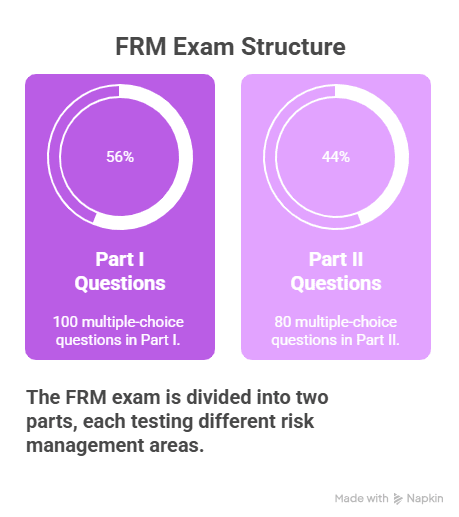
100 multiple-choice questions
80 multiple-choice questions
Duration
4 hours
4 hours
Study Time
275-300 hours recommended
275-300 hours recommended
Smart Tip: If you schedule 2 hours daily for quantitative practice and another hour for reading GARP core texts. By four months, complex probability models that initially seemed daunting become intuitive.
FRM Course Cost Breakdown
Here’s a quick overview of the FRM course fees to help you understand how the total cost is distributed across different components.
Component
Cost (USD)
Notes
Enrolment Fee
$400
One-time fee
Part I Exam Fee
$600-$800
Based on early vs. standard registration
Part II Exam Fee
$600-$800
Based on early vs. standard registration
Estimated Total
$1,600-$2,000
A small investment for a big return!
Think about it – spending $2,000 to unlock global career opportunities and leadership roles is a small price for financial freedom and professional growth.
FRM Course Pass Rates
The FRM Certification remains one of the most demanding credentials in financial risk management – official data from GARP shows that exam pass rates for Part I typically range between 40% and 50%, while for Part II they trend higher, at about 50% to 60%.
These moderate pass rates reflect the rigorous nature of the exams and why holding the FRM credential is viewed as a mark of serious competence in risk management skills.
How to Prepare for the FRM Course?
Using the right techniques can make a huge difference when it comes to acing your exams. Here are a few practical tips to help you prepare effectively for the FRM exams:
Structured Study Plan: Break the syllabus into weekly milestones with a reputable provider. Consistency beats cramming.
Mock Exams: Build stamina and timing. FRM isn’t just about knowledge – it’s about applying it under pressure.
GARP Core Readings: Don’t skip them. They’re the backbone of exam success. Supplement with trusted third-party question banks.
Real-World Application: Whenever possible, link theory to your current work. For example, use Part II frameworks to evaluate your company’s operational risks.
Why is the FRM a game-changer?
Let’s be real – the FRM isn’t just another finance certification you add to your résumé. It’s a powerful launchpad that can completely change the direction of your career. Let’s break it down:
Massive Paycheck: According to the U.S. Bureau of Labour Statistics, risk management roles and FRM holders enjoy median salaries soaring around USD 156,100 globally. For Indian finance professionals, this translates to career paths that not only elevate your earning potential but position you as a coveted expert in a field that’s gaining unprecedented strategic importance.
Job Security & Growth: Roles in financial management are expected to grow by a strong 16% through 2032. Plus, 40% of risk-management jobs require or prefer the FRM credential.
Global Elite: Join a network of 90,000+ FRM professionals operating in over 190 countries. Talk about a serious networking edge!
In-Depth Expertise: You won’t just learn buzzwords. You’ll master cutting-edge quantitative models, stress testing, and frameworks for complex risks like climate and cybersecurity.
Future is Bright: A staggering 73% of professionals expect risk management roles to increase over the next 18 months, and 85% would recommend a risk career to a peer. Optimism is high. And you need to be ready to step up!
Why Choose the FRM Course?
Let me be honest: the FRM is not for everyone. This certification is purpose-built for finance professionals who are ready to seize the leadership seat. If you’re in a finance role and feel limited by repetitive tasks, FRM can change your trajectory.
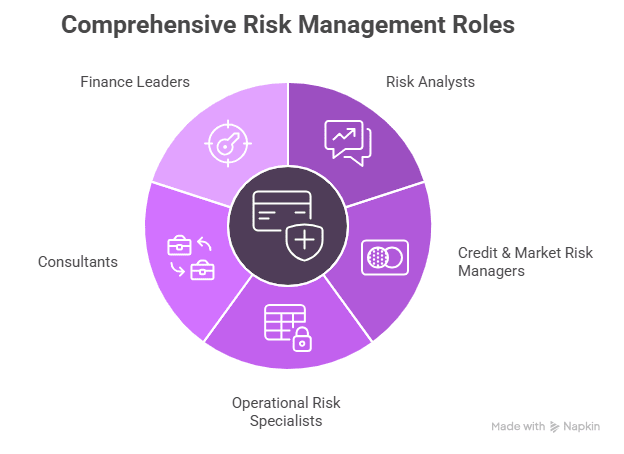
You should pursue the FRM if you are a:
Risk Analyst ready to lead projects and transition into management.
Credit & Market Risk Manager seeking the deepest, most authoritative insights.
Operational Risk Specialist looking to streamline firm-wide processes and influence enterprise strategy.
Consultant advising clients on macro-level risk and corporate resilience.
Finance Leader committed to steering a firm through market volatility and regulatory change.
Stop settling for a career of calculations. The FRM course is the definitive step to becoming an indispensable, high-earning financial strategist.
💡 Did You Know?
According to the 2025 FRM Global Practice Analysis Report, 40% of financial risk managers have responsibilities related to climate risk. 42% of financial risk managers view AI/machine learning as a key area for continuing education. 55% of financial risk managers spend at least half of their time performing risk management tasks.
Insights from the 2024 GARP Risk Careers Survey
GARP‑certified professionals are in high demand. More than 40% of survey respondents said the FRM Certification is listed as preferred or required in job postings.
Nearly 79% of survey respondents globally reported a high degree of satisfaction in their work. 73% anticipate opportunities in risk management will increase slightly or significantly over the next 18 months. 54% plan to hire more risk professionals, and 85% would recommend a risk management career to peers.
This underscores why FRM holders are in demand worldwide.
FRM Course Benefits
Imagine being the person in the room who can spot a financial storm before it hits – a professional everyone turns to for guidance when markets shift unexpectedly. That’s the kind of edge the FRM certification gives you.
Earning your FRM isn’t just about learning risk – it’s about becoming the go-to expert in a fast-moving financial world.
Top banks, investment firms, consultancies, and regulators look for professionals who can spot, analyse, and manage complex risks that others might miss.
It also opens doors to better pay – FRMs often earn 15-30% more than their peers and career paths that can take you from risk analyst all the way to chief risk officer.
With a global network of over 90,000 risk professionals across 190 countries, your opportunities aren’t limited by geography.
And with emerging areas like ESG, climate, and cyber risks shaping the future of finance, FRM helps you stay ahead, think strategically, influence decisions, and turn your expertise into real impact, reputation, and career growth.
FRM Career Path
When I first looked into the FRM course, what really grabbed my attention was how practical and career-focused it is. Unlike generic finance certifications, FRM is built to give you skills you can actually use in high-impact roles.
Here’s what you stand to gain from pursuing the FRM:
Strategic Risk Expertise: You’ll learn how to spot, measure, and manage financial risks before they become big problems. Think of it as having a financial radar for every decision your company makes.
Global Recognition: FRM is recognised in over 190 countries. Your skills aren’t just for local roles—they make you a global asset.
Leadership Readiness: FRM doesn’t just teach technical stuff. It trains you to make smarter decisions under uncertainty – a skill that sets you apart for managerial and executive roles.
Future-Proof Skills: From ESG and climate risk to AI in finance, FRM ensures your knowledge stays relevant as the industry evolves.
Networking Opportunities: You join a community of over 90,000 professionals worldwide, opening doors to mentorship, collaboration, and career growth.
Real-World Impact: Imagine being a Risk Analyst, and your bank is eyeing a new investment portfolio. FRM equips you to quantify market and credit risks, spot operational weak spots, and make recommendations that protect the firm’s bottom line – turning you into a trusted decision-maker.
But the opportunities don’t stop there. The rise of fintech and digital banking has created new roles in model risk, compliance analytics, and stress testing, where FRM knowledge gives you a powerful edge. Even consulting and tech-driven financial companies now rely on FRM-certified professionals to design robust, data-backed risk frameworks.
Whether your goal is to work with global banks or lead risk strategy for an emerging fintech, the FRM badge signals that you’re equipped to guide decisions – not just report on them.
Emerging Specialisations: ESG, AI, and Sustainable Finance
Risk management isn’t just about markets anymore. With global shifts in ESG (Environmental, Social & Governance) standards, climate risk, and AI-driven analytics, FRMs are at the forefront of defining what financial sustainability looks like.
These evolving domains are opening new, high-impact roles in green finance, climate risk assessment, and digital risk strategy – all areas where FRM knowledge gives you a clear edge.
FRM Salary in India
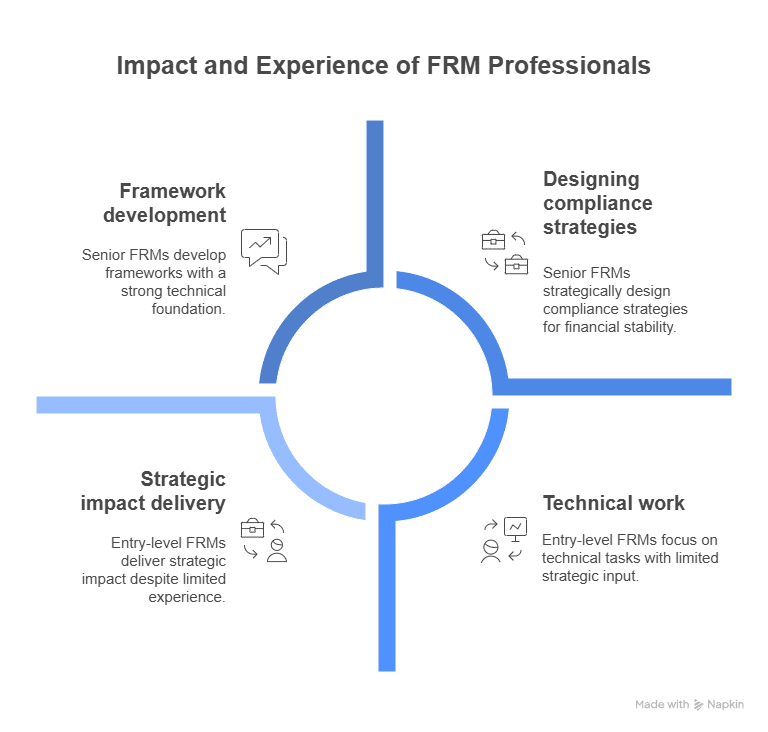
More than just a pay bump, the certification opens doors to leadership. Many professionals transition from routine finance roles to strategic positions like Risk Manager or even Head of Risk within a few years of completing their FRM journey.
Let’s talk numbers. One of the biggest motivators for taking any certification is the career upside – and FRM salary delivers.
Senior Risk Manager, Head of Risk, Chief Risk Officer (CRO)
₹30-50 LPA+
Fresh FRM-certified professionals start in analytical or junior management roles across banks, NBFCs, and consulting firms.
With experience, FRMs move into risk management and treasury functions, handling complex portfolios and regulatory reporting.
At senior positions, FRMs lead enterprise-wide risk frameworks, policy compliance, and strategic decision-making across financial institutions.
You can transition from an Analyst role at a mid-sized bank to a Senior Risk Manager position at a multinational after completing FRM. Within three years, your salary can nearly double, and you can lead a team that directly advises on strategic investments.
Globally, salaries are even more attractive than the FRM salary in India: FRM holders in the US, Singapore, and the Middle East often earn USD 100,000-180,000+, depending on experience and industry.
Why Choose Imarticus for the FRM Course?
The FRM is the smartest move for ambitious finance pros who want to lead, not just calculate. It’s in high demand, offers great pay, and equips you with future-proof expertise in a rapidly evolving financial world.
Thinking of studying FRM on your own? That’s possible – but here’s why Imarticus Learning makes it easier and more effective:
Why Choose Imarticus FRM:
Learn from Experts: Mentorship from industry pros who’ve managed risk at global banks.
Complete FRM Coverage: Structured, GARP-aligned guidance for Part I & II.
Interactive Classes: Real-time problem-solving, case studies, and doubt-clearing sessions.
Smart Progress Tracking: AI tools highlight your strengths and areas to improve.
Trusted Study Material: Kaplan resources and mock exams included.
Flexible Learning: Full-time, part-time, or hybrid options for working professionals.
Career Support: Assistance with placements at top banks and firms.
Pass & Career Guarantee: Structured coaching to get you exam-ready and job-ready.
Real-World Learning: Cases drawn from actual boardrooms, trading floors, and advisory work.
Success in FRM isn’t about cramming formulas; it’s about connecting those numbers to real situations – like understanding how a shift in interest rates ripples through bond portfolios or liquidity positions. With a clear plan, discipline, and the right training support like Imarticus’ GARP-aligned modules, most committed candidates manage to clear both parts confidently.
🎥Curious about how the FRM stacks up against other big finance certifications like ACCA, CMA, CFA, or CPA? Check out this video:
FRM Course vs CA vs CPA vs CFA vs CMA vs ACCA: Which Finance Qualification Wins?
The FRM is specialised in risk management, whereas general finance certifications like CFA or CPA focus on investments, accounting, or auditing. For professionals aiming to lead strategic decision-making in uncertain markets, FRM offers unmatched expertise and credibility.
Credential
Focus
Global Reach
Senior Salary (India)
Top Role Target
FRM
Risk Management (ESG, Credit)
Global
₹30 LPA+
Chief Risk Officer
CFA
Investment Analysis
Global
₹28 LPA+
Fund Manager
CPA
Accounting (US GAAP)
Global
₹25 LPA+
CFO
CA (India)
Accounting & Tax
India
₹20 LPA+
Domestic CFO
CMA (USA)
Management Accounting
Global
₹22 LPA+
Corporate CFO
ACCA
Global Accounting
Global
₹22 LPA+
Audit Specialist
Why FRM is the Preferred Choice?
Directly prepares you for leadership roles in risk management.
Global recognition in 190+ countries ensures career mobility.
Hands-on skills in quantitative modelling, ESG risk, climate, and AI.
High earning potential with strategic career growth.
Networking edge with 90,000+ FRM professionals worldwide.
For finance professionals looking to step into roles where decisions shape business outcomes, FRM is not just another certification – it’s a career accelerator.
FAQs About the FRM Course
If you’re considering the FRM course, you probably have a few questions. Here are a few frequently asked questions covering topics such as eligibility, exam difficulty, salaries and career opportunities related to the FRM course.
What is the FRM Course?
The FRM course, offered by the Global Association of Risk Professionals (GARP), is one of the most respected and in-demand qualifications in the finance world. It’s designed to help you truly understand how risks affect businesses and how to manage them effectively. Whether it’s market, credit, operational, or liquidity risk, FRM gives you the real-world tools to handle them confidently. In simple terms, it trains you to think like a risk expert – the kind of professional companies rely on when the markets get unpredictable.
Is FRM better than CFA?
Honestly, it depends on what you want to do in your career. The CFA is great if you’re drawn to investment analysis, portfolio management, or research. On the other hand, the FRM is all about understanding and managing financial risks – perfect if you’re interested in banking, treasury, or enterprise risk roles. They’re both valuable in their own ways. In fact, many professionals choose to pursue both, as the combination provides them a strong balance of investment knowledge and risk expertise – a real advantage in today’s financial world.
Who is eligible for the FRM course?
Anyone interested in finance or risk can register for FRM Part I. There aren’t strict eligibility rules. To actually earn the FRM Charter, though, you need to pass both Part I and II and have at least two years of relevant work experience in finance, investments, or risk management.
What are the FRM course fees?
The total cost of the FRM course typically ranges between ₹1,41,800 and 1,80,000. This covers a one-time enrollment fee plus the exam fees for both Part I and Part II. The exact cost depends on when you register – those who sign up early usually pay less. So, if you plan and register during the early window, you can save quite a bit compared to the standard registration fee set by GARP.
Is FRM tougher than an MBA?
They’re different. An MBA gives you a broad understanding of business, while FRM is highly specialised and technical. Many people find FRM more quantitative, especially in areas such as probability, statistics, and valuation models. That said, pairing an MBA with an FRM can give you an edge in strategic and technical skills.
Is the FRM Course Very Difficult?
Let’s be honest – yes, it’s challenging. GARP designed the exam to test real-world understanding, not just theory or rote learning. You’ll be diving deep into quantitative methods, risk models, and decision frameworks that push you to think like a strategist. Pass rates usually range between 40% and 60%, which tells you it’s rigorous but absolutely doable with the right approach.
Can I complete the FRM course in 1 year?
Yes! With the right plan, it’s doable. Many candidates take Part I in May and Part II in November. With consistent study and guidance from institutes like Imarticus Learning, you can complete both parts in just one year.
What is the FRM Salary?
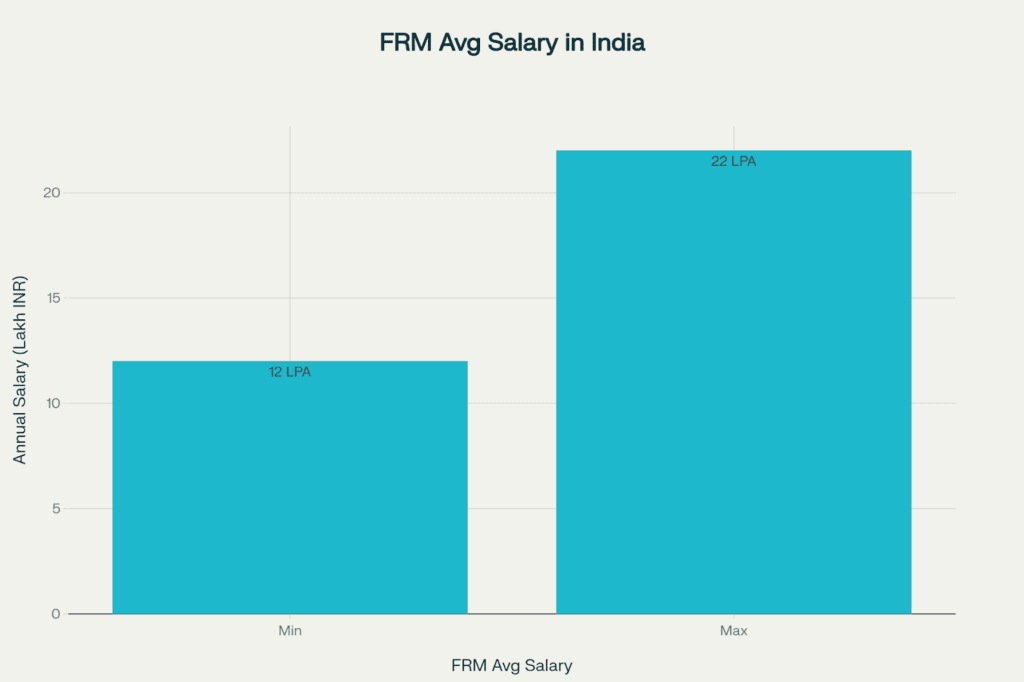
FRM-certified professionals generally start around ₹12-15 LPA in entry-level roles, often as Risk Analysts or Associates. Once you gain a few years of experience, the numbers rise quickly – mid-level professionals earn between ₹18-25 LPA, while senior roles, especially in risk leadership or treasury, cross ₹30 LPA and beyond.
Who Hires FRMs in India?
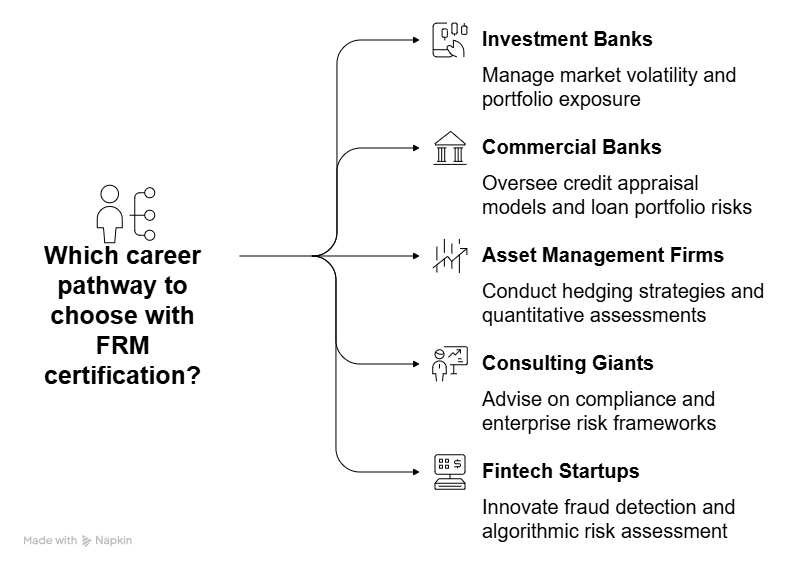
FRM professionals in India land roles at some of the biggest names in finance – HDFC, ICICI, SBI, and the Big Four consulting giants like Deloitte and KPMG. You’ll also find them steering risk at global banks like Morgan Stanley, Citi, and HSBC. But it’s not just the traditional players – fintech startups, asset managers, rating agencies, and even regulatory bodies are now actively hunting for FRM-certified talent. If you want to be the go-to person who helps firms navigate risks and make smarter decisions, getting your FRM opens doors everywhere.
Take Charge of Tomorrow’s Financial Challenges with FRM
The FRM course is your ticket to stepping out of routine finance tasks and into strategic risk leadership. The FRM isn’t just about clearing exams – it’s about truly mastering the skills to navigate real-world challenges like market volatility, credit risks, operational hiccups, and even newer threats such as ESG and cybersecurity.
It’s a globally recognised credential that earns you respect and opens doors to top banks, consulting firms, fintechs, and regulatory bodies. More than anything, it gives you the confidence and credibility to make an impact where it matters most – in key financial decisions.
Ready to lead, not just calculate? Start your FRM Course journey with Imarticus Learning, where expert mentors, GARP-aligned curriculum, smart progress tracking, and real-world case studies come together to make your success achievable. Take that decisive step towards becoming the financial strategist tomorrow’s market needs.
When you hear about the Financial Risk Manager (FRM) certification, one of the biggest questions you probably have is: What kind of salary does an FRM in India actually earn? Because let’s be honest- salary talks matter. They’re not just numbers; they symbolise career growth, recognition, and the return on investment you’re making in your education and skills.
The FRM Certification isn’t just about pay; it offers diverse opportunities across banking, asset management, fintech, and consulting, unmatched by most finance certifications.
If you’re curious about the FRM salary journey in India – how it starts, how it grows, and what top professionals are earning – this guide breaks it all down. From early-career paychecks to six-figure packages, we will explore the full picture based on real data and industry insights of the Indian finance industry.
What is FRM?
You might be wondering, What is FRM? Firstly, the FRM certification, offered by the Global Association of Risk Professionals (GARP), isn’t just a fancy line on your resume. It’s a global gold standard for risk management professionals. When you earn your FRM, you’re telling employers you understand market risk, credit risk, operational challenges, and how to manage financial uncertainty.
That specialisation makes you highly sought after, especially by banks, asset management firms, insurance companies, and consulting agencies. This demand is what pushes the salary numbers higher.
FRMs aren’t limited to one sector- they work in banking, fintech, consulting, insurance, and asset management, offering unmatched career flexibility.
When markets swing unexpectedly, FRMs are already a step ahead, running scenarios to prevent huge losses. At a fintech startup, they use their FRM skills to spot risky loans before they turn sour. A consultant dives into flawed models to fix mistakes and guide smarter decisions. Day to day, FRMs are the ones who anticipate problems, weigh risks, and keep big financial moves safe, just like having a financial safety net on a massive scale.
If you want to get a Global Finance Certification, this video will guide you in your journey.
Comparing FRM Salaries Across Career Stages
This table shows a rough overview of the salary range across various stages of FRM.
Experience Level
Typical Salary Range (INR)
Common Roles
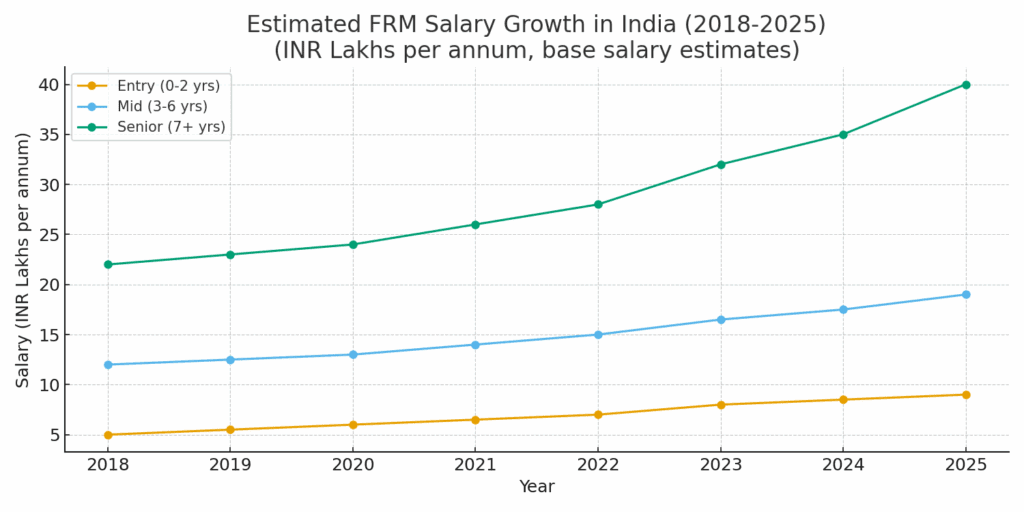
0-2 Years
₹4-7 LPA
Risk Analyst, Junior Risk Consultant
3-7 Years
₹8-15 LPA
Risk Manager, Senior Risk Analyst
8+ Years
₹20-35+ LPA
Head of Risk, CRO, Director of Risk
For highly experienced professionals with global portfolios, salaries have been recorded at or above ₹1 crore per annum, especially in multinational banks or risk consulting firms headquartered abroad.
This upward trajectory reflects not just market demand but how the FRM equips professionals to keep adding more quantifiable value year after year.
The Growing Demand for FRMs in India
The Indian financial sector is not what it was a decade ago. It is moving at a fast pace with rapid digitisation, security measures, increased compliance and regulatory requirements, and dynamic market risks have transformed how financial institutions operate. Banks, NBFCs, fintech companies, and investment firms now view risk management not as a support function but as a strategic one.
That’s where Financial Risk Managers come into play. FRMs are professionals trained to identify, measure, and mitigate risks from market and credit risks to operational and liquidity challenges. The certification, offered by the Global Association of Risk Professionals (GARP), has become the global benchmark for risk expertise.
In India alone, the surge in demand is remarkable. As financial institutions expand globally, the need for professionals who can anticipate and manage risk exposure has multiplied. According to recent GARP data and industry reports, FRM-certified professionals consistently fall within the top 15% of finance earners across roles.
Why FRM Certification Has High Salary Potential
When people talk about the FRM, they often focus on the exams – the formulas, the case studies, and the long nights spent with risk models and quantitative analysis. But what truly gives the FRM its value is what it represents to employers:
An FRM-certified professional signals the ability to think strategically under uncertainty, manage measurable risk, and align financial decision-making with long-term stability.
This combination of technical precision and business understanding is exactly what companies pay a premium for.
If you want to boost your earning potential, this video will help you choose the right career track.
FRM Salary for Freshers
For most professionals, it starts soon after passing Part I (or sometimes both parts) of the FRM exams and stepping into their first analytical or risk-related role.
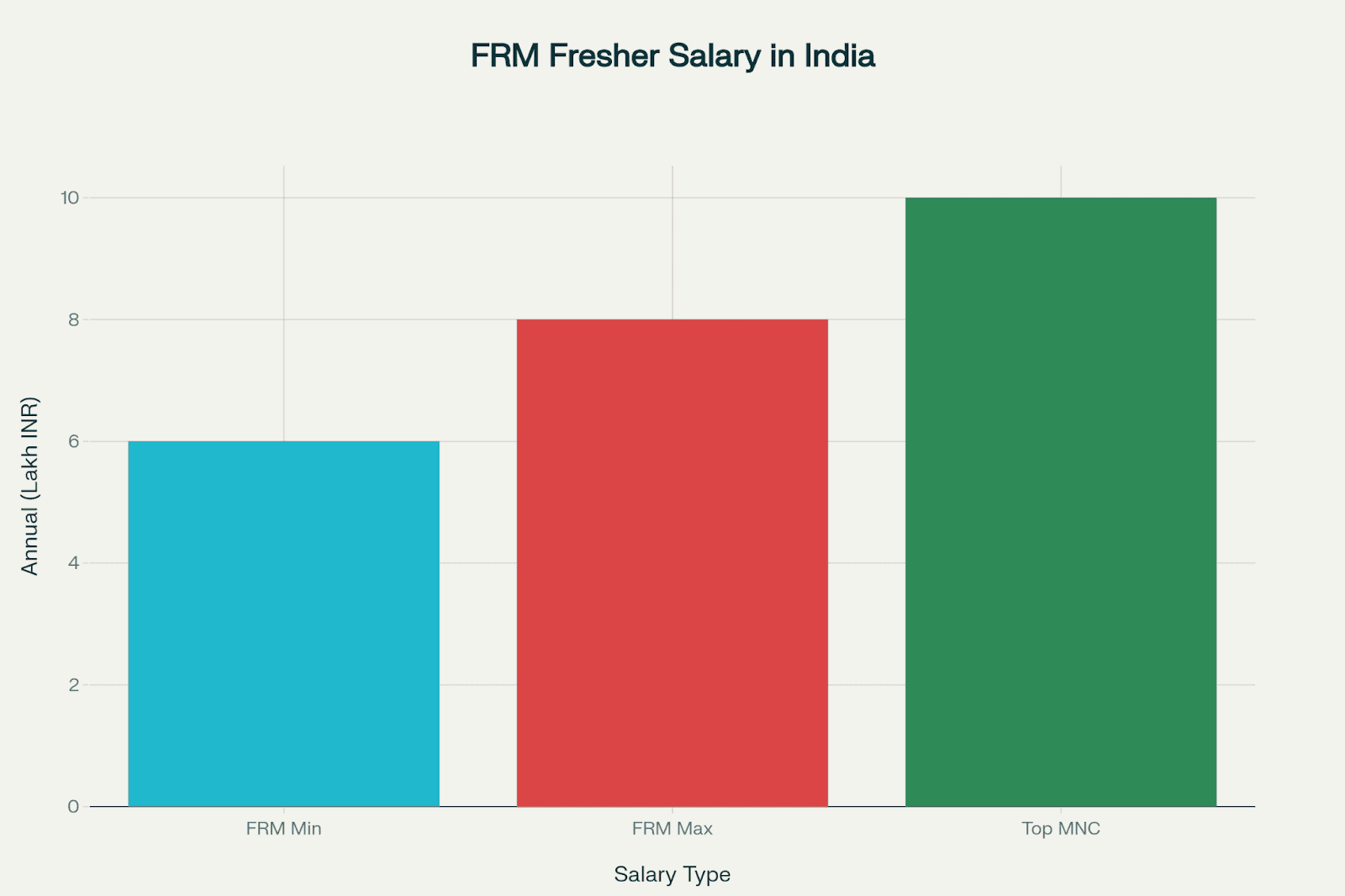
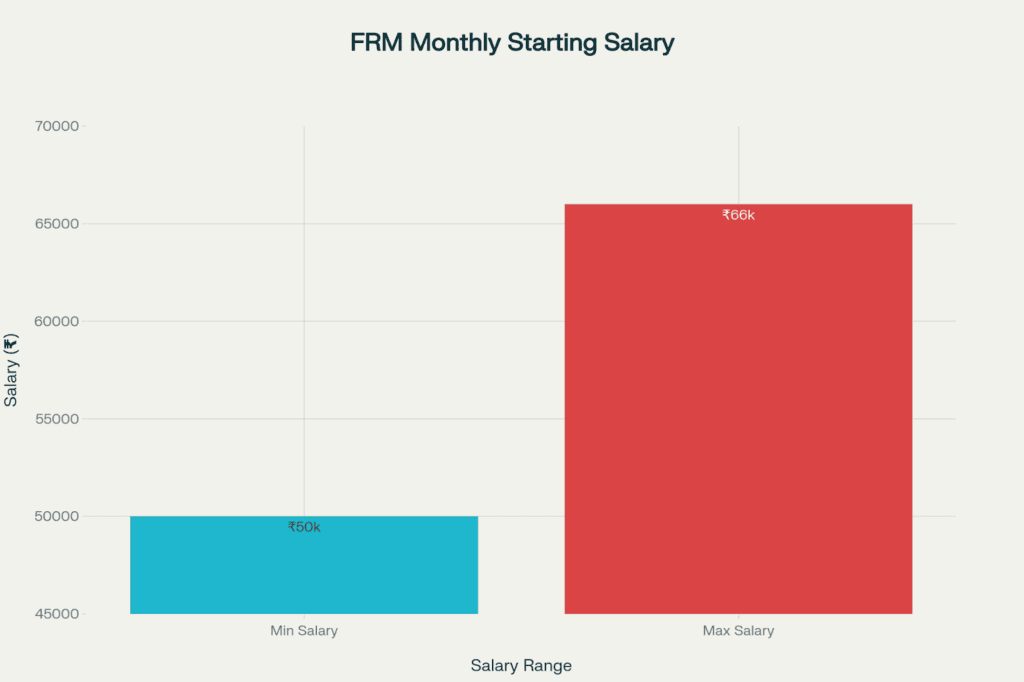
The salary range for these entry-level professionals generally falls between ₹4-7 LPA.
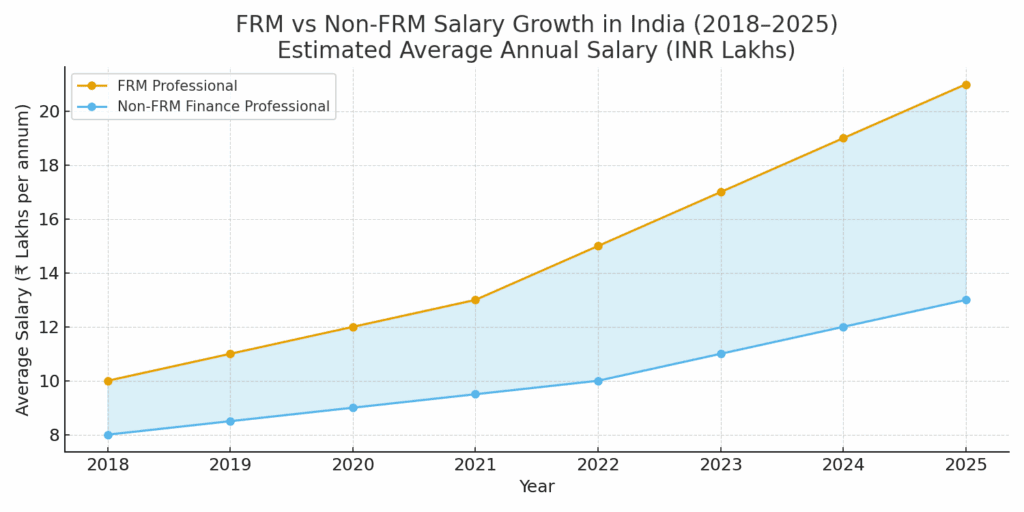
While that may sound modest at first glance, the distinction lies in what the FRM credential represents. Unlike most fresh entrants into finance or banking, FRM holders are seen as technically trained specialists, not generalists. This perception allows them to command 20-30% higher starting pay compared to their non-certified peers.
In cities like Mumbai, Bengaluru, Pune, and Delhi-NCR, where multinational financial institutions and risk consulting firms dominate, FRM freshers often receive offers on the higher end of this range.
But what really makes this stage powerful is how fast things begin to move once you start applying what you learned. The early exposure to risk analytics, data modelling, and compliance systems sets the foundation for accelerated career and salary growth.
Mid-level and Managerial FRM Salaries
Once you’ve spent a few years in the trenches – reading financial statements, building stress-testing models, running VaR simulations, and reporting risk forecasts – your value multiplies rapidly.
This phase, typically between 3-7 years of experience, is where FRMs begin to transition into roles that combine technical work with decision-making responsibilities.
The salary range for these mid-level FRMs in India generally falls between ₹8 to ₹15 LPA.
This is also the point where your compensation starts to reflect impact. Companies don’t just pay you for identifying risks – they pay you for protecting assets, anticipating losses, and building frameworks that save millions.
That’s why professionals who actively develop cross-functional skills, especially in Python, R, SQL, Power BI, or Tableau, see faster jumps. Additionally, working alongside business strategy or treasury teams exposes mid-level FRMs to decision-making layers that later qualify them for managerial positions.
One of the most rewarding aspects at this stage is recognition.
Within five years, many FRM professionals find themselves managing teams, leading compliance audits, or presenting risk analysis reports directly to CFOs or risk committees. Every such milestone justifies the upward salary climb.
Senior and Leadership-level FRM Salaries
Reaching this stage is like crossing the summit of a steep but rewarding mountain. By now, you’ve accumulated 8-15 years of experience and are often handling risk across functions, divisions, or even regional units for large enterprises.
Senior and executive-level roles often come with titles like:
The salary range at this level typically spans ₹20-35+ LPA, with certain roles – particularly in global investment banks, Big 4 consulting firms, or multinational corporations touching and even exceeding ₹50 lakhs annually.
If you’re part of international risk teams or manage compliance across regions, these numbers can cross into seven-figure salaries in global terms ($100,000+).
This phase is less about technical modelling and more about strategic leadership – guiding corporate policy, ensuring regulatory alignment, and shaping a company’s risk culture at the macro level.
What’s most notable? The FRM doesn’t just add financial value; it compounds it over time. Each stage amplifies your skill set, experience, and earning potential.
With FRM skills in risk modelling, stress testing, and forecasting, professionals stay in demand even during market downturns- job security that many other finance certifications can’t match.
Factors That Shape FRM Salary in India
Even though the certification provides a solid base, several factors influence how much an FRM earns at any stage. Understanding these helps you plan your career trajectory more strategically.
1. Industry or Sector Risk professionals earn the highest pay in banking and investment firms due to the complex demands of risk management, followed by competitive salaries in insurance and asset management for actuaries and claims risks, while consulting and fintech offer fast growth and performance-based bonuses, with smaller firms providing broader, multi-dimensional roles.
2. Company Size and Reputation Large multinational firms and global banks pay significantly more than startups or regional institutions due to the scale of their financial exposure and compliance requirements.
Mumbai leads as India’s financial capital, offering the highest pay.
Bengaluru and Delhi NCR follow closely, thanks to their corporate risk hubs.
Tier-2 cities may offer slightly lower compensation, but often balance it with a better cost of living.
4. Additional Certifications & Education Professionals who combine FRM with CFA, CPA, or MBA in Finance see stronger salary growth. Employers value multi-certified experts who can bridge investment decision-making with risk policy.
5. Skill Set Quantitative proficiency alone isn’t enough anymore. Mastery of data analytics tools, modelling software, and coding languages like Python, R, or VBA can lift salaries by up to 20–30%.
6. Soft Skills and Communication FRMs with the ability to communicate risk in business language, mentor teams, and manage stakeholders elevate compensation, especially in leadership roles.
FRM Salary Insight: India and International
FRM is a global designation, and it’s common to hear that FRMs in countries like the US, UK, or Singapore earn significantly more. While nominal earnings are indeed higher abroad, the real story lies in purchasing power parity.
The advantage here is growth at home. Indian FRMs working for global teams in domestic offices can often draw international compensation bands, especially in cities like Mumbai, Hyderabad, and Gurugram. So, even while based in India, FRMs have the potential to achieve seven-figure (in INR terms) salaries with global exposure.
Local Impact, Global Reach
Indian FRMs today are writing a new chapter in global finance- one that’s no longer limited by location, but enriched by global opportunities right here at home. While the FRM designation is recognised across continents, for professionals in India, the world is increasingly coming to them. Instead of an apples-to-apples comparison of salaries abroad, the modern FRM journey is about leveraging international opportunities and enjoying the unique advantages of India’s thriving financial sector.
What sets the Indian FRM experience apart is the ability to access international compensation bands and exposure, without leaving the country. Many multinational employers now match global pay scales for top Indian talent, especially for those in strategic roles or leading regional risk functions.
A Journey Fueled by Opportunity
For those considering the FRM credential, the most powerful narrative isn’t just about salary numbers, but about the quality of opportunities. Indian risk managers are now shaping global best practices, networking with leaders across time zones, and building careers that blend international experience with local advantages.
Risk professionals based in India increasingly work on cross-border risk mandates, participate in global strategy meetings, and manage portfolios that span continents. A ₹30 LPA salary in India can offer a lifestyle comparable to a $120,000 package in the US due to differences in the cost of living. Plus, India’s risk management ecosystem is now globally integrated. Many international investment banks and financial tech giants operate their risk control centres in India, giving professionals local access to global pay scales.
The Big Picture
Ultimately, the FRM salary story in India today is about aligning ambition with unique opportunities close to home. As financial markets integrate and global firms deepen their roots here, Indian FRMs find themselves at the centre of high-value, globally relevant roles- living the kind of career journey that past generations could only imagine.
FRMs in the US or Europe typically earn higher nominal salaries (think $100,000 and beyond).
While earning potential is a hallmark of the FRM journey, how fast you reach your goals depends largely on strategy. Here’s what consistently makes the difference for high-earning FRM professionals:
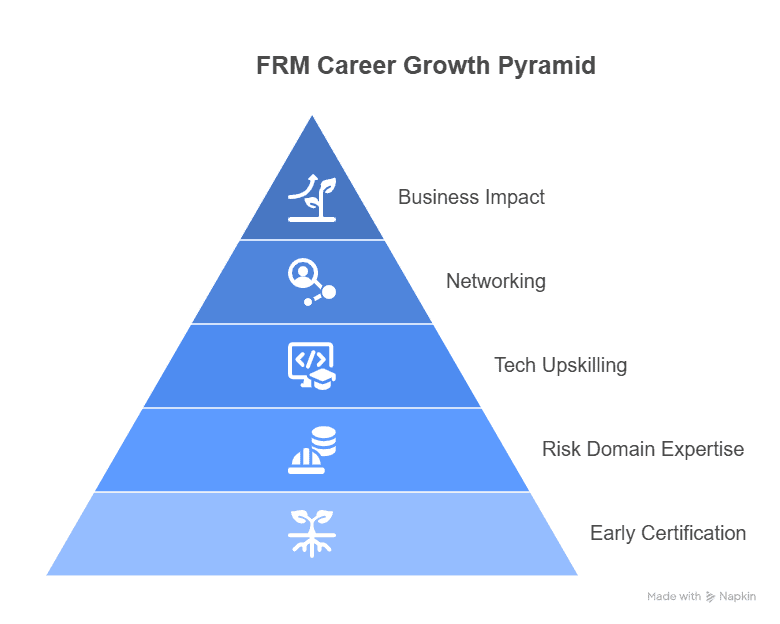
Get Certified Early Passing both FRM exam parts early lets you dedicate more energy to specialised learning, project work, and networking. The earlier you earn your designation, the faster your salary compounding begins.
Gain Diverse Experience Exposure across multiple risk domains – credit, market, liquidity, and operational- makes you versatile. Recruiters pay a premium for professionals capable of handling multi-dimensional risk mandates.
Keep Learning Continuous education in regulatory changes, data analytics, and financial modelling ensures your profile stays in demand. Upskill with AI in risk, fintech regulation, or quantitative methods.
Network Effectively Engage with the GARP community, LinkedIn groups, webinars, and industry events. Referrals and informational connections can unlock exclusive job offers that may not be publicly listed.
Demonstrate Business Impact Don’t just quantify risks, quantify outcomes. When your analysis leads to measurable profit protection or compliance cost savings, those tangible contributions justify salary hikes and promotions.
A Day in the Life of an FRM: Turning Planning into Risk Management
An FRM starts their day like most of us- planning. Just as we budget for our dream vacation by measuring all scenarios for travel, they run stress tests to see how sudden market changes could affect their firm’s investments.
When they help a fintech client design a lending algorithm, it’s like figuring out how much to spend on a wedding without going into debt- balancing opportunity with caution.
Later, reviewing risk models for a corporate client feels like checking loan options before buying a house, making sure every decision is safe and informed.
FRM skills turn the careful planning we do in daily life into strategies that protect millions, helping companies navigate uncertainty with confidence.
FRM Salaries Across Industries in India
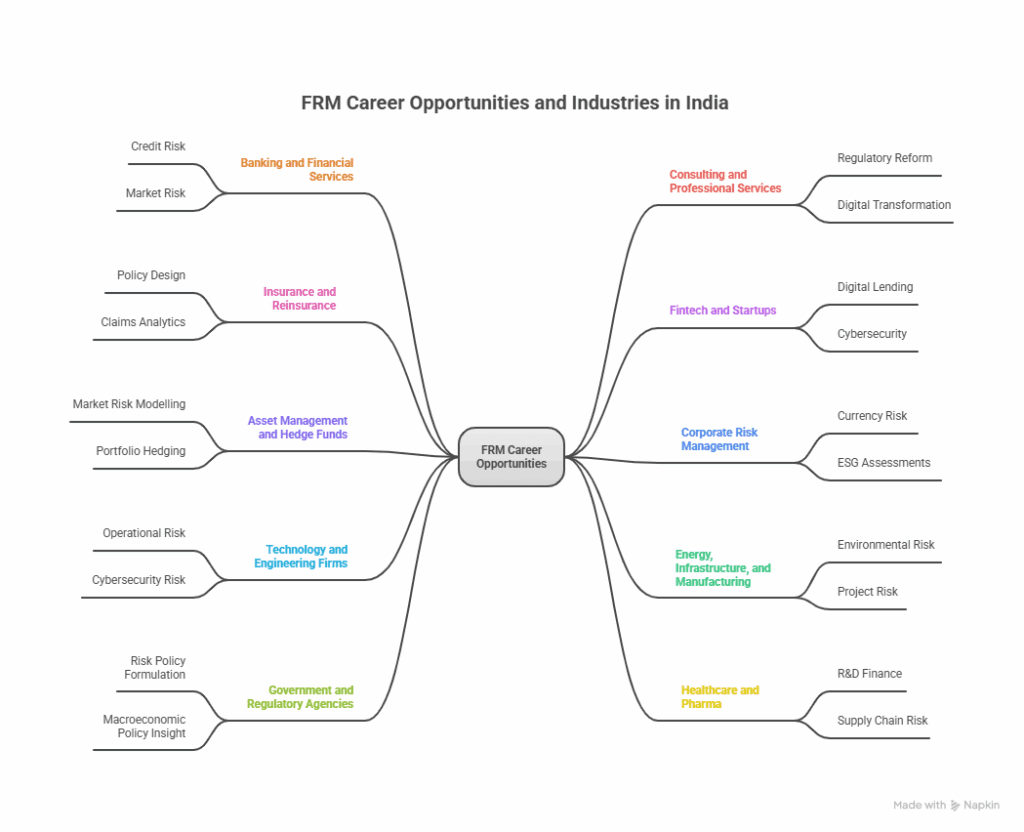
One of the most fascinating aspects of an FRM career is how versatile the certification is. From banks to fintechs, and even energy companies and regulatory agencies, risk management expertise is now indispensable everywhere. But how much do FRM-certified professionals really make across different industries?
This table shows an overview of the top employers for FRM across various industries.
Industry
Top Employers
Banking and Financial Services
HDFC Bank, ICICI Bank, Axis Bank, Kotak Mahindra, SBI, Citibank, Barclays, JP Morgan India
Consulting and Professional Services (Big 4 & Beyond)
Deloitte, KPMG, PwC, EY, McKinsey, Boston Consulting Group (BCG)
Reserve Bank of India (RBI), SEBI, NABARD, Ministry of Finance
Healthcare and Pharmaceuticals
Sun Pharma, Dr. Reddy’s, Biocon, Apollo Hospitals
The Broader View
Across all these industries, the average FRM salary in India is now approximately ₹21-22 LPA, with senior professionals easily exceeding ₹35 lakhs or more, depending on specialisation.
Career Pathways Beyond Salaries
Sure, salary is a big motivator, but the real win of being an FRM goes beyond the paycheck. Think of it this way: one year, you could be analysing credit risk for a global bank; a few years later, you might be helping a fintech startup design AI-driven risk models.
The variety ensures that as you climb the salary ladder, you’re also expanding your professional horizon in tangible, rewarding ways.
FAQs About FRM Salary
Here are a few frequently asked questions about the FRM Salary.
Can a fresher earn a decent salary after FRM?
Yes, freshers with FRM certification typically start at ₹4-7 LPA, which is competitive compared to non-certified peers.
Does FRM certification guarantee a salary hike?
While not automatic, FRM significantly enhances your profile and chances of a salary increase, especially when paired with relevant experience.
How long does it take to reach six figures as an FRM in India?
Typically, 7-10 years of experience combined with FRM certification can lead to six-figure salaries, depending on the company and role.
Is the FRM salary higher than the CFA in India?
Both certifications have value in different finance areas; FRMs generally earn more in risk management roles, while CFAs often lead in investment management. At senior levels, the salary gap between the two tends to even out.
How does location affect FRM salaries?
Location plays a big role. Major cities with a dense financial ecosystem or hubs, such as Mumbai, Bengaluru, and Delhi, likely pay 20-40% more on average than other cities due to higher corporate presence and the cost of living.
Which industries hire FRM professionals?
FRMs are in huge demand across all sectors due to globalisation and business expansions. Banks, financial institutions, asset management and hedge fund companies, insurance firms, actuarial firms, consulting agencies, fintech startups, corporate risk management, engineering companies, energy, infrastructure and manufacturing companies, government and regulatory agencies, healthcare and pharmaceutical industries, and even tech companies dealing with financial data hire FRMs in large numbers.
FRM Salary in India: Key Takeaways and Career Insights
The FRM isn’t just a credential that pays well; it’s a career multiplier that combines intellectual satisfaction with financial reward. And what’s even more inspiring is that the FRM journey aligns with India’s own economic trajectory. As financial systems evolve, the value of certified risk professionals grows exponentially.
The journey may start small, but with focus, resilience, and continual learning, it leads to something far bigger – the power to turn financial risk into professional opportunity. From the first ₹4-lakh paycheck to ₹30+ lakh leadership salaries, every stage is a step toward mastery, confidence, and influence in the financial world.
If you’re passionate about finance, analytics, and strategy, and you want a career where your decisions directly shape business outcomes, then the FRM is far more than an exam. It’s a pathway to security, respect, and six-figure success. Take charge of your career and step into the world of financial risk management. The FRM certification offers a proven path to both professional excellence and financial success.
FRM is recognised as the gold standard in risk management, with top global companies actively hiring certified professionals. In India, FRM holders command an average salary of ₹18 LPA, and with Imarticus’s program fees at just ₹90,000, the return on investment is exceptional. Beyond the financials, the certification equips you with globally relevant skills, opens doors across banking, fintech, consulting, and asset management, and positions you for leadership roles. If you’re aiming for a high-growth, high-impact career in finance, FRM is the sure-shot next step.
Finance today isn’t just about numbers on a spreadsheet; it’s about navigating uncertainty, making high-stakes decisions, and staying ahead of risks that can ripple across markets overnight. In this fast-evolving world, credibility isn’t given; it’s earned. That’s where the FRM Certification comes in. Offered by the Global Association of Risk Professionals (GARP), this designation is more than a credential; it’s a signal that you can interpret complex market behaviour, quantify risks, and guide strategic decisions with confidence.
As 2025 unfolds, the finance landscape is changing fast:
Algorithmic trading and AI-driven lending are creating new market risks
ESG and climate analytics are reshaping investment strategies
Global regulations demand smarter risk oversight
FRM-certified professionals are uniquely prepared to translate complex risk data into actionable insights. They don’t just react; they influence decisions, protect assets, and help firms stay competitive in a volatile world.
This isn’t about earning another certification. It’s about transforming how the world sees your expertise, opening doors across industries, geographies, and leadership levels, and building a career that’s truly future-proof.
In this blog, we’ll unpack together what FRM certification really means, the skills it builds, the career opportunities it unlocks, and why it’s becoming one of the most valuable finance credentials in 2025.
If I had to summarise the FRM Certification in one line, it’s the qualification that transforms how the finance world trusts your judgment.
What is the FRM Certification?
The FRM Certification is a globally recognised professional credential awarded by GARP to individuals who demonstrate deep competence in measuring, managing, and responding to financial risk. When someone asks “what is FRM?”, the simplest way to explain it is this: it’s a qualification that proves you understand how risk actually behaves in the real world, in markets, in balance sheets, in business models, and in financial systems.
Why should you pursue an FRM Certification?
Unlike many finance qualifications that lean heavily on static theory, the FRM Certification is built on how risk evolves in practice. The curriculum is shaped by real market events: liquidity crises, credit defaults, interest-rate shocks, model failures, operational breakdowns, and this makes the learning experience grounded and current.
You’re not just memorising formulas; you’re learning how risk interacts with decision-making under uncertainty.
At its core, the FRM Certification tests your ability to:
Identify risk across markets, credit portfolios, operations, and investments
Quantify it using statistical tools and model frameworks
Interpret risk outputs with judgment, not just numbers
Recommend strategies that protect profitability and long-term stability
Here’s a quick snapshot:
Parameter
Details
Credential Name
Financial Risk Manager (FRM)
Awarding Body
Global Association of Risk Professionals (GARP)
Levels
Part I and Part II
Focus Areas
Market, Credit, Operational, and Investment Risk
Recognition
Globally recognised in 190+ countries
Typical Duration
6–12 months (depending on study pace)
To get a comprehensive understanding of what the FRM course entails and what it means for your career as a financial risk professional, this quick guide would be very helpful to you:
Skills of an FRM Professional
An FRM-certified professional brings a specialised blend of analytical, technical, and strategic skills that make them indispensable in risk-focused roles.
At a glance, here’s the core skillset:
Quantitative & Statistical Analysis: Ability to interpret data, build models, and draw insights from complex financial patterns.
Risk Modelling Expertise: Proficiency in tools like VaR, stress testing, scenario analysis, and sensitivity metrics.
Financial Markets Knowledge: Deep understanding of derivatives, fixed income, structured products, and how market behaviour affects risk.
Regulatory & Compliance Awareness: Familiarity with Basel norms, global regulatory frameworks, and risk governance standards.
Problem-Solving & Decision-Making: Capacity to evaluate risk trade-offs and guide sound strategic choices.
Technical Skills: Working knowledge of Excel, Python, R, and risk engines used in large institutions.
Here is a visual that sheds light on the core skill sets an FRM or an aspiring FRM should command in order to excel in their careers:
Why FRM Certification is the Best Choice!
What makes the FRM certification the best choice in 2025 isn’t just that the demand for risk professionals is growing: it’s that the nature of finance itself has changed. The skills the FRM builds are no longer “specialised”; they are becoming core to how modern financial institutions operate.
Let’s look at what’s driving this surge in demand:
The demand for FRM-certified professionals is accelerating, driven by a mix of global and technological forces. GARP’s 2024 Global Risk Careers Survey reports that 21% of financial institutions plan to expand risk-management hiring in the next three years, signalling a clear industry shift toward specialised expertise.
As AI, algorithmic trading, and digital banking reshape financial systems, organisations urgently need talent that can decode complex data risks and emerging tech-driven vulnerabilities.
Add to that the tightening regulatory landscape under IFRS 9 and Basel III, and the FRM credential becomes even more valuable—serving as the critical link between risk data, strategic decisions, and regulatory compliance.
The world’s financial ecosystem is becoming more volatile and interconnected. Why? Because every major financial event: SVB collapse (2023), UK pension LDI crisis (2022), pandemic-driven credit shocks, all highlighted one thing:
Firms don’t just need analysts; they need people who can foresee, quantify, and mitigate risk. And that’s exactly what FRM professionals are trained to do.
Career Growth with FRM Certification
FRM certification acts like a career accelerator, especially for young professionals who want to jump from basic analyst roles into specialised, high-impact positions.
Typical FRM Career Path (India + Global)
Curious about where an FRM certification can take you? This section walks you through the typical career path for FRM professionals in India and around the world, showing how the credential can help you move from entry-level risk roles to senior leadership positions, all while keeping your career options open across banks, fintechs, consulting, and global finance firms.
Analyst → Specialist (1–3 years)
Most graduates start in generic roles: Credit Analyst, Product Analyst, or Finance Trainee. FRM helps you break out of “entry-level silos” into specialised, high-impact roles, the ones recruiters actively hunt for.
Where you move:
Market Risk Junior Analyst
Credit Policy Analyst
Liquidity Monitoring Specialist
Why the career jump happens? Because these roles require technical foundations that most analysts don’t have.
Specialist → Strategist (3–6 years)
This is the phase where FRM adds the most value. You now move into roles where you influence decisions, not just carry out analysis.
Where you move:
Risk Modelling
Stress Testing
Portfolio Risk Management
Treasury & ALM
What changes: Your work directly affects capital allocation, lending strategy, hedging decisions, and regulatory posture, increasing your FRM salary trajectory sharply.
Strategist → Leadership (7–12 years)
By this stage, firms want professionals who understand:
Risk behaviour during market cycles
Regulatory reporting
Liquidity crises
Large-scale financial systems
Where you move:
VP – Enterprise Risk
Head of Market/Credit/Operational Risk
Model Governance Lead
What changes: Your work shifts from executing analysis to shaping strategy and influencing key decisions. You start leading teams, designing risk frameworks, and advising senior management on capital allocation, regulatory compliance, and enterprise-wide risk policies.
Leadership → C-Suite (12–20 years)
FRM is one of the most common pathways to becoming a Chief Risk Officer (CRO) – a role whose importance and compensation have grown faster than almost any other in BFSI.
This top-of-the-pyramid role is becoming indispensable because every major firm now considers risk a strategic function, not a back-office one.
What changes: At the C-Suite level, your role moves from managing teams and processes to shaping the organisation’s risk culture and long-term strategy. You’re influencing board-level decisions, aligning risk with business growth, and ensuring the firm navigates uncertainty while staying compliant and profitable. Your focus is no longer on individual risks but on enterprise-wide resilience and sustainable value creation.
And yes, FRM is globally recognised. Whether you’re applying to BlackRock in London, DBS Bank in Singapore, or Kotak Mahindra in India, the FRM credential is understood and valued.
It’s not just about prestige; it’s about global employability. FRM certification aligns perfectly with the finance industry’s evolution, where data, risk, and technology converge.
Benefits of FRM Certification
One of the biggest advantages of earning the FRM certification is the range of doors it unlocks. FRM gives you a toolkit that applies across banks, consulting firms, investment companies, fintechs, NBFCs, regulatory institutions, and even global risk teams.
This is because the world of risk management touches every financial decision: credit approvals, trading desks, treasury operations, stress testing, digital lending algorithms, regulatory reporting, you name it, an FRM’s skillset is needed somewhere in the process.
Here’s how FRM professionals are positioned across industries:
Job Role
Typical Employer
Core Skills Leveraged
Risk Analyst
Banks, NBFCs
Market & Credit Risk Analytics
Treasury Manager
Asset Management Firms
Liquidity & Capital Allocation
Risk Consultant
Big 4 Consulting
Enterprise Risk Strategy
Investment Analyst
Hedge Funds
Quantitative Risk Modelling
Regulatory Advisor
Central Banks, Regulators
Policy & Compliance Risk
💡Imagine this: You start your career as a Risk Analyst at a private-sector bank. Within a year, your FRM background helps you understand how loan portfolios behave during volatile markets. That knowledge gets you picked for a special project evaluating digital lending risk, a project that puts you in meetings with senior treasury and credit teams.
A year later, the same risk skills make you a strong candidate for an investment research role at an asset management firm, where you’re now applying the same concepts to portfolio risk and factor modelling.
Same skillset, multiple career paths.
ROI after FRM Certification
When it comes to career impact, the FRM certification delivers one of the strongest payoffs in global finance. Across major financial hubs, FRM-certified professionals consistently earn 25–40% higher salaries than non-certified peers in comparable roles.
This uplift isn’t arbitrary. It stems from the FRM’s reputation for producing professionals who can navigate market volatility, regulatory pressures, model risk, and fintech-driven disruptions. Employers pay a premium for that skill set.
Here’s how the difference looks across common mid-career roles:
Role
Without FRM
With FRM Certification
Risk Analyst
₹8 LPA
₹11.5 LPA
Treasury Manager
₹12 LPA
₹16.5 LPA
Credit Manager
₹10 LPA
₹14 LPA
Risk Consultant
₹13 LPA
₹18 LPA
That’s a substantial ROI, especially since FRM is one of the most cost-efficient short-term certification courses in finance, typically completed in under a year and at a fraction of the cost of MBA or CFA programs.
Credibility & Networking Edge
The FRM designation doesn’t just validate your technical skills; it gives you entry into one of the most respected global communities in finance. With 95,000+ certified risk professionals across 190+ countries, the FRM network includes senior leaders across banking, asset management, consulting, and fintech.
You’re not just adding a credential; you’re joining a circle of practitioners shaping modern risk frameworks. Many FRM-certified professionals hold influential roles at institutions like Morgan Stanley, Citigroup, J.P. Morgan, Deloitte, PwC, HSBC, and BlackRock, where FRMs routinely work on regulatory stress testing, trading-book risk, climate-risk analytics, and model validation.
What truly sets this network apart is its constant flow of high-quality knowledge. Through GARP forums, annual conventions, research publications, and regional chapter events, FRMs engage in real conversations around:
Basel III/IV reforms, capital buffers, and global regulatory alignment
Fintech-driven risk evolution, including AI governance and blockchain risk
ESG and climate-risk models, now central to institutional strategy
Market volatility cycles, VaR backtesting, and liquidity-risk controls
Being FRM-certified positions you at the heart of these discussions, giving you not only credibility but visibility. It signals to employers and peers that you’re part of the cohort shaping the next phase of global risk management.
Future-Proof Career Skillset
Finance keeps shifting: new products emerge, regulations tighten, markets behave unpredictably, and technology reshapes how risk is measured. In this kind of ecosystem, static knowledge loses value quickly. The FRM Certification stands out because its curriculum evolves with the same forces that reshape global markets. It trains you in skills that stay relevant even as financial systems change.
Part I sharpens your ability to measure risk, while Part II strengthens your ability to manage it.
Together, they prepare you for decisions where judgment matters as much as formulas, the kind of decisions organisations increasingly value.
Here’s a simplified look at what the FRM course covers:
FRM Part
Core Topics
Industry Application
Part I
Foundations of Risk, Quantitative Analysis, Financial Markets & Products
Market & Credit Risk Quantification
Part II
Market, Credit, Operational, and Investment Risk Management
Enterprise Risk Strategy & Model Governance
Why These Skills Matter in Today’s Job Market
Every major financial sector is increasing risk hiring, not just banks. Fintech, NBFCs, insurance firms, and even global technology companies now rely on risk teams to make sense of volatility.
Skill Area
Job Demand (%)
Industry Report Insights
Market Risk
35%
Demand is high due to increased economic volatility, regulatory changes, and rapidly shifting market conditions in banking and finance. Risk professionals now need analytical, technology, and predictive modelling skills to address new hazards and compliance needs.
Credit Risk
30%
Significant growth driven by consumer lending and analytics. US employment for credit risk analysts is projected to increase by 11% between 2018 and 2028, with salaries rising and new analytics roles growing rapidly. Demand is especially strong in banking, fintech, and portfolio management.
Operational Risk
20%
Operational risk management has become a strategic priority for organisations worldwide due to supply chain disruptions, cybersecurity threats, and increasing regulatory scrutiny. Firms are investing in talent for digital process safety and business continuity.
Quantitative Modelling
15%
Quantitative skills and modelling are central to financial innovation, AI integration, and big data analytics. Although quantitatively lower, the demand for quants is surging in diverse industries (finance, tech, insurance). Data science jobs, including quant roles, are expected to grow by 36% in the US between 2023 and 2033.
Demand Drivers and Trends
Risk management jobs are increasing due to economic volatility, cyber threats, AI adoption, and evolving regulations.
Quantitative modelling is integral in big data, AI, trading, and financial engineering, with companies prioritising interdisciplinary and advanced analytics skills.
Salary trends show continued growth; for example, average US salaries for credit risk analysts have climbed 7% in five years.
Versatility is valued in data-driven roles: 57% of 2025 data science postings seek professionals with broad expertise across AI, ML, and quantitative analysis.
How to Earn Your FRM Certification
Becoming an FRM isn’t complicated, but it does require steady preparation and an understanding of the FRM course structure and steps involved. The process is organised, the requirements are clearly defined by GARP, and once you know what to expect, planning your timeline becomes much easier.
This section walks through the essentials: from registration to clearing both exam levels and fulfilling the work experience requirement, so you have a clear roadmap from where you are today to becoming a certified Financial Risk Manager.
FRM Certification Pathway
Register with GARP: Start by enrolling for the FRM Part I exam on the GARP website.
Pass Both Levels: You’ll need to clear Part I and Part II, offered in May and November annually.
Gain Work Experience: Two years of relevant risk management experience are required.
Apply for Certification: Once verified, you’ll officially be recognised as a Financial Risk Manager.
Why Choose Imarticus Learning for the FRM Course
Preparing for the FRM Certification becomes significantly easier when you’re learning with a structure that has already worked for thousands of candidates. Imarticus Learning’s FRM program is built to deliver clarity, efficiency, and exam-ready confidence.
India’s 1st & Only GARP-Approved Exam Prep Provider This matters because it means the curriculum, teaching methodology, and assessments follow the exact global standards set by GARP, assuring learners that the preparation is accurate and exam-aligned.
100% Pass Guarantee If you follow the program requirements but don’t pass, Imarticus lets you repeat the next batch at no additional cost. This safety net ensures learners never prepare alone or unassisted.
300+ Hours of Expert-Led Training Every concept in the FRM course is taught by seasoned industry professionals. The teaching focuses on clarity, simplifying quant-heavy topics, breaking down risk models, and linking them to real-world financial situations.
4,000+ Practice Questions & Full-Length Mock Exams The question bank mirrors the complexity and structure of actual FRM exams. Full-length mocks help you develop exam stamina, time management, and topic mastery; three factors that directly influence pass rates.
Live + Recorded Learning Flexibility Learners can attend live online classes and revisit every session as recorded videos. This flexibility helps working professionals and college students pace their preparation without losing continuity.
Performance Tracking & Doubt-Clearing Support Analytics-based progress dashboards, doubt-clearing sessions, and mentor interactions help you stay on track and strengthen weaker areas before exam day.
Career Support After the Exam Once learners complete the FRM Certification requirements, Imarticus offers placement assistance, resume building, and networking access across banks, consulting firms, and risk management teams.
FAQs About FRM Certification
The FRM Certification is a significant step for anyone planning a career in risk management or financial analytics. To help you evaluate whether it aligns with your goals, this section addresses the most frequently asked questions about the course, career growth, exam difficulty, eligibility criteria, and its relevance in India and abroad.
Is FRM better than CFA?
While both CFA and FRM certificationare prestigious finance credentials, they serve different purposes. The CFA focuses broadly on investment management, portfolio analysis, and equity research, whereas FRM dives deep into risk management, like credit, market, and operational risks. For professionals aiming for careers in risk analytics, compliance, or financial regulation, the FRM certification offers more focused and globally recognised expertise. Many learners at Imarticus Learning even pursue FRM alongside CFA to complement their skill sets and maximise their global finance potential.
What is the FRM certificate?
The FRM certification, or Financial Risk Manager certification, is a globally recognised credential offered by GARP (Global Association of Risk Professionals). It validates your ability to identify, assess, and mitigate financial risks across banking, fintech, and corporate sectors. Earning the FRM certificate demonstrates mastery in areas like quantitative analysis, financial markets, and credit risk. At Imarticus Learning, the FRM course is taught through a structured, mentorship-based model that ensures learners are exam-ready and industry-aligned from day one.
Is FRM very tough?
The FRM certification exam is considered challenging due to its analytical and quantitative rigour, but it’s absolutely achievable with the right preparation strategy. It requires a solid understanding of financial mathematics, risk frameworks, and real-world case studies. Candidates who follow structured programs, like those offered at Imarticus Learning, benefit from guided mentorship, mock tests, and curated study materials that simplify complex concepts and increase first-time pass rates. With consistent preparation, the difficulty of FRM becomes manageable and rewarding.
Who is eligible for the FRM exam?
Anyone with a strong interest in finance, economics, or quantitative analysis can register for the FRM certification exam. There are no formal prerequisites; even students in their final year of graduation can appear for FRM Part I. However, to earn the full certification, candidates must pass both FRM exams and complete two years of relevant work experience. The Imarticus Learning FRM course helps candidates build the required foundational knowledge and practical readiness, whether they are fresh graduates or mid-career professionals.
What is the FRM salary?
Professionals holding the FRM certification often command impressive salary packages due to their expertise in risk management. Globally, FRM-certified professionals earn between ₹10–25 lakhs annually in India and $90,000–$150,000 internationally, depending on experience and industry. Employers such as JPMorgan, Goldman Sachs, and Deloitte actively hire FRMs for high-stakes financial roles. Many learners from Imarticus Learning’s FRM course report significant salary hikes and faster promotions within the first two years post-certification, thanks to their globally validated skills.
Is FRM harder than CA?
Comparing FRM certification with CA (Chartered Accountancy) is like comparing specialisation depth to academic breadth. CA is more focused on accounting, auditing, and taxation, while FRM emphasises advanced risk management, financial modelling, and market risk analytics. The FRM is shorter in duration and less extensive in volume but more quantitative and analytical. Many professionals find the FRM conceptually demanding but practically more rewarding in terms of global career opportunities and industry mobility.
Is FRM maths heavy?
Yes, the FRM certification is math-intensive, but not to an unmanageable level. The exam includes quantitative sections involving probability, statistics, and basic calculus. However, the focus is on application, using math to understand risk models, financial instruments, and valuation metrics. Structured training programs like Imarticus Learning’s FRM course simplify mathematical concepts through real-world examples, ensuring that even non-engineering or non-mathematical backgrounds can grasp them effectively.
Is 27 too late for CFA?
Absolutely not. In fact, 27 is one of the most common ages for professionals pursuing both the CFA and FRM certification. Many candidates start their finance upskilling journey in their mid-to-late 20s to pivot into higher-paying roles in banking, consulting, or investment risk. What matters most is strategic preparation and the right guidance, both of which are available through platforms like Imarticus Learning, which tailor learning experiences for working professionals seeking to advance their global finance careers.
Who earns more, FRM or MBA?
The earning potential of an FRM certification holder often matches, and sometimes exceeds, that of MBA graduates, depending on industry and role. While MBAs typically pursue general management paths, FRM professionals specialise in high-demand areas like risk analytics, investment strategy, and regulatory finance. Employers value FRM-certified candidates for their technical and analytical edge. Combining an MBA with FRM can unlock top-tier roles in financial consulting, making it one of the most powerful finance combinations globally.
Is FRM in demand in India?
Yes, the FRM certification is in exceptionally high demand in India due to the rapid growth of risk and compliance functions in banking, fintech, and NBFCs. Major employers like ICICI Bank, HDFC, KPMG, and PwC are actively seeking FRM-certified professionals to strengthen their risk frameworks. The rising focus on digital finance and regulatory governance has made FRM one of the top short-term certification courses in finance. Enrolling with Imarticus Learning can help Indian candidates gain the right preparation and placement support for these emerging roles.
Who is the richest MBA in India?
Some of the richest MBAs in India include business leaders like Sundar Pichai (IIT + Wharton) and Indra Nooyi (IIM Calcutta + Yale). However, unlike MBA programs that cost lakhs, the FRM certification offers a more cost-effective route to high-paying finance roles globally. With Imarticus Learning’s mentorship-based FRM course, candidates can achieve similar global exposure and financial success at a fraction of the time and cost. While this question doesn’t directly relate to FRM certification, it highlights the value of finance education in shaping high-income careers.
Bringing It All Together
Once you break down what the FRM actually teaches, you start noticing how much of modern finance is shaped by risk, sometimes more than returns themselves.
Once you start understanding risk the way FRM teaches you to, markets stop feeling random. You begin to recognise patterns, anticipate movements, and connect the dots between global events and financial outcomes.
Most people in finance spend years learning these insights through trial, error, and experience. The FRM simply accelerates that maturity; it gives you the lens professionals use at banks, hedge funds, and consulting firms to make decisions that actually move money and manage billions.
And that’s why this qualification carries so much weight. It sharpens your judgment, broadens your global relevance, and gives you a framework to navigate a career where uncertainty is constant and expertise is rare.
If reading this helped you see the bigger picture of what the FRM can unlock, you’re already one step closer to making a more informed career choice. And if you decide to pursue it, the FRM Course preparation offered by Imarticus Learning can give you the structure, clarity, and support you need to move confidently through the journey, without feeling overwhelmed or directionless.
Your next step only has to be intentional. And the FRM might just be the step that shifts everything forward.
Have you ever wondered what kind of salary a Financial Risk Manager earns? If you’re eyeing a career in risk management or finance, what is the FRM salary in India? is probably one of the first questions that comes to mind. And rightly so – after all, your job should reward both your skills and the time you invest in building them.
If you’ve ever found yourself wondering, “How much can I really earn with an FRM certification?” – you’re asking a very practical question. Now more than ever, risk management isn’t just a buzzword. It’s where careers are not only built but accelerated, in India and around the world.
The FRM certification, offered by GARP, has become one of the most prestigious global designations in finance. Employers across banking, consulting, and fintech respect it. But how much can you earn with an FRM under your belt in India? Let’s break it down.
What is FRM?
If you’re wondering what is FRM, think of the FRM (Financial Risk Manager) credential as a global passport in finance. Offered by GARP (Global Association of Risk Professionals), it proves your ability to handle the toughest challenges in modern finance, from market volatility and credit risk to regulatory compliance.
It’s not just another qualification on your résumé; it’s a recognition that you can help companies plan confidently through uncertainty. That’s why leading banks, investment firms, consulting companies, and fintechs actively seek FRM-certified professionals. With the demand for skilled risk managers rising, the FRM salary in India continues to reflect the value of this globally respected certification.
What Does an FRM Professional Actually Do?
FRMs are the financial risk experts who keep organisations safe when markets get unpredictable. They work behind the scenes, analysing data, building risk models, and designing strategies to minimise potential losses.
In simple terms, FRMs don’t just crunch numbers – they help businesses make smarter, safer decisions.
You’ll find them in:
Banks that manage credit or market risk.
Hedge funds and asset management firms, optimising portfolios.
Fintech companies, strengthening digital risk frameworks.
Regulatory bodies like the RBI or SEBI ensure compliance and stability.
Their expertise makes them essential to the financial ecosystem, and that’s exactly why FRM-certified professionals are among the most sought-after in today’s finance world.
Which Industries Hire FRMs?
From banks to startups, FRMs are found anywhere money meets uncertainty:
Industry
Top Employers
Banking & Financial Services
HDFC, ICICI, Axis, SBI, Barclays
Consulting & Big 4
Deloitte, KPMG, PwC, EY
Insurance & Actuaries
LIC, HDFC Life, SBI Life
Fintech & Startups
Paytm, Razorpay, Cred
Asset Management & Hedge Funds
BlackRock, Franklin Templeton
Corporate Risk (Non-financial firms)
Tata, Reliance, Mahindra
If you land an offer at Nomura, expect Analyst salaries to average ₹16-40 LPA, driven by location and market division.
Confused about what to do after BCom? This video cuts through the noise – no hype, no fluff – just clear guidance on the best certification that can fast-track your career, boost your earning potential, and help you stand out in today’s finance job market.
FRM Salary in India: A Closer Look
The FRM salary in India can vary depending on your experience, industry, and location. According to a recent salary research by QuintEdge, FRM-certified professionals in India earn between ₹6.7 LPA to ₹50 LPA.
Here’s a quick breakdown:
Experience Level
Average Salary (INR)
FRM Fresher
₹6-8 LPA
2-5 Years Experience
₹10-18 LPA
5-10 Years Experience
₹20-30 LPA
10+ Years / Leadership
₹40-50 LPA
What’s driving these numbers? Companies have been facing growing regulatory pressures from the RBI and SEBI. Add the rise of digital banking and market volatility, and suddenly, risk experts are more important than ever. This demand is directly boosting FRM salary packages, especially in 2026 and beyond.
Most recent surveys show FRM-certified professionals in India earn well above average finance roles. Jobtedpegs the average around ₹12 LPA, whereas 6Figr reports experienced FRMs earning nearly ₹22 LPA annually.
The FRM Salary Ladder in India
Salary isn’t just about digits; it’s about growth and the kind of career arc you can expect. The journey starts at the fresher stage, moves quickly through specialist roles and then peaks with strategic leadership.
Experience Level
Typical Salary (INR)
Common Roles
0-2 Years
₹4-7 LPA
Risk Analyst, Junior Risk Consultant
3-7 Years
₹8-15 LPA
Risk Manager, Senior Risk Analyst
8+ Years
₹20-35+ LPA
Head of Risk, CRO, Director of Risk
In fact, veterans with global experience and broader portfolios can cross ₹1 crore per annum, especially at multinational banks or consulting houses.
Even entry-level roles such as Risk Analyst or Credit Risk Associate average ₹6-8 LPA on AmbitionBox, which is notably higher than most finance graduate salaries.
FRM Salary City-wise
Location plays a big role in salary potential – metros dominate the charts.
City
Average Salary
Mumbai
₹8-25 LPA
Bengaluru
₹7-22 LPA
Delhi NCR
₹6-20 LPA
Pune
₹5-15 LPA
Tier-2 Cities
₹4-12 LPA
Metro cities also offer faster career acceleration due to the concentration of multinational banks, consulting firms, and fintech startups.
Did You Know? Mumbai-based FRMs at J.P. Morgan can earn ₹18-30 LPA+, boosted by annual bonuses.
FRM Fresher Salary in India: Is It Worth It?
The short answer – yes, absolutely. An FRM fresher in India can expect to earn between ₹6 LPA and ₹8 LPA, depending on where they work. That’s already higher than most other finance graduates starting.
Common entry-level jobs for FRM-Certified Professionals include:
These are strong starting points that often lead to mid-level roles within a few years, which come with substantial pay hikes.
Interesting Fact! Top-tier employers (J.P. Morgan, Morgan Stanley, BlackRock, Nomura) pay above market – entry roles starting at ₹16-19 LPA, with senior managers crossing ₹31-75 LPA, including bonuses. – 6 Figr & Levels.FYI.
Why FRM Professionals are Paid Well
Ask any recruiter: the right risk expert doesn’t just spot issues; they prevent millions in losses. FRM-certified professionals earn more because:
They deliver strategic impact, not just technical work.
Freshers enjoy a 20-30% premium over generalist finance grads, especially in metros like Mumbai, Bengaluru, and Delhi.
Mid-level and senior FRMs design frameworks and compliance strategies that save money and keep companies afloat during downturns.
Did you know?
Naukri and Glassdoor listings for FRM roles often show salaries 20-30% higher than comparable non-certified finance positions, especially in metro cities like Mumbai and Bengaluru. This difference is visible across platforms.
FRM Jobs and Pay Scale: Roles You Can Target
Earning your FRM qualification doesn’t box you into one type of job – in fact, it opens up multiple career paths.
Role
Salary Range (INR)
Risk Analyst
₹6-12 LPA
Credit Risk Manager
₹10-18 LPA
Market Risk Analyst
₹8-15 LPA
Portfolio Risk Manager
₹18-25 LPA
Treasury Manager
₹15-22 LPA
Regulatory Compliance Lead
₹20-35 LPA
FRM Salary in India Per Month
To get a clearer picture of earning potential, it helps to see how these annual figures translate into monthly pay. Here’s what FRM professionals in India typically earn per month.
Level
Average Monthly Salary (INR)
Fresher
₹50,000 – ₹66,000
Average (All)
₹64,000 – ₹1,60,000
Senior
₹1,30,000 – ₹2,80,000+
Entry-level FRMs usually start around ₹50K/month in top cities.
Senior FRMs (10+ years or leadership roles) can cross ₹2 lakhs/month in MNCs and large banks.
FRM Average Salary in India
According to the latest 2026 reports, the average FRM salary in India varies across sources.
while Glassdoor reports an average of about ₹10 LPA.
Together, these figures highlight how FRM-certified professionals in India typically earn between ₹10-22 LPA, depending on experience, role, and organisation.
These numbers reflect the rising appetite for certified risk professionals, especially as Indian banks and fintechs ramp up regulatory compliance teams in 2026.
The typical FRM-certified professional rolls in at ₹12-23 LPA on average, with mid-career specialists trending closer to ₹20 LPA.
FRM Starting Salary in India
When you’re just starting in risk management, the FRM fresher salary in India typically ranges from ₹6-8 LPA, but those landing analyst roles in top MNCs can see their starting package bumped up to ₹10 LPA, setting a solid financial foundation right from day one.
The fresher’s salary is significantly higher than most non-certified finance roles. The starting package is driven up for those placed in Mumbai/Delhi with Big 4 or top banks.
FRM Fresher Salary in India
If you’re just starting and wondering what your first paycheck as an FRM might look like, here’s a quick snapshot of what freshers typically earn in India.
Typical range: ₹6-8 LPA for Risk Analysts, Credit Risk Associates, or Jr. Market Risk roles.
Large consulting firms/US banks may pay close to ₹10 LPA for well-qualified starters.
Most freshers get their first hike within 2-3 years as they build practical risk and analytics experience.
You’ve finished your BCom, landed your first job, but somewhere deep down, you’re wondering – is this it? Or can a commerce graduate like you really break into the seven-digit salary club? This video will guide you through the best certification options after a BCom degree that can turn that question into reality.
CA FRM Salary in India
Those holding both CA and FRM certifications are paid premium salaries in risk, treasury, and strategic finance roles, quickly reaching mid- to senior-level pay bands.
Profile
Average Salary
CA
₹7-12 LPA (Freshers to 3 yrs)
CA at Top MNC
₹13-23 LPA (with 5-8 yrs)
CA + FRM
₹12-20 LPA (3-5 yrs), ₹30+ LPA (Sr)
FRM vs CFA Salary in India
Both FRM and CFA are globally respected designations. Now that we know FRMs earn handsomely, the next big question is- how do they stack up against CFAs? Let’s break down the salary face-off between these two finance powerhouses.
Experience Level
CFA Salary
FRM Salary
Entry (0-3 yrs)
₹7-12 LPA
₹6-9 LPA
Mid (4-7 yrs)
₹13-25 LPA
₹10-15 LPA
Senior (8+ yrs)
₹26-50+ LPA
₹20-30+ LPA
CFA is preferred in investment/portfolio roles, while FRM is preferred for risk, compliance, and treasury.
Both see rapid jumps post 5 years, but CFA may command the highest peaks in portfolio mgmt/banking, while FRM leads in risk-intensive domains.
CFA FRM Salary in India
Salary for professionals holding both CFA and FRM ranges from ₹8-15 LPA for 1-4 years of experience, quickly rising to ₹18-30+ LPA with 5-8 years, especially in investment banks, asset management, and risk strategy.
Dual-certified specialists are sought after for hybrid roles – investment risk, risk analytics, and portfolio risk consulting.
Did you know? Picking up Python or R can instantly add ₹2-3 lakhs to your annual offer, as risk analytics is a premium skill.
FRM Salary in India vs Other Certifications: Value
FRM isn’t alone; CMA and CFA also give a clear career boost.
Certification
Typical Indian Salary
Main Roles
Skills That Boost Pay
FRM
₹4-7 LPA Fresher, up to ₹35+ LPA Senior
Risk Management, Analytics
Data modelling, Python, Regulatory expertise
CMA
₹3-5 LPA Fresher, up to ₹30 LPA Senior
Management Accounting, Costing
Power BI, SAP, Strategy, Communication
Why FRM sometimes edges ahead: Risk roles now attract huge demand, faster salary hikes, and job security, even during downturns.
FRM Salary in India by Job Roles
When you begin your journey as an FRM-certified professional, the title on your business card isn’t just a designation; it’s a reflection of the value you bring to the financial ecosystem.
From entry-level analysts crunching market data to directors shaping risk strategies at multinational banks, every role tells a story of growth, expertise, and reward.
Picture this-
You begin as a Risk Analyst, working behind the screens to identify early warning signs in portfolios – earning around ₹6-8 LPA. As you sharpen your understanding of credit exposure and regulatory metrics, that number begins to climb.
Soon, you might step into the shoes of a Credit Risk Manager, balancing decisions worth crores – salaries here often reach ₹15-25 LPA depending on the organisation and city.
Move a few years ahead – you’re no longer just assessing risks; you’re defining frameworks. As a Market Risk Specialist or Operational Risk Manager, your expertise becomes pivotal to every trade and compliance decision, fetching ₹20-35 LPA or more in global banks.
And for those who keep climbing, to Senior Risk Leaders, VPs, or CROs – the story turns exponential. Strategic decision-making, cross-border exposure, and advanced analytics can push annual compensation well above ₹50 LPA in top-tier firms.
FRM Salary in India: What’s the Future?
The outlook for FRM salaries in 2026 is bright. Experts predict an average 12-18% salary hike across all levels. So what makes the FRM certification a smart financial move? Let’s summarise.
Faster Salary Growth: FRM-certified professionals often get promoted faster because they bring proven credibility to risk roles.
Job Security: Risk management remains a top hiring priority even during recessions.
Global Mobility: The FRM credential makes it easier to transition into international finance jobs.
Career Diversity: From banking to fintech, every financial institution needs risk experts.
This growth is mainly driven by:
Stricter regulations by the RBI and SEBI
Expansion of GIFT City in Gujarat
Rising ESG and compliance mandates
In short, risk management is becoming the backbone of modern finance, and FRM-certified professionals are leading that change.
The demand for certified risk managers is set to grow sharply with India’s expanding financial sector and regulatory oversight.
According to Naukri and LinkedIn hiring insights, FRM-related job postings have increased by nearly 35% YoY since 2023.
By 2030, salaries in advanced risk roles are expected to rise by another 20-25%, especially in fintech and global investment banking domains.
Factors Impacting FRM Salary in India
Several things move the needle for better or worse on your pay:
Industry: Banking, investment, and insurance top the charts; consulting and fintech are strong challenger sectors.
Company Size: Large MNCs and global banks pay far more than regional outfits.
Location: Mumbai is king, followed by Bengaluru and Delhi NCR for top packages.
Skill Set: Knowing Python, R, Power BI, or Tableau? Expect a 20-30% lift.
Certifications: Adding CFA, CPA, or an MBA to FRM multiplies the value.
How to Boost Your FRM Salary
Earning your FRM is just the first milestone – how you build on it determines how fast your salary grows. Here are a few proven ways to stay ahead of the curve and maximise your earning potential:
Get certified early, start compounding your growth.
Work across risk domains: credit, market, liquidity.
Upskill in data analytics, AI, and fintech regulation.
Stay networked: GARP members, LinkedIn, webinars.
Always show business impact in appraisals.
Where to Start: Preparing for the FRM Journey
If you’re inspired to pursue your FRM journey, preparation is the key. Look for learning programs that provide:
GARP-approved study materials
Mock exams and classroom support
1:1 career mentorship
Placement guidance
India’s only GARP-authorised provider, the Imarticus FRM Certification Program, offers a structured path to earning your FRM credential and accelerating your risk career.
FAQs about FRM Salary in India
Here are a few frequently asked questions about FRM Salary in India to understand advanced career opportunities and salary growth for professionals aiming to master risk management in the finance industry.
Who earns more, FRM or CFA?
While both CFA and FRM professionals enjoy competitive pay, FRMs often earn slightly higher in specialised risk management roles due to their niche expertise in managing financial uncertainty. On the other hand, CFAs earn more in investment and portfolio management roles. Ultimately, the better-paying path depends on your interest in domain – risk or investments.
What is the salary of an FRM in Deloitte India?
At Deloitte India, FRM-certified professionals typically earn between ₹5-12 LPA for freshers; the pay range increases depending on experience and role. Mid-senior professionals in risk consulting or financial advisory can see packages crossing ₹25 LPA. FRM certification adds a strong edge in global risk and compliance projects.
What is the salary of ACCA vs FRM in India?
Both ACCA and FRM offer global finance careers, but their pay scales differ by role. FRMs specialise in risk management and usually earn around ₹10-20 LPA, while ACCAs specialise in accounting and audit roles, earning an average of ₹6-15 LPA. The FRM salary in India tends to rise faster due to their demand in banking and fintech risk functions.
Is FRM in demand in India?
Absolutely. FRM-certified professionals are increasingly sought after as Indian banks, NBFCs, and fintech firms strengthen their risk and compliance frameworks. With the RBI tightening regulatory norms, FRMs are now among the most in-demand finance specialists in 2026.
What is the expected FRM salary in India in 2026?
In 2026, the FRM salary in India is projected to range between ₹10-30 LPA depending on experience, role, and sector. Senior professionals in banking and treasury roles often command packages above ₹25 LPA.
What is the average Financial Risk Manager salary in India?
The average FRM salary in India stands around ₹12-18 LPA for mid-level professionals, according to AmbitionBox and Glassdoor data. This number continues to climb as more firms recognise the value of certified risk talent.
What is the FRM fresher’s salary in India?
Fresh FRM-certified professionals typically start between ₹6-8 LPA. Companies like Deloitte, KPMG, and fintech startups actively hire FRM freshers for entry-level risk and analytics roles, offering a solid launchpad for career growth.
How are FRM jobs and pay scale structured?
FRM salaries scale quickly with experience and role complexity. Risk analysts and associates earn mid-level pay, while risk managers, treasury heads, and credit risk specialists earn significantly more due to higher responsibility and exposure.
What is the average FRM salary in India for freshers?
For FRM-certified freshers, salaries usually fall in the ₹6-8 LPA range, depending on the company, role, and city. Tier-1 firms and global banks may offer slightly higher packages to those with additional finance or analytics skills.
Which companies hire FRM-certified professionals in India?
Top recruiters include Deloitte, KPMG, PwC, Barclays, and various fintech startups.
What roles can I get after FRM certification?
Common roles include Risk Analyst, Credit Risk Manager, Market Risk Analyst, and Treasury Manager.
Transform Your Finance Career With FRM
Choosing a career is never just about passion; it’s also about potential. And when it comes to both, the FRM certification delivers on every front.
FRM salary in India ranges from ₹4 LPA as a fresher to ₹35 LPA+ at leadership/strategy roles, with global salaries crossing $100K for experienced pros. Major cities and global firms offer the best packages and now often match international pay for Indian talent. Salary is just the start – risk management means you’re helping shape finance and business strategy, both locally and worldwide.
From strong starting salaries to international opportunities, the FRM opens doors to some of the most dynamic and secure roles in finance. Whether you’re a fresh graduate or a mid-career analyst, earning your FRM could be the smartest investment you make this year.
If you love analytics, strategy and want a career with impact and global recognition, FRM is more than an exam. It’s the next leap in finance – backed by salary, security, and story. So if you’ve been thinking about it, now’s the time to leap. The world needs skilled risk managers, and your next big opportunity could be just one FRM exam away. Enrol Now!
FRM Exam Part I Books
These official books for the FRM Exam Part I include 4 volumes:
• Foundations of Risk Management
• Quantitative Analysis
• Financial Markets and Products
• Valuation and Risk Management
Sample questions are included in each book to facilitate better preparation.
FRM Exam Part I eBooks
Access to all four volumes of the FRM Exam Part I books are done through PearsonVue’s eBook application. This version contains the offline and online access to the study material for 3 years on up to 3 devices i.e. an iPad, a desktop and / or an Android tablet. The volumes offered via the eBooks are the same as the FRM books mentioned above.
Financial Risk Manager Handbook by Philippe Jorion
In-depth insights and practical implications offered in the Financial Risk Manager Handbook makes it an essential text for risk management training across the globe. The book is presented in a clear and consistent design and is supported by GARP. Authored by Philippe Jorion, this handbook summarizes the core knowledge requirements for financial risk managers:
Insights on market, credit, operational, and liquidity risk management.
Examines the importance of structured products and other derivative instruments.
Facilitates understanding extreme value theory, operational risk management techniques, and corporate risk management.
Schweser Study Package
This package offers convenient mobile-friendly tools facilitate study anytime, anywhere. These concise SchweserNotes™ enable mastering the curriculum and application of this knowledge through questions and self-tests.
SchweserPro™ QBank fine tunes exam-taking skills through practice questions.
This package also includes an Online Review Workshop for exam strategies and a realistic Schweser Mock Exam to simulate exam conditions.
Options, Futures and Other Derivatives by John C. Hull
This book is primarily for courses in Options and Futures, Risk Management and Financial Engineering typically found in business, finance, economics and mathematics departments and facilitates acquisition of working knowledge of how derivatives are analyzed. This best seller blends theory and practice and provides a link between academia and its application in the real-world for valuations.
Practice Material
Practice is more, if not as important as studying. Regular practice is the biggest differentiator between successful and unsuccessful candidates.
PrepSmarter: Study and Practice to Pass.
With over 4,000 questions for FRM; PrepSmarter identifies knowledge gaps in your preparation and enables the learning so you focus on your weaknesses and retain your strengths.
• Detailed Explanations: Receive real-time feedback.
• Study Groups: Because we’re all social learners!
• Spacing Effect: Practice daily to remember longer.
• Comparative Statistics: Know where you stand against others.
• Active Dashboard: Summarizes you performance and compares you to others. All the best!