Financial accounting is the easiest of all the pillars of commerce and finance. You are a commerce student, an aspiring working professional who wants to be finance literate, or an exam aspirant like CFA or CPA; you must be good at financial accounting. We must be good at reading and interpreting statements and making shrewd business decisions.
But accounting scares you as it entails technical terms, regulations, and a lot of mathematics problems. But a positive attitude and pragmatic study schedule will put you at ease learning accounting principles and getting good marks in the exams. Through this manual, we will be sharing proven techniques, financial accounting study tips, and practice strategies to be a financial accounting master in a time-saving and effective way.
Understanding Financial Accounting Basics
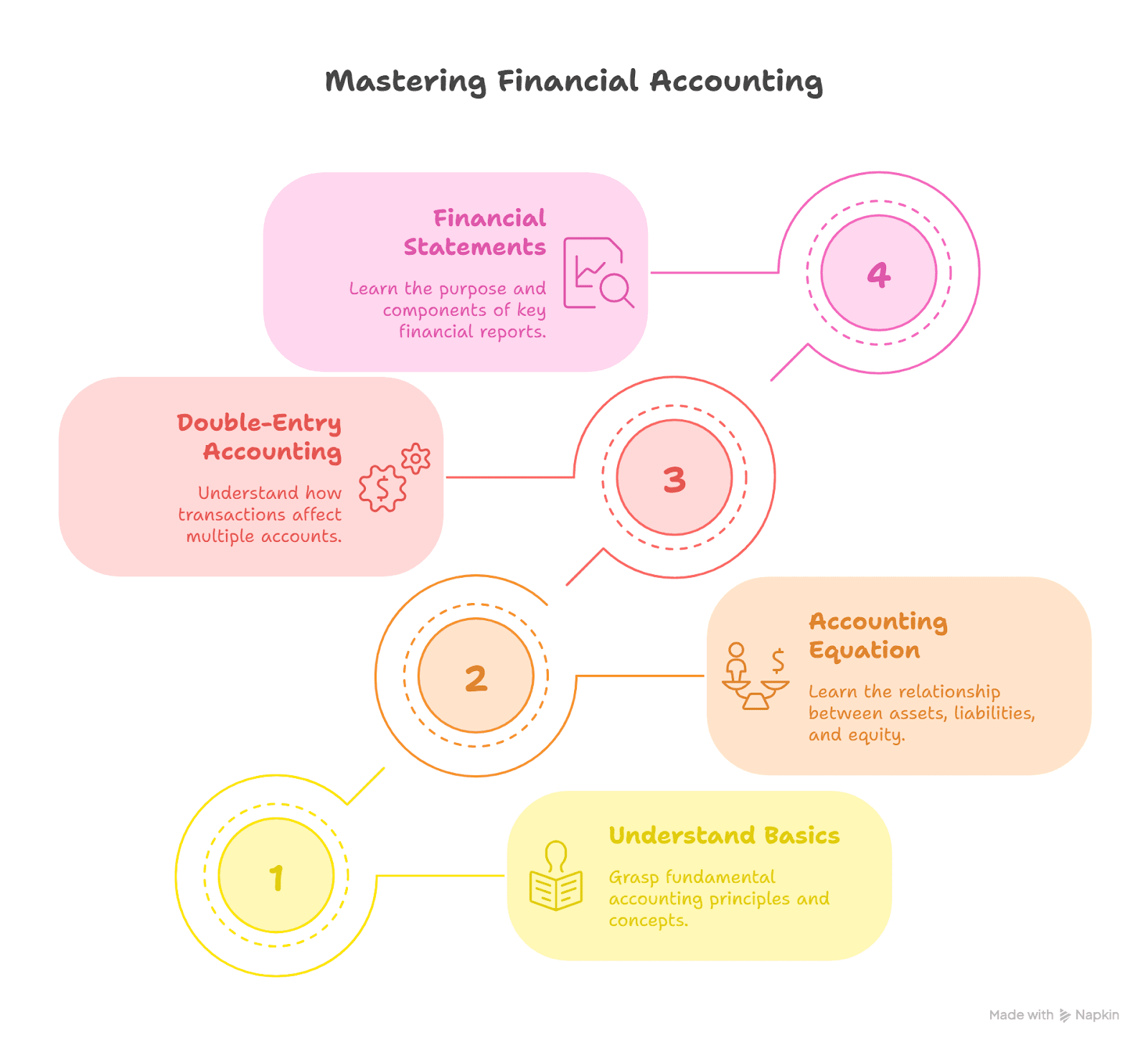
Let us learn about financial accounting first and then proceed with study procedures. Financial accounting is the process of recording, aggregating, and reporting transactions involving finances that are generated from business operations within a period of time. It entails preparing key financial statements that provide a snapshot of an organization’s financial status.
The key elements of financial accounting are:
- Income Statement – Provides revenues and expenses within a time frame.
- Balance Sheet – Accounts for the company’s assets, liabilities, and capital at a specific point in time.
- Cash Flow Statement – Accounts for inflow and outflow of money within the company.
These accounts follow international accounting standards called GAAP (Generally Accepted Accounting Principles) or IFRS (International Financial Reporting Standards) depending on the country’s location. Knowing these basics is worth understanding as they form the basis of understanding and interpreting accounting information used for actual decision-making.
With these fundamentals, students and professionals are more keen in finance and precise in forecasting and analysis. Mastering the meaning of these statements once, even difficult account subjects are simple to prepare for the future.
Key Accounting Concepts and Principles
- Accrual Principle – Expenses and revenues are incurred when they are accrued and not when the cash is paid or received.
- Matching Principle – Expenses must be paired with matching revenues for the same time period.
- Conservatism Principle – Under doubt, select that option which gives less profit.
- Consistency Principle – Where a choice is taken in accounting, be consistent.
- Going Concern Assumption – Presumes business will keep going as a going concern unless mentioned expressly.
Understanding such principles facilitates effectuating the rules effectively as well as provide regulatory-compliant brief financial reports.
Common Challenges and How to Overcome Them
Accounting finances will ever be challenging on the first try for most students. It is a blend of conceptual ideas, numerical accuracy, and challenging analytical reasoning. When all those are ill defended, it does look too daunting. Don’t worry, however-most of them might have been overcome using certain techniques and determination.
- Issues and ways of avoiding them are discussed below:
- Memorizing Definitions and Terms: Flashcards or a computer program like Quizlet can be utilized to memorize terms and definitions.
- Learning Credits and Debits: T-accounts and transaction tables, graphical aids, can be employed to learn credits and debits.
- Mastering Difficult Concepts: Break them into bits and pieces and read them in frequent intervals.
- Numerical Problem Solving: Practice, practice, practice. Practice various types of problems to become confident.
- Consistency: Follow a routine schedule and divide your syllabus into small chunks.
These are cut with time, patience, and determination, but it is simpler if there is proper attitude and study material. The urge is not merely to memorize but comprehend accounting in business.
Effective Accounting Study Plan
- Understand the Syllabus: Highlight those areas which are marked heavier.
- Plan a Timetable: Keep some days for theory and numerals practice.
- Use Good Study Material: Use textbooks recommended by your school or syllabus.
- Revise Regularly: Revision helps to store ideas in the long term.
- Stay Updated: Keep yourself in harmony with new accounting standards developments.
How to Prepare for Accounting Exams
Accountancy exam preparation is not necessarily page-turning in your notes. It requires a strategy with timely discipline, practice, and self-testing. Go. Go. Go. Because theory knowledge and practical skills application in financial accountancy exam questions, one can only prepare sufficiently.
Here are tips that can accompany your preparation:
- Practice Past Papers: Practice past papers under timed conditions.
- Practice Time Management: Practice pacing yourself for different types of questions.
- Mock Tests: Practice testing environment to minimize nervousness.
- Know Question Patterns: Pattern practice—MCQs, journal entries, long-answer questions.
- Target Weak Areas: Find weak areas and practice more there.
- Don’t Cram At The Last Moment: Practice well in advance and make steady progress.
By doing so, not only are you well-prepared long in advance, but you’re also less nervous on the exam day.
Best Way to Study Accounting
- Textbooks: Directly quote books such as ‘Financial Accounting’ by T.S. Grewal or ‘Principles of Accounting’ by Needles and Powers.
- Online Websites: Online websites such as Coursera, Khan Academy, and edX provide courses from beginner to advanced level.
- Mobile Apps: Use apps such as Accounting Basics, Investopedia, and Ledger.
- YouTube Channels: YouTube channels such as ‘Accounting Stuff’ or ‘Farhat’s Accounting Lectures’ are optimal for visual learning.
- Tutors and Forums: Post on forum forums such as Reddit or Quora to clarify any doubts.
Real-Life Applications of Financial Accounting
- Budgeting: Allows firms to prepare realistic budgets and manage costs.
- Investment Decisions: Investors make investment choices based on financial statements to assess firms.
- Loan Approvals: Banks approve loans based on balance sheets and profit and loss accounts.
- Compliance with the Law: Good accounting allows firms to stay within the law.
- Performance Monitoring: Managers track activities based on key financial performance indicators.
FAQs About Studying Financial Accounting
Q1. How to learn accounting?
Divide topics into small portions, practice regularly, and use visual and theoretical study tools.
Q2. How much time is needed to learn financial accounting?
Financial accounting can be learned in 2–3 months with regular effort.
Q3. Learning financial accounting: is it that hard?
Hard to begin with, but anyone can learn by learning it in a systematic approach and through practicing, anybody can learn it.
Q4. Must I study financial accounting on my own?
Yes, but if you possess the necessary material such as text books, internet tutorials, and practice problems.
Q5. What are some things I must learn for financial accounting exam preparation?
Journalizing, financial statement, trial balance, and depreciation.
Q6. Why are accounting principles so vital?
Very important—accounting principles govern how to account and interpret financial data.
Q7. Is there an app to learn financial accounting?
Yes, there is an app such as Accounting Basics and Quizlet that is extremely useful in practice and revision.
Conclusion
Financial accounting is a valuable skill for any person working in the investment, business, or finance sector. With periodic practice, wisely scheduled study timings, and clever study materials, it is definitely possible to become a master of this topic. Not only that, but it is also an extremely solid platform for other finance topics, and it also increases your decision-making ability along with your business capabilities.
Whatever your college exam preparation, professional courses like CFA, or perhaps an interest in learning to read the language of business even better, learning financial accounting is headed in the right direction. Put in the efforts, work hard, but always try to get to the “why” and not the “how.”.
With our economy being data-driven our reserve can actually have an impact on business results for those who are able to read numbers. With accounting skills, and increasingly more career opportunity doorways of entry, there are more geographies, functions, and industries.