A Complete Guide For Deep Learning!

Deep Learning is known as neurally organized or as learning of various levels. It is one piece of an even more extensive type of group of the techniques used for machine learning in the aspect of learning and retrieving information, instead of undertaking the particular calculations. Also, learning could be directed, or semi-managed or even unsupervised.

Hence, careers in the field of Deep Learning renders organizations with different kinds of arrangements for systems in order to look after the issues of complex explanatory and also drives rapid developments in the counterfeit consciousness.

Complex undertakings such as- picture examination and discourse, can be performed with the help of models prepared by fostering calculations of deep learning amidst an immense amount of information.

These models of Deep learning are generally identified with the data preparing as well as with correspondence designs that are in a system of organic sensory, for example, the neural coding that attempts to characterize one connection between distinct data and the related reactions of neurons inside the brain. Therefore, a career in deep learning looks prospering.

What are the job positions that one can expect in the field of Deep Learning?

Mentioned below are the job positions that a person who specializes in deep learning can look out for:

  1. Research Analyst
  2. Data Scientist
  3. Neuroinformatics
  4. Image Recognition
  5. Research Scientist
  6. Deep Learning Instructor
  7. Full-stack deep learning web developer
  8. Process Engineer for Natural Language
  9. Software Engineer
  10. Data Analyst
  11. Data Engineer
  12. Bioinformatician
  13. Software Developer
  14. Research Fellow
  15. Applied Scientist
  16. A lead manager in Deep Learning

This shows that a career in Deep Learning has lots of options to make a future in.

Career Outlook

The information researcher hunts through enormous measures of unstructured as well as organized information in order to give fractions of knowledge; plus, it also helps to meet the particular business requirements or needs and objectives. Similar work needs to be done if you have pursued the Machine-Learning courses.

From where should you pursue the deep learning course?

Imarticus Learning is one of the best platforms to learn and help yourself make a future in the field of Deep Learning. Here, you will get to learn all the skills that are essential to becoming an expert in the field of Deep Learning. Because there are a number of skills and academic study required, Imarticus offers a ‘Machine Learning & Deep Learning Prodegree’, in association with the edtech partner, IBM.

It is the first-of-its-kind certification course of more than 145+ hours of training. This provides in-depth data science exposure, as well as, big data, machine, and deep learning as well. The meticulous curriculum-aligned as per the industry provides a comprehensive knowledge of Python as well as data science for a flourishing future and career in machine learning and big data as well. This program also stars seven projects of industry, various case studies as well as periodic interaction with industry leaders inside the ecosystem of machine learning.


How Statistics Relate to Machine Learning?

Introduction

Machine learning and statistics have always been closely related to each other. This led to an argument about whether it was different from machine learning or formed a part of machine learning. Several Machine learning courses specify statistics as one of the perquisites for machine learning.

Hence, we need to develop an understanding of the fact if statistics relate to machine learning and if it does, how?

Individuals working in the field of machine learning concentrate on the task of model building and the result interpretation from the model that was constructed while the statisticians perform the same task but under the cover of a mathematician concentrating more on the mathematical theory involved in the machine learning task concentrating more on the explanation of the predictions made by the machine learning model. So, we can say that in spite of the differences between statistics and machine learning, we need to learn statistics in machine learning.

Statistics and machine learning

Both statistics and machine learning are related to data. Although they work with the data in their way, some requirements are needed by both and hence they form a close relationship with each other. Given below is a step by step analysis as to how statistics relate to machine learning.

Data preprocessing requires statistics

To proceed with the machine learning task, cleaning of data is a mandatory step. This process involves tasks such as identifying missing values, normalization of the values, identifying the outliers, etc. These operations call for statistical concepts such as distributions, mean, median, mode etc.

Model construction and statistics

After the data has been cleaned, the next step is to build a model with that data. A hypothesis test might be needed for model construction which calls for good statistical concepts.

Statistics in evaluation

Model evaluation requires tasks such as validation techniques to be performed so that the accuracy and model performance increases. These validation techniques are easily understood by the statisticians but a bit difficult for the machine learners to interpret as it involves mathematical concepts.

Presenting the model

After the successful construction and evaluation of the model, the model is presented to the general public. The interpretation of results requires a good understanding of concepts such as confidence interval, quantification, an average of the predicted results based on outputs produced and so on.

Other than the above-mentioned steps some additional concepts must be adhered to while working with machine learning. Some of these concepts are listed below:

  • Gaussian distribution – It is often represented by a bell-shaped curve. The bell-shaped curve plays a very important role while normalising the data as a normalised data is supposed to lie at the point where the bell-shaped curve is divided into two equal parts.
  • Correlation– It can be either positive, negative or neutral. A positive correlation indicates that the values change in the same manner(positive causes positive and negative leads to negative). A negative correlation indicates values change oppositely while neural suggests no relationship. This concept is of great importance to the analysts while identifying the tendencies in the data.
  • Hypothesis- An assumption might be done for the elementary predictive analysis in machine learning that requires a good understanding of the hypothesis.
  • Probability – Probability plays an important role in predicting the possible class values in classification tasks and hence forms an important part in machine learning.

Conclusion

Statistics is of huge importance to machine learning, especially in the analysis field. It is one of the key concepts for data visualization and pattern recognition. It is widely used in regression and classification and helps in establishing a relationship between data points. Hence, statistics and machine learning go hand in hand.

What Is The Quickest Way to Learn Math For Machine Learning and Deep Learning?

Synopsis

Math is integral to machine learning and deep learning. It is the foundation on which algorithms are built for artificial intelligence to learn, analyze and thrive. So how do you learn math quickly for AI? 


Machines today have the ability to learn, analyze and understand their environment and solve problems on the basis of the data given to them. This intelligence of the machines is known as artificial intelligence and the ability to learn and thrive is known as machine learning. Algorithms form the crux of everything you do in technology and a Machine Learning Course provides you with an understanding of the same. 


Today, individuals who are proficient after completely a Machine Learning Certification is highly sought after and employed. Companies invest a large sum of money to have professionals trained in AI as the applications of AI are vast and cost-effective.  It is a lucrative career to pursue one that involves complex and challenging problems that need to be solved in creative ways. 


Mathematics forms the foundation of building algorithms as all programming languages use the basics. Binary code is the heart of machines and the language used to teach them things is the programming language. So do you pursue Machine Learning Training, and also learn math quickly at the same time? 


Here are a few ways to understand how math is applicable in AI 


Learn the Basics 

Important sections such as  Statistics, Linear Algebra, Statistics, Probability and Differential Calculus are the basics of math that one needs to know in order to pursue learning a programming language. While this may sound complicated, they form the basis for machine learning, so investing in courses that teach the above-mentioned functions will go a long way in programming.  There are plenty of online resources that are useful repositories when it comes to learning math for deep learning. 


Invest Sufficient Time

Learning math depends on the ability to absorb and apply the math learned in machine learning. Applications of statistics, linear algebra is important in machine learning and hence investing 2-3 months to brush up on the basics go a long way. Constant applications of the lessons learned also helps when it comes to math for AI. Since the principles are the same but the various derivatives and applications can change with the algorithm constant practice and brushing up will help while learning the code. 


Dismiss The Fear

One of the biggest ways to learn math quickly for machine learning is by dismissing the fear associated with numbers. By starting small and investing efforts, one can move forward in the code. Since there is no shortage of resources when it comes to learning math, taking the initial step and letting go of any fear towards the subject will greatly help. 


Conclusion

Learning a programming language whose principles are based on mathematics can sound daunting and tedious but it is fairly simple once you understand the basics of it. This can be applied while programming for machine learning and artificial intelligence

Is Statistics Required for Machine Learning?

What is Statistics?

Statistics is a branch of mathematics that is used for comparing and analyzing various data points and the numbers associated with them. It also includes the study of numbers and drawing out insights from those numbers. Some of the statistical measures include average, median, mode, variance, standard deviation, correlation, regression, etc. Some of these help in analyzing single sets of data while others are used in comparing two or more sets of data and then making a comparative analysis in the form of trends and patterns. Often these tools are also brought into play when it comes to predicting future numbers.

What is Machine Learning?

Machine Learning is the application of artificial intelligence where the systems are programmed to perform a specific set of tasks. The computers are programmed to function automatically depending on the various scenarios and come up with the required results. It enables the analysis of huge data for drawing out various business insights.

Also, it makes the sorting and analysis of data quick and easy as the automation is brought into play with the help of machine learning. It is a really powerful tool in this data-driven world of today. It collects data from various sources as given by the algorithm, prepares it for analysis and then evaluates this data for bringing out insights and also throws light on various performance indicators in the form of patterns and trends.

Statistics and Machine Learning

Both Statistics and Machine Learning deal with the analysis of data therefore one could guess that the two areas are interrelated. Various statistical methods are used to transform raw data and bring out various results. Many believe that knowing Statistics is a prerequisite for understanding Machine Learning. Statistics is important as the data sets have to be created which can be easily made if one has prior knowledge of Statistics. Also, with the help of statistics, the observations are transformed and put to good use.

Machine Learning has a deep relation with Statistics and the elements of statistics such as the collection of data, classification, and sorting of data, analysis of data, etc. Predictive modeling can be done by someone who at least has a basic understanding of Statistics. Machine learning is also known as “Applied Statistics” as it practically uses various statistical theories and principles to drive growth and various results.

Data analysis is important for machine learning and statistics is an art of handling data. It is the primary skill that drives machine learning algorithms. Statistics plays a very important role when it comes to machine learning. One needs to know about the various parameters on which the data shall be analyzed to bring out desired results.

Methods such as Correlation and Regression are often used to compare various sets of data and these tools are built into algorithms with the help of machine learning so that these numbers of comparison can be automatically calculated and a comparative study can be made based on these numbers. Learning Statistics before getting into machine learning is the best way to go about it. Various Machine Learning training will also give you an idea about statistics and how it is applied to Machine Learning.

Conclusion
Machine Learning and Statistics are two parts of the same coin. Machine Learning makes use of statistics for sanitizing data and on the other hand, Statistics is given a practical shape and is made applicable with the help of machine learning. Therefore, it becomes easy to conclude that one must have at least a basic understanding of statistics to understand the aspects of Machine Learning.

Bots In Learning AI And Personalized Learning Experience

Bots In Learning AI And Personalized Learning Experience

The class sizes keep increasing with compulsory education and teachers are often facing many challenges in giving attention and help to the large numbers of students. A big challenge like this has been simplified by incorporating computer programs that allow each student to follow his own pace and learning curve.

Since the ideal teacher-student ratio has long been overtaken, a lot of educational instructors have unobtrusively introduced AI and ML to help with self-scoring assignments, computer-aided assignments and course review modules and videos that help the learning process which tends to be different in style, pace, and manner of learning in each individual student.

However such early initiation has led to students thinking of the quickest and easiest way to beat the system. This was supposed to be a part of the personalized learning process which probably needs a review given that AI and a machine learning course have a huge role to play in the future of technologies.

Learning Bots:

The newer methods of experiential learning at educational institutions use advanced techniques of AI, machine learning and deep learning in instructing and teaching like Chatbots and learning bots.

A few examples of such learning bots are:

  • Botsify is a suite of bots that have bot assistants like the tutoring bots, FAQ bots and more.
  • Mika is a math bot tutor based on AI used widely in schools and higher education institutions.
  • Snatchbot helps administrators and teachers with templates to help customize a bot to the classroom needs and subjects.
  • Ozobot is a specialized coding bot.

AI has thus personalized the teaching and learning experience by incorporating a machine learning course for bots to enable their functioning in the field of education and instruction.

Learning supports with AI:

Individualized learning modules can help find knowledge gaps and personalize the learning materials to fill in the gaps. By so adjusting the learning rate no student in a class is way ahead or too far back on the learning curve. Since learning styles, rates and methods may vary over each student, adaptive learning scores by understanding and identifying the gap in learning and taking corrective action before it is too late.

A differentiated AI style of learning deals with the most effective style to help the student learn. Adaptive AI-based learning curates the learning exercises matching them to the student’s needs and knowledge gaps. Competency-based AI and machine learning course tests aid the students to gauge their learning levels and progress from thereon. Using all these three types of learning AI can test how well the students can adapt their learning to applications of it and thus promote the progress of students based on individual interests.

Tutoring help:

The bots have become extremely popular and the future will probably have specialized tutoring bots where the learners can ask questions and receive answers in real-time. Chatbots, tutoring bots and even bots for teachers to help score examinations, assess large volumes of answer sheets and more are being used to improve the learning and educational process. Tweaking the earlier bots have led to specialized bots that even suggest and provide resources specific to a learning style.

Administrative tasks aids:

Teaching is a challenge and scoring and grading are tasks that are repetitive and time-consuming. Multiple choice questions and online testing are AI forms of grading already in use where learning responses need not be essentially written responses. Thus a lot of paperwork and unnecessary wastage of time is eliminated.

Since bots are able to quickly analyze the responses, feedback can be near-instantaneous. Teachers can now get truly involved in teaching and rectifying the lacunae in the learning process. Besides, the teachers can also get recommendations on how to rectify the issues, what learning materials to use for personalizing the process and much more to help herd the students towards the right levels of comprehension and skills required. This could also be used for learning processes of differently challenged students.

Concluding notes:

Both bot technology and its AI technology has started the process of personalizing and improving the education system of learning. Today bots are not new to students who can exploit their benefits at will and at their own pace to learn advanced subjects. Such advancements in AI, ML and bot technologies spur demand for professionals in this emerging field which has immense potential. Would you like to do a machine learning course at Imarticus Learning and join the ranks of the highly paid professionals who face no dearth of jobs? Start today. Hurry!

For more details, you can also contact to our Live Chat Support system or can even visit one of our training centers based in – Mumbai, Thane, Pune, Chennai, Bangalore, Hyderabad, Delhi, Gurgaon, and Ahmedabad.

NLP vs NLU- From Understanding A Language To Its Processing!

Today’s world is full of talking assistants and voice alerts for every little task we do. , Conversational interfaces and chatbots have seen wide acceptance in technologies and devices.

Their seamless human-like interactions are driven by two branches of the machine learning (ML) technology underpinning them. They are the NLG- Natural Language Generation and the NLP- Natural Language Processing.

These two languages allow intelligent human-like interactions on the chatbot or smartphone assistant. They aid human intelligence and hone their capabilities to have a conversation with devices that have advanced capabilities in executing tasks like data analytics, artificial intelligence, Deep Learning, and neural networking.

Let us then explore the NLP/NLG processes from understanding a language to its processing.

The differences:

NLP:
NLP is popularly defined as the process by which the computer understands the language used when structured data results from transforming the text input to the computer. In other words, it is the language reading capability of the computer.

NLP thus takes in the input data text, understands it, breaks it down into language it understands, analyses it, finds the needed solution or action to be taken, and responds appropriately in a human language.

NLP includes a complex combination of computer linguistics, data science, and Artificial Intelligence in its processing of understanding and responding to human commands much in the same way that the human brain does while responding to such situations.

NLG:
NLG is the “writing language” of the computer whereby the structured data is transformed into text in the form of an understandable answer in human language.

The NLG uses the basis of ‘data-in’ inhuman text form and ‘data-out’ in the form of reports and narratives which answer and summarize the input data to the NLG software system.

The solutions are most times insights that are data-rich and use form-to-text data produced by the NLG system.

Chatbot Working and languages:

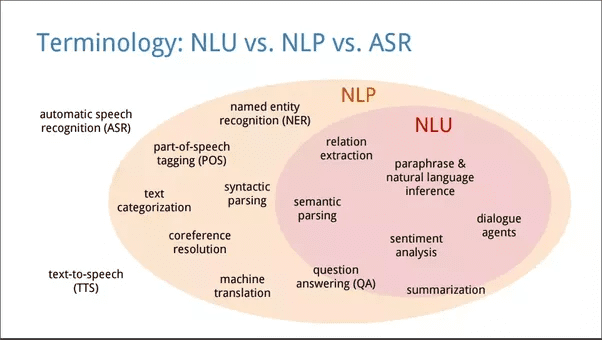
Let us take the example of a chatbot. They follow the same route as the two-way interactions and communications used in human conversations. The main difference is that in reality, you are talking to a machine and the channel of your communication with machines.NLG is a subset of the NLP system.

This is how the chatbot processes the command.

  • A question or message query is asked of the chatbot.
  • The bot uses speech recognition to pick up the query in the human language. They use HMMs-Hidden Markov Models for speech recognition to understand the query.
  • It uses NLP in the machine’s NLP processor to convert the text to commands that are ML codified for its understanding and decision making.
  • The codified data is sent to the ML decision engine where it is processed. The process is broken into tiny parts like understanding the subject, analyzing the data, producing the insights, and then transforming the ML into text information or output as your answer to the query.
  • The bot processes the information data and presents you a question/ query after converting the codified text into the human language.
  • During its analysis, the bot uses various parameters to analyze the question/query based on its inbuilt pre-fed database and outputs the same as an answer or further query to the user.
  • In the entire process, the computer is converting natural language into a language that computer understands and transforming it into processes that answer with human languages, not machine language.

The NLU- Natural Language Understanding is a critical subset of NLP used by the bot to understand the meaning and context of the text form. NLU is used to scour grammar, vocabulary, and such information databases. The algorithms of NLP run on statistical ML as they apply their decision-making rules to the natural-language to decide what was said.

The NLG system leverages and makes effective use of computational linguistics and AI as it translates audible inputs through text-to-speech processing. The NLP system, however, determines the information to be translated while organizing the text-structure of how to achieve this. It then uses grammar rules to say it while the NLG system answers in complete sentences.

A few examples:

Smartphones, digital assistants like Google, Amazon, etc, and chatbots used in customer automated service lines are just a few of NLP applications that are popular. It is also used in online content’s sentiment analysis.NLP has found application in writing white papers, cybersecurity, improved customer satisfaction, the Gmail talk-back apps, and creating narratives using charts, graphs, and company data.

Parting Notes:

NLG and NLP are not completely unrelated. The entire process of writing, reading, and talk-back of most applications use both the inter-related NLG and NLP. Want to learn more about such applications of NLP and NLG? Try the Imarticus Learning courses to get you career-ready in this field. Hurry!

What Are The Prerequisites For Artificial Intelligence?

Artificial intelligence keeps changing in its definition as does its scope and capabilities. A few decades ago, simple calculators were considered artificial intelligence since math problems were previously only solved by the human brain. Today, artificial intelligence powers home automation systems and gadgets like Google Home, Siri, and Alexa. We see new AI being released almost every week with juggernauts like Google and Facebook it improve the user experience. The auto-reply feature with suggested replies on Gmail is an example of artificial intelligence where the responses are ‘taught’ to the machine.
Having a good foundation is imperative if you want to foray into artificial intelligence. It isn’t as simple as attending a machine learning course to be a valuable employee in the field of AI. People who are interested in artificial intelligence can take several paths to learn the various AI skills necessary for the subject. Based on your previous knowledge and skill level, you should chart your own course.

The prerequisites of artificial intelligence will give you a good foundation to stand upon when you are learning the key concepts. You will have to have a good foundation in calculus, linear algebra, and statistics in order to help you to develop algorithms. You will also need a good knowledge of Python and Python for data science track as it is the predominant language used in machine learning.
Whatever math skills you might have already, you might want to brush up on them before foraying into Artificial Intelligence. There are many courses available online that will go into depth about the various concepts used in AI. If you are getting into AI to solve a problem, then you can rely on existing libraries to help you with the math required. However, if you are looking to get into research or deep into machine learning, you will have to get an in-depth knowledge of math.
The next steps involve learning and soaking up as much machine learning concepts and theory as you can. It will help you on many fronts including planning and collecting data, interpretation of model results, and creating better models.
The next step should focus on data cleaning, exploration, and preparation. As someone who will be working with machine learning, you will have to have a good quality of feature engineering and data cleaning on the original data you have. This is a very important step and will regularly feature in your work in the future. You should spend as much time as you can here, doing practice tests and runs.
For practice, you should participate in as many Kaggle competitions as you can. These are generally easy and will help you work with multiple scenarios and typologies. With machine learning, the more practice you have, the better you are.
As a beginner, these are the steps you will have to take in order to understand the basics of artificial intelligence. If you are interested in a deeper understanding of the subject, then you can opt of Deep Learning and Machine Learning with Big Data.

What Is The Best Way To Learn Artificial INtelligence For a Beginner

10 Essential Qualities For The Age Of Artificial Intelligence

Top Artificial Intelligence Trends For 2021

Artificial Intelligence Futuristic Career Options

Deep Learning and its Application for Facial Recognition

Deep Learning, ML and AI are all used to support facial recognition and used traditionally the Eigenvalues for vectors and spaces defining the features of the space projected by the face. In 2012 AlexNet tweaking and deep learning technologies like the DeepID, DeepFace, FaceNet, and VGGFace went beyond the human capacity to recognize faces by aligning, using feature extraction, detection, and recognition techniques. Thereby the use of verifying faces in a photograph under various lighting conditions, an aged face, with glasses or without facial hear was made possible by leveraging deep learning of face datasets and model representations.
The recognition software is biometric in nature and can accurately identify, authenticate and verify a face just by comparing the facial features and contours against very large databases.
It is widely used for: 

  • The enforcement of the law by the police and detection agencies.
  • In businesses for biometric logging in and out.
  • In banking to ensure KYC and restricted access to lockers.
  • In AR and VR applications for animated film making.

Authentication through facial recognition:
The most useful advantage of facial recognition is that facial contours do not change and can be captured from a distance. It never fails since faces cannot be replicated or imitated successfully. The technology itself is of a non-contact biometric type and has been successful in restricting entry, ensuring attendance, for crime prevention, law enforcement and as a security measure. The technology is also inexpensive and infallible when compared to other methods like fingerprinting, Retinal scans and such biometric methods which are contractual in nature needing the voluntary provision of data for further process.
Many devices need and work on authentication based on face photograph verification either taken from videos or still photos. Human beings are very good at this task and deep learning simulates the same process.
Deep Learning and ML use ConvNets for the analysis and identification processes. Such neural networks are highly intelligent, self-taught and have other applications sewn in like the NLP processor, video analyzer, recommender modules and such.
The four essential steps involved are:
1. Detection which involves detection and using a boundary box for the image face. It generally falls into two categories namely
Based on features and using hand-work filters based on knowledge of the domain.
Based on images and ML where neural networks work on extraction and location of the image.
2. Alignment tasks normalize the photometry, geometry and such parameters with the database since most photographs contain more than one face and need to be aligned. The alignment output depends on the following task categories.

  • Binary labels for class and probability.
  • Similarity parameters.
  • Category labels.

3. Extraction of facial features is used for the task of recognition. The tasks can be further classified as tasks for

  • Matching and finding the best results.
  • Similarity analysis for faces.
  • Feature transformation and generation of new similar face images.

4. Face Recognition itself consists of two main tasks to identify any given image. Namely,

  • Verification where features of the identified face are mapped to the given image.
  • Identification where a given image is mapped against the database.

ML has proved to be invaluable to Deep Learning solutions. The present-day technological advancements make facial recognition and such issues easy. One has to choose the algorithm and feed in the given face image or data. The built-in neural network and trained dlib models will then take care of analyzing the face, comparing it against its databases and giving us an accurate match of the face against it. Further, the face recognition software on Github is easy to use, has a great library and is a rapid install.
Conclusion:
Deep learning machine algorithms and neural networks can currently manipulate, detect and identify facial contours from very large databases very quickly and this ability is far beyond human capacities.
If you are interested in such specific applications you will need to do courses that are skill-oriented in ML, Neural networks, Deep Learning, handling databases and applications, AR, VR, and such futuristic technology. Most of these courses are offered by Imarticus Learning where learning is practically based and you are job-ready from day one. Who does not like able-mentorship from certified trainers, a widely accepted global certification and assured placements when looking to transition careers? Don’t wait too long. The route and opportunities are just right at the moment.

3 Ways in Which AI is Transforming Business Operations

The business scenario today has evolved and kept pace with technological developments. And AI has been at the helm of the change experience impacting literally every area that affects growth and development. The changing economic, geopolitical and social environments are in a state of constant flux and need businesses to adapt very quickly to tide over the changes in organizational dynamics, critical business glitches like employee retention and hiring or landscape requirements like being scalable and Agile.
Artificial intelligence can help bridge over troubled waters in many areas where human intelligence and limitations fail. Let us explore some of these critical areas where AI has and still has the potential to improve the business scenario.
The successful customer and user experience:
The experience of the customer is what tells brands apart and this differentiator is best exploited through successfully harvesting of the data and changes brought about by AI. Research and use of Walker data suggest that large multinationals like Adobe, Intuit, and EMC have benefitted greatly by entwining the customer experience into their operational daily routines of marketing, sales, and operational routines. And AI makes it possible to offer those great user-experiences crafted from forecasts and gleanings of data on why the customer buys, when and for how much, how the competition fares and their latest parleys, or what the customer wants from you.
The arsenal of data forecasts and insights can personalize an individual’s experience to match his needs, budget, etc, through a more seamless integrated process that offers high satisfaction and customer loyalty. The results are most helpful in rapidly predicting markets, changing products, forecasting customer- behavior, and staying up to date with the latest offers of technology. Thus AI is the one tool that has immense potential in accumulating, understanding and changing the fortunes of business enterprises by forecasting touch-points, trends, brand preferences, pricing strategies and more.
Bettering the hiring process:
The acquisition of skilled talent is critical to all businesses. However, most processes like recruitments, interviews, talent hunting, employee-referrals, and assessments are subject to very many biases, nepotism, controls, and flaws.
For bettering the hiring process certain tasks are all important. Firstly, one has to cast the net wide. Secondly, the talents need to be matched to the job requirements and the process of pivoting in on the right candidate needs to be free of human errors and bias. Lastly, the holistic use of data using the latest developments needs to be deployed. Not surprisingly, AI aided assistants today can make short work of the recruitment process while ensuring a great supply database for recruitments and keeping in mind the specifics of talent growing into higher roles and reducing the pitfalls of employee migration and retention issues.
Retaining and engaging the employees:
Skill and talent lie at the core of the hiring process. With increased demand comes the problem of retention and employee engagement turning into a competitive minefield. Poor management practices, lack of growth on the job and employee engagement have turned into major contributors for lack of retention of employees as is evident from surveys conducted by SalesForce and Gallup.
AI has enabled cutting-edge technologies like analysis of employee sentiments, biometric trackers, and such AI-empowered techniques can aid in effective retention through timely motivation, employee empowerment, continued learning opportunities and ensuring deserving rewards, career growth, skill up-gradation and more. More engaged employees mean better retention, employee loyalty, and engagement.
Conclusion:
In parting, it is valid to note that AI helps the new operations in business which in turn can change the dynamics of a beyond satisfying customer-experience, growing engagement with employees, hiring and retention. People are assets to the company and the twist that AI and technology have brought in can easily transform companies through efficient dynamics, change and people management.
To learn all about futuristic technologies like adaptations of artificial intelligence, powering AI through effective Machine Learning, scouring the growing volumes of data through Deep Learning and beyond to futuristic technology like blockchains for fintech industries try the Imarticus Learning experience.
The Agile Scrum Tutorial are succinct with due emphasis on the practical applications of knowledge and concepts coupled with invaluable modules of self-development and soft-skill training. Besides, one gets the mentorship of certified and industry-drawn mentors and instructors. Go ahead and make the most of opportunities and jobs on offer in their placement program too. Why wait then?

How Do You Start Applying Deep Learning For My Problems?

Deep Learning helps machine learn by example via modern architectures like Neural Networks. A deep algorithm processes the input data using multiple linear or non-linear transformations before generating the output.
As the concept and applications of Deep Learning are becoming popular, many frameworks have been designed to facilitate the modeling process. Students going for Deep Learning, Machine Learning course in India often face the challenge of choosing a suitable framework.
Machine Learning Course
Following list aims to help students understand the available frameworks in-order to make an informed choice about, which Deep Learning course they want to take.

1.    TensorFlow 
TensorFlow by Google is considered to be the best Deep Learning framework, especially for beginners. TensorFlow offers a flexible architecture that enabled many tech giants to embrace it on a scale; for example Airbus, Twitter, IBM, etc. It supports Python, C++, and R to create models and libraries. A Tensor Board is used for visualization of network modeling and performance. While for rapid development and deployment of new algorithms, Google offers TensorFlow which retains the same server architecture and APIs.
2.    Caffe 
Supported with interfaces like C, C++, Python, MATLAB, in addition to the Command Line Interface, Caffe is famous for its speed. The biggest perk of Caffe comes with its C++ libraries that allow access to the ‘Caffe Model Zoo’, a repository containing pre-trained and ready to use networks of almost every kind. Companies like Facebook and Pinterest use Caffe for maximum performance. Caffe is very efficient when it comes to computer vision and image processing, but it is not an attractive choice for sequence modeling and Recurrent Neural Networks (RNN).
3.    The Microsoft Cognitive Toolkit/CNTK
Microsoft offers Cognitive Toolkit (CNTK) an open source Deep Learning framework for creating and training Deep Learning models. CNTK specializes in creating efficient RNN and Convoluted Neural Networks (CNN) alongside image, speech, and text-based data training. It is also supported by interfaces like Python, C++ and the Command Line Interface just like Caffe. However, CNTK’s capability on mobile is limited due to lack of support on ARM architecture.
4.    Torch/PyTorch
Facebook, Twitter and Google etc have actively adopted a Lua based Deep Learning framework PyTorch. PyTorch employs CUDA along with C/C++ libraries for processing. The entire deep modeling process is simpler and transparent given PyTorch framework’s architectural style and its support for Python.
5.    MXNet
MXNet is a Deep Learning framework supported by Python, R, C++, Julia, and Scala. This allows users to train their Deep Learning models with a variety of common Machine Learning languages. Along with RNN and CNN, it also supports Long Short-Term Memory (LTSM) networks. MXNet is a scalable framework making it valuable to enterprises like Amazon, which uses MXNet as its reference library for Deep Learning.
6.    Chainer
Designed on “The define by run” strategy Chainer is a very powerful and dynamic Python based Deep Learning framework in use today. Supporting both CUDA and multi GPU computation, Chainer is used primarily for sentiment analysis speech recognition etc. using RNN and CNN.
7.    Keras
Keras is a minimalist neural network library, which is lightweight and very easy to use while stocking multiple layers to build Deep Learning models. Keras was designed for quick experimentation of models to be run on TensorFlow or Theano. It is primarily used for classification, tagging, text generation and summarization, speech recognition, etc.
8.    Deeplearning4j
Developed in Java and Scala, Deeplearning4j provides parallel training, micro-service architecture adaption, along with distributed CPUs and GPUs. It uses map reduce to train the network like CNN, RNN, Recursive Neural Tensor Network (RNTN) and LTSM.
There are many Deep Learning, Machine Learning courses in India offering training on a variety of frameworks. For beginners, a Python-based framework like TensorFlow or Chainer would be more appropriate. For seasoned programmers, Java and C++ based frameworks would provide better choices for micro-management.