


A stronger wave of analytical, research-driven and ethically aligned finance roles is emerging across global and Indian markets, and the CFA Program sits at the centre of this shift. As financial decisions grow more data-heavy, organisations increasingly look for professionals who can analyse information with discipline, interpret markets accurately and communicate insights with precision. The CFA certification has become one of the most recognised pathways to building these capabilities.
Today, I see how the CFA benefits have extended far beyond exam success. This qualification often becomes a kind of professional filter. It signals that you can stay consistent over long study horizons, digest dense concepts, and still keep a practical perspective on real-world markets.
There is a subtle confidence I notice in professionals pursuing the CFA certification.
“They speak about risk not as a theoretical construct but as something they can frame, quantify, and manage.”
They talk about valuations through the lens of cash flows rather than stock price noise. These shifts don’t happen overnight. Ahead, I’ve detailed the CFA benefits that shape better analysts and stronger thinkers, along with the roles, skills and professional behaviours that evolve through this learning journey.
A Closer Look at the CFA Certification
Before I break down the CFA benefits that finance professionals rely on, it is important to understand what is CFA at its core. The CFA certification, offered by the CFA Institute, is an intensive learning path designed to teach investment analysis, ethical judgment and market interpretation with precision. The CFA course is recognised worldwide because it represents a blend of technical depth and disciplined learning.
The curriculum spans areas that any modern finance role touches, from reporting analysis to derivatives, portfolio theory and alternative investments. When candidates begin this journey, they often discover that the coursework pushes them to refine how they think, measure, and communicate. This context forms the backdrop for the rest of the blog, because the benefits become clearer once you see the foundation on which they are built.
Technical depth of the CFA
Before diving into the wider benefits of the CFA charter, I want to unpack the conceptual scaffolding behind it. The curriculum doesn’t shy away from difficult territory. The finance world demands precision, and the programme is designed to build it.
Here’s how various concepts discussed in CFA strengthen analytical instincts:
- Ethics builds a north star for decision-making, something that professionals carry through their careers.
- Quantitative methods give the mathematical grounding to back intuitive assessments.
- Economics provides the macro and micro reasoning needed to map business dynamics.
- Financial reporting and analysis sharpen the ability to interpret statements beyond surface-level numbers.
- Corporate finance roots you in capital structuring choices that organisations make every day.
- Equity and fixed income create a dual-lens understanding of markets.
- Derivatives encourage analytical rigour and scenario thinking.
- Portfolio management brings everything together into a strategic allocation.
This layered structure is one reason CFA benefits feel long-lasting. The learning feels cumulative rather than fragmented. When learners begin applying these frameworks in their roles, the connections between topics usually stand out. The infographic below covers a few more aspects of the skills that you will acquire during the charter:

Professional Advantages that Consistently Stand Out
The following points highlight the professional advantages consistently associated with the CFA qualification, based on recurring trends across investment, research, risk and corporate finance functions.
1. A sharpened decision-making framework
Professionals often say they have gained the ability to pause and assess situations with more structure. Even outside pure analytical work, this helps when evaluating business cases, making hiring decisions, or assessing risk exposures. The rigour built through the curriculum creates a stable mental model to approach uncertain scenarios.
2. A natural alignment with how global firms work
Large institutions like BlackRock, JP Morgan, and Morgan Stanley usually appreciate how the entire programme aligns with real-world investment practice. The emphasis on professional judgement, evidence-based reasoning, and ethical frameworks mirrors the expectations in these organisations. For many roles, the CFA certification becomes an advantage because it signals readiness for structured environments.
3. Meaningful headroom for long-term growth
When candidates complete the programme, they often mention how they suddenly understand conversations that once felt inaccessible. They can decode discussions on credit markets, private equity models, or multi-asset portfolio positioning. This bridges the gap between junior and senior interaction points and accelerates long-term learning.
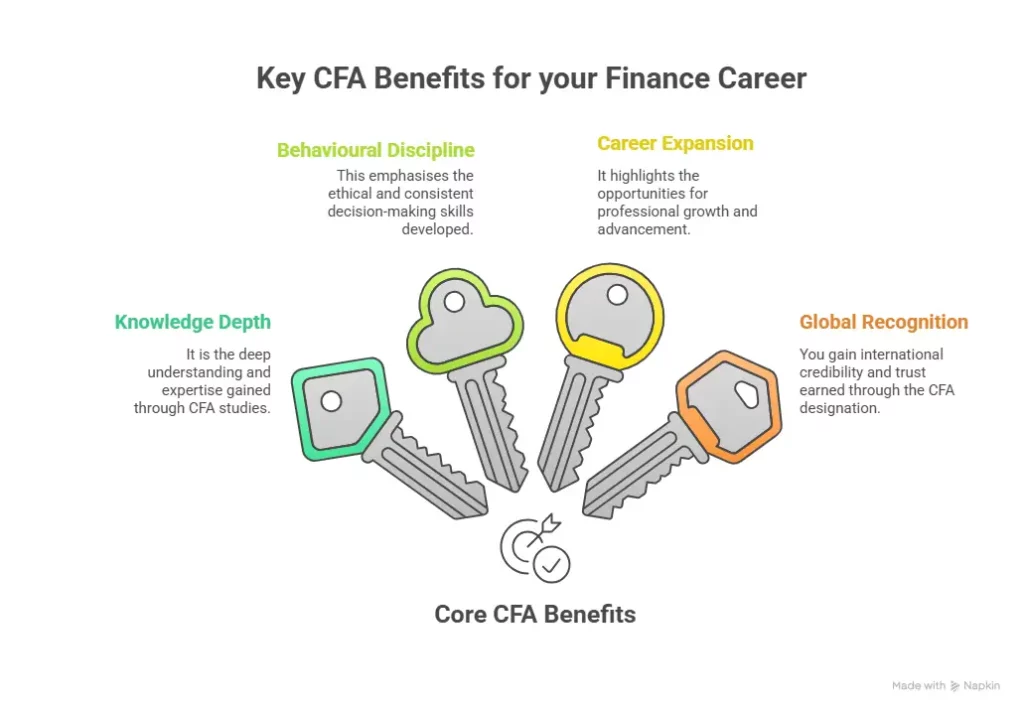
The following visual encapsulates the various CFA benefits a charterholder gains that help them bolster their finance careers not just with conviction but in-depth knowledge:
Benefits Of CFA Level 1 For Early-Career Learners
This section matters especially for students or young professionals who wonder whether the first exam alone carries value. I’ve seen Level 1 act as a confidence anchor for those who want exposure to finance fundamentals without prior experience.
Before presenting a quick table, here’s the reasoning behind the Level 1 advantage. It gives learners:
- Vocabulary of finance
- Ability to interpret financial statements
- Calculate yields
- Understand simple valuation logic
This makes early conversations in internships feel more meaningful. Candidates start feeling comfortable in technical discussions, which improves workplace credibility.
What CFA Level 1 contributes to early careers
| Aspect | Benefits for learners |
| Knowledge foundation | Candidates develop proficiency in core finance concepts that employers can trust. |
| Workplace confidence | Familiarity with terms like beta, duration, and free cash flow reduces hesitation in early analyst roles. |
| Proof of discipline | Passing Level 1 signals that a candidate can commit to structured learning. |
| Entry-level opportunities | Many firms consider Level 1 as an encouraging indicator for analyst positions. |
This blend of credibility and competence is why the benefits of CFA Level 1 have become a frequent discussion point among students I mentor.
Why the CFA Designation Matters in India’s Financial Job Market
Finance roles in India have changed significantly in the last decade. Firms are investing more in analytics teams, risk departments, ESG research units, and structured product desks. With the financial ecosystem expanding, the benefits of CFA in India have become more visible.
Let me illustrate this through actual market evidence.
According to the LinkedIn Workforce Report, hiring demand for roles like investment analysts and credit researchers has increased across cities such as Mumbai, Bengaluru, and Gurugram.
Simultaneously, NSE and BSE-listed firms have been expanding analyst coverage. The ecosystem needs professionals who can work comfortably with data-driven frameworks, and CFA candidates often step in confidently.
Professionals in India say that the curriculum gives them a competitive advantage because they can talk across functions. They understand reporting, valuation, macroeconomics, and risk modelling, which makes them comfortable working across departments.
CFA Benefits on Global Recognition and Mobility
One of the most understated CFA benefits is the idea that the designation preserves value across borders. Professionals relocating from India to Singapore, the UAE, or the UK often find that the CFA certification offers a stable reference point for recruiters.
In my experience mentoring learners who have moved abroad, two patterns appear frequently:
- Recruiters respond positively when they see the charter progression on a resume.
- The ethical and analytical foundation helps professionals integrate into new markets quickly.
Professionals regularly mention that the consistency of standards across the world gives them the confidence to transition without feeling lost in new environments.
Membership privileges that enhance long-term learning
Before presenting the details, I want to describe how membership benefits quietly shape a professional’s growth. The events, research publications, and discussion circles create a community-driven approach to learning. Professionals tell me they enjoy how the resources encourage them to stay curious long after completing the exams.
A closer look at CFA membership benefits
| Benefit | Why it matters |
| Access to journals and research | Helps professionals stay in touch with global insights. |
| Networking opportunities | Offers entry into a community of investment professionals. |
| Continuing education resources | Encourages lifelong learning. |
| Career tools | Access to global job boards and employer networks. |
These membership touchpoints create a sense of direction for professionals who want continuous skill development. Whilst keeping this global appeal in mind, watch this video that breaks down a few myths that are often discussed regarding the CFA certification:
The Deeper Strategic Advantages Professionals Often Discover
Below is a list that captures the CFA benefits patterns I’ve observed across mid-career professionals who pursued the CFA charter during demanding work schedules. The benefits of CFA charter status show up gradually. They influence strategic thinking, leadership approaches, and the way professionals synthesise complex information.
Strategic habits that develop over time
- Elevated analytical maturity
Professionals say they begin evaluating situations through multiple frames rather than jumping to a single conclusion. Whether it is a debt restructuring project or an investment pitch, they naturally consider risks, constraints, and scenario outcomes. - Ability to communicate technical points clearly
This is something employers value immensely. I’ve noticed that charterholders can explain complicated concepts like duration hedging or operating leverage in a simple manner. This clarity builds trust within teams. - Comfort with multi-asset thinking
Many professionals who come from accounting or business backgrounds begin with limited exposure to portfolio theory. Over time, they develop comfort with asset allocation frameworks, which enables them to participate in conversations that once felt reserved for specialists. - Higher-quality decision filters
This is one reason the benefits of CFA charter status often extend beyond pure finance roles. Professionals become more disciplined in assessing trade-offs in operations, strategy, or product finance contexts.
A Practical Overview Of CFA Advantages And Disadvantages
Before listing out the CFA benefits and disadvantages in detail, I want to explain why this section matters. Many learners only hear the upside, while the realities of the journey are equally important for informed decision-making. A clear-eyed view builds commitment and reduces surprises later.
CFA Advantages and Disadvantages
Below is a straightforward table capturing the balance of effort and reward.
| Area | Advantages | Disadvantages |
| Knowledge Depth | Strong foundation in valuation, reporting, portfolio and economics. | Requires long study hours across multiple exam levels. |
| Analytical Skills | Better interpretation, modelling clarity and structured reasoning. | High complexity; challenging without disciplined study. |
| Professional Credibility | Recognised signal of rigour and commitment. | Does not guarantee job placement without experience. |
| Career Flexibility | Skills apply across research, risk, wealth, strategy and corporate finance. | Value varies across industries and non-finance roles. |
| Global Recognition | Accepted across major global finance markets. | Recognition strength differs slightly by geography. |
| Ethical Framework | Strong grounding in professional ethics and decision standards. | Continuous adherence to ethics may feel demanding. |
| Cost Efficiency | High long-term ROI relative to knowledge depth. | Exam, registration and prep costs may feel heavy. |
| Learning Discipline | Builds lasting study habits and self-management skills. | Hard to balance with full-time work or academics. |
| Career Growth | Opens pathways to analytical and strategic finance roles. | Benefits unfold gradually, not instantly. |
| Skill Integration | Unifies multiple finance domains into one cohesive framework. | Some concepts feel abstract without practical exposure. |
Most candidates tell me they feel clearer once they understand both sides. This awareness helps them prepare mentally for the journey, which in turn improves performance. This video explains the nuances of how the CFA charter can be the best move of your finance career:
How CFA Thinking Influences Workplace Behaviour
I’ve always felt that one of the strongest CFA benefits is how it subtly improves behaviour in professional settings. Let me break down a few patterns I’ve noticed repeatedly among those I’ve mentored.
1. Respect for data integrity
Candidates become more cautious about using incomplete information. They double-check assumptions and validate sources. This creates reliability in their work, which colleagues appreciate.
2. Composure during analytical ambiguity
Finance roles involve uncertainty. Markets swing, valuations change, and information may be incomplete. Professionals with the CFA certification seem more comfortable navigating unclear scenarios because they prioritise logic over instinctive reactions.
3. Long-term orientation
The emphasis on ethical conduct and portfolio thinking naturally pushes professionals to look at career growth as a series of skill accumulations rather than quick wins.
4. Clearer financial intuition
Once professionals internalise frameworks like DCF valuation, compounding effects, yield curves, or risk premiums, they can interpret headlines with more clarity. They connect events to financial implications instantly.
Roles and Salaries That Reflect the True CFA Benefits
Understanding CFA benefits becomes much easier when you look at how they translate into real workplace responsibilities and compensation. This is also reflected in the impact assessment of the CFA Program in India that the financial industry rewards professionals who demonstrate structured reasoning, valuation depth, ethical consistency and clear communication, and these strengths map directly to several high-growth roles.
| Job Role | How CFA Benefits Apply | Average Salary Range |
| Equity Research Analyst | Strengthens valuation depth, modelling clarity, and report-building structure. | ₹6–18 LPA |
| Investment Analyst | Helps interpret market trends, build investment theses, and evaluate businesses. | ₹7–22 LPA |
| Credit Risk Analyst | Enhances understanding of financial statements, risk frameworks and credit assessment. | ₹5–14 LPA |
| Portfolio Analyst | Improves portfolio construction logic, risk interpretation and asset allocation skills. | ₹8–20 LPA |
| Corporate Finance Associate | Supports capital structure analysis, budgeting, valuations and decision modelling. | ₹7–18 LPA |
| Wealth Management Advisor | Strengthens product understanding, asset allocation insight and communication clarity. | ₹5–15 LPA |
| Investment Banking Analyst (IB Support) | Provides strong grounding in valuation, reporting analysis and transaction fundamentals. | ₹10–28 LPA |
| ESG / Sustainability Analyst | Helps link financial metrics with sustainability frameworks and risk evaluation. | ₹6–16 LPA |
| Fintech Strategy Analyst | Builds structured analytical thinking and product-level financial evaluation. | ₹8–20 LPA |
| Risk Modelling Analyst | Supports statistical reasoning, scenario modelling and sensitivity assessment. | ₹7–18 LPA |
(Source: Glassdoor, AmbitionBox)
Companies hire based on a blend of analytical depth, decision maturity and communication clarity. These qualities often rise noticeably as candidates progress through CFA Level 1, Level 2 and the charter.
The roles listed above illustrate how the programme creates measurable workplace value, while the salary ranges offer a realistic view of where professionals with CFA exposure tend to find opportunities in India’s evolving finance ecosystem.
Understanding the long-term significance of the CFA designation
Whenever I conduct workshops with experienced professionals, someone inevitably asks about the long-term value of the designation. People want to know whether it remains relevant beyond the immediate job search phase.
What I’ve observed is that the relevance often increases with seniority. Here’s why:
- Leaders handle multi-dimensional decisions that require structured thinking.
- Strategic roles need a strong grasp of valuation, risk, and long-term capital allocation.
- Senior professionals must interpret market shifts meaningfully.
- Roles in investment committees often require grounding in ethical frameworks.
These elements align naturally with the strengths that CFA candidates develop.
Additionally, many professionals say the benefits of CFA in India are expanding because organisations are expanding their asset management and global capability centres. Markets like Mumbai, Bengaluru, Chennai, and Hyderabad have seen rising involvement from global firms, and the need for analytical talent continues to grow.
How global employers view the designation
Recruiters at multinational firms often use the CFA certification as a screening filter for analytical roles. It is not a guarantee of selection, but it signals that the candidate has prepared rigorously.
For instance:
- JP Morgan, through its open postings on the global careers website, indicates a preference for candidates familiar with valuation and investment principles.
- Goldman Sachs, through several public-facing analyst role listings, emphasises research and modelling proficiency.
- Deloitte, EY, and KPMG frequently highlight analytical depth and structured thinking in job requirements.
Candidates with CFA progress often match these expectations more naturally.
The Softer Outcomes That Often Go Unnoticed
While most conversations around CFA benefits revolve around salaries and job titles, there are quieter shifts that matter just as much. I want to highlight a few because these often reshape a professional’s long-term trajectory.
1. Stronger financial storytelling
Professionals learn to connect data, trends, and decisions into a coherent narrative. Whether preparing an investment thesis or presenting a market outlook, charterholders often articulate their reasoning clearly.
2. Improved multidisciplinary awareness
Many professionals tell me they begin connecting macroeconomic shifts with company-level dynamics with greater ease. They can see how inflation data may influence valuations or how policy decisions may shape industry risk.
3. Higher self-accountability
The programme demands consistency. This habit tends to spill into work. People track deadlines better, manage multiple workstreams, and take ownership of outcomes more confidently.
4. Wider professional networks
Between study groups, alumni associations, and local societies, candidates and charterholders find themselves part of a community that shares opportunities and knowledge generously.
How Imarticus Learning Strengthens Your CFA Journey
When you think of a finance course that doesn’t just prepare you for exams but also aligns with real-world demands, a few things matter more than theory. The CFA course is powerful in itself, but what elevates the journey is the training backing, and that’s exactly what Imarticus delivers:
- Globally-aligned, approved prep: Imarticus is an authorised provider for the CFA credential (among the top global finance accreditations worldwide).
- Industry-connected curriculum: Their CFA programme is designed in collaboration with KPMG in India, ensuring what you learn reflects actual finance and market-analysis demands, not just exam theory.
- Live classes + flexible delivery: Imarticus offers live online training, making the CFA journey accessible and manageable even alongside work or study commitments.
- Comprehensive support system: Beyond lectures, you get curated study material, structured mock exams, revision kits, and mentorship, helping you convert learning into clarity and competence.
- Broad recognition and mobility: With a globally respected qualification and preparation that meets international standards, the path to jobs, whether in India or abroad, becomes more realistic and reliable.
FAQs About CFA Benefits
Below are the most frequently asked questions related to CFA benefits, answered with depth, context, and practical insights. Each answer is crafted to reflect real-world value while integrating the required keywords naturally.
What are the benefits of getting a CFA?
The CFA benefits are multidimensional. Candidates gain strong valuation skills, confidence in financial modelling, a deeper appreciation for risk frameworks, and improved decision-making clarity. Many professionals also appreciate the global recognition the charter brings, especially when exploring opportunities across India, Singapore, the Middle East, or the UK. Over time, the benefits of CFA charter status expand into leadership capabilities, clearer communication, and a long-term orientation that supports career resilience.
What are the disadvantages of CFA?
While the benefits are significant, the programme also demands consistent effort, which some consider a disadvantage. The curriculum is extensive, requiring sustained focus over multiple years. Exam cycles demand planning, and balancing preparation with work or academics can feel challenging. The CFA certification journey requires discipline, and those entering without a structured plan may feel pressured. Many candidates manage this more comfortably by choosing Imarticus Learning, where guided preparation helps reduce the stress of navigating the curriculum alone.
Is CFA really worth it?
The qualification improves analytical instincts, strengthens modelling skills, and enhances the way professionals interpret financial news, corporate actions, and market data. Professionals who study through structured platforms like Imarticus Learning often say the combination of curriculum depth and guided instruction creates meaningful career acceleration. For individuals who value long-term analytical strength and global recognition, the programme is often worth the commitment.
What are the top 3 skills for a financial analyst?
The first essential skill is valuation capability, which includes understanding cash flows, pricing models, and comparative metrics. The second is analytical reasoning, which helps professionals interpret news, sector dynamics, and company data in a structured manner. The third is communication, allowing analysts to convert complex insights into clear reports or presentations.
Will CFA increase salary?
Many professionals experience salary improvement after acquiring the CFA certification because employers value structured analytical expertise. Individuals often transition into higher-paying roles in equity research, investment analysis, portfolio support, and risk functions. When combined with strong experience and performance, the programme improves negotiation strength and visibility for promotions.
How is life after CFA?
Life after completing the programme often reflects a sense of clarity and professional assurance. The CFA benefits show up in the ability to engage confidently in financial discussions, interpret business challenges with more nuance, and contribute meaningfully to analytical projects. Many professionals also experience expanded networks through membership communities and events.
What is the salary of a CFA Level 1 in JP Morgan?
For CFA Level 1 candidates applying to analyst roles at JP Morgan typically earn ₹8 – 18.5 LPA. The average base salary is around ₹11.4 LPA, with total compensation commonly landing between ₹13-15 LPA when bonuses are included. This range varies based on city, business line and prior experience, but CFA Level 1 often strengthens a candidate’s technical credibility during the selection process.
Does Deloitte hire CFA Level 1?
Yes, Deloitte hires candidates who have completed CFA Level 1, especially for roles in valuation, financial advisory, and risk analysis. While Level 1 alone does not guarantee selection, it significantly strengthens a profile. Learners who gain guidance at Imarticus Learning often feel more confident during interview interactions because their understanding of core concepts is more grounded.
A Final Perspective to Carry Forward
The CFA benefits accumulate gradually, then reveal themselves suddenly the moment professionals realise they can interpret markets more confidently, contribute to decisions more meaningfully, and navigate opportunities with far greater clarity than before.
What stands out most to me is how it encourages patience, structured reasoning, and long-term judgment, qualities that matter deeply in a finance world shaped by complexity.
Whether someone chooses investment research, corporate strategy, asset management, or a role in India’s expanding financial ecosystem, this learning journey continues to offer direction long after the exams are over.
If you’re preparing to take your first step or planning your next level, choosing the right learning environment can make the process lighter and more purposeful. The CFA Course prep offered by Imarticus Learning provides top-notch learning outcomes for students who want structure, clarity, and experienced faculty walking with them through each concept.