



Last Updated on 4 weeks ago by Imarticus Learning
Data today is everywhere. Sales numbers. Marketing metrics. Financial forecasts. Customer behaviour reports. Every click, transaction, and interaction creates a new data point.
But here’s the real challenge – it’s not about collecting data anymore. Most organisations already have more data than they can process. The real value lies in how quickly you can understand that data, turn it into insights, and share it with the right people without compromising security.
That’s where Tableau Online comes in, and courses like Data Science and Analytics help you gain the skills to use these tools.
Think about it like:
→A marketing team wants campaign results in real time.
→A finance manager needs updated dashboards for decision-making.
→A business leader wants clear visual reports, not complex spreadsheets.
Everyone wants answers fast, and they want those answers presented in a way that actually makes sense.
For students stepping into the analytics world, Tableau Online offers a practical way to build real, job-ready skills. For working professionals, it’s a tool that can instantly upgrade reporting, presentation, and decision-making abilities. And for anyone researching the best way to learn Tableau, understanding the online version is essential because many companies today use cloud-based analytics tools rather than desktop-only solutions.
In this guide, I’ll break everything down in simple terms. You’ll learn what Tableau Online is, how it works, its key features, pricing, login process, training options, career scope, and most importantly – whether it’s actually worth learning in today’s job market. Let’s start with something interesting.
Did you know?
Learning Tableau Online can open doors in analytics, consulting, finance, marketing, and even operations.
What Is Tableau Online and How Does It Work?
Tableau Online is the cloud version of Tableau. That means you don’t need to install heavy servers, manage IT infrastructure, or worry about technical maintenance. Everything runs securely on the cloud.
In the past, companies had to set up Tableau Server on their own systems. That required hardware, updates, IT teams, and constant monitoring. Tableau Online removes all of that stress.
You focus on analysing data. The cloud handles the rest. Here’s the practical flow:
- You create your dashboards in Tableau Desktop – connecting data, building charts, and designing reports.
- Once ready, you publish those dashboards to the Tableau Server online.
- Your team logs in through a web browser and accesses the dashboards securely from anywhere.
- And the best part? The data can refresh automatically based on your settings. So your reports stay updated without manual effort.
- It’s honestly like Google Drive – but instead of documents, you’re sharing live, interactive dashboards.
No emailing Excel files back and forth. No version confusion. No “final_final_version_3” file names. Just one live dashboard everyone can access.
If flexibility, speed, and secure sharing matter to you, Tableau Online simply makes life easier. And if you’re planning to build a career in analytics, understanding how cloud-based tools like this work is no longer optional – it’s mandatory.
If you’re planning a career in data analytics and wondering where to start. This video answers those questions practically. It walks through the exact skills companies expect from modern data analysts and explains how you can move from beginner level to employable – even if you’re starting from scratch.
What is the Difference Between Tableau Desktop and Tableau Online?
If you’ve started exploring Tableau Certification, this is probably one of the first questions you typed on the search engine: What’s the difference between Tableau Online and Tableau Desktop?
And you’re not alone. Almost every student or working professional learning data analytics gets confused here. You hear different names – Desktop, Online, Server, Public, and suddenly it feels like you need a full technical guide just to understand which one does what. The good news? It’s actually much simpler than it sounds.
In most companies today, both tools are used together. Analysts build dashboards in Tableau Desktop and then upload them to the online Tableau editor, so teams and leaders can access them from anywhere through a browser.
So instead of thinking about Tableau Desktop vs Tableau Online, think of it as creating vs sharing.
One helps you build insights. The other helps you distribute them. Let’s simplify it.
| Feature | Tableau Desktop | Tableau Online |
| Installation | Installed on the local computer | Cloud-based |
| Purpose | Create dashboards | Share & manage dashboards |
| Internet Required | Not always | Yes |
| Data Storage | Local machine | Cloud |
| Collaboration | Limited | High |
| IT Maintenance | Not needed | Managed by Tableau |
If you’re practising, you’ll likely use Desktop first. If you’re working in a company, you’ll probably interact with Tableau Online daily.
If you’re an analyst:
- You build dashboards in Desktop.
- Your leadership views them in Tableau Online.
If you’re a manager:
- You may never open Desktop.
- You interact with Tableau Online daily.
So when you learn Tableau Online, you’re learning how dashboards are deployed and consumed in corporate environments.
Who Uses Tableau Online?
It’s not just big corporations. Tableau Online is preferred by almost everyone nowadays.
- Large companies use it when teams are spread across cities or countries. Cloud access makes collaboration easy.
- Startups love it because they don’t need expensive IT infrastructure. They can set up analytics quickly and scale as they grow.
- Consultants use it to share professional, real-time dashboards with clients instead of static PowerPoint reports.
- Analysts prefer it because they can access reports securely from anywhere – office, home, or while travelling.
Also Read: Data analytics skills that can boost your career.
Tableau Online Login
Accessing Tableau Online is simple. By following these simple steps, you can start using it:
- Visit the Tableau Cloud portal.
- Enter your credentials.
- Access your dashboards instantly.
The Tableau online login system allows:
- Role-based access
- Secure authentication
- Multi-user collaboration
You might also face some common login issues, which include:
- Expired trial accounts
- Wrong site selection
- Permission restrictions
If you’re practising individually, you’ll likely access Tableau Public online instead. Understanding login systems is important if you aim for a BI Administrator or analytics support role.
Is Tableau Online Free?
Here’s the honest answer. Tableau Online is not permanently free. However, there is:
- A limited free trial
- Student discounts
- Academic access options
Many beginners confuse Tableau Public online with Tableau Online.
| Feature | Tableau Public Online | Tableau Online |
| Cost | Free | Paid |
| Privacy | Public dashboards | Secure & private |
| Company Use | Not ideal | Designed for business |
| Data Security | Low | High |
If you want to practice Tableau online as a beginner, Tableau Public is a great starting point. But companies use Tableau Online for real business intelligence.
Tableau Online eliminates the need for on-premise server infrastructure:
Tableau’s own guidance on cloud analytics highlights that moving analytics to a cloud-hosted environment reduces infrastructure and maintenance burdens compared with traditional on-premise deployments.
How to Practice Tableau Online As a Beginner
When you first come across Tableau Online, one question usually pops up almost instantly: “How to learn Tableau Online?” or, “How do I actually practise this if I’m just starting?”
A lot of beginners assume Tableau Online is only for people already working in companies. It sounds like a professional, enterprise tool – something you’ll only get access to once you land a job. But that’s not really true. You can start learning and practising even as a student, fresher, or someone switching careers. You just need a practical approach.
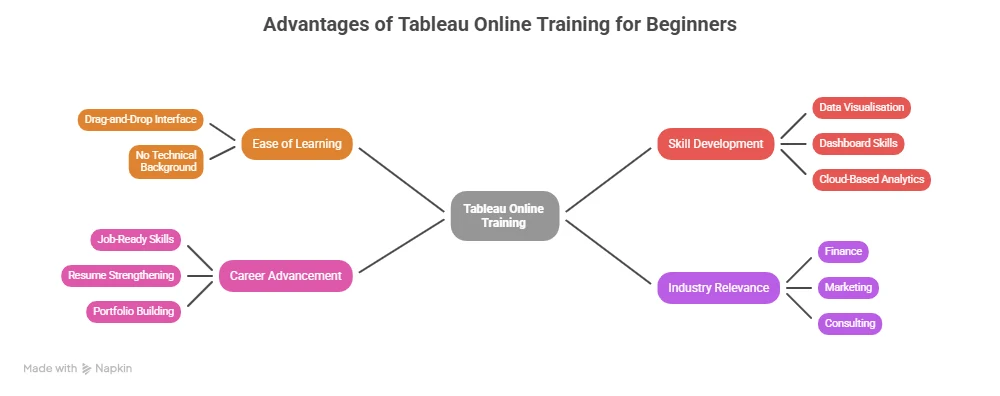
Where most beginners go wrong is trying to do too much too soon. They open Tableau, see advanced dashboards on YouTube, and immediately try to build something complex. When it doesn’t work, they feel stuck or assume the tool is too technical. In reality, data analysis with Tableau becomes much easier when you take it step by step.
Step 1: Learn the visualisation basics in Tableau Public Online
Use Tableau Public online to:
- Connect Excel files
- Create bar charts and line charts.
- Build dashboards
Step 2: Learn Data Concepts and Practice Data Scenarios
Get familiar with Sales analysis, Customer segmentation, and working on Financial dashboards.
Understand:
- Joins
- Blends
- Calculated fields
- LOD expressions
Step 3: Simulate Corporate Publishing
Use trial access to:
- Publish dashboards
- Assign user roles
- Set refresh schedules
Step 4: Explore Cloud Publishing
If possible, get trial access to Tableau Online and publish sample dashboards. Ask yourself:
Can I connect data sources?
Can I create calculated fields?
Can I design an interactive dashboard?
Practising consistently matters more than watching tutorials.
Tableau Online Training
Now let’s talk about structured learning. There are multiple options to get the best Tableau training online:
- Self-paced video courses – This is a budget-friendly and flexible option which requires discipline.
- Instructor-led programs – These programs offer structured learning, live doubt-solving sessions, and also give project guidance.
- Corporate training – This training includes deployment concepts, governance, and cloud integration.
- Certification-focused programs – These dedicated programs help you to build conceptual and practical skills like desktop fundamentals, publishing workflows, cloud data management, performance optimisation, governance and security basics.
The key is choosing a course that includes:
- Hands-on projects
- Real datasets
- Cloud publishing practice
- Interview preparation
The best online Tableau courses don’t just teach buttons – it teaches business thinking.
Also Read: Why pursuing data analytics in Bangalore is the right choice.
Best Tableau Courses Online
When you start searching for the best Tableau courses online, it’s easy to get overwhelmed. There are dozens of options, different price ranges, flashy promises, and every course claims to be “industry-ready” or “job guaranteed.”
Naturally, most people do what seems practical – they compare prices first.
But here’s one mistake you should avoid: don’t choose a Tableau course based on price alone.
A cheaper course might save money today, but cost you time and opportunities later if it doesn’t actually build job-ready skills. On the other hand, an expensive course isn’t automatically better either. The real question isn’t how much the course costs – it’s what value you’re getting from it.
Think about why you’re learning Tableau in the first place.
Is it to add a strong skill to your resume?
Switch into analytics?
Grow in your current job?
If your goal is career growth, then the quality of training matters far more than the price tag.
A good Tableau course should help you understand real-world dashboards, cloud sharing through Tableau Online, and practical business use cases – not just basic charts. It should also give you hands-on projects and guidance that make you confident using the tool professionally.
So before enrolling anywhere, take a step back and evaluate the course properly.
Here’s what you should actually look at.
| Criteria | Why It Matters |
| Live Projects | Recruiters value application |
| Cloud Publishing Training | Important for Tableau Online |
| SQL Integration | Most data is stored in databases |
| Case Studies | Business storytelling |
| Placement Support | Crucial for beginners |
| Instructor Experience | Real-world insights |
| Curriculum Depth | Beyond basics |
| Certification Prep | Adds credibility |
The best online course for Tableau should cover Tableau Desktop + Tableau Online, include case studies, and teach dashboard storytelling.
Who Should Learn Tableau Online?
You should consider learning Tableau Online if you are:
- A commerce graduate.
- A BBA/B.Com student.
- An MBA aspirant.
- A finance professional.
- A marketing analyst.
- A data science beginner.
- An Operations Manager
- A MIS Executive
- An IT professional moving into analytics.
Cloud analytics is becoming standard. Companies don’t want dashboards stuck on someone’s laptop.
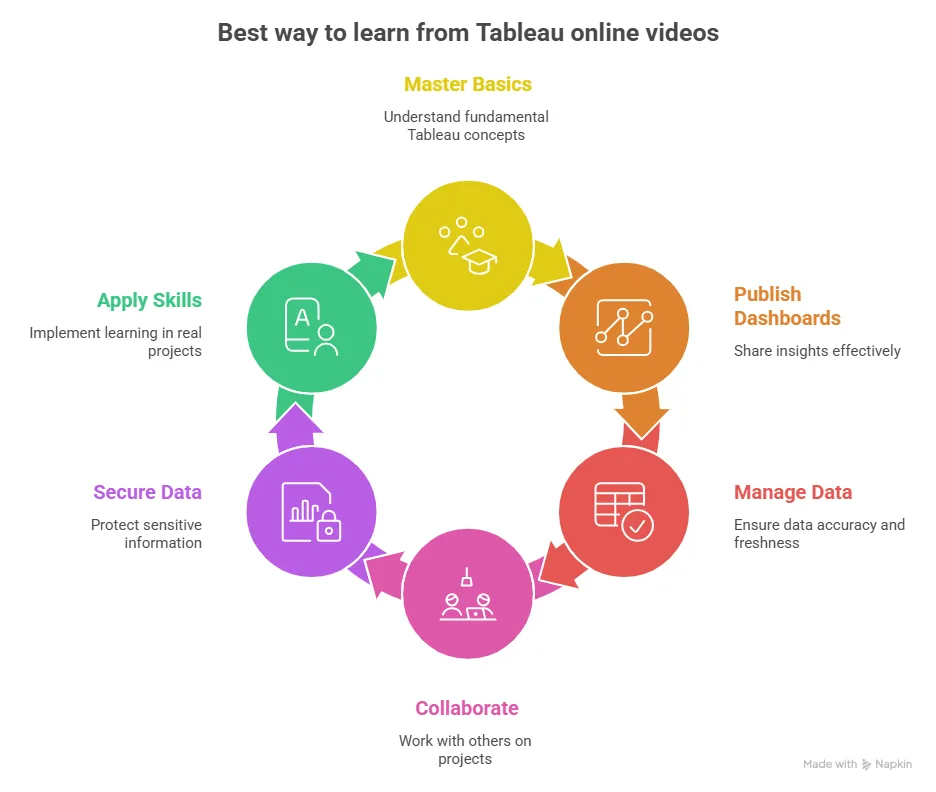
If you’re exploring careers in data and feeling confused between data science and data analytics. Watch this quick video to get a clear perspective on where data analytics, Tableau, and business intelligence fit compared to the broader world of data science.
Is Tableau Online Worth Learning
Here’s the honest answer: if your goal is to build a career in business intelligence, analytics, data visualisation techniques, or corporate reporting, then yes – learning Tableau Online is absolutely worth it.
These roles are not just about analysing numbers. They’re about communicating insights. Companies don’t make decisions based on raw data. They make decisions based on dashboards, trends, performance summaries, and visual reports that clearly show what’s happening. That’s where Tableau becomes powerful.
In real business environments, leaders want answers quickly.
What are the sales trends?
Which region is underperforming?
How did last month’s campaign perform?
They don’t want to dig through spreadsheets. They want visual clarity. And professionals who can create and share those dashboards – especially in cloud environments like Tableau Online stand out.
In corporate environments – especially in mid to large organisations – Tableau Online skills significantly improve employability. Recruiters increasingly look for candidates who understand not just how to build dashboards, but also how to publish, share, and manage them in cloud platforms. That practical, business-ready knowledge makes a difference.
So be strategic. Choose Tableau tools that match the career you’re building. If you’re heading toward business analytics and reporting, Tableau Online isn’t just useful – it’s a strong advantage.
Also Read: Why you should pursue data analytics in Chennai?
Career Scope and Salary for Tableau Online Skills
Every company talks about being “data-driven,” but what they really need are people who can make sense of all that information. Not just spreadsheets full of numbers, but clear dashboards that tell a story. That’s exactly where Tableau Online skills come into the picture.
Earlier, data tools were mostly used by tech teams or hardcore analysts. Today, that’s no longer the case. Finance teams track performance dashboards. Marketing teams monitor campaign metrics. Sales teams review targets visually. Even HR teams use dashboards to understand hiring and attrition trends. Tableau Online makes this easier because it’s cloud-based – meaning teams can access and collaborate on dashboards from anywhere.
As more companies move to cloud systems, professionals who know how to create, manage, and share dashboards on Tableau are becoming increasingly valuable.
Let’s have a look at how Tableau enhances career prospects:
| Job Role | What you do | Typical Salary Range |
| Data Analyst | Creates dashboards, analyses data, and presents insights to teams. | ₹6.4 – 7.1 LPA |
| Business Intelligence (BI) Analyst | Tracks KPIs, builds performance dashboards, and supports business decisions. | ₹5.6 – 6.2 LPA |
| Data Visualisation Specialist | Designs interactive dashboards and visual data stories. | ₹12.5 – 13.8 LPA |
| Reporting Analyst | Builds automated reports and monitors business metrics | ₹5.7 – 6.3 LPA |
| Consultant or Freelancer | Implements Tableau solutions and trains teams/clients | ₹9.5 – 10.5 LPA |
Also Read: How students can turn Tableau skills into real career opportunities.
How Imarticus Learning Can Help You Learn Tableau Online
Imarticus Learning offers a Postgraduate Program in Data Science & Analytics that integrates business intelligence tools, including Tableau.
Here’s why students prefer Imarticus Learning:
- 100% Job Assurance or Money Back
- Industry-designed curriculum
- 25+ real-world projects
- Exposure to tools: Python, SQL, Tableau
- Capstone projects
- Resume building & interview prep.
- Dedicated career services
- Industry mentorship
- Live interactive sessions
- Strong alumni network
This isn’t just a Tableau course – it’s a full analytics pathway. If you want structure instead of random YouTube tutorials, structured programs accelerate progress.
FAQs About Tableau Learning
Before you start learning Tableau Online or investing in a course, you’d be curious about the tool and want to know whether it’s worth your time, money, and career effort. Here are some frequently asked questions students and working professionals ask the most.
Can I learn Tableau Online without a technical background?
Absolutely. Tableau is designed for business users. If you can understand Excel formulas, you can learn Tableau. The real skill isn’t coding – it’s understanding data and business logic.
How long does it realistically take to become job-ready in Tableau Online?
If you’re consistent, it might take you 2-3 months to learn basics, and 4-6 months to become interview-ready. It depends on the intensity of your practice. If you enrol in a reputed institute like Imarticus Learning, it can help you boost your preparation and become job-ready quickly.
Is Tableau Online different from Tableau Desktop in job interviews?
Yes. Interviewers may ask you: How do you publish dashboards? What is the exact refresh? Or, how do permissions work? Knowing Tableau Online makes you more industry-ready and allows you to answer these questions with more confidence.
Is Tableau certification necessary?
For entry-level jobs, it is not mandatory as skills matter more. But having a certification helps Freshers and career switchers in the resume shortlisting process for hiring.
Is Tableau Online better than Power BI?
Both Tableau and Power BI are strong tools. Tableau is preferred in many global consulting and enterprise firms. Power BI dominates Microsoft ecosystems. It is better to learn one deeply before jumping to both.
Can I do online Tableau practice for free?
You can practice visualisation using Tableau Public online. For a full cloud experience, you need trial or corporate access. It is not mandatory to have prior coding knowledge or experience to use the free tool. However, after gaining expertise, advanced users combine it with SQL or Python for deeper analytics.
What industries use Tableau Online?
Tableau Online is widely used in sectors like Banking, Consulting, Retail, Healthcare, E-commerce, and SaaS. Many businesses are shifting toward cloud-based analytics platforms, which means more business sectors and industries will expand or transition to Tableau Online.
Is Tableau still relevant in 2026?
Yes. Especially in cloud-based BI environments. While there isn’t a single public statistic for “Tableau Cloud experience” in job ads, industry demand trends show that skills in cloud analytics services and cloud-hosted BI tools are increasingly sought after by employers – especially as organisations shift data workloads to SaaS platforms.
Start Your Next Step with Tableau Online
By now, you might have realised that Tableau Online is not just a tool but a skill with the ability to enhance your career. If you’ve been thinking about building a future-proof skill, this is your sign to start learning. Data isn’t going anywhere. In fact, it’s only becoming more central to how businesses operate. The real question is – will you just work around data, or will you be the person who understands and presents it clearly?
Tableau Online gives you a practical way to step into the world of analytics without needing to be a coding expert. It helps you think visually, communicate insights confidently, and contribute real value to teams and organisations. Whether you’re a student planning your career or a working professional looking to upskill, this is a skill that pays off.
Don’t wait to add that skill to your resume. Start now. Learn the fundamentals, build real dashboards, practice with real datasets, and publish your work. Take the next step today by investing in the Postgraduate Program in Data Science and Analytics, and moving closer to the data-driven career you want.
