


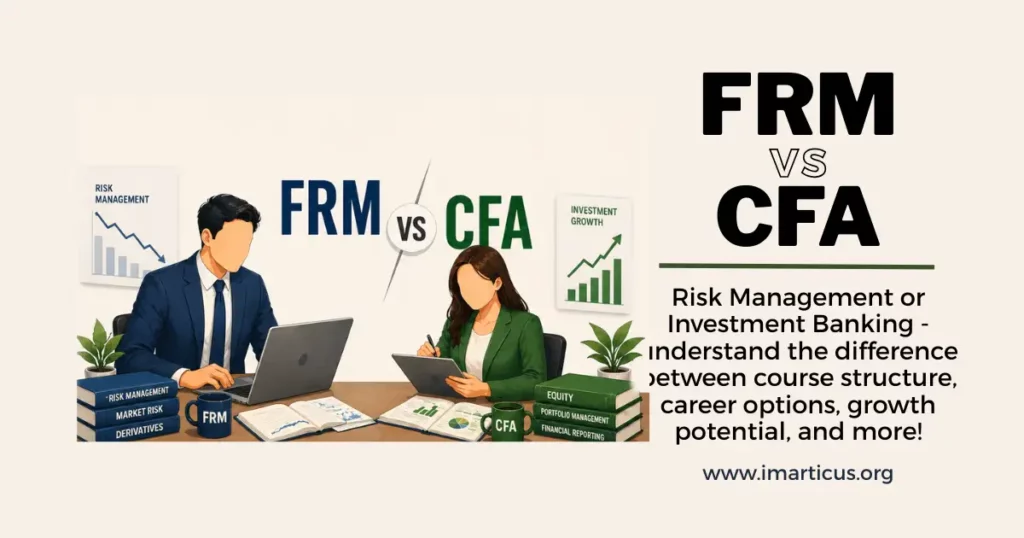
Last updated on June 22nd, 2026 at 04:59 pm
Let’s be real for a moment. If you’re in finance – or trying to break into it – the question of FRM vs CFA has probably come up more than once. Maybe your manager has one. Maybe your college senior is prepping for the other. Maybe you’ve been Googling this for the past hour, trying to figure out which one is actually worth your time and money.
And the honest answer? Both are worth it. But they’re worth it for very different reasons, for very different types of people, and for very different career paths. Whether you’re considering the FRM certification for risk management roles or the CFA for investment-focused careers, this blog gives you the complete and clear comparison of FRM vs CFA – covering everything from exam structure and pass rates to salary data, career opportunities, and the all-important question: which one should YOU pursue? We’ve done the research, gathered the numbers, and laid it all out so you can stop second-guessing and start planning.
Whether you’re a recent graduate, a working professional, or someone looking to pivot into finance, by the end of this blog, you’ll know exactly where you stand on FRM vs CFA. Let’s get into it.
What is the FRM Certification?
I’ve often seen people search and ask about: ‘What is FRM?’ The Financial Risk Manager (FRM) is the world’s leading certification for financial risk management professionals, awarded by GARP – the Global Association of Risk Professionals. It’s the credential that tells the world you know risk – not just in theory, but in practice.
Don’t Let Our Best Advice Get Buried
Add Imarticus as a Preferred Source — see more of what we publish, every time you search.

When you see an FRM designation after someone’s name, it means they’ve demonstrated the ability to identify, measure, monitor, and manage risk in complex financial environments. That’s exactly the kind of expertise that banks, insurance companies, investment firms, and regulators are constantly looking for.
The FRM is a two-part, computer-based examination – and unlike many professional qualifications, it has no formal educational prerequisites. You don’t need a specific degree to register. What it does demand is rigorous preparation, a strong quantitative foundation, and a commitment to truly understanding how risk works in the real world.
Here’s what makes the FRM stand out:
- It is recognised by 97,000+ certified professionals across 190+ countries and regions
- It is the go-to credential for risk functions at banks, NBFCs, hedge funds, and regulatory bodies worldwide
- The FRM curriculum is reviewed and updated annually by a committee of leading risk practitioners – so the content stays current with evolving market risks, regulatory changes, and emerging areas like climate risk and cryptocurrency risk.
- It can be completed in as little as 1-2 years, making it one of the fastest routes to a globally recognised finance designation.
- The 2-year work experience requirement (for full certification) is flexible – you can complete it before, during, or within 10 years of passing your exam.s
If your career is at risk – or you want it to be – the FRM is not just a nice-to-have. In many financial institutions today, it’s becoming the expected credential for serious risk professionals.
Everything you need to start your FRM journey is closer than you think. From costs to career scope, getting the full picture could be the first step toward a future you’ve been building toward all along.
What is the CFA Certification?
Students often begin their research by searching for: ‘What is CFA? ‘ The Chartered Financial Analyst (CFA) is arguably the most widely recognised investment credential in the world, awarded by the CFA Institute. It’s the designation that investment professionals, portfolio managers, equity researchers, and wealth advisors pursue when they want to signal the deepest level of competence in investment analysis and portfolio management.
With 190,000+ charterholders across the globe, the CFA is more than a certification – it’s a community, a standard, and for many employers, a non-negotiable requirement for senior investment roles.
The CFA is a three-level program that builds progressively – from foundational investment tools at Level 1, through asset valuation at Level 2, to portfolio management and wealth planning at Level 3. It covers ten broad topic areas, and the sheer volume of content means candidates typically invest 900-1,000 hours across their study journey.
Here’s what defines the CFA:
- A comprehensive curriculum spanning equities, fixed income, derivatives, alternative investments, portfolio management, economics, and financial reporting.
- Strong emphasis on ethics and professional standards – tested at all three levels.
- Globally respected – sought after in investment banking, asset management, equity research, hedge funds, and wealth management.
- A 4-year relevant work experience requirement to receive the charter (can be completed before, during, or after the exam).
- A rigorous multi-year commitment that filters for only the most dedicated finance professionals.
The CFA is the definitive credential for anyone serious about investment finance. If portfolio management, equity research, or investment banking is where you want to go, the CFA is built exactly for you.
Some career decisions have the power to change everything. If finance is your calling, discovering why one globally respected credential continues to open the biggest doors might just be the sign you needed.
FRM vs CFA at a Glance
Before we dig into the details, here’s the big picture – every major parameter compared side by side.
| Parameter | FRM Certification (Financial Risk Manager) | CFA (Chartered Financial Analyst) |
| Awarding Body | GARP (Global Association of Risk Professionals) | CFA Institute |
| Primary Focus | Risk management (market, credit, operational, liquidity risk) | Investment analysis, portfolio management, corporate finance |
| Study Hours Required | ~400-500 hours (total) | ~900-1,000 hours (total) |
| Global Recognition | 97,000+ FRM-certified professionals across 190+ countries | 190,000+ CFA charterholders worldwide |
| Best Career Paths | Risk analyst, credit risk, compliance, treasury roles | Portfolio manager, equity research, investment banking, wealth management |
Key takeaway: FRM is specialised, faster, and highly quantitative. CFA is broad, more comprehensive, and deeply respected in investment finance. Both are world-class credentials – the right choice depends entirely on your career direction.
FRM vs CFA Eligibility Criteria
One of the most common questions candidates have is simply: ‘Am I eligible?’ Here’s the good news – both FRM and CFA are designed to be accessible.
| Criteria | FRM Certification | CFA |
| Education | No formal requirement | Bachelor’s degree or final-year student |
| Work Experience (to register) | Not required | Not required (needed for charter) |
| Age Limit | None | None |
| Student Eligibility | Yes | Yes (final year only) |
| Experience (for certification) | 2 years in risk management | 4,000 hours (~4 years) in investment roles |
| Experience Timing | Before/during/after exams (within 10 years) | Before or after all 3 levels |
| Ethics Requirement | GARP Code of Conduct | CFA Institute Code of Ethics |
For FRM: There are no educational or professional prerequisites whatsoever to sit the exam. You can be an undergraduate student, a working professional, or a career changer – GARP welcomes everyone. The only requirement for the full FRM certification (the designation) is 2 years of relevant work experience, which can be completed before, during, or after your exams.
For CFA: You’ll need a bachelor’s degree (or be in your final year) to register for Level 1. The full charter requires 4 years of relevant investment decision-making experience – but this can be accumulated at any point in relation to your exams. Many candidates pass all three levels before fulfilling the full experience requirement.
The open eligibility of both programs makes them genuinely accessible – but don’t mistake accessibility for ease. Both exams demand serious, structured preparation.
FRM vs CFA Exam Structure
Understanding the exam structure is one of the most important steps when comparing FRM vs CFA. Here’s a clear breakdown to help you understand what to expect.
FRM Exam Structure
The FRM exam has two parts, both delivered via computer-based testing (CBT) at authorised centres globally. You must pass Part 1 before sitting Part 2 – and the exam windows are offered three times a year in May, August, and November.
| Criteria | FRM Part I Exam | FRM Part II Exam |
| Exam Format | Computer-based MCQs | Computer-based MCQs |
| Number of Questions | 100 questions | 80 questions |
| Exam Duration | 4 hours | 4 hours |
| Topics Covered | Foundations of Risk Management, Quantitative Analysis, Financial Markets & Products, Valuation & Risk Models | Market Risk, Credit Risk, Operational Risk, Liquidity & Treasury Risk, Risk in Investment Management, Current Issues in Financial Markets |
The exam is entirely multiple choice – but don’t let that fool you. The questions are heavily application-based, scenario-driven, and require genuine mastery of the concepts. There’s very little room for rote theoretical recall.
- Part 1 is all about building your toolkit – the fundamental concepts and quantitative methods used in risk assessment. Think probability distributions, risk measures like VaR and Expected Shortfall, derivatives pricing, and the theoretical underpinning of risk models.
- Part 2 is where you apply that toolkit. It’s more practical and scenario-driven – covering how real financial institutions manage market risk under Basel frameworks, how credit risk is assessed and mitigated, how operational risk events are classified and controlled, and how liquidity risk is managed under stress conditions.
CFA Exam Structure
The CFA program has three levels, each building progressively on the previous one. All three levels are computer-based, and while Level 1 can now be taken up to three times a year, Levels 2 and 3 are offered twice annually.
| Parameter | Level 1 | Level 2 | Level 3 |
| Exam Format | MCQ (180 questions, 2 sessions) | Item set (vignette-based MCQs) | Item sets + essay |
| Focus Area | Investment tools, ethics, basics | Asset valuation, financial reporting | Portfolio management, wealth planning |
| Study Hours | ~300 hours | ~300 hours | ~300 hours |
What distinguishes CFA Level 3 – and what makes it uniquely challenging – is the constructed response format (essay questions). Candidates must articulate well-reasoned, clearly written portfolio management recommendations, not just pick the right answer. This demands a different kind of preparation from CFA Levels 1 and 2.
Across all three levels, ethics is embedded, tested at every level and weighted meaningfully. The CFA Institute takes professional ethics extremely seriously, and so does the exam.
Exam format insight: FRM uses 100% MCQ (application-heavy, quantitative). CFA uses MCQ at Levels 1 and 2, then adds essay-style constructed response at Level 3. Both require deep understanding – surface-level revision won’t be enough for either.
If FRM is one of the paths you’re considering, use these FRM sample papers to understand how risk management concepts are applied and assessed throughout the qualification.
DOWNLOAD HERE: FRM Exam Paper
FRM vs CFA Duration
Time is arguably the biggest practical difference between FRM and CFA. And it matters – a lot – when you’re planning your career trajectory.
| Factor | FRM Certification | CFA |
| Typical Completion Time | 1-2 years | 3-4 years (average) |
| Exam Attempts per Year | 3 windows (May, Aug, Nov) | Level 1: up to 3; Level 2 & 3: twice/year |
| Minimum Duration | ~6 months (both parts in the same year) | ~2.5 years (all levels cleared first attempt) |
| Study While Working | Manageable (200–240 hrs/part) | Demanding (300+ hrs/level) |
| Mandatory Training | None | None |
| Work Experience Deadline | Within 10 years of passing Part 2 | Required for charter (before or after exams) |
FRM: Most candidates complete both parts within 12-18 months. The exam windows are three times a year, meaning you can attempt Part 1 and Part 2 in the same calendar year if you’re well-prepared. There’s no mandatory training period running in parallel – you can study while working full-time and qualify relatively quickly. The 2-year work experience requirement can be submitted before or after passing, giving you flexibility.
CFA: The minimum possible timeline for CFA is around 2.5 years – but the average candidate takes 3-4 years, and many take longer. With 300+ study hours per level, the CFA demands a sustained multi-year commitment that requires exceptional time management alongside a full-time career.
For candidates who want a globally recognised credential sooner rather than later, the FRM’s shorter timeline is a genuine advantage. For those who are playing a longer game and want the most comprehensive investment credential in the world, the CFA’s duration is a worthwhile investment.
Also Read: Everything you need to know about the FRM course duration before you enrol.
FRM vs CFA Cost Comparison
Let’s talk numbers – both in terms of what you’ll spend and what you’ll get back.
| Cost Component | FRM (INR Approx.) | CFA (INR Approx.) |
| One-Time Enrollment Fee | ₹33,000 | ₹29,000 (Level 1 only) |
| Exam Fees (Early) | ₹50,000 per part | ₹75,000 per level |
| Exam Fees (Standard) | ₹67,000 per part | ₹1,00,000 per level |
| Total Exam Fees | ₹1.2 – 1.7 lakhs | ₹2.6 – 4.1 lakhs |
| Coaching (Imarticus Programs) | ₹75,000 – ₹1.2 lakhs | ₹1.2 – 2.5 lakhs |
| Study Material (Included in Program) | Included | Included |
| Total Investment (All-In) | ₹2 – ₹3 lakhs | ₹4 – ₹6.5 lakhs |
- FRM is the more affordable certification – significantly so. The total investment for an Indian candidate is typically in the ₹1.8-2.5 lakh range, including exam fees, enrollment, and coaching. The 3-exam-window structure also means you’re less likely to wait long before attempting a retake, reducing time-based costs.
- CFA is a larger financial investment – reflecting its longer duration and three-level structure. Total costs for an Indian candidate typically range from ₹3.5-5.5 lakhs, including fees, materials, and coaching. Early registration is strongly recommended for both programs – the savings are substantial.
Cost vs ROI: FRM is more affordable and delivers ROI faster (1–2 years post-qualification). CFA costs more and takes longer, but tends to command higher lifetime earnings in investment roles. Both offer strong return on investment – the question is which path aligns with your career goals.
FRM vs CFA Pass Rates
Pass rates are one of the most searched-for data points in FRM vs CFA comparisons – and they can be both illuminating and misleading. Here’s the real picture.
| Parameter | FRM Certification | CFA |
| Level 1 Pass Rate | ~45-55% (Part 1) | ~40-45% |
| Level 2 Pass Rate | ~55-60% (Part 2) | ~45-50% |
| Level 3 Pass Rate | N/A | ~50-55% |
| Overall Completion Rate | ~35-40% | ~20-25% |
| Retake Policy | Retake only the failed part | Retake only failed level |
| Credit Validity | Part 2 within 4 years of Part 1 | No time limit between levels |
| Negative Marking | No | No |
FRM pass rates are notably higher than CFA at a per-exam level – roughly 45-55% for Part 1 and 55-60% for Part 2 in recent years. This reflects the focused, two-part structure and the fact that FRM attracts a self-selected pool of candidates who are already working in financial risk or adjacent fields.
CFA pass rates are lower – around 40-45% per level – and the overall completion rate (passing all three levels) is only around 20-25%. Level 1 acts as the biggest filter. The multi-year commitment also means that dropout rates are higher, which distorts some pass rate statistics.
What both programs share: neither has negative marking, both allow candidates to retake failed sections/levels independently, and both use a pass/fail grading model without a published minimum score.
Bottom line on pass rates: FRM is more likely to be cleared within 2 years of starting. CFA has greater cumulative difficulty due to its length and volume. Neither is a walkover – structured preparation is essential for both.
Also Read: Smart strategies for planning your FRM fees.
FRM vs CFA Subjects
What will you actually study? This is where the two certifications diverge most clearly – in both philosophy and depth.
| Subject Area | FRM Certification | CFA |
| Quantitative Methods | Heavy (calculus, stats, VaR) | Moderate (stats, regression) |
| Financial Markets & Products | Deep (derivatives, fixed income) | Broad (equities, FI, derivatives) |
| Risk Management | Core focus (all risk types) | Limited (not primary focus) |
| Ethics | GARP Code of Conduct | Strong focus (all levels) |
| Portfolio Management | Risk-focused (Part 2) | Core subject (esp. Level 3) |
| Equity & Corporate Finance | Limited | Extensive (valuation, FSA) |
| Economic Analysis | Moderate (macro risk) | Moderate (dedicated topic) |
| Current Issues | Yes (Part 2 topics) | Integrated, not standalone |
| Mathematical Depth | Very high | Moderate |
| Coverage Style | Specialised (depth-focused) | Broad (10 topic areas) |
FRM Curriculum:
- The FRM curriculum is purpose-built for risk. Every subject ties back to identifying, measuring, monitoring, or managing financial risk.
- The quantitative depth is genuinely advanced – candidates deal with Value at Risk models, copula functions, credit default swaps, Monte Carlo simulations, and regulatory frameworks like Basel 3 and FRTB.
- If you enjoy working at the intersection of mathematics and real-world financial systems, the FRM curriculum will engage you deeply.
CFA Curriculum:
- The CFA curriculum is purposefully broad. Ten topic areas, three progressively complex levels, and a strong emphasis on ethical practice make it the most comprehensive general finance qualification available.
- It’s designed to produce well-rounded investment professionals who can analyse securities, build portfolios, communicate recommendations, and act with professional integrity.
There is meaningful curriculum overlap – particularly in quantitative methods, financial markets and products, and fixed income. Candidates who complete one certification often find the other more manageable as a result. Around 35-55% of FRM Part 1 content overlaps with the CFA curriculum.
Also Read: Understanding the FRM syllabus can help you plan your study journey.
FRM vs CFA Difficulty
This is genuinely one of the most debated questions in finance certification communities – and the honest answer is: it depends on who you are.
Here’s how most candidates who have done both describe it:
- FRM feels more intense per session – the quantitative depth, the application-based questions, and the absence of theoretical ‘safe’ ground mean you can’t bluff your way through.
- CFA feels like a longer endurance test – the volume is enormous, the commitment spans years, and maintaining study momentum across Level 1, 2, and 3 while managing a career is a genuine challenge.
- Candidates with strong maths backgrounds tend to find FRM more manageable; candidates with broader finance backgrounds tend to find CFA more approachable.
- FRM’s 400-500 total study hours are less than half of CFA’s 900-1,000 hours, making the per-exam experience different, even if individual sessions feel equally demanding.
The verdict on difficulty: FRM is harder quantitatively – it demands comfort with advanced maths and risk modelling. CFA is harder in terms of sustained commitment – it’s a 3-4 year intellectual marathon across 10 topic areas. Neither is easy. Both reward those who prepare seriously and systematically.
The path to becoming a sought-after risk professional is more achievable than ever. If you’ve been sitting on the fence, this might be exactly the clarity and direction you’ve been waiting for.
FRM vs CFA Salary
Let’s address the question everyone is really asking. Here’s the salary data – with honest context.
| Experience Level | FRM Salary (India) | CFA Salary (India) |
| Entry Level (0-2 yrs) | ₹6 – 10 LPA | ₹6 – 12 LPA |
| Mid-Level (3-6 yrs) | ₹12 – 20 LPA | ₹12 – 25 LPA |
| Senior Level (7-12 yrs) | ₹22 – 40 LPA | ₹26 – 50 LPA |
| Leadership (CRO / CIO) | ₹50 – 80 LPA+ | ₹60 LPA- ₹1 Crore Per Annum+ |
| Average (Mid-Career) | ~₹18 – 25 LPA | ~₹22 – 30 LPA |
A few important nuances before drawing conclusions:
- CFA holders in investment roles – portfolio management, equity research, asset management – tend to earn slightly more on average. The CFA Institute reports average base salaries of ~$126,000 for portfolio managers in the US, with total compensation around $177,000.
- FRM holders in specialised risk roles at top banks and hedge funds can match or exceed CFA salaries – especially at senior levels where risk expertise commands premium compensation.
- In India, both credentials drive 20-35% salary premiums over non-certified peers in comparable roles.
- Role and sector matter as much as the credential – an FRM-holder in credit risk at a top bank will often out-earn a CFA-holder in a mid-tier investment advisory firm.
- The combination of FRM + CFA is increasingly considered one of the most powerful professional profiles in finance – professionals with both regularly command top-of-the-band compensation.
To summarise: CFA has a marginally higher average salary ceiling in investment roles. FRM has a very strong and growing salary trajectory in risk roles. Both certifications deliver significant ROI. Choose based on your career path – not just the salary data.
FRM vs CFA Global Recognition
Recognition – by employers, regulators, and industries – is ultimately what gives a certification its career value. Here’s how FRM and CFA compare across geographies and roles.
| Dimension | FRM Certification | CFA |
| Nature of Difficulty | Quant-heavy, model-driven | Broad syllabus across 3 levels |
| Question Style | Application-based, scenario-driven | Mix of conceptual + analytical |
| Mathematics Required | Advanced (probability, VaR, risk models) | Moderate (stats, valuation) |
| Total Study Hours | ~400-500 hours | ~900-1,000 hours |
| Study Hours per Level | ~200-240 hours/part | ~300 hours/level |
| Who Finds It Harder? | Those weak in maths | Those lacking time or finance basics |
| Exam Pressure | Intense but shorter journey | Long-term, multi-year commitment |
| Overall Difficulty | High (quant-focused) | High (endurance-focused) |
- FRM’s global footprint is growing rapidly. GARP reports 97,000+ FRM-certified professionals across 190+ countries.
- CFA’s global recognition is unmatched in investment finance. With 190,000+ charterholders globally, the CFA charter is the definitive mark of investment expertise.
The key insight: these credentials are not competing for the same turf. FRM dominates in risk and compliance; CFA dominates in investment and portfolio management. Knowing which world you want to operate in will make your choice clear.
Also Read: Essential factors that help you boost your FRM salary in India.
FRM vs CFA Career Opportunities
Here’s where the rubber meets the road – what jobs do these certifications actually unlock?
| Job Role | FRM Certification | CFA |
| Financial Risk Manager | Primary fit | Supportive |
| Chief Risk Officer (CRO) | Industry standard | Complementary |
| Credit Risk Analyst | Core role | Overlap |
| Market Risk Analyst | Core role | Overlap |
| Operational Risk / Compliance | Strong fit | Limited |
| Portfolio Manager | Adds risk perspective | Core role |
| Equity Research Analyst | Limited | Core role |
| Investment Banking | Niche use | Strong fit |
| Asset / Wealth Management | Adds risk lens | Core role |
| Treasury & ALM | Excellent fit | Useful |
| Quant / Model Validation | Strong fit | Moderate fit |
| Regulatory (Basel / FRTB) | Top credential | Limited fit |
FRM vs CFA: Who Should Choose What?
Stop overthinking it. The right choice depends on your career goals, strengths, and timeline.
Choose FRM If:
- You want to specialise in risk management (market, credit, operational, liquidity)
- You’re targeting banks, NBFCs, insurance firms, or regulatory roles
- You’re comfortable with quantitative analysis, models, and formulas
- You want a faster certification (1-2 years)
- You’re already in finance and want to deepen risk expertise
- You want a globally recognised risk credential (FRM certification by GARP)
Choose CFA If:
- You want a broad finance career (investment, portfolio management, analysis)
- You’re aiming for asset management, equity research, IB, or wealth advisory
- You enjoy markets, valuation, and strategy
- You’re ready for a 3-4 year commitment
- You’re early in your career and want a comprehensive finance foundation
- You want the most widely recognised investment credential globally
Still Confused? Use These Real Scenarios
- In credit risk at a bank? → FRM fits directly
- Finance graduate targeting equity research or IB? → CFA is the better path
- Working in treasury/compliance? → FRM strengthens your current role
- Already have CFA and want leadership roles? → Add FRM for risk depth
- New to finance? → Start with CFA, consider FRM later
Can You Do Both FRM and CFA?
Yes, and many top professionals do. The FRM + CFA combination is one of the most powerful profiles in finance because it blends:
- Risk expertise (FRM)
- Investment expertise (CFA)
Why FRM + CFA Works
- Covers both risk and return – critical for senior roles
- Strong fit for CRO, CFO, and leadership positions
- Highly valued in global banks, hedge funds, and MNCs
- Combines quant depth (FRM) with investment breadth (CFA)
Who Benefits the Most?
- Portfolio managers adding risk expertise
- Risk professionals moving into investment roles
- Professionals targeting hedge funds, PE, or global banks
- Those working in Basel/regulatory roles transitioning to the front office
What This Combination Signals to Employers
- You understand both investments and the risks behind them
- You can make decisions at the risk–return intersection
- You’ve completed two of the toughest global finance certifications
Best Strategy: Which One First, FRM or CFA?
Start with FRM, then move to CFA.
- FRM builds a strong base in probability, statistics, and risk models
- This makes CFA’s quantitative sections easier to handle
- Overlap in financial markets reduces overall study time.
Many candidates choose to do CFA first and then pursue FRM. So, it’s completely up to you. There’s no fixed rule, but just.
Pro Tip:
- If you’re planning to pursue FRM certification or CFA, structured guidance can save you months of trial and error.
- Choose a program that aligns with your background and helps you transition efficiently – especially if you’re doing both.
Also Read: Skills and strategies you need for FRM jobs.
Why Choose Imarticus Learning for FRM or CFA?
Choosing the right preparation partner is almost as important as choosing the right certification. At Imarticus Learning, they’ve built programs for both the FRM course and the CFA that are designed for ambitious Indian finance professionals – whether you’re just starting or looking to level up a career already underway.
They don’t just teach the curriculum. They teach you how to think like a risk manager or an investment analyst – which is exactly what the exams and your future employers are testing.
- Expert Faculty (FRM-certified & CFA charterholders) – Learn from professionals who’ve cleared the exams and work in the industry.
- Structured Study Plan (FRM Parts & CFA Levels) – Clear roadmap from registration to results – no wasted time.
- Practice Question Banks + Mock Exams – Simulate real exam conditions and identify weak areas early.
- Flexible Learning Options (Live, Recorded, Hybrid) – Study alongside your job without disrupting your schedule.
- Dedicated Doubt-Clearing Sessions – Get expert help whenever you’re stuck.
- Exam Strategy Coaching – Learn time management, question prioritisation, and scoring techniques.
- Placement Support & Career Mentoring – Prepare for real job roles, not just exams.
- Alumni Network (350,000+ learners) – Access referrals, peer learning, and industry connections.
FRM is one of the fastest routes to a globally recognised risk management credential – and Imarticus Learning gives you the structured coaching, practice materials, and expert mentorship to get there efficiently.
FAQs About FRM vs CFA
Choosing between FRM and CFA often raises practical questions around difficulty, salary, eligibility, and career outcomes. Here are the most frequently asked questions – answered clearly to help you make the right decision.
Is FRM harder than CFA?
Both are challenging – but in different ways. FRM certification is harder quantitatively, with advanced maths and application-heavy questions. CFA is harder in terms of breadth and time commitment, spanning 3 levels over 3-4 years. Many candidates say FRM feels more intense per exam, while CFA feels like a long-term marathon.
Can I do FRM and CFA together?
Technically, yes, but it’s not recommended. The combined workload can be overwhelming. A smarter approach is to complete one first – typically FRM in 12-18 months, then move on to CFA (or vice versa based on your career path).
Which is better for salary – FRM or CFA?
CFA professionals tend to earn slightly higher on average, especially in investment roles. However, FRM professionals in senior risk roles (banks, hedge funds) can match or exceed those salaries. Your role and industry matter more than the certification alone.
Is FRM worth it in India in 2026?
Yes. Demand for risk professionals in India is rising due to RBI regulations, Basel norms, and global banking expansion. FRM-certified professionals often command 20-35% higher salaries compared to non-certified peers.
Which should I do first – FRM or CFA?
If you are already working in risk, start with FRM. If you are targeting investment roles, start with CFA. If you are unsure, FRM is faster and helps you gain a credential sooner. Imarticus Learning can help you get career guidance and choose the right course for you.
Does CFA cover risk management?
Yes, but only from an investment perspective (portfolio risk, derivatives). FRM goes deeper, covering market risk, credit risk, operational risk, liquidity risk, and regulatory frameworks.
Can I get an FRM job without work experience?
You can take the FRM exams without experience. However, to earn the FRM designation, you need 2 years of relevant risk management experience. Many candidates complete this while working after passing the exams.
FRM vs CFA: The Choice That Defines Your Career
FRM and CFA aren’t competing choices – they’re career-direction decisions. If you’re drawn to risk, banking, and regulatory roles, the FRM course is the smarter, faster path with growing demand. If you’re aiming for investment careers like portfolio management or equity research, CFA offers broader opportunities and stronger global recognition.
At the end of the day, neither is universally “better.” The right choice depends on where you want to go in finance. And if you’re thinking long-term, combining both can give you a rare edge – covering both risk and investment, which is exactly what leadership roles demand. Choose based on your career path, commit fully, and focus on building real skills – not just collecting certifications.
Liked This? Follow Us Where You Already Search.
Preferred Sources is Google’s built-in follow button — no app, no login, just more Imarticus in your results.
