



Last updated on March 24th, 2026 at 12:39 pm
Last Updated on 1 week ago by Rina Chouhan
Three years ago, if you told someone you were looking for a data analytics course in Lucknow, they would have suggested you move to Bengaluru. That advice no longer holds. The city has changed faster than most people outside of it have noticed.
Gomti Nagar now has IT offices. The UP government’s digital push has created an entirely new category of public sector data roles. Regional banks, hospital chains, and the city’s giant coaching industry are all sitting on data they cannot fully use yet. The analysts who can make sense of that data are in short supply locally. That gap is your opportunity.
Entry-level analysts here earn between ₹3.2-5.5 LPA. Three years in, that number looks very different. The ceiling moves quickly for people who build the right skills early.
What makes this moment worth paying attention to is simple. Employer demand in Lucknow is outpacing the local supply of trained analysts. That gap will not stay open indefinitely. The students who complete a serious programme in the next twelve months are stepping into a hiring environment that is still in their favour.
Most people searching for a data analytics course in Lucknow already know they want the career. What they are not sure about is which program is worth the fees, which ones actually place their students, and whether their background is the right fit. This guide covers the full picture with an honest breakdown of what to look for, what to avoid, and how to make this decision without second-guessing yourself later.
Who is the Data Analytics Course in Lucknow is Actually For
Put aside the idea that data analytics belongs to engineers. Walk into any cohort running data analytics courses in Lucknow today, and you will find a BCom graduate sitting beside a mechanical engineer. Both are learning the same SQL query. Neither has an unfair advantage at that stage.
Commerce students often grasp financial datasets faster because they already understand what the numbers represent. Science graduates pick up statistics with less friction. Humanities students tend to present findings more clearly because they are trained to construct arguments for non-expert audiences. The profiles most commonly seen in serious programmes:
- BCom, BBA, BSc, and BA graduates who want a career with a clear skill ladder and strong salary growth.
- B.Tech and BCA graduates targeting analytics roles over software development.
- Working professionals in finance, marketing, or operations aiming for a career switch or a promotion that requires data credibility.
- MBA holders who want technical depth behind their business understanding.
If you are a non-IT fresher, the barrier to entry is lower than you think. SQL reads more like filtered logic than code. Python for data analysis is far friendlier than the word “programming” suggests.
Also Read: What’s Driving 93% of Companies Toward Data Analytics by 2030?
Syllabus of a Data Analytics Course in Lucknow
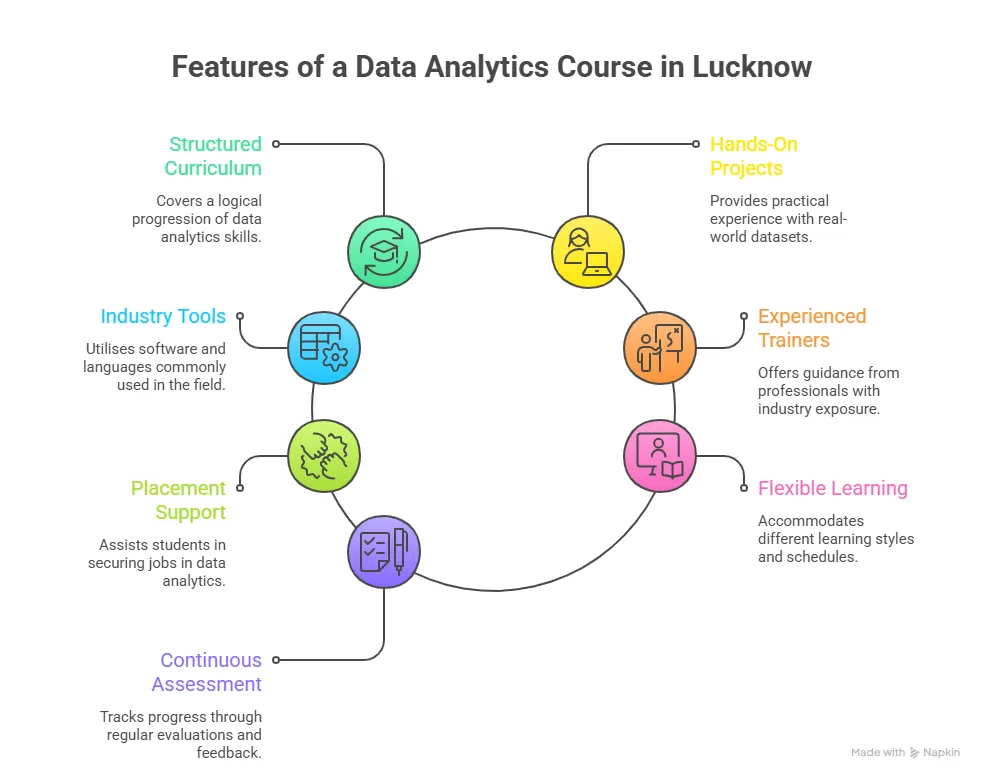
Every course brochure lists the same tools. Excel, SQL, Python, Power BI, Tableau. The list alone tells you nothing. What matters is how deeply each tool is taught and whether the learning is applied to real, messy datasets or only demonstrated through clean tutorial examples.
Real datasets have missing values, inconsistent formatting, and columns that make no sense until you understand the business context. Tutorial datasets do not. The ability to handle the real kind is what interviews test for. The table below shows the core modules, what each one actually builds in you, and how much time a serious program typically dedicates to each.
| Module | What It Builds | Approx. Duration |
| Excel and Statistics | Data reasoning, pivot analysis, descriptive stats | 3 to 4 weeks |
| SQL | Database querying, joins, and data extraction logic | 4 weeks |
| Python for Data Analysis | Data cleaning, manipulation, and visualisation | 5 to 6 weeks |
| Power BI and Tableau | Business dashboards, stakeholder reporting | 3 to 4 weeks |
| Machine Learning Basics | Regression, classification, model evaluation | 4 weeks |
| Capstone Project | End-to-end analysis on a real business dataset | 3 weeks |
An advanced data analytics course in Lucknow extends this further into predictive analytics, cloud data tools like Google BigQuery and AWS Redshift, and sector-specific case studies in banking, healthcare, and retail. If you are targeting a senior analyst or data science role within two years of course completion, the advanced track is the right investment.
A closer look at what data analysts actually work on can help bridge the gap between learning skills and applying them in real-world roles.
Fees Related to a Data Analytics Course in Lucknow
The fee range across data analytics courses in Lucknow is wide enough to suit different financial situations. The short certificate programmes are accessible starting points. The longer diploma and PG-level programmes offer more structured learning and stronger placement support, which tends to produce better outcomes in the job market.
| Programme Type | Fee Range (INR) | Duration |
| Data Analytics Certificate Course | ₹15,000 – ₹35,000 | 2 to 3 months |
| Diploma or PG Programme | ₹60,000 – ₹1,20,000 | 6 to 9 months |
| Advanced Specialisation | ₹1,20,000 – ₹2,50,000 | 9 to 12 months |
| Executive Programme (IIM-style) | ₹2,50,000 – ₹5,00,000 | 6 to 12 months |
A data analytics certificate course in Lucknow works well as a first step if you want to confirm the field suits you before committing more money and time. The practical limitation is that certificate-only credentials carry less weight with recruiters than a full diploma or PG programme. If a career switch is the goal, the longer format gets you there faster.
Interesting Insight→ Entry-level data analysts in Lucknow earn between ₹3.2 LPA and ₹5.5 LPA. With two to three years of experience, the salary climbs to ₹7 LPA to ₹12 LPA depending on the sector and company size.
Big Data Analytics Courses in Lucknow
The phrase “big data” puts people off. It sounds like something only Amazon or the government deals with. In practice, any organisation processing millions of records that a single laptop cannot handle comfortably is working with a big data infrastructure.
A logistics company managing deliveries across twenty UP districts. A cooperative bank processes ten thousand loan applications a month. A hospital chain tracking patient flow across eight facilities. All of these are big data problems, and all of them exist in and around Lucknow right now.
Big data analytics courses in Lucknow prepare you to work at that scale. The tools shift from Excel or a Power BI tool to Apache Spark, Hadoop, and cloud platforms like AWS and Google BigQuery. The underlying analytical thinking is the same. The infrastructure just handles volume that desktop tools cannot.
For students targeting roles in banking, logistics, or government data projects, adding big data skills to your profile moves you into a smaller, higher-paid talent pool. Fewer candidates are trained for these roles, which translates directly into faster hiring and better starting salaries.
Interesting Insight→ The global big data analytics market is projected to reach $745 billion by 2030, growing at 13.5% annually. India’s contribution to that growth is accelerating faster than the global average.
The IIM Lucknow Question for a Data Analytics Course in Lucknow
IIM Lucknow carries genuine brand weight in the analytics space. A data analytics course in IIM Lucknow is built for a very specific audience: working professionals with several years of experience who want to move into analytics leadership, management consulting, or corporate strategy functions.
These programmes are case-study intensive. The peer learning environment is as valuable as the formal instruction. The discussions in class assume you are drawing on real professional experience, not hypothetical scenarios from a textbook.
For a senior finance manager at 32 who wants to pivot into a Chief Analytics Officer track, the IIM executive programme is a sound investment. For a 21-year-old BCom graduate looking for their first analytics job, it is the wrong starting point. The programme is not designed for that entry point, and the return on investment will be slower.
The broader lesson here is that prestige and fit are different things. The right programme is the one designed for where you currently are, not the one with the most impressive name attached to it.
Also Read: How Long Does It Really Take to Become Job-Ready in Data Science?
How to Choose a Data Analytics Certificate Course in Lucknow
Institute websites all look the same. “Industry-aligned curriculum.” “Expert faculty.” “100% placement support.” These phrases appear on nearly every page. They have been repeated so many times that they carry no information anymore.
Questions to Ask About the Curriculum:
Ask when the syllabus was last updated and request the current version in writing. Check whether the tools being taught match the ones appearing in current job listings on Naukri and LinkedIn. Ask whether live projects use real industry datasets or pre-cleaned classroom files.
Questions to Ask About Faculty:
Find out whether instructors are currently working in the analytics industry or are exclusively academic. Ask if you can attend one live demo session before enrolling.
Questions to Ask About Placement:
Ask for the percentage of students placed within six months of the last two batches. Ask for company names and verify them through alumni on LinkedIn. Ask whether placement support has a cutoff date or continues until the student is placed.
Questions to Ask About Structure:
Find out the batch size. Anything above 35 students starts to reduce individual attention meaningfully. Ask whether session recordings are available if you miss a class. Ask whether there is a dedicated mentor assigned to you or just a general support channel.
Also Read: Is Data Science a Good Career Path for Freshers?
Career Paths in Data Analytics Course in Lucknow
One thing that gets glossed over is the variety of roles that open up after a well-completed analytics course. People assume it leads to one job called “data analyst.” The actual landscape is wider for data analytics careers.
The table below maps the most accessible post-course roles to the key skills each requires and the realistic starting salary range in India.
| Role | Core Skills Required | Starting Salary Range |
| Data Analyst | SQL, Excel, Power BI | ₹3.5 to 5.5 LPA |
| Business Analyst | SQL, communication, Excel | ₹4 to 7 LPA |
| Marketing Analyst | Google Analytics, Python, Excel | ₹3.5 to 6 LPA |
| Risk Analyst (BFSI) | SQL, statistics, Excel | ₹4.5 to 8 LPA |
| Data Engineer (after additional learning) | Python, Spark, cloud tools | ₹6 to 12 LPA |
BFSI is worth calling out specifically for Lucknow. Regional offices of SBI, PNB, and Bajaj Finance actively hire analysts for credit risk, customer data, and fraud detection functions. These roles pay above the general analytics average at the entry level and have a steady growth path.
Preparing for interviews goes beyond learning tools; it’s about understanding how to apply concepts in real scenarios. This kind of insight helps you align your preparation with real interview standards and build confidence for the hiring process.
Industries Hiring Students from the Data Analytics Course in Lucknow
Generic “the market is booming” statements do not help you prepare. Knowing which sectors in Lucknow are actively hiring lets you build a portfolio that speaks directly to the recruiters you will actually face.
- Banking and Financial Services: It is the most consistent source of analytics hiring in the city. Credit risk modelling, customer segmentation, and collections analytics are live functions at multiple institutions with local offices.
- Healthcare: It is growing faster than most people outside the sector realise. Medanta Lucknow and regional diagnostic chains use data for patient flow management, bed occupancy analysis, and billing intelligence.
- Coaching and EdTech: These are uniquely large in Lucknow, given the city’s position in the competitive exam preparation industry. Student retention analysis, performance tracking, and batch planning are real analytics use cases at these organisations.
- Government and Smart City Projects: Done through Lucknow Smart City Limited, have created a new category of public analytics roles. These barely existed three years ago.
- Logistics and Supply Chain: These, along the Lucknow-Kanpur industrial corridor, hire analysts for route optimisation and demand forecasting functions.
Build at least one portfolio project around a sector from this list. A churn analysis for a regional NBFC dataset will land better with a Lucknow recruiter than a generic e-commerce project built on a tutorial file.
Also Read: How to Build a Career in Data Science?
Duration of a Data Analytics Course in Lucknow
Students consistently underestimate the tools and overestimate the thinking. The tools are genuinely fast to pick up. The job-ready thinking takes longer to develop and cannot be rushed.
SQL at a working level takes three to four weeks of daily practice. Python for data cleaning and analysis takes another five to six weeks. What takes time after that is applying those tools to problems you have not seen before, figuring out what question the data is actually answering, and explaining your method clearly enough that someone without an analytics background understands why your finding is credible.
That development takes repeated exposure. It is why serious programmes run for six months rather than three. Here is a realistic timeline based on the starting profile:
| Starting Profile | Recommended Duration | Realistic Time to First Job |
| Commerce or Arts graduate, no coding background | 6 to 9 months | 9 to 12 months total |
| Engineering or Science graduate | 4 to 6 months | 6 to 9 months total |
| Working professional with Excel experience | 3 to 5 months | 5 to 8 months total |
| MBA with business analytics exposure | 4 to 6 months | 5 to 8 months total |
These timelines include the job search phase after course completion. Building your portfolio, applying, clearing multiple interview rounds, and receiving an offer typically adds two to three months after the course ends. Budgeting for that gap, both financially and mentally, makes the process far less stressful.
Also Read: What Skills Do You Need to Succeed in Data Analytics?
Portfolio Work That Actually Gets Noticed
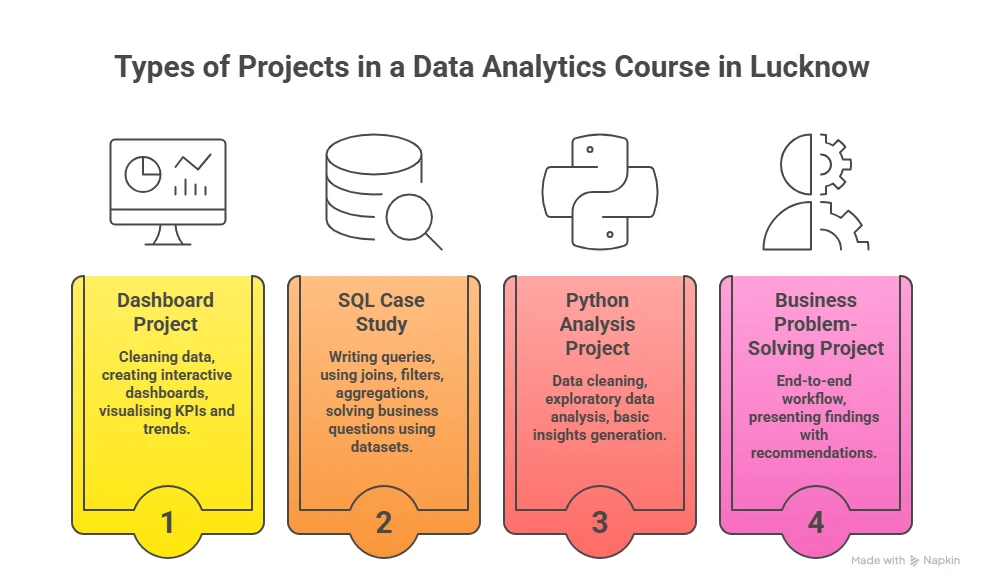
A certificate gets you past the first filter on a job listing. A portfolio gets you the interview. Recruiters in Lucknow do not want to see that you completed a tutorial. They want to see that you looked at a real problem, made decisions under uncertain conditions, and produced something a manager could walk into a meeting with.
Think of a portfolio project the way you would think of a sample work submission. The standard it should clear is: would someone in the role you are targeting find this useful?
What Separates a Strong Portfolio Project from a Weak One:
The project should use a real or publicly available dataset. Kaggle and tutorial sites provide clean, pre-structured data specifically so learners can practice. That is fine for learning. It is not enough for a portfolio. Use data that has missing values, inconsistencies, and structural problems you had to work through.
- The project should open with a clear business question. “I analysed this dataset” is not a project. “I wanted to understand which customer segments at a regional NBFC are most likely to default within 60 days of disbursement” is a project.
- The project should end with a recommendation, not a chart. Charts are evidence. The recommendation is the deliverable.
- Present your work on GitHub with a short written explanation of your methodology. A one-page summary of what you did and why matters more to most non-technical hiring managers than the code itself.
Free datasets suited to Lucknow-relevant projects are available at Kaggle, Data.gov.in, and the World Bank Open Data portal. The UP government’s open data platform publishes district-level datasets on health, finance, and infrastructure that produce highly relevant local market projects.
Also Read: How Can Data Analytics Help You Become a Better Entrepreneur?
Classroom vs Online: The Question Behind the Question
The format debate is often a proxy for a more useful question: how much structure do I need to actually complete this?
Self-paced online courses have one persistent problem. Research from MIT Sloan puts global MOOC completion rates between 3% and 6%. Most people start with strong intentions. Life gets busy around week four. Without a cohort, a live instructor, and a schedule, the course sits unfinished.
| Aspect | Offline (Classroom Learning) | Online (Self-Paced / Remote Learning) |
| Structure | Fixed schedule with regular classes | Flexible schedule with no fixed routine |
| Accountability | High, due to attendance and deadlines | Low, depends on self-discipline |
| Completion Rate | Higher due to a structured environment | Lower, many learners drop off midway |
| Learning Consistency | Easier to stay consistent with set timings | Difficult to maintain consistency over time |
| Interaction | Direct interaction with trainers and peers | Limited or delayed interaction |
| Doubt Resolution | Immediate, in-class support | Often delayed or self-driven |
| Suitability | Ideal for learners who need guidance and routine | Suitable for self-motivated learners |
| Flexibility | Limited due to fixed timings | High flexibility to learn anytime |
| Best Fit For | Students who prefer structured, guided learning | Learners balancing multiple commitments |
Hybrid models combine live instruction with the flexibility of online access. For many learners in Lucknow, hybrid formats offer structure without the need to relocate.
Building a career in data analytics requires a clear roadmap, especially with evolving industry expectations. This perspective helps connect course learning with the practical steps needed to enter the field with confidence.
Why Students Choose Imarticus Learning for a Data Analytics Course in Lucknow
For students weighing their options across a data analytics course in Lucknow, Imarticus Learning is worth a close look for specific reasons rather than general reputation.
The curriculum is developed with direct input from hiring companies. The syllabus reflects what recruiters actually test for in interviews rather than what sounds comprehensive in a brochure. Here is a snapshot of what the programme includes:
- 10 Guaranteed Interviews backed by a formal job assurance commitment
- 25+ Live Projects built on real industry datasets across sectors
- 10+ Tools covered, including Python, SQL, Power BI, Tableau, and machine learning frameworks
- 1,500+ Students Placed across the Imarticus alumni network
- 400+ Hiring Partners actively recruiting from the programme
- 52% Average Salary Hike reported across placed students
- The highest salary of Rs 22.5 LPA was achieved by a program alumnus
- Classroom and Live Online Training available in both weekday and weekend batch formats
- Designed for fresh graduates and early-career professionals from both tech and non-tech backgrounds
FAQs About the Data Analytics Course in Lucknow
The answers below are to the most frequently asked questions related to data analytics education in India. They reflect how the field and job market actually work for you to get a clear understanding.
Which Is the Best Course for Data Analysis?
The best data analytics course in Lucknow teaches current tools, runs live projects on real datasets, and prepares you for interviews before graduation. Imarticus Learning builds its curriculum directly with hiring companies, which means the syllabus reflects what recruiters are actually testing for in 2026 interviews.
Can I Become a Data Analyst in 3 Months?
Three months is enough time to learn the core tools if you already have some comfort with numbers, and you practice every single day without gaps. Most quality data analytics courses in Lucknow run four to six months because building a portfolio and clearing interviews takes time beyond the syllabus. Imarticus Learning builds interview prep into the programme itself, not as an afterthought at the end.
What Is the Best Data Analytics Institute with Placement Opportunities?
The best institute treats placement as a deliverable, not a promise. Before enrolling in any data analytics course in Lucknow, ask what percentage of the last two batches were placed and which companies hired them. Imarticus Learning maintains an active placement cell across banking, consulting, and tech, with support that continues until you are placed.
What Are Some Data Analytics Courses?
Options range from two-month certificate courses covering basic tools to nine-month PG programmes including Python and machine learning. Big data analytics courses in Lucknow go further into Spark and cloud infrastructure. Executive programmes at IIM Lucknow target senior professionals. Imarticus Learning covers the full progression in one structured PG programme without needing multiple certifications stacked over time.
Which Is the Best Institution for Taking a Data Analyst Course for Non-IT Background Freshers?
Non-IT freshers worry that the technical content will move too fast. Today’s tools are far more accessible than they used to be. A data analytics course in Lucknow from Imarticus Learning starts with a foundation phase that brings commerce, arts, and science graduates to the same level before the technical modules begin. No prior coding experience needed.
Is There Any Course on Data Analytics with Job Placement?
Yes, several data analytics courses in Lucknow include placement support. The difference lies in what that support actually means. Some institutes offer a single hiring event. Imarticus Learning provides ongoing support through resume reviews, mock interviews, and direct employer introductions that continue until you are placed, not just until the course ends.
Which Are the Best Courses for Data Analytics That Can Give Placement Assurance?
Placement assurance comes with conditions tied to attendance and project completion. Longer programmes consistently produce better outcomes because students have time to build a portfolio before going to market. A PG-level data analytics course in Lucknow from Imarticus Learning offers structured placement support backed by verified company partnerships you can independently check before enrolling.
Your Data Analytics Course in Lucknow Decision Comes Down to This
Lucknow’s data analytics hiring market is not saturated yet. Students graduating from serious programmes over the next twelve to eighteen months are entering a local job market where employer demand still exceeds the available talent pool.
The decision itself is not complicated once you know what you want from your career. If strong salary growth, a clear skill ladder, and genuine demand across multiple industries matter to you, analytics delivers all three. What determines the outcome is how seriously you approach the program you choose and how much you build outside of class hours.
If you are a fresher from any background or a working professional ready to make the switch, the groundwork you lay in the next six to nine months determines where your career sits two years from now.
Imarticus Learning’s data science and analytics program is built around exactly these priorities. The curriculum is updated with hiring company input, live projects, and the placement support does not stop when the course does. If you are ready to take the next step, explore the data analytics course in Lucknow with Imarticus Learning and see where your profile fits on the roadmap.
