So, you’re thinking about stepping into the shoes of a Chief Financial Officer (CFO)? That’s a big move. The role of CFO is a dynamic one, filled with challenges, strategic decision-making, and a whole lot of numbers. But hey, if you love balancing the books and steering a company’s financial future, it might just be the perfect gig for you.
Before we get deep into what a CFO role profile looks like, let’s talk about how you can equip yourself with the right skills. If you’re serious about stepping into this high-stakes role, you should check out theCFO course by Imarticus Learning. It’s designed to help you master the complexities of the financial world and lead with confidence.
Understanding the Role of CFO
A CFO isn’t just the number-cruncher-in-chief. This role goes way beyond managing spreadsheets and financial reports. In fact, modern CFOs are more like business strategists, helping drive growth, optimise costs, and ensure the company’s financial health stays in check.
What Does a CFO Actually Do?
At its core, the CFO role profile revolves around three main aspects:
Financial Strategy & Leadership: Setting long-term financial goals and ensuring the company has the resources to achieve them.
Risk Management: Identifying potential financial risks and putting strategies in place to mitigate them.
Performance Management: Keeping a close watch on financial KPIs to measure business health and efficiency.
CFO Roles and Responsibilities
The CFO roles and responsibilities have evolved significantly over the years. Gone are the days when CFOs just handled accounting and audits. Today, they play a massive role in shaping a company’s overall strategy.
1. Financial Planning & Analysis (FP&A)
A CFO is responsible for preparing detailed financial forecasts, analysing market trends, and ensuring the company’s financial strategy aligns with its business goals.
2. Cash Flow & Capital Management
Cash is king, right? A CFO ensures the company has enough liquidity to operate smoothly while also optimising working capital.
3. Compliance & Risk Management
Navigating the maze of financial regulations and tax laws isn’t easy. CFOs ensure that everything is in line with the law and that risks are minimised.
4. Investor Relations
If a company has shareholders, it’s the CFO’s job to maintain transparency and keep them informed about the company’s financial health.
5. Technology & Digital Transformation
Modern CFOs are also expected to embrace financial technologies (FinTech), automation, and AI-driven analytics to enhance efficiency.
Role of CFO in a Company: How Important is It?
To put it simply, a CFO is the financial backbone of a company. Without one, businesses would struggle to keep their financial house in order. But their role goes beyond just balancing books.
Let’s look at a table that breaks down the CFO role profile across different industries:
Industry
Key CFO Responsibilities
Tech & Startups
Fundraising, scaling strategies, budgeting
Manufacturing
Cost control, supply chain financing
Healthcare
Compliance, revenue cycle management
Retail
Inventory financing, profit margin optimisation
Financial Services
Risk mitigation, investment strategies
As you can see, while the role of CFO in a company varies, the core financial leadership aspect remains constant.
Do You Have What It Takes to Be a CFO?
Not everyone is cut out for this role. If you’re eyeing the top financial seat, here are a few must-have traits:
Strong Analytical Skills: Numbers need to make sense to you.
Leadership & Decision-Making: You’ll be leading teams and making high-stakes calls.
Financial Acumen: Understanding balance sheets and P&L statements is non-negotiable.
Strategic Thinking: You need to see the big picture and help grow the business.
Adaptability: The financial landscape is constantly changing. Can you keep up?
How to Become a CFO?
The journey to becoming a CFO isn’t a short one. Here’s a roadmap to get you there:
Get a Strong Educational Background: A degree in finance, accounting, or business is a great start.
Earn Professional Certifications: Consider getting a CPA, CFA, or an MBA.
Gain Experience in Financial Management: Work your way up in roles like financial analyst, controller, or treasurer.
Develop Leadership Skills: CFOs need to be leaders, not just finance experts.
Expand Your Network: Build relationships with industry professionals.
Keep Learning: The financial world is evolving. Stay ahead by upskilling.
If you’re serious about preparing for this role, check out theCFO Programme by Imarticus Learning. It’s a great way to build the skills and confidence needed to excel.
Final Thoughts
At the end of the day, the CFO role is a mix of strategy, leadership, and number-crunching. If you thrive in high-pressure environments, love finance, and enjoy leading teams, then this role might just be your calling.
And remember, if you’re looking for a structured learning path to kickstart your journey, theISB Chief Financial Officer Programme by Imarticus Learning is a solid place to start.
Frequently Asked Questions
What are the key CFO roles and responsibilities?
The CFO is responsible for financial planning, risk management, cash flow optimisation, and investor relations.
How long does it take to become a CFO?
It can take anywhere from 10-20 years of experience in finance and leadership roles to reach the CFO level.
Does every company need a CFO?
Not necessarily. Smaller businesses may manage without one, but larger firms rely heavily on a CFO for financial strategy.
Is a CFO higher than a COO?
It depends on the company, but typically, the CFO and COO are both senior executives reporting to the CEO, each handling different aspects of business operations.
Tired of seeing your career and your paycheck stay stuck at the same level? You might have the string foundation, but what’s missing is the global edge. That’s exactly where the Certified Public Accountant (CPA) license comes in.
This isn’t just an “American” qualification. The CPA is the gold standard in global accounting and finance. For ambitious professionals in India, it’s one of the most powerful credentials you can add to your résumé if you’re aiming for:
Rapid salary growth
Leadership and decision-making roles
Opportunities with the Big 4 and top MNCs
International career mobility
The CPA salary in India varies based on experience, industry, and location, but CPAs consistently earn higher pay packages than non-certified finance professionals in similar roles.
When it comes to unlocking real career growth, one phrase on your profile changes everything:
“CPA Certified.” That’s why the CPA is recognised worldwide in the finance and accounting community.
Curious about how this translates into real earning potential?
Let’s break down what the CPA salary in India looks like across experience levels and job roles, and why it’s considered a career-defining qualification.
“CPAs are trusted financial advisors who help individuals, businesses and other organisations plan and reach their financial goals.” – AICPA
What is CPA?
The CPA isn’t just a certification; it’s a lens into the global finance ecosystem that transforms how you understand and influence business.
So, what is CPA, really? It’s the industry’s way of measuring whether you understand how money actually moves, not just in theory, but in real-world businesses under pressure.
Here’s a simple way to see it: If a CA gives you a panoramic view of Indian accounting, the CPA hands you the lens that lets you zoom into global standards; the mechanics of auditing, regulation, and financial reporting. It’s like learning to read the financial “DNA” of a company rather than just its headlines.
It’s more than a title. It signals credibility, deep expertise, and global trust. Employers know that a CPA professional has mastered:
Advanced accounting principles
Auditing standards
Taxation and regulatory frameworks
Ethical and analytical decision-making at a leadership level
The CPA exam assesses your grasp of accounting, auditing, taxation, regulation, and business concepts through four parts, each structured to build a different layer of expertise.
“Analysis shows that passing the CPA exam leads to rewards in small, medium, and large companies. Accountants who pass the CPA exam receive a measurable earnings premium.” – Journal of Accountancy article (AICPA‑affiliated).
Understanding the CPA Certification
The CPA program is a structured pipeline that transforms you from a candidate into a respected CPA professional honoured worldwide.
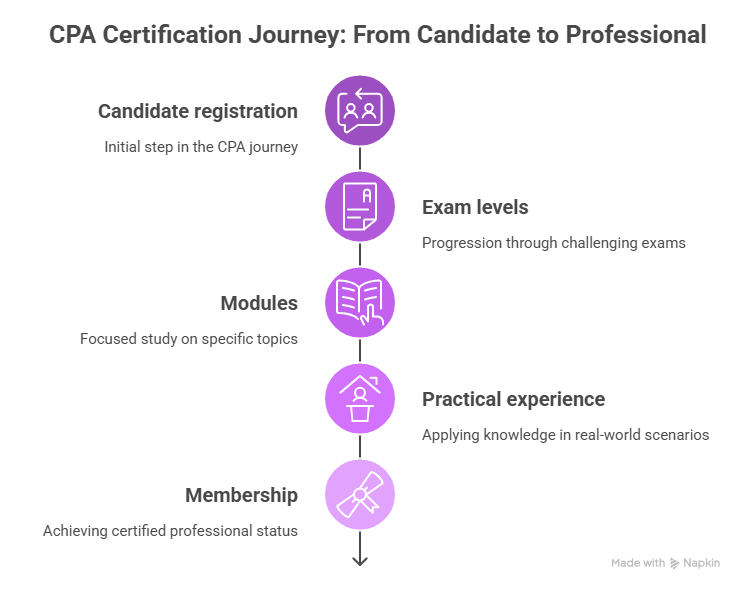
When people talk about the “CPA certification,” they’re talking about a comprehensive journey – from registering with the exam board, passing four challenging exam sections, fulfilling professional experience requirements, to becoming a licensed CPA and maintaining your credentials through continuous education.
The CPA course duration typically ranges from 12-18 months, depending on how consistently you prepare and balance your schedule.
In an increasingly global market, specialised expertise like CPA certification translates directly into premium pay and unparalleled career mobility.
Is the CPA Salary in India Worth the Investment?
This is the moment every aspirant waits for – the real ROI on CPA certification. CPAs earn higher salaries compared to their non-certified peers, and the credential itself opens doors to lucrative career options globally.
The CPA credential signals your mastery of accounting principles, auditing rigour, tax expertise, and most importantly, professional ethics. These skills are indispensable for companies that handle complex financial data or navigate multifaceted compliance landscapes.
Real growth is not just about the numbers – it’s the expanded career access, the trust clients and employers place in you, and your ability to step confidently into decision-making roles.
Mid-Level Professionals CPA Salary in India: ₹12-20 LPA, roughly 20-30% higher than peers without certification.
Senior and Leadership Roles CPA Salary in India: ₹20-70 LPA+, a 40%+ premium difference that can translate into an extra ₹1 crore or more over a lifetime.
Multinational Finance & Consulting Firms: Salaries are often premium to domestic averages due to the high value placed on CPA expertise. Indian organisations, especially multinational corporations and Big 4 accounting firms, prize CPA holders for roles in financial reporting, internal controls, tax strategy, risk management, and executive leadership positions.
Starting salaries for new hires with master’s degrees rose about 17% to a median of $67,750, compared to the last survey.
Want to know what US CPA-qualified professionals really earn, both in India and abroad? You’ll get a practical breakdown of the top CPA roles, actual salary ranges at every career stage, and global opportunities open to CPA holders in this video.
Why the CPA Salary in India is Surging?
The most compelling reason to invest in the CPA is simple: Money. The return on investment (ROI) is staggering, particularly in the Indian market, where expertise in US GAAP and international taxation commands a hefty premium.
Think of your career like travelling from a busy airport. Without the right credentials, your options are limited. But with a CPA, it’s like having priority access – more routes open up, and you move ahead faster.
That’s why CPA professionals often earn higher salaries – it shows you have the expertise and credibility to take on roles that really impact financial decisions.
Non-CPA vs CPA Salary
Forget incremental raises. The CPA license provides an immediate, structural bump to your earning potential that only widens over time. This difference can be summarised as mentioned below:
Experience Level
CPA Salary in India (Range)
Non-CPA Salary
Salary Differential
Entry-Level (0-3 yrs)
₹6-8.5 LPA
₹5-6 LPA
15-20% Premium
Mid-Career (3-7 yrs)
₹9-28 LPA
₹7-20 LPA
20-30% Premium
Senior (7+ yrs)
₹20-70+ LPA
₹15-40 LPA
40%+ Premium
The Takeaway: At the senior/managerial level, a CPA can earn 40% or more than a non-certified peer. This difference can easily translate into an extra ₹1 Crore+ in lifetime earnings.
Deep Dive: CPA Salary in India by Experience & Role
The term “CPA salary in India” is too broad. Compensation depends heavily on where you work and the nature of your job. Here are a few key job roles and their salary:
Role/Experience Tier
Typical CPA Salary in India
Key Responsibilities
Audit/Tax Associate (Entry-Level)
₹6-9 LPA
Bookkeeping, journal entries, tax return preparation, and basic auditing.
Senior Financial Analyst (2-4 Yrs)
₹10-18 LPA
Financial modelling, budgeting, forecasting, and reporting for global clients.
Audit/Tax Manager (5-8 Yrs)
₹18-35 LPA
Leading client engagements, managing teams, risk assessment, and complex compliance.
Financial Controller/Director (8+ Yrs)
₹35-70 LPA+
Overseeing all accounting/finance functions, strategic planning, and internal controls.
CFO/Partner-Track (Top Tier)
₹80 LPA – ₹1 Crore+
Ultimate financial authority, board-level strategy, M&A guidance, and global risk management.
Where you work can completely change your career trajectory. CPAs often find themselves fast-tracked in workplaces that value global standards, and that’s exactly why the Big 4 and top MNCs prefer hiring them.
These environments reward skill, expertise, and international-level financial knowledge, which is why CPA professionals see faster growth and higher starting packages.
Location Matters: Where you are in India matters. Companies allocate higher budgets in metropolitan areas to attract top-tier global talent. Metro hubs like Mumbai, Delhi-NCR, and Bengaluru offer higher salaries due to the concentration of industries in these areas. For instance, senior CPAs in Mumbai and Delhi often reach ₹20-38 LPA+ swiftly.
Big 4 (Deloitte, EY, KPMG, PwC): These firms offer structured progression paths and often start CPAs at ₹12-25 LPA (depending on experience). They are the largest recruiters because they handle clients that adhere to the standards of the US SEC and the US GAAP.
Top Metros (Mumbai, Delhi-NCR, Bengaluru): These cities command the highest salaries due to a concentration of Global Capability Centres (GCCs) and MNC headquarters. For instance, senior CPAs in Mumbai and Delhi often reach ₹20-38 LPA+ quickly.
Industries that Pay the Most: Financial Services (BFSI), Consulting/Big 4, and Global Technology/GCCs are consistently the highest payers due to their direct revenue impact and the complexities of compliance.
“Big 4 firms and MNCs don’t just hire CPAs – they fast-track them into leadership roles because CPA expertise drives their business success.”
CPA Salary in India: City-wise Breakdown
If you’re planning your career move, knowing how CPA salaries differ by city can help you decide where to work. Some cities offer higher pay because they have more multinational companies and Big 4 offices. Here’s how salaries compare.
Tier 1 Cities – These metro-cities offer the highest CPA salaries because of strong finance and consulting ecosystems.
Growth is steady, especially as more companies expand outside metros. The CPA credential amplifies growth anywhere – but in Tier 1 hubs, it accelerates it faster.
Where you work matters. The right city can amplify not just your salary but your exposure to cutting-edge finance roles.
What Makes CPA Globally Valuable?
The CPA’s value extends far beyond salary; it’s about access, authority, and global relevance.
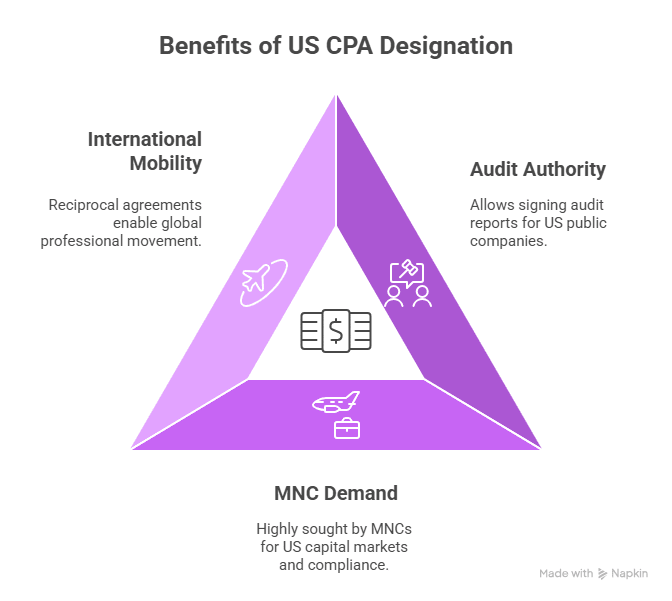
The Gold Standard: The CPA is granted by the AICPA (American Institute of Certified Public Accountants) and governed by State Boards, thereby granting legal authority. It is the only accounting designation that allows you to sign audit reports for US public companies.
MNC Requirement: Any company that deals with US capital markets, adheres to US GAAP (Generally Accepted Accounting Principles), or faces US federal taxes requires a CPA on staff. In today’s global economy, nearly every major company operating in India is involved.
International Mobility: The CPA has reciprocal agreements with other top global bodies (like CPA Canada and CA Australia/New Zealand), making it easier to migrate or work internationally without needing to re-qualify fully.
“CPAs play a critical role in protecting the public interest by ensuring the reliability of financial information.” – AICPA
What Makes the CPA Salary in India So Competitive?
When you look at the CPA salary in India and why it stands out, it’s not just about earning more money – it’s about what those earnings say about your skills, credibility, and value in the industry. The CPA is a badge of global expertise, legal authority, and deep technical proficiency that the market highly values.
Here’s the real deal: Indian companies increasingly operate on a global scale and need professionals who can navigate international accounting rules and compliance seamlessly.
CPAs are legally authorised to sign audit reports for US public companies, which is a key responsibility and an enormous indicator of trust. Not every finance professional can do that, and companies are willing to pay a premium for those who can.
Then there’s the international mobility factor. CPA certification opens doors across markets by removing geographical barriers and puts you in the running for high-paying roles worldwide.
Put it all together – the technical mastery, legal standing, and global relevance, and you see why CPA salaries in India are not just competitive but command a serious premium. It’s more than a salary: it’s professional validation, career flexibility, and long-term financial growth, all rolled into one powerful package.
Curious about where your CPA certification can take you? This video shows how CPA can help you land in finance leadership role as a CFO.
Earning a CPA license can potentially increase your earning potential by hundreds of thousands of dollars over the course of your career.” – AICPA article.
How to Maximise Your CPA Value?
Earning the CPA is step one. Leveraging it for maximum CPA salary in India and the US, and career growth is the next step.
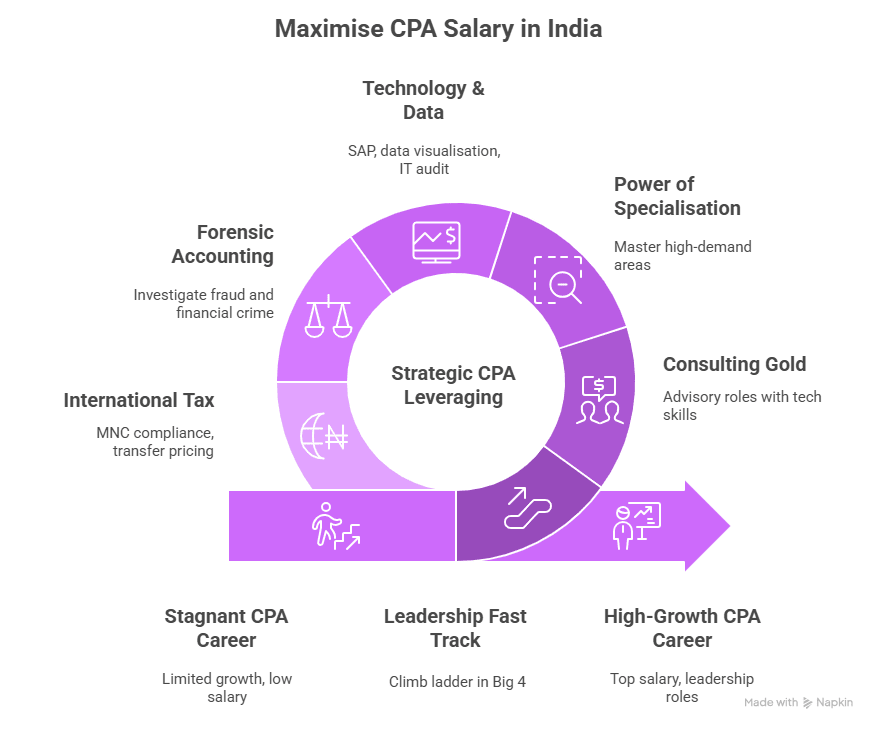
The Leadership Fast Track
The CPA qualification is a mandatory requirement for climbing the ladder in Big 4 and MNCs:
From Associate to Manager: The CPA is often a prerequisite for promotion to Manager roles (3-5 years), where salaries jump well above ₹20 LPA.
The CFO Pipeline: Most senior finance leadership roles (Controller, VP of Finance, CFO) are filled by CPAs because of their comprehensive, legally-backed expertise.
Consulting Gold: Advisory roles in Risk Management, Transaction Services, and IT Advisory highly value the CPA combined with tech skills, leading to some of the highest packages in India.
The Power of Specialisation (Post-CPA): Once certified, don’t stop. Specialising in high-demand areas pushes your CPA salary in India to the top of the range.
Technology & Data Analytics: CPAs who master tools like SAP, Power BI, data visualisation, and IT audit are in incredibly high demand in Bangalore/Hyderabad’s tech hubs (GCCs).
Forensic Accounting: Investigating fraud and financial crime – a high-stakes, high-pay niche.
International Tax & Transfer Pricing: Highly complex and highly compensated, essential for MNC compliance.
Final Action Steps: Your 18-Month Plan
Embarking on the CPA journey is a significant professional commitment, but with the right roadmap, it becomes an achievable and rewarding goal. Here’s a concise plan to navigate the CPA certification efficiently:
Evaluate Eligibility: Consult an expert to map your Indian education to the 150-credit-hour rule for CPA Eligibility in the US.
Select a State: Choose a US state board with favourable requirements for your background.
Find a Learning Partner: Enrol in a high-quality CPA review course that understands the Indian context (e.g., provides exam centre guidance).
Commit to the Preparation: Dedicate 400+ hours of focused time to study all four parts within the 18-month window.
Get Licensed: Pass the exam and complete the work experience requirement (typically 1-2 years under a licensed CPA) to obtain your final license.
Is CPA Worth It for Indian Professionals?
Absolutely. It’s an investment that pays off not just at the start of your job search but continues to deliver through accelerated promotions, broader job opportunities, and leadership roles with attractive compensation.
With India’s financial services sector expanding rapidly and multinational companies deepening their presence, accounting professionals with a CPA license find themselves in high demand.
The credential’s reciprocity with other top accounting bodies means you don’t have to start over when moving between countries; your skills and licensure travel with you. Beyond salary, CPAs benefit from access to global networks, continuing education, and lifelong career support.
To explore course details and career guidance on CPA certification, turn your ambitions into achievements with Imarticus Learning and unlock your salary potential in India’s competitive finance landscape.
CPA vs Other Certifications
In the fast-evolving world of finance, whether you’re deciding between CPA, CFA, CA, or CMA. It’s essential to understand how each certification aligns with your career goals, industry demands, and growth timelines to make an informed choice.
Credential
Focus
Duration
Global Recognition
Ideal Roles
ROI Timeline
CPA
Auditing, Accounting, Tax
1.5 – 3 years
Very High
Audit, Tax, Financial Leadership
Medium term (2+ years)
CFA
Investment Management
3 – 4 years
High
Asset Management, Equity Research
Longer term (3-4 years)
CA (India)
Indian Tax, Accounting
4 – 5 years
Moderate (India)
Public Accounting, Tax Compliance
Long term
CMA
Managerial & Cost Accounting
~2 years
Moderate
Corporate Finance, Cost Control
Medium term
Salary Potential Comparison in India
When you’re choosing between CPA, CA, CFA, or CMA, the real question is simple: which one actually takes your salary to the next level? Each certification opens different doors, leads to different roles, and builds different types of expertise – so understanding their earning potential makes your decision much clearer.
Let us look at how top finance certification holders’ pay scales progress across experience levels, making the decision clearer and way more practical.
Confused between pursuing a CPA or a CA in India? This video breaks down the key differences that matter – career progression, global recognition, salary comparisons, and which qualification Indian MNCs prefer for top finance roles like CFO and Finance Director.
Benefits of a Comprehensive CPA Preparation Program
Starting the CPA journey is easier when you have guidance that fits your reality – balancing work, study, and U.S. requirements. Instead of generic study materials, you get a clear plan: live online sessions, simplified explanations, and mentors who actually support you through doubts and exam strategy.
But the goal isn’t just clearing exams—it’s what happens after. The right training helps you present your CPA confidently in interviews, understand licensing requirements, and position yourself for roles that pay more and carry greater responsibility, especially in Big 4 firms and global companies.
The right support doesn’t just help you earn the CPA. It helps you use the CPA to accelerate your career and salary growth.
Imarticus Learning’s CPA certification program is designed exactly for that: efficient exam preparation backed by real career outcomes—so your qualification becomes a catalyst for real advancement, not just another line on your resume.
FAQs About CPA Salary in India
Looking into the landscape of CPA salary in India and what it means for your career? These frequently asked questions will help you understand earning potential, growth opportunities, demand, and how the CPA compares to other finance qualifications – so you can decide if it’s the right move for you.
What is the salary of a CPA in India?
CPA salaries typically start around ₹6-9 LPA at the entry level. With a few years of experience, CPAs move into the ₹12-28 LPA range, and senior roles such as Controller, Finance Director, or CFO can go ₹35 LPA to ₹1 crore+, depending on the company, sector, and city.
Who earns more, CA or CPA?
It depends on where you want to work. In India-focused roles, CAs and CPAs can earn similarly. In Big 4 firms, MNCs, and companies working with US GAAP, CPAs often earn more because of their global reporting and compliance expertise. If your goal is global mobility or US-based roles, CPA has the advantage.
What is the salary of a CPA in the Big 4 in India?
Big 4 firms offer some of the strongest salary progression for CPAs:
Because the Big 4 handle US clients, having a CPA often fast-tracks promotions.
What is the CPA salary in India for freshers?
Freshers with a CPA typically earn around ₹6-9 LPA, which is noticeably higher than the packages offered for standard accounting or finance roles. Companies, especially the Big 4 and top MNCs, are willing to pay more because the CPA signals strong technical knowledge, global accounting standards expertise, and readiness for client-facing work.
Does having a CPA increase salary?
Yes. The CPA credential has a direct impact on salary growth. CPAs earn 20-40% higher salaries across most experience levels because employers value their expertise in global accounting standards, auditing, taxation, and compliance.
Will a CPA help me work abroad?
Yes, and that’s one of the biggest reasons professionals choose the CPA. Since the CPA is recognised globally, it gives you the flexibility to explore jobs in countries such as the US, Canada, Australia, the Middle East, and Singapore. Many CPAs start their careers in India and then move abroad through internal company transfers or client-based onsite opportunities. The qualification simply makes it much easier for employers to trust your expertise, no matter where you go.
Is the CPA difficult to pass?
The CPA exam is known to be rigorous, with global pass rates averaging around 45-55% across the four sections. The challenge isn’t just memorising concepts – the exam tests your ability to apply accounting, audit, tax, and regulatory knowledge in real business situations.
Is CPA a tough course?
Yes, it’s challenging, but manageable with the right preparation strategy and learning partners like Imarticus Learning. The concepts are professional and practical, and candidates who follow a structured study plan often clear all parts within 12-18 months.
Is CA or CPA better?
It depends on your career goal: Choose CA if you want to build your career strongly within India (audit, taxation, compliance). Choose CPA if you want global roles, Big 4 exposure, or work with US/International accounting standards.
Is CPA in demand in India?
Yes. The demand is rising fast due to the growth of MNCs, Big 4 firms, Global Capability Centres (GCCs), and companies working with US GAAP and international reporting. CPAs are especially valued in audit, financial reporting, controls, and tax strategy roles.
Build a Global Finance Career with CPA
With India’s financial services sector rapidly expanding and multinational firms deepening their footprint, CPA-certified professionals are increasingly sought after. CPA certification is not just an investment in certification – it’s an investment in your career future and earning potential.
Whether you’re aiming for Big 4 firms, MNC leadership, or strategic finance roles, earning the CPA with a partner like Imarticus Learning unlocks your full salary potential in India’s competitive market.
By choosing the right preparation route with expert guidance, you can navigate the CPA journey efficiently, accelerating your path to higher salary bands and leadership roles.
Start your CPA certification journey today to transform your career and earnings because every professional deserves the global edge that CPA provides. Partner with Imarticus Learning and take the definitive step towards becoming a globally recognised accounting expert.
Earning your CPA credential through the US CPA exam feels nearly impossible when you attempt it alongside full-time employment, right? The rigorous CPA curriculum, along with demanding work schedules and personal commitments, create an overwhelming situation.
However, a well-structured approach and disciplined training can lead you to success. And here’s where you’ll need a Certified Public Accountant (CPA) course to help you with your preparation. In addition, those pursuing the CPA designation must follow these effective strategies to reach their goals.
1. Create a Solid Study Plan
Success at the CPA exam begins by developing a productive yet practical study schedule. You should plan your exam dates right after the testing period begins. Divide the preparation into four iterations before the CPA exam dates:
First Round (30 days)
Review all instructions from the course extensively.
Second Round (15 days)
The next phase of the study involves both concept review and practice question work.
Third Round (7 days)
Focus on a fast-paced revision.
Final Review (1 day before the exam)
Skim through your notes and essential bullet points.
A well-structured timeline directly leads to higher retention of concepts.
2. Eliminate Distractions
Social media presents a significant distraction which can consume the time you need to study. Reserve study hours by erasing your social media applications and silencing superfluous WhatsApp group alerts. Your CPA exam certification mandates that you set the right priorities because its effects will persist throughout your career.
3. Be Fully Committed to Your CPA Exam Classes
Your attendance at every CPA exam training program session should be a priority. Previous accounting experience cannot substitute in-class attendance because inconsistent participation lowers your concentration and comprehension. Regularly engage with instructors during your sessions by asking questions and resolving any concerning points immediately.
4. Set Short-Term Goals
When you divide your study material into smaller achievable targets, it helps you maintain focus. Creating daily and weekly goals helps you sustain consistent work habits. Your study targets need to be established from a perspective of personal abilities and time constraints.
For example, your daily targets might involve completing two chapters during the week and solving a definite number of practice questions every day. Consider using planners or digital apps to monitor your advancement while adapting your schedule to fit your learning needs.
5. Use Highlighting and Summarisation Techniques
Underline and highlight key sections of the study material for quick revision. Create independent summaries of crucial chapter information in an independent document. The notes will support your final exam preparation through brief examinations.
You can use flashcards to memorise formulas. Mnemonic devices come in handy to help/store critical concepts, while flowcharts can help you visualise complex accounting operations.
6. Time Management is Key
Make your CPA exam preparation the top priority, as you will set aside less important tasks. Plan your daily routine effectively:
Devote specific time each day to study, then protect this time frame as inviolable.
Studying during early mornings and late afternoons can increase productivity and retention. Try and accommodate this in your schedule accordingly.
Employ study techniques such as the Pomodoro method, where you study for 25 minutes, followed by a short break.
Devote equal shares of effort between your career and academic responsibilities alongside personal downtime to fight exhaustion.
7. Take Mock Tests
Mock tests will help you gauge your progress and identify weak areas. Schedule at least two mock tests per section:
First Mock Test (15 days before the exam)
Second Mock Test (7 days before the exam)
These tests will familiarise you with the exam pattern and improve your time management skills. The CPA exam schedule also plays a vital role in your preparation; try to study in alignment with the exam schedule so that you can perform well in the actual exam.
8. Manage Stress and Take Breaks
Burnout negatively impacts academic productivity and overall work performance. Time off between studies helps you stay focused on your work. Relaxing activities like exercising, meditation, walking, or listening to music are great ways to de-stress. Deep breathing techniques, along with mindfulness, reduce exam stress. Your information retention capability and motivation levels directly depend on sustaining positive thinking.
9. Prioritise Health and Well-Being
You will learn more effectively when your body and mind operate at peak performance. Here are some simple habits to prioritise your health and well being ahead of exam stress:
Getting 6–7 hours of daily sleep helps your brain function optimally and maintain better memory retention.
Eating dietary proteins, healthy fats, and vitamins will help you maintain your energy supply while learning.
Drinking enough fluid and limiting caffeine intake will help you maintain clear mental concentration.
Light exercises like walking or yoga help relieve stress and improve your concentration.
Final Thoughts
While preparing for the CPA exam alongside a full-time job can be challenging, you can navigate the challenges with the right approach. A well-structured study plan, dedication, and time management will set you up for success. Stick to these tips, stay focused, and you’ll soon earn your CPA designation and advance your career!
Joining a CPA course can also make a huge difference. The US CPA Certification course by Imarticus is a one-stop resource to help you study more efficiently, especially if you are juggling work and exam prep.
Frequently Asked Questions
Am I eligible to take the CPA exam if I don’t have an accounting degree?
Yes, you are. However, the CPA exam eligibility varies from state to state. Most states require specific accounting and business coursework. Additional courses help you meet eligibility requirements if you have a non-accounting degree.
What is the recommended period for studying for the CPA exam when working full-time?
The least disruptive times to study are early morning and after regular work hours. You should invest long hours into your studies over weekend days.
When preparing for my CPA exam, should I tackle all four sections consecutively or separate them into equivalent tests?
The timing of your studies depends on your available hours for study and how quickly you learn. Most professionals going through this experience pick one section at a time to effectively manage work alongside their studies.
What strategies keep me focused during my CPA exam preparation journey?
Your CPA success requires both goal setting and achievement rewards. Group participation in CPA studies and constant focus on your professional ambitions are equally important.
As an aspirant, the first question that one usually searches for is – ” What is the CPA salary in India?” As we move into 2026, the demand for competent accountants and Certified Public Accountants (CPAs) has reached unprecedented levels. This becomes even more apparent with the globalisation of companies. Regulatory frameworks are becoming increasingly complex, so CPAs will have a crucial role in financial management.
However, how much do CPAs earn in India and the US? The following article looks at the CPA salary of both countries, covering factors that may have a bearing on their earnings and career prospects as accountants.
Understanding CPA Salaries in the US
The United States is among the most competitive job markets for accounting professionals. On average, accountants in the US make about $85,371 per year. However, those with the CPA designation can earn much higher salaries due to their expertise and certifications.
Average CPA Salary in the US
Lower range of CPA salary
$34,000 per year
Higher range CPA salary
$159,000 per year
Opportunities for Indian CPAs in the US
The demand for Indian accounting professionals in the US job market is high. They can land lucrative jobs with top companies in India and abroad with the right qualifications and certifications. With the high demand for CPA certification in the US, companies are constantly seeking CPA-certified professionals, creating excellent job opportunities.
CPA Salary in India
The CPA designation is gaining prominence in India as companies seek highly qualified accounting professionals to handle complex financial matters. CPAs in India earn attractive salaries, especially those working in multinational firms or financial hubs like Mumbai, Bangalore, and Delhi. The average salary of a CPA in India stands at INR 2.2 Lakh per annum.
Average CPA salary in India
Entry-level CPA Salary
INR 1 Lakh per year
Experienced CPA Salary
INR 11.9 Lakh per year
CPA Jobs in India and the US
Types of industries CPAs can work in include:
Public accounting (Big 4 Firms): CPAs in public accounting provide external audits, income statements, tax strategising, advisory services, and risk assessments for large corporations.
Corporate accounting and finance: CPAs who work in corporations usually perform internal audits, strategise financially, forecast budgets, and ensure compliance with regulations.
Investment banking and hedge funds: These CPAs work on financial modelling, asset valuation, risk analysis and mergers and acquisitions.
Government and non-profit organisations: These professionals oversee public funds, conduct audits, ensure tax compliance, and aid in financial planning for public institutions.
Healthcare and manufacturing: CPAs in these industries are responsible for financial reporting, cost accounting, regulatory compliance, and budget optimisation.
Key CPA Job Roles
CPAs hold different roles depending on their specialisation and the industry. Some sought-after CPA jobs are listed below:
Auditor
CPAs audit and review financial statements, ensure compliance with regulations and assess risks and inefficiencies. Public accounting firms, internal audit departments of corporations and governmental agencies employ them. Their duties include reviewing financial statements, detecting fraud and ensuring corporations comply with accounting standards.
Tax Consultant/ Tax Manager
Tax CPAs assist individuals and businesses with tax compliance, tax strategy optimisation, and tax liability reduction. They produce tax returns, give tax advice, and make sure their clients follow changing tax regulations. They work in accounting firms, corporate tax departments, and as independent consultants.
Financial Analyst
Financial analysts analyse accounting data and key financial metrics to assess a company’s financial health, explore funding options, and manage risks. CPAs in this role carry out financial analysis and trend assessment to develop investment strategies for corporations, banking, and investment advisory firms.
Forensic Accountant
Forensic accounting involves investigating fraud cases and collecting financial evidence in a court of law. Forensic accountants comb through financial records, looking for irregularities, and testify in court about financial corruption cases. Law offices, regulatory agencies, and forensic accounting firms hire these professionals.
5. Chief Financial Officer (CFO)
Experienced CPAs qualify to become CFOs who handle the financial operations, risks and investment portfolios of corporations. By overseeing financial report preparation, budget development and strategic decision implementation, CFOs seek to strengthen the company’s financial standing. Candidates for this job must have substantial experience and skills in financial management and management expertise.
Growth Prospects for CPAs
High demand and job security: With increasing regulatory requirements, tax complexities, and corporate governance standards, CPAs remain in high demand across industries.
Career advancement opportunities: CPAs can move into leadership positions such as CFOs, financial controllers, and partners in accounting firms, where they often oversee critical financial decisions.
Global career prospects: The CPA designation is recognised internationally, allowing professionals to explore opportunities in multinational corporations and financial hubs worldwide.
Specialisation and niche roles: CPAs specialising in forensic accounting, international taxation, risk assessment, or data analytics can command higher salaries and enjoy rapid career growth.
Technological adaptation: With the rise of AI and automation in finance, CPAs who adapt to emerging technologies, such as blockchain and data analytics, will have a competitive edge in the industry.
Wrapping Up CPA Salary in India
The CPA designation is a turning point in the accounting profession, paving the way for higher-salaried job opportunities in India and the US. In both countries, CPAs are assured promising career paths and a handsome average CPA salary.
Becoming a CPA is an excellent investment for a career in accounting both in India and the US and will help you lead a successful and financially esteemed life. Enrolling in a reputable CPA course, such as those offered by Imarticus, can significantly improve your chances of passing the exam.
FAQs About the CPA salary in India
Is CPA a good career choice?
CPA is a highly respected and lucrative career with strong growth potential, job security, and global recognition.
How long does it take to become a CPA?
It typically takes 1-2 years to clear the CPA exam and meet the experience requirements.
Can I work internationally with a CPA certification?
A US CPA is recognised in many countries, including India, Canada, and the Middle East.
Do CPAs need to continue their education?
CPAs must complete Continuing Professional Education (CPE) credits to keep their certification valid.
If you’re planning to build a career in finance, investment banking, equity research, or portfolio management, your journey will likely start with the CFA Level 1 Exams. And it’s completely normal to feel a little overwhelmed at first – the curriculum is vast, the exam pattern is new, and everyone seems to say it’s “the toughest finance exam out there.”
But here’s the good news:
Once you understand how the CFA Exams actually work, what they test, and how to prepare for them, the entire process becomes far more manageable.
I’ll break down everything you need to know – the CFA Level 1 syllabus, what the CFA Level 1 Exams involve, what you’ll study, how difficult it really is, preparation strategy, common mistakes, and more. By the end, you’ll know exactly how to approach it smartly – not stressfully.
Let’s get started.
📊Quick CFA Facts: For the August 2025 testing window, the Level 1 pass rate was 43% globally.
What Exactly Are the CFA Level 1 Exams?
Before we go further, let’s quickly answer the big question: what is CFA?
The CFA Certification is a globally respected certification that trains you to think like an investment professional – analysing markets, evaluating companies, and making sound financial decisions.
Think of the CFA Level 1 Exams as the gateway into the world of professional investing.
Level 1 isn’t trying to turn you into a portfolio manager overnight – it’s simply building your base. It’s like learning a new language. You don’t begin with deep conversations. You begin with simple words and short phrases, and gradually, it all starts to click. Once those basics are in place, the more complex concepts no longer seem so intimidating.
Level 1 does the same:
It teaches you the core concepts in finance so you can confidently understand and later analyse how markets work, how companies perform, and how investments are evaluated.
Ideal for individuals entering finance or transitioning into it.
Passing the CFA Level 1 exams means you’re ready for the deeper analytical work in Level 2.
Why Is Level 1 So Important?
CFA Level 1 Exams are important because they set your entire CFA journey in motion.
The CFA Level 1 syllabus builds your fundamentals in:
Financial reporting
Quantitative methods
Capital markets
Ethics
Portfolio basics
These aren’t just exam topics – they’re skills you’ll actually use in real-world finance roles. These become the backbone of Levels 2 and 3. If Level 1 is strong, the rest of the CFA program becomes significantly easier.
CFA Level 1 Exams: Full Syllabus Breakdown (2025)
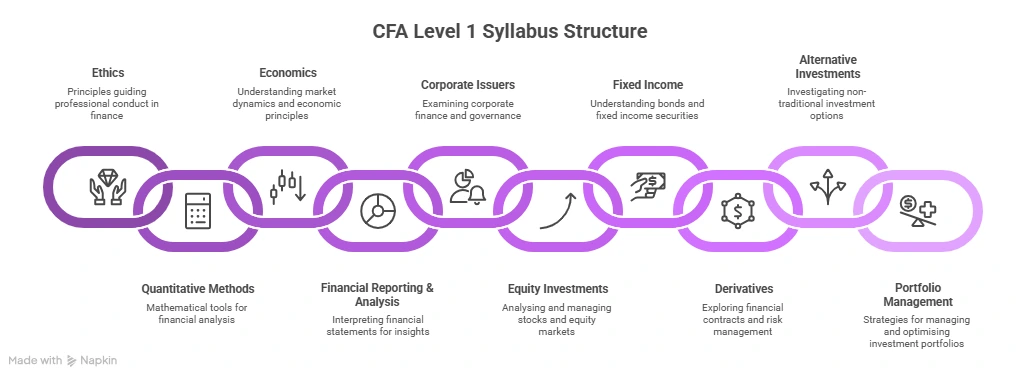
The CFA Level 1 syllabus is built around 10 core topics – each one adding a different piece to your overall finance skill set.
Here’s a simple breakdown:
1. Ethical & Professional Standards:This is the backbone of the CFA program. You learn how to act responsibly and make decisions that put investors first.
2. Quantitative Methods:All the numbers that drive finance – statistics, probability, time value of money. Basically, the maths behind smart decisions.
3. Economics:Micro and macro concepts, inflation, growth, and how entire economies function.
4. Financial Reporting & Analysis (FRA): Often considered the most important Level 1 topic. You learn how to read financial statements and truly understand what they’re saying.
5. Corporate Issuers:How companies make financial choices – capital structure, dividends, and funding decisions.
6. Equity Investments: How stock markets work, how stocks are valued, and the different strategies investors use.
7. Fixed Income: All things bonds: yields, risks, credit analysis – a huge part of real-world portfolio management.
8. Derivatives: Options, futures, swaps, and how they help manage risk or create returns.
9. Alternative Investments: Real estate, hedge funds, private equity, commodities – all the “non-traditional” assets.
10. Portfolio Management & Wealth Planning: The basics of building a solid portfolio, balancing risk and return, and thinking like a wealth manager.
Every topic builds on the others, and that’s what makes the CFA curriculum so effective. It slowly brings all the pieces together, allowing you to start seeing the bigger picture of how the finance world works.
You can also explore these CFA course details to understand how the full program strengthens your resume and boosts your long-term career profile.
📊Quick CFA Facts: CFA Level 1 exams focus on basic tools, inputs, and concepts, not advanced analytics. According to the CFA Institute, successful candidates often spend over 300 hours preparing for Level 1.
CFA Level 1 Topic Weightage (2025)
A topic’s weightage is basically the exam’s way of telling you how important that subject really is. Here’s the updated distribution:
Topic
Weightage (%)
Ethics
15-20%
Quantitative Methods
8-12%
Economics
8-12%
Financial Reporting & Analysis
13-17%
Corporate Issuers
8-12%
Equity Investments
10-12%
Fixed Income
10-12%
Derivatives
5-8%
Alternative Investments
5-8%
Portfolio Management
5-8%
Focus Areas: Ethics, FRA, Equity, and Fixed Income carry the most weight – mastering these gives you a major advantage.
CFA Level 1 Registration Process
Registering for the CFA Level 1 exam is simple, but many students get confused about deadlines and requirements. Here’s a clear roadmap:
Create your CFA Institute account – Visit the CFA Institute website and register using your email ID.
Choose your exam location – Select your test centre or opt for available locations in your city.
Pay the fees – Early registration helps you save more.
Schedule your exam date – After paying, book your exact exam day and session slot.
Exam Windows & Registrations
The CFA Level 1 Exams are conducted 4 times a year:
February
May
August
November
Registrations usually open 10-12 months in advance. If you’re planning to attempt it. It’s smart to pick a date 6-9 months ahead so you can schedule your study time comfortably.
Registration tips:
Always aim for early registration, as fees are much lower.
Pick an exam window that gives you at least 6 to 8 months for preparation.
Once registered, track the deadlines for rescheduling, deferrals, and admission tickets.
Eligibility for CFA Level 1
You can appear for the CFA Level 1 exams if you meet any of these:
Have a bachelor’s degree (completed or in final year).
Have 4,000 hours of work experience (any field).
Have a combination of university + work experience totalling 4,000 hours.
CFA Level 1 Exams – Program Fee Details
Preparing for the CFA Level 1 exam is an investment in your finance career, and Imarticus Learning offers flexible modes to suit every learner – whether you prefer a classroom environment or live online learning.
The CFA Course Fees vary for every level based on the training institute, time of registration, scholarship eligibility, and a lot more. Here’s a brief overview of Imarticus Learning’s fees for CFA Level 1:
Mode
Fee (INR)
Reg. Fee
Includes
Classroom
₹75,000
₹10,000
In-person classes, resources, mentorship
Live Online
₹60,000
₹10,000
Live online classes, resources, mentorship
Every tough moment in your CFA Level 1 preparation is helping you grow – not just academically, but as a future finance leader. This video will guide you through a solid study plan.
CFA Level 1 Exam Format (2025 Pattern)
Here’s what the CFA Level 1 exam pattern actually looks like:
To excel under the CFA exam pattern, you need a combination of:
✔ Concept clarity.
✔ Problem-solving skills.
✔ Time management.
✔ Daily practice.
✔ Rote learning won’t work here.
Understanding the CFA Passing Score (MPS)
CFA Institute does not reveal the exact cut-off or “Minimum Passing Score” (MPS), but historically:
MPS is estimated to be around 60-70%
Ethics adjustment can influence borderline results.
A strong performance in heavy-weight subjects improves your chances significantly.
Aim for a minimum of 70% across topics in mocks to be safe.
If you’re still exploring whether the CFA journey aligns with your goals, this overview of the CFA course explains the qualification, structure, and career path.
CFA Study Plan: How to Prepare for CFA Level 1 Exams
To plan effectively, it’s useful to know how each subject builds on the next. This detailed look at the CFA Course Syllabus will help you understand the bigger learning roadmap. Here’s a practical CFA study plan followed by successful candidates who have cleared the CFA Level 1 Exams:
✔ Start 6-8 months early
Consistency matters more than last-minute cramming.
✔ Follow the 70/20/10 rule
70% → Learn concepts
20% → Practice questions
10% → Mocks & revision
✔ Don’t ignore Ethics
It’s weighted heavily and influences borderline outcomes.
✔ Make FRA your strongest area
Its weightage alone can boost your overall score.
✔ Solve 1,500-2,000 questions
Patterns repeat even if questions don’t.
✔ Attempt 3-5 full mock exams
Build stamina – the real exam is long.
✔ Consider joining a structured coaching program
If you’re a working professional, mentoring helps maintain discipline.
Ideal Study Hours for CFA Level 1 Exams
The recommended preparation time is around 300-350 hours spread over 6-8 months.
Here’s how most successful candidates divide it:
Concept learning: 150-170 hours.
Practice questions: 100-120 hours.
Mock exams & revision: 50-60 hours.
This video gives a clear overview of how to clear CFA Level 1 while working full-time:
Best Study Materials for CFA Level 1 Exams
Your CFA preparation becomes significantly easier when you use the right resources. Here’s what most successful candidates rely on:
These help revise faster and simplify difficult concepts – especially FRA, Quant, and Fixed Income.
5. Professional Training Programs (Optional but very effective)
Opting for professional training is quite useful if you are:
A working professional.
Struggle with discipline.
Prefer structured learning.
Need mentorship and doubt-solving.
How Difficult Are the CFA Level 1 Exams Really?
Let’s be honest – the CFA Level 1 difficulty level is quite challenging. But not impossible. The syllabus is huge and requires consistent effort. Recent global pass rates hover around 37-42%, emphasising that consistent preparation is essential.
What makes it tough:
Massive syllabus across 10 subjects.
Heavy focus on financial reporting & analysis.
New exam format for many students.
Ethics can make or break your result.
FRA requires a deep understanding.
Quantitative methods can be tricky.
Question style emphasises application.
Need for both conceptual clarity and speed.
In essence, the CFA Level 1 difficulty comes from covering a wide syllabus in a short period. But with a structured CFA study plan, clearing Level 1 on the first attempt is absolutely possible.
Common Mistakes CFA Level 1 Candidates Make
If you want to avoid retaking the exam, avoid these:
❌ Ignoring Ethics.
❌ Memorising formulas without understanding where to apply them.
Month-by-Month Study Roadmap for CFA Level 1 Exams
While the roadmap and study routine differ for person-to-person, here’s a simplified guide that gives you a structured CFA study plan:
Months 1-2: Build Your Basics
Ethics fundamentals.
Quantitative Methods.
Economics basics.
Solve 20-30 questions per session.
Months 3-4: Core Technical Learning
FRA (most important).
Equity.
Fixed Income.
Corporate Issuers.
Derivatives + Alternatives basics
Month 5: Serious Practice Phase
Start timed practice sessions.
Finish 1,000-1,500 questions.
Identify weak topics and work on them.
Month 6: Mock Exam Phase
3-5 full mocks.
Review mistakes deeply.
Strengthen Ethics and FRA.
Light revision of formulas
This roadmap ensures consistency without burnout.
Exam Day Checklist – What to Carry & Expect
Avoid last-minute stress – here’s what you must carry for CFA Level 1 exams:
Carry These:
Valid, unexpired international passport.
Exam confirmation email (digital copy allowed).
Approved financial calculator
TI BA II Plus
HP 12C
Allowed items:
Calculator batteries.
Water bottle (transparent, no labels).
Sweater/light jacket without pockets.
Not allowed:
Mobile phones
Smartwatches
Bags
Notes or study material
At the test centre:
Arrive at least 45-60 minutes early.
Expect security checks.
You’ll get a small locker for personal items.
After Session 1, you’ll have a mandatory break before Session 2.
This helps set the right expectations and reduces exam-day anxiety.
CFA Exam Tips for Exam Day
If you are wondering how to crack the CFA Level 1 and walk in confidently, follow these CFA exam tips:
Time-check from the get-go: Track your time from the start. The CFA Level 1 Exams run in two sessions. Start by scanning how many questions you have in each block and estimate how much time you can assign per question (including review).
Read carefully, answer smart: Multiple-choice doesn’t mean simple. Some questions will be wordy, with traps in the phrasing. Pause, parse the scenario, then answer – don’t rush.
Flag and move on: If you encounter a question that you’re stuck on, mark it and move. Come back later if time permits. Getting stuck on a single question for too long doesn’t just eat up your time – it throws off your entire flow. Once your momentum breaks, the pressure starts piling up.
So stay focused, stay steady: Stay calm and maintain a steady pace. Short breaks don’t help during the exam – stay present. Use your natural pause between sessions to re-centre: deep breath, quickly review your time, and press on.
Final 15 minutes = review time: Think of those last 10-15 minutes as your “calm check.” Go back to the questions you marked, skim through your formulas one last time, and look out for those tiny slip-ups or errors – especially in ethics and quant, where mistakes sneak in without you realising.
When you handle your paper this way, exam day stops feeling like a fire drill and starts feeling like something you’re genuinely in control of.
Are you aiming to clear the CFA Level 1 on your first attempt? While that’s quite aspirational, it requires a structured approach. This video equips you with the tips and tricks to achieve your goals.
Is the CFA Level 1 Exam Right for You?
If you’re curious about the roles and pay packages you can target after clearing Level 1, you can also explore this detailed breakdown of the CFA salary in India to understand industry expectations and growth opportunities. You should consider pursuing CFA Level 1 if you want to build a career in:
Investment banking
Equity research
Portfolio management
Risk management
Wealth management
Asset Management
Corporate finance
Financial analysis
Valuations & Financial Modelling
Clearing CFA Level 1 Exams shows commitment – a trait that finance recruiters deeply value.
It’s also ideal for:
B.Com, BBA, and MBA finance students.
Working professionals who want a global credential.
Career switchers looking to enter finance.
CFA is not ideal for a career in marketing, HR, operations, or non-finance fields.
If you want structured preparation, industry guidance, and a clear CFA study plan, Imarticus Learning can make a real difference.
With Imarticus, you get:
Live faculty-led classes
CFA Institute-aligned curriculum
Doubt-solving sessions
Topic-wise quizzes & assignments
Mock exams & exam strategies
Revision bootcamps
This guided approach not only enhances your understanding but also significantly boosts your chances of clearing the CFA Level 1 Exams on your first attempt.
FAQs About CFA Level 1 Exams
If you still have doubts, these frequently asked questions about the CFA Level 1 Exams will clear things up.
What exactly are the CFA Level 1 Exams?
Think of the CFA Level 1 exam as your official entry point into the CFA world. It checks whether you understand the fundamental tools of finance – ethics, investment basics, financial reporting, numbers, analysis – all the stuff you need before diving into the deeper, more demanding content in Levels 2 and 3. It’s your foundation layer.
How many exams are there for CFA Level 1?
Just one. Level 1 comes as a single computer-based exam that covers all topics in the CFA Level 1 syllabus. Clear this, and you “unlock” Level 2 – literally like progressing to the next level in a game. One exam, one big milestone.
How difficult are the CFA Level 1 Exams?
CFA Level 1 exams can feel tough in the beginning, mainly because the syllabus is huge. The paper thoroughly assesses whether you understand the concepts and can apply them in different scenarios. Once you get used to that style through practice questions and mocks, the whole thing starts to feel much more manageable with the right strategy. And if you’re learning with expert guidance, mock-driven preparation, and doubt support – like at Imarticus Learning – the entire process feels even more structured and doable.
Is 60% enough to pass CFA Level 1?
There’s no fixed 60% rule for passing. The CFA Institute sets a new cut-off for every exam window. A good benchmark is to score 70% or more in your mocks, which usually puts you on safe ground.
What if I fail the CFA Level 1 Exams?
One exam result doesn’t define your CFA journey at all. If you don’t clear the CFA Level 1 Exams, don’t worry. You can register for the next exam window and retake it. The key is to learn from your experience and mistakes, focus on weaker areas, and come back stronger. Imarticus Learning’s structured CFA Level 1 program supports you every step of the way with expert mentorship, mock tests, and a clear roadmap to success.
How many Indians pass CFA Level 1?
The exact number of Indian passers isn’t published separately, but India is among the top markets for CFA – thousands attempt it each year. With good preparation, many Indian candidates clear Level 1 with flying colours.
What topics are hardest on Level 1?
It varies for everyone, but many students find Fixed Income, Derivatives, FRA, and Ethics a bit tricky. These topics require real understanding and practice – you can’t just mug up and hope for the best.
What is included in the CFA Level 1 syllabus?
The CFA Level 1 syllabus covers 10 key topics: Ethical and Professional Standards, Quantitative Methods, Economics, Financial Reporting & Analysis, Corporate Issuers, Equity Investments, Fixed Income, Derivatives, Alternative Investments, and Portfolio Management. Imarticus Learning helps break down these complex subjects into manageable parts, so you build a strong foundation from day one.
What is the exam pattern for CFA Level 1?
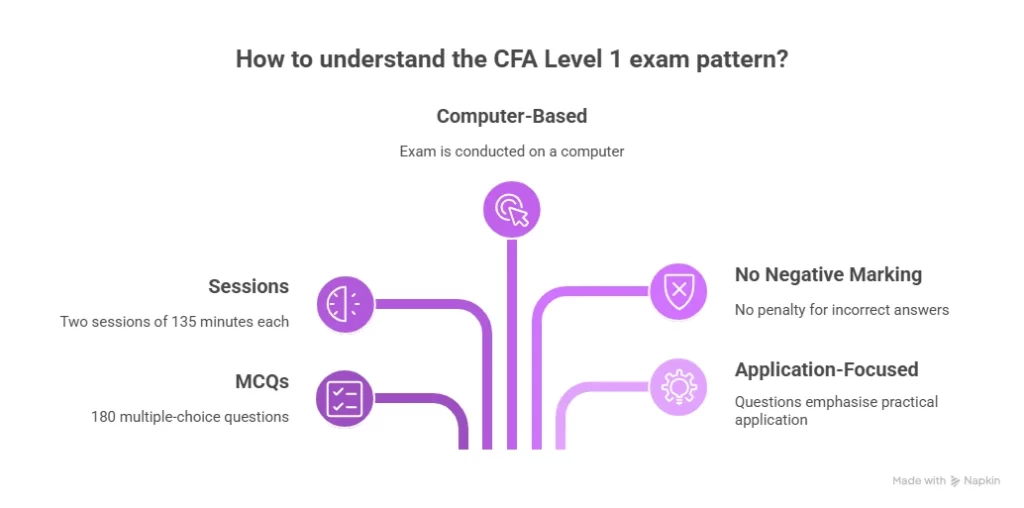
The CFA Level 1 exam has 180 MCQs, split into two sessions of 2 hours and 15 minutes each. Imarticus Learning offers guidance on mastering this exam pattern through timed practice sessions and real exam simulations.
How long does it take to prepare for the CFA Level 1 Exams?
Most students spend approximately 300 hours preparing for the CFA Level 1 exams, usually over 5-6 months. It’s very doable when you spread it out. At Imarticus Learning, the study plan is built to keep things balanced – a mix of concept learning, weekly practice, and regular mock tests so you’re never cramming at the last minute. Plus, having mentors check in on your progress makes it much easier to stay motivated and stick to the plan.
How many hours should I study for CFA Level 1?
The hours of study required are subjective and depend on your pace of learning, previous experience, and background. Usually, most students spend 250-350 hours preparing for the CFA Level 1 exams. Dedicating 10-12 hours per day or following a routine that suits you consistently is the key to acing your exams. Programs like Imarticus Learning make this even easier with structured plans and mentor-led guidance.
Are mock tests important for the CFA Level 1 Exams?
Yes, they are extremely essential. Mocks are basically your rehearsal for the real exam. They help you understand timing, question style, and identify your weak areas. Many candidates say mocks made the biggest difference in their final result.
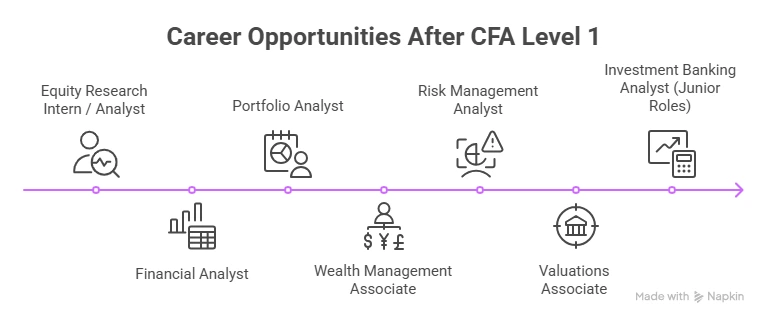
What are the job opportunities after clearing CFA Level 1?
CFA Level 1 shows employers you’re serious about finance. You can work in roles like:
Research Analyst, Investment Banking support roles, Equity or Risk Analyst, Wealth Management Associate, and Corporate Finance roles. It’s a strong starting point, and the opportunities grow as you progress through Levels 2 and 3.
Your Path to Cracking the CFA Level 1 Exams
The CFA Level 1 Exams may seem challenging. Still, with the right CFA study plan, a smart approach to the CFA Level 1 syllabus, and consistent practice under the CFA exam pattern, clearing the exam becomes absolutely achievable. Whether you’re a student, working professional, or someone switching into finance, Level 1 is your gateway into a rewarding global finance career.
With structured classes, expert guidance, and mock-driven preparation, the CFA training program at Imarticus Learning can help you build confidence, stay disciplined, and improve your chances of clearing the CFA Level 1 Exams on your very first attempt.
Your CFA journey doesn’t have to be confusing or stressful. Start right, stay consistent, and let the CFA Certification become the foundation of your global finance career.
So, you’re passionate about finance and aspire to a successful career on Wall Street or beyond. You’ve likely encountered the illustrious CFA® designation, a credential held by the industry’s elite. But what exactly is the CFA® program, and why is it considered the gold standard?
This article delves into the world of CFA®, unveiling its secrets and highlighting the lucrative career paths it unlocks. We’ll explore the reasons behind the CFA®’s prestige, the exciting career options after CFA it opens doors to, and the journey you’ll embark on to achieve this coveted designation.
You can enrol in theChartered Financial Analyst Certification Program by Imarticus Learning to crack the CFA Course easily.
What is the CFA® Program?
Offered by the CFA Institute, the CFA® program is a globally recognised professional designation program designed to equip individuals with the knowledge and skills to excel in investment analysis and portfolio management. It’s a rigorous three-level exam journey that demands dedication and perseverance. But for those who conquer it, the rewards can be significant, as we’ll soon discover.
Why is the CFA® Program Considered the Gold Standard?
The CFA® program has earned its reputation as the gold standard for several reasons:
Unparalleled Curriculum: The CFA® curriculum covers a comprehensive range of investment analysis topics, from asset valuation and portfolio management to ethics and professional conduct. This in-depth knowledge equips CFA® charterholders with a well-rounded skillset that’s highly sought-after by employers.
Rigorous Exams: The three-level CFA® exams are notoriously challenging. Passing them demonstrates a candidate’s exceptional knowledge, analytical abilities, and commitment to the profession.
Global Recognition: The CFA® designation is recognised by employers worldwide. CFA careers signify a level of expertise and professionalism that transcends geographical boundaries.
Ethical Standards: The CFA Institute upholds a strict code of ethics and professional conduct. CFA® charterholders are bound by these principles, ensuring they act with integrity and in the best interests of their clients.
Lucrative CFA Career Paths
Earning the CFA® designation opens doors to a wide range of exciting and lucrative career paths in finance. Here are some of the most sought-after options:
Portfolio Manager: Analyse investments, construct portfolios, and manage client assets.
Investment Analyst: Research potential investments, assess risk-return profiles, and make recommendations to clients.
Financial Advisor: Provide comprehensive financial planning services to individuals and institutions.
Risk Analyst: Identify and assess financial risks, develop risk management strategies, and ensure portfolio stability.
Investment Banking: Advise corporations on mergers and acquisitions, capital raising, and other strategic financial transactions.
Private Equity: Source and invest in promising private companies, seeking high returns for investors.
The CFA Career Path
The CFA career path is a journey of dedication and continuous learning. Here’s a glimpse into what you can expect:
Preparation and Exams: Each CFA® exam level requires in-depth study and preparation. Many candidates utilise study materials, attend review courses, and dedicate significant time to self-study.
Experience Requirement: To earn this designation, you’ll need to gain relevant work experience in the investment industry, typically a minimum of four years.
Lifelong Learning: The financial world is constantly evolving. CFA® charterholders are expected to commit to ongoing professional development to stay current with industry trends and best practices.
The CFA® Career Journey
Earning the CFA® charter is a significant achievement that opens doors to a wide range of exciting career opportunities. The journey typically involves:
Level I: Covers a broad range of foundational topics in finance.
Level II: Delves deeper into investment analysis and portfolio management.
Level III: Focuses on portfolio management and wealth planning, with a greater emphasis on application and decision-making.
To earn this designation, you have to:
Pass all 3 levels of the rigorous exams.
Meet the required work experience: Typically, a minimum of four years of professional work experience in the investment decision-making process is required.
Adhere to the CFA Institute’s Code of Ethics and Standards of Professional Conduct.
Building a Successful Career with the CFA®
The CFA® designation is not just about passing exams; it’s about building a successful career in finance. Here are some key factors to consider:
Networking: Building strong professional relationships is crucial. Attend industry events, connect with other CFA® charterholders, and leverage your network to explore career opportunities.
Continuous Learning: The financial world is constantly evolving. Stay updated on the latest industry trends, regulations, and best practices through ongoing professional development.
Specialisation: Consider specialising in a particular area of finance, such as equity research, fixed-income analysis, or portfolio management.
Mentorship: Seek guidance from experienced professionals who can offer valuable insights and support.
Beyond the Gold Standard: Building a Fulfilling Career
While the CFA® designation unlocks doors to lucrative careers, it’s not just about the money. Here are some additional factors to consider when charting your finance career path:
Work-life balance: CFA careers can be demanding, but many firms offer work-life balance programs and flexible work arrangements.
Company culture: Find a company culture that aligns with your values and fosters professional growth.
Mentorship and Sponsorship: Seek mentors and sponsors who can guide you in your career journey and advocate for your advancement.
Conclusion
The CFA® program is a challenging but rewarding journey that can significantly enhance your career prospects in the finance industry. By diligently preparing for the exams, adhering to the highest ethical standards, and continuously developing your skills, you can unlock a world of opportunities and achieve your career aspirations.
Remember that the CFA® designation is a valuable asset, but it’s just one step on your professional journey. Continuous learning, professional development, and a commitment to excellence are essential for long-term success in the career options after CFA.
Frequently Asked Questions
What are the benefits of earning the CFA® designation?
Enhanced career prospects and earning potential.
Increased credibility and respect within the financial industry.
Access to a global network of CFA® charterholders.
Improved analytical and decision-making skills.
A strong foundation for a successful career in investment management.
What are the challenges of pursuing the CFA® program?
The exams are rigorous and require significant time and effort to prepare.
The program involves a significant financial investment.
Maintaining a balance between work, study, and personal life can be challenging.
What are the CFA careers for charterholders?
Portfolio Manager, Investment Analyst, Financial Advisor, Risk Analyst, Investment Banker, Private Equity Professional, and many more.
How can I prepare for the CFA® exams?
Enroll in a reputable review course.
Utilise study materials provided by the CFA Institute.
According to the Institute of Management Accountants (IMA) 2023 Global Salary Survey, Certified Management Accountants (CMAs) earn 24% more in median total compensation than their non-CMA peers.
According to the IMA’s 2023 survey findings, professional CMA practitioners earn superior salaries, receive enhanced job security and career progression, and experience strong professional fulfilment. The CMA credential remains vital for financial experts worldwide because of rising organisational demands for strategic financial leadership.
While self-study alone can be challenging, enrolling in a US CMA course can significantly improve your chances of passing the exam and gaining a strong foothold in the market.
CMA Salaries by Region
USA
CMAs in the USA are among the highest earners globally. According to the IMA survey, the median CMA USA salary is $137,137, with a median total compensation of $163,932.
This marks a 20% increase in CMA salary and a 24% increase in total compensation compared to non-CMAs for the same role. The growing demand for professionals skilled in financial management and strategic decision-making has made CMAs an essential asset for organisations, contributing to their higher compensation.
Europe
In Europe, CMA professionals also enjoy competitive salaries, though they may not reach the same levels as the US. However, the total compensation figures are still strong, driven by the growing recognition of CMAs in enhancing business performance and financial strategy. The average CMA salary in Europe is $104,369. If bonuses are added to this base CMA salary, the total compensation is around $124,024.
European businesses continue to acknowledge the importance of skilled financial professionals who can navigate complex financial environments and drive long-term growth.
Middle East & Africa (MEA)
The future appears bright for CMAs operating within the Middle East and African (MEA) territory. The regional organisations in this area understand that CMAs provide significant worth through their contributions to organisational efficiency and financial stewardship.
The average CMA salary in this region is $40,000, and the median pay is around $30,000. Organisations seek CMAs intensively because they need experts to oversee financial operations in modern, competitive market environments.
India
The Indian region demonstrates a growing demand for CMA professionals. However, compensation can be significantly lower than professionals in all other global regions. It is startling that this degree remains popular even though salaries are far below those in other countries.
The rising use of digital financial technology and organisations’ demands for strategic accounting practices result in salary growth. The average CMA salary in India is $22,500, with the median at $8,000. This equates to an average CMA salary (per month) of $1,875. As the region develops further and professionals take control of financial leadership roles, CMA certification value will keep growing simultaneously.
The Global Perspective
On a global scale, the median total compensation for CMAs is $86,955, 21% more than the compensation earned by non-CMAs. This premium demonstrates the financial benefits of holding a CMA certification and highlights the credential’s worldwide recognition.
Career Advancement and Job Security
The CMA certification provides financial success, career development opportunities, and robust employment security for the long term. Survey results indicate that 82% of CMAs found new job possibilities because of their certification, and 77% believe their companies value their contributions. CMAs have reported that their certification makes them excel in various business areas, with 75% reporting better functionality across different operational functions.
CMA Salary Growth Post-Pandemic
The salary growth of CMA professionals has persisted during the global industry transformations triggered by the COVID-19 pandemic. Salaries for CMAs across the USA increased by 75% despite financial corrections for inflation. Data from multiple geographical areas demonstrate that the market relevance and value of Certified Management Accountants continue to grow regardless of recent industry reformations caused by the pandemic.
Gender Pay Equity Among CMAs
A particularly encouraging trend in the 2023 IMA survey is a narrowing gender pay gap among CMAs. In younger age groups, mainly those aged 20-29, women reported a 25% higher median base CMA salary than their male counterparts. Although gender pay disparities still exist in certain regions, especially among professionals aged 50 and older in the U.S., the growing gender equity is a positive development for the profession.
The Future of CMA Salaries
Technological advancements and the increasing reliance on data-driven decision-making will continue to drive salary growth for CMAs. The IMA survey points to their expanding role in key areas such as digital transformation, risk management, and strategic financial planning.
As businesses seek skilled professionals to guide their financial strategies, CMAs will remain in high demand, and their salaries will reflect this trend.
Summing Up
According to the IMA’s 2023 Global Salary Survey, CMA-certified professionals achieve higher pay even when compared to their non-certified counterparts in every geographical region. Holding the CMA certification delivers more than improved earnings. It builds career flexibility and ensures professional financial stability while delivering meaningful job contentment.
Financial expertise is increasingly valuable across industries. The CMA certification is an intelligent career investment for finance professionals who want long-term success in international employment opportunities.
A US CMA course can make clearing the exam easier. Imarticus offers a well-structured CMA course with excellent resources to support your preparation.
Frequently Asked Questions
Is Certified Management Accountant remuneration similar to Certified Public Accountant pay scales?
While both CMA (Certified Management Accountant) and CPA (Certified Public Accountant) certifications offer strong career prospects, CMA salaries tend to be higher in management roles, particularly in corporate finance and strategic planning. CPAs, on the other hand, may see higher salaries in public accounting and auditing roles. The best choice depends on career goals and industry preferences.
Are CMA salaries graded differently between the various industries?
CMA professionals can receive a range of salaries, which vary depending on their roles and industry. Offerings like financial services to technology enterprises and healthcare institutions lead CMAs toward higher compensation than their counterparts delivering services to non-profit and government entities.
What influence does professional work experience have on Certified Management Accountant compensation levels?
The experience level determines what CMAs can earn in salaries. Junior CMAs start their career with lower pay than experienced professionals who have worked ten years and beyond. CFOs and financial directors earn considerably higher salaries because they contribute business strategy expertise while having financial planning abilities and leadership responsibilities.
Can CMA professionals earn performance-based bonuses in their professional practice?
CMA professionals can benefit from performance-based bonus programs offered by various organisations. Performance bonuses link compensation to financial results across three criteria: business outcome measurements, cost reduction accomplishments, and strategic career development activities. Senior CMAs frequently hold leadership positions that earn base compensation and incentive payouts, which are usually quite hefty.
So you’re eyeing a career in accounting and finance, and the prestigious ACCA qualification has caught your eye. But let’s be honest, financial security is a major concern. The question that probably keeps you up at night is: “How much can I realistically earn with an ACCA under my belt?”
Well, fret no more, curious minds! This article delves into the fascinating world of ACCA salaries, exploring global earning potential and shedding light on what factors can influence your paycheck. We’ll also take a specific look at the ACCA salary landscape in India, a country with a booming job market for qualified accountants.
What is the ACCA Course?
The ACCA (Association of Chartered Certified Accountants) qualification is a globally recognised professional program that equips you with the knowledge and skills to excel in accounting, finance, and management. It’s a journey of dedication, but the rewards can be significant, as we’ll soon discover. You can find more details about the ACCA course on our website.
ACCA Salary in India
For our Indian audience, let’s get straight to the rupee-levant details! The average annual salary for ACCA qualifiers in India can vary depending on experience, location, industry, and the specific role. On average, the ACCA salary in India for articles and members is INR 3,00,000 to INR 14,20,000. But to give you a ballpark figure, experienced ACCA members in India can typically command salaries in the range of ₹9 lakhs to ₹23 lakhs per annum. This is just the salary for managerial roles and even more senior leadership positions such as finance director would pay even more.
ACCA Jobs in India
The good news is that ACCA careers India opens doors to a wide range of exciting career opportunities in this country. Some of the high-demand areas for ACCA professionals include:
Management Accounting
Financial Reporting
Taxation
Risk Management
Corporate Finance
Global ACCA Salary Landscape
Now, let’s broaden our horizons and explore the global ACCA salary scene. The beauty of the ACCA qualification is its international recognition. This means your skills and expertise are valued by employers worldwide.
Here’s a glimpse into what ACCA members can expect to earn (average salaries) in some key countries:
Remember, these are just general ranges. Several factors can influence your ACCA salary, including:
Experience: The more experience you have, the higher your earning potential.
Location: Salaries tend to be higher in developed countries and major financial hubs.
Industry: Certain industries, like finance and consulting, typically offer higher salaries for ACCA professionals.
Employer: Larger companies and multinational corporations may offer more competitive salaries.
Job Role: Specialised roles and leadership positions generally command higher salaries.
Skills and Expertise: Developing additional skills like data analytics or forensic accounting can boost your earning potential.
The Power of Negotiation
Don’t be afraid to negotiate your salary! Research the market rate for similar positions with your experience level and qualifications. This will give you a strong foundation for confident negotiation.
Continuous Learning is Key
The world of finance is constantly evolving. To stay ahead of the curve and maximise your earning potential, commit to continuous learning. Pursue additional certifications, attend industry events, and stay updated on the latest trends.
The Global Reach of the ACCA
The ACCA qualification isn’t just a ticket to a good job in India. It’s a passport to a global career. ACCA is recognised worldwide. This opens doors to exciting opportunities across the globe. From bustling financial centres like London and New York to emerging markets in Asia and Africa, ACCA professionals are in demand.
Key Considerations for Career Growth
While the potential earnings are enticing, remember that salary is just one piece of the puzzle. Consider these factors when planning your career path:
Work-life balance: Look for roles and companies that align with your personal priorities.
Career progression: Explore opportunities for advancement within your chosen field.
Professional development: Continuously upgrade your skills through further education, industry certifications, and professional development courses.
Networking: Build strong professional relationships. Attend industry events, join professional associations, and connect with other ACCA members.
Conclusion
The ACCA qualification can significantly enhance your earning potential and open doors to a fulfilling career in finance. By understanding the global salary landscape, developing in-demand skills, and actively pursuing career growth opportunities, you can maximise your earning potential as an ACCA professional. Remember, the journey towards financial success is a continuous one. Embrace lifelong learning, adapt to new challenges, and strive for excellence in your chosen field.
Frequently Asked Questions
What are the highest-paying industries for ACCA salary in India?
Generally, industries like investment banking, consulting, and private equity tend to offer higher salaries for ACCA professionals.
How can I increase my earning potential as an ACCA professional?
Focus on developing specialised skills, such as data analytics, financial modelling, and risk management. Gain relevant experience in high-growth sectors and actively network to build your professional connections.
What is ACCA course?
The ACCA qualification provides you with a globally recognised credential, enhancing your career prospects and opening doors to international opportunities. It also equips you with valuable skills and knowledge that are highly transferable across various industries.
How can I stay competitive in the evolving financial landscape?
Continuous learning is crucial. Stay updated on the latest industry trends, regulations, and technologies. Explore opportunities for further professional development and consider pursuing additional certifications or specialisations.
Accounting is a critical field, offering lucrative career paths. Professionals seeking global recognition often pursue ACCA. The ACCA (Association of Chartered Certified Accountants) credential is internationally respected. It equips individuals with financial expertise and strategic decision-making skills. Understandingwhat is ACCA is essential for aspiring accountants.
If you want to excel in accounting, structured learning is crucial. Enrol in our ACCA course to gain the skills and certification needed for global opportunities.
What is ACCA?
ACCA is a globally recognised professional accountancy qualification. It provides expertise in taxation, financial reporting, management accounting, and corporate finance. Recognised in over 180 countries, it enhances global employability. ACCA-certified professionals work in consulting, risk management, and leadership roles.
The certification follows a structured curriculum covering financial principles, ethical practices, and strategic decision-making. Individuals earning ACCA certification stand out in the finance industry, securing top roles in multinational corporations, public accounting firms, and financial institutions.
Why Choose ACCA for a Career in Accounting?
ACCA is an excellent choice for professionals aiming for a stable and lucrative accounting career. Here are some of the top reasons why you should choose ACCA:
Global Recognition: The ACCA qualification is accepted worldwide, opening international career opportunities.
Comprehensive Curriculum: ACCA covers a vast range of accounting, taxation, financial management, and strategic decision-making topics.
Flexibility: The ACCA qualification allows professionals to study while working full-time, making it convenient for career development.
High Employability: ACCA-certified professionals are in demand globally, with many securing top finance roles.
Career Growth: ACCA provides career growth in finance, consulting, corporate management, and leadership roles.
Career Objective for Accountants Pursuing ACCA
Professionals pursuing an ACCA career aim for financial stability, career progression, and expertise in global accounting practices. Common career objectives for accountants with ACCA include:
Becoming a financial analyst in multinational firms.
Securing high-paying roles in taxation.
Leading corporate finance teams and making strategic decisions.
Advising clients in financial consulting.
Managing risk, compliance, and regulatory standards.
By setting clear career objectives, ACCA professionals can navigate their path efficiently and excel in the financial world.
Career Paths in an ACCA Career
Public Accounting
Public accounting is one of the most popular career paths for ACCA professionals. It involves tax consulting, and advisory services. Many ACCA professionals secure roles in top accounting firms, including the Big Four: Deloitte, PwC, EY, and KPMG.
Corporate Finance
Companies need skilled finance professionals to manage their investments, financial planning, and budgeting. ACCA-certified individuals often work in corporate finance departments of global corporations, handling financial forecasting, risk assessment, and investment analysis.
Financial Advisory
Financial advisors assist businesses and individuals in managing their financial assets, investments, and growth strategies. ACCA professionals with expertise in risk management and financial analysis excel in this field, offering insights on mergers, acquisitions, and corporate restructuring.
Taxation
Tax consultants help businesses and individuals with tax planning, compliance, and regulatory adherence. With ACCA certification, professionals can secure roles as tax specialists, helping organisations minimise tax liabilities while complying with legal standards.
Management Accounting
Management accounting focuses on budgeting, performance analysis, and financial decision-making within organisations. ACCA professionals play a crucial role in tracking company expenses, identifying cost-saving opportunities, and optimising financial performance.
ACCA Certification Levels and Career Progression
ACCA Level
Key Skills Acquired
Potential Roles
Applied Knowledge
Financial reporting, business law
Entry-level accountant, finance assistant
Applied Skills
Taxation, management accounting
Tax consultant, financial analyst
Strategic Professional
Risk management, corporate governance, leadership
CFO, finance director, senior consultant
Skills Required for ACCA Careers
ACCA certification prepares professionals with essential accounting and finance skills. The key skills required for success in ACCA careers include:
Financial reporting and analysis: Understanding financial statements and reporting standards.
International accounting standards: Compliance with IFRS and GAAP.
Strategic decision-making: Applying financial knowledge to business growth.
Ethical decision-making: Maintaining integrity in financial operations.
Risk assessment and management: Identifying financial risks and mitigating strategies.
Leadership and strategic thinking: Guiding teams and companies toward financial success.
Challenges in Pursuing ACCA
Pursuing ACCA comes with challenges, but overcoming them leads to significant career rewards. Here are common challenges faced by ACCA candidates:
Time commitment: ACCA exams require significant preparation and dedication.
Complexity of subjects: Topics like taxation, financial reporting, and risk management can be challenging.
Adapting to international regulations: Accounting standards vary by country, requiring adaptability.
Continuous learning: Finance professionals must stay updated with evolving industry trends.
How to Excel in ACCA Careers
To succeed in ACCA careers, candidates must stay committed to continuous learning and professional growth. Here are some strategies for excelling:
Follow a structured study plan: Preparing systematically for ACCA exams increases the chances of passing.
Gain practical experience: Applying accounting concepts in real-world scenarios enhances expertise.
Stay updated with industry trends: Learning about changing financial regulations keeps professionals competitive.
Develop networking skills: Connecting with finance professionals helps in career advancement.
Pursue additional certifications: Complementing ACCA with CFA or CPA boosts career opportunities.
Conclusion
ACCA is an excellent choice and career objective for accountant roles and aspiring accountants. It offers flexibility, recognition, and career growth. Mastering ACCA can lead to high-paying roles worldwide. To accelerate your career, explore ACCA and gain globally recognised expertise.
Frequently Asked Questions
What is ACCA? ACCA is an international accounting certification providing expertise in financial management, and taxation.
Why pursue ACCA for an accounting career? It offers global recognition, high employability, and strong career growth opportunities. It is a great career objective for accountant and finance roles.
What are common ACCA career paths? Taxation, financial analysis, management accounting, and financial advisory.
How long does it take to complete ACCA? It typically takes 2-3 years, depending on prior qualifications and exam pace.
Landing top analyst jobs at Multinational Corporations (MNCs) is highly competitive, but with the right approach, you can significantly improve your chances. From formulating financial plans and projections to creating analytical reports, a financial analyst’s job role extends to guiding investment decisions. They are currently among the most sought-after positions in the finance industry, especially at MNCs, where financial decision-making and data analysis are crucial for global operations.
Pursuing a financial analysis course is a great way to gain the technical and analytical expertise that will set you apart from other candidates. This training helps you master advanced tools and techniques essential for making it to top MNCs.
Understand the Analyst Role at MNCs
The financial analyst job description at MNCs typically involves evaluating complex data to help businesses make informed decisions. Key responsibilities include financial modelling, budgeting, forecasting, and financial reporting.
In MNCs, the role often extends to global financial analysis and cross-functional collaboration to align financial strategies with the company’s global objectives. Analysts are expected to identify trends, analyse market conditions, and provide actionable insights to senior management. Understanding the scope of the role is crucial to tailor your skills and approach effectively.
Essential Skills to Stand Out
To secure top analyst jobs, mastering a combination of technical skills and soft skills is imperative.
Technical Skills: Proficiency in financial modelling, advanced Excel, SQL, data analysis tools (e.g., Power BI, Tableau), and ERP systems (such as SAP) is essential. These tools help analysts perform complex calculations, analyse large datasets, and automate financial processes. For example, financial modelling is crucial for forecasting future financial outcomes and business valuation, while SQL enables analysts to extract large volumes of data from databases efficiently.
Qualitative Skills: Strong communication skills are vital to translate complex data into clear, actionable insights. Critical thinking and the ability to solve problems in uncertain scenarios are also essential. Being detail-oriented is particularly important in ensuring the accuracy of financial reports and forecasts, as even minor errors can lead to costly financial mistakes. Adaptability is another critical skill, as the financial landscape is constantly evolving.
Education and Certifications that Matter
While a degree in finance, accounting, or economics is a common educational background for financial analyst jobs, additional qualifications can set you apart. Strong math skills, including probability and statistics, are essential for analysing financial data, assessing risk, and making accurate forecasts. These skills help financial analysts interpret market trends, evaluate investment opportunities, and develop financial models with precision.
Relevant certifications, such as a financial analysis course or a certificate in CFA or FRM, will further bolster your profile. These programmes equip you with the skills necessary for complex financial analysis and demonstrate your commitment to the profession.
For financial analyst jobs for freshers, especially in MNCs, internships and entry-level roles in small companies can also provide practical exposure to the job functions and industry-specific requirements.
Tailoring your Resume and LinkedIn Profile
When applying for analyst jobs, it’s crucial to tailor your resume and LinkedIn profile to reflect the specific skills and experiences employers seek.
Highlight relevant coursework, internships, and projects that demonstrate your ability to perform the tasks listed in your preferred financial analyst job description.
If you’re new to the field, focus on transferable skills such as analytical thinking, proficiency with Excel, or any finance-related internships.
Be sure to optimise your LinkedIn profile with keywords such as “financial modelling,” “data analysis,” and “financial forecasting” to attract recruiters.
Networking and Building Industry Connections
Building a professional network is vital for landing a top financial analyst job role. Connect with professionals in the industry through LinkedIn, alumni networks, and industry events like finance seminars or webinars.
Networking increases your chances of receiving referrals, which can be a significant advantage in the hiring process. Engage with recruiters and professionals from MNCs to learn about upcoming job openings and expectations for candidates.
Go the extra mile by
participating actively in finance-specific clubs,
conducting independent research in evolving areas like AI in finance,
attending industry conferences.
Acing the Interview
Interviews for financial analyst jobs are typically rigorous, focusing on both technical knowledge and soft skills. Expect to answer questions about financial modelling, past analytical projects, and how you’ve handled complex data.
Practice case studies and financial scenarios to demonstrate your problem-solving and analytical thinking abilities. Preparing for commonly asked questions like “How would you analyse a company’s financial performance?” or “What financial models would you use for forecasting?” can give you an edge.
Gaining Experience: Internships and Entry-Level Roles
For freshers or those transitioning into the financial analysis field, gaining relevant experience through internships or entry-level roles is crucial. Many MNCs offer graduate programs or internships that provide hands-on experience with financial modelling, data analysis, and financial reporting. This experience will not only enhance your skill set but also give you a real-world understanding of the financial analyst job role in a multinational setting.
Staying Updated on Industry Trends
The finance industry is constantly evolving, with new tools, technologies, and regulations shaping how financial analysis is conducted. Analysts aiming for positions in MNCs should be well-versed in trending topics such as ESG (Environmental, Social, and Governance) investing, blockchain in finance, AI-driven financial modelling, fintech innovations, and global economic policies.
Regularly read industry reports, follow influential finance blogs, and take part in webinars and financial analysis courses.
Conclusion
Breaking into top analyst jobs at MNCs requires technical proficiency, industry awareness, and professional credentials. Skills in financial modelling, investment analysis, and data-driven decision-making, combined with certifications in financial analysis, strengthen your profile. Internships, networking, and hands-on experience further increase your chances, as do a sound knowledge of evolving industry trends such as AI-driven finance, ESG investing, and fintech innovations. Enrol in Imarticus’ Financial Analysis Course for structured learning and hands-on exposure to the finance industry. It bridges the gap between theory and practice, preparing you for success in the global finance industry.
FAQs
What are some of the highest paid financial analyst jobs?
The salary of a financial analyst varies based on experience, industry, and specialisation. The highest paid financial analyst jobs include investment banking analyst, hedge fund analyst, and financial planning & analysis (FP&A) analyst, among various others.
Can freshers get financial analyst jobs at MNCs? Yes, freshers can secure financial analyst jobs by gaining relevant skills, pursuing internships, and earning certifications like CFA or financial analysis courses.
What are the top industry trends financial analysts should know? Key trends include AI in finance, ESG investing, fintech innovations, blockchain applications, and global economic policy shifts impacting financial decision-making.
What are some MNCs that hire financial analysts?
Some of the leading MNCs that regularly recruit financial analysts are Goldman Sachs, Deloitte, JPMorgan Chase & Co., EY, and HSBC.