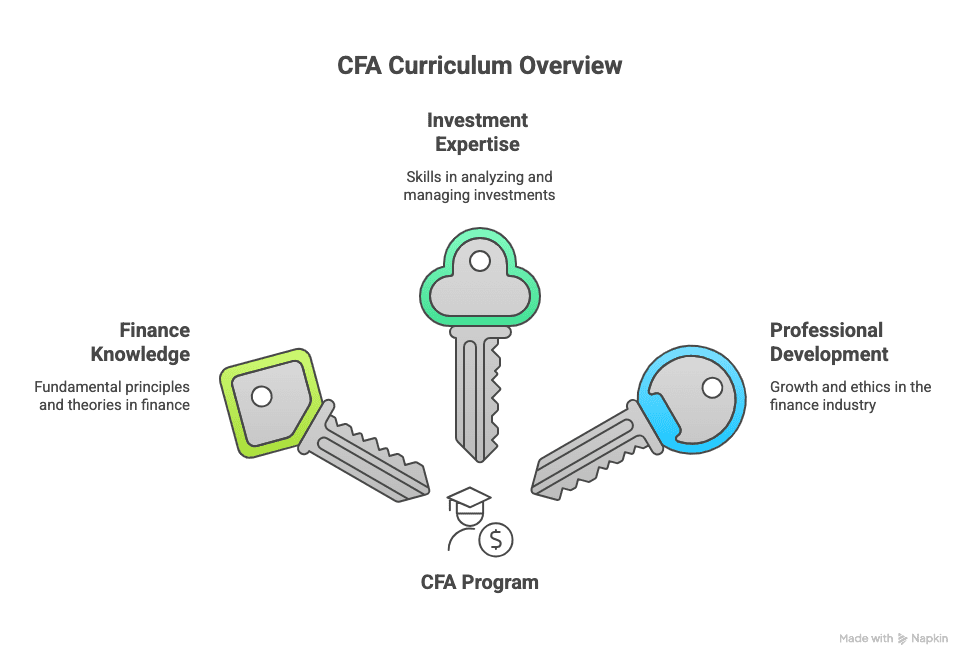
If you are considering a future in investment banking, portfolio management, or financial analysis, the CFA Curriculum provides the best roadmap for you. The CFA Program is viewed as the gold standard in finance certification and is a challenging, yet transformational, program. But what exactly do you study across its three levels? That’s the question this blog will answer for you in complete detail.
The CFA Curriculum is updated annually to align with changing industry requirements. Even if only in a general sense, knowing what subjects to expect at each level is crucial. If you’re a commerce graduate in Mumbai, or a finance professional in Delhi, knowing the structure of the 2025 CFA syllabus will allow you to plan appropriately. This blog walks you through the subjects, their weightage, and how they evolve from basic concepts to strategic applications.
CFA Level 1 Subjects: A Foundational Start
The first level of the CFA Curriculum is centered on knowledge and comprehension. It is a focus on a good understanding of finance, economics and investment principles. The goal is to provide you with the fundamental foundations necessary to provide you with the essential tools and concepts to make decisions in finance. Aspirants often find Level 1 both accessible & intense. Accessible.. because the concepts are beginner-friendly & intense because the breadth of topics can be overwhelming! The CFA Level 1 subjects span a wide spectrum -demanding time management & a deep conceptual understanding.
Subjects Covered in CFA Level 1
Ethical and Professional Standards
Quantitative Methods
Economics
Financial Reporting and Analysis
Corporate Finance
Equity Investments
Fixed Income
Derivatives
Alternative Investments
Portfolio Management
Level 1 Weightage Table
Subject
Approximate Weight (%)
Ethical and Professional Standards
15-20%
Quantitative Methods
8-12%
Economics
8-12%
Financial Reporting & Analysis
13-17%
Corporate Finance
8-12%
Equity Investments
10-12%
Fixed Income
10-12%
Derivatives
5-8%
Alternative Investments
5-8%
Portfolio Management
5-8%
CFA Level 2 Curriculum: Application and Analysis
Level 2 takes everything you have learned from Level 1 and now making use of your knowledge in real world settings. The curriculum for the CFA Level 2 charter focuses on advanced analysis, complex valuation methodologies, and ethical decision-making in practice.
Professionally, it is often considered the hardest level, especially for the working professional. It demands not just understanding but application. You’ll dive deep into case studies, interpret financial reports, and make investment decisions based on data and ethics.
Subjects Covered in CFA Level 2
Ethical and Professional Standards
Quantitative Methods
Economics
Financial Reporting and Analysis
Corporate Issuers
Equity Investments
Fixed Income
Derivatives
Alternative Investments
Portfolio Management and Wealth Planning
Key Features of Level 2 Curriculum
Emphasis on item set questions
More weight on valuation and analysis
Real-life case studies dominate question formats
Heavy reliance on interpretation of financial statements
CFA Level 3 Topics: Strategy and Synthesis
Finally.. Level 3 of the CFA Curriculum is where everything comes together. This level tests your ability to synthesize data, apply investment strategies & manage portfolios in real world situations. If Level 2 was about application -Level 3 is about strategy.
The CFA Level 3 topics lean heavily on portfolio management, ethics, and wealth planning. Indian candidates preparing for Level 3 must adjust their study style—rote learning won’t help here. Instead, practice essay-type questions and master the art of presenting structured financial arguments.
Subjects Covered in CFA Level 3
Ethical and Professional Standards
Behavioral Finance
Private Wealth Management
Institutional Investors
Asset Allocation
Fixed Income and Equity Portfolio Management
Derivatives and Risk Management
Alternative Investments
Trading, Monitoring, and Rebalancing
Performance Evaluation and GIPS
Topics Presented in Bullet List
Deep dive into portfolio construction and management
Emphasis on behavioural finance and its role in decisions
Strategies for private wealth and institutional clients
Performance measurement and attribution
Understanding of risk and return trade-offs
Mastery of ethics in ambiguous situations
CFA Exam Subjects in Tabular Format
To help you understand the progression of topics, here’s a comparative view:
Level
Focus Area
Primary Objective
1
Basic Knowledge
Understand concepts and tools
2
Application and Analysis
Apply and interpret financial data
3
Synthesis and Strategy
Formulate and justify strategies
This table simplifies what each level expects from you, aligning directly with your preparation goals.
What is Covered in the CFA Exam: An Overview
Still wondering what is covered in the CFA exam? From ethics to alternative investments, the exam tests every corner of the finance universe. And yes, the CFA Curriculum ensures you’re exam-ready and industry-ready.
Each level has its own testing format. Level 1 is entirely multiple choice, Level 2 uses item sets, and Level 3 blends item sets and essay questions. You’ll need a multi-dimensional strategy to crack all three.
Summary of Exam Coverage
1: Basic knowledge, high breadth
2: Analytical skills, case-based
3: Strategic application, essay-driven
For up-to-date information on exam trends, check CFA Institute’s Curriculum Update and recent Kaplan Schweser reports. You can also read insights from Financial Times on CFA’s global value.
CFA Course Content: Real-World Relevance
The CFA Curriculum is aligned closely with industry needs. It doesn’t just test textbook knowledge.. it challenges you to think like a real financial analyst. Each level builds on the last, ensuring you come out of the program job-ready.
From understanding capital markets to assessing equity valuations, the CFA course content mirrors the demands of real world finance jobs. This alignment is one of the reasons why -CFA holders are in high demand across India’s top investment firms & MNCs.
Key Highlights of the CFA Course Content
Ethics is present at all levels, reinforcing its significance
Every level requires at least 300 hours of study
Emphasis shifts from theory to analysis to synthesis
Real-life case studies and essay-based responses
Key Takeaways
The CFA Curriculum progresses from basic knowledge to strategy.
CFA Level 1 subjects cover a wide array of foundational topics.
The CFA Level 2 curriculum focuses on applying valuation techniques.
The CFA Level 3 topics revolve around portfolio strategy and wealth management.
Subjects like ethics, economics, and equity investments repeat across all levels, deepening each time.
FAQs
1. How many subjects are in the CFA Curriculum?
There are 10 core subjects spread across three levels, with some recurring themes like ethics, fixed income, and portfolio management appearing in all levels to varying depths.
2. What is the most difficult CFA level?
Most candidates find Level 2 the most difficult due to its analytical intensity and item set format, requiring deep understanding and interpretation.
3. Can I clear all CFA levels in 2 years?
Yes, but it’s highly demanding. You must pass one level every six months, maintain study discipline, and manage your time exceptionally well.
4. What is covered in the CFA exam format-wise?
Level 1 uses multiple choice questions, Level 2 uses item sets & Level 3 uses a combination of item sets and essay questions.
5. Is the CFA Curriculum updated yearly?
Yes.. the CFA Institute revises the curriculum annually to stay aligned with market trends, regulatory updates & global finance practices.
6. Are the CFA subjects theoretical or practical?
They are a blend of both. While foundational topics are theoretical, the application and strategic levels (Level 2 and 3) are highly practical.
7. What is the pass rate for CFA exams?
Historically, pass rates range from 40% to 50% for Level 1 with slightly higher rates for Levels 2 & 3 depending on the exam cycle.
8. Can I self-study for the CFA?
Yes! self study is possible & common. However, many candidates opt for coaching or online courses, especially for Level 2 & 3.
9. How relevant is the CFA Curriculum for Indian finance jobs?
Extremely relevant. Employers in India value CFA certification, especially in roles related to investment banking, equity research, and portfolio management.
10. Do the CFA subjects overlap with an MBA finance curriculum?
Some overlap exists, especially in subjects like corporate finance and economics, but CFA offers far deeper and more rigorous coverage of investment-related content.
Conclusion
The CFA Curriculum is an organized and thorough way to progress wherever you are on your financial journey. Each level brings you further along the path to global credibility, career advancement, and subject matter expertise. If you’re dedicated to finance, the CFA Program is not simply a path forward; it is a game changer.
Understanding the learning objectives of the curriculum in all three levels will allow you to develop a study plan that is:- smart, efficient & aimed at successful outcomes. So.. are you ready to embark on your journey & master finance level-by-level?
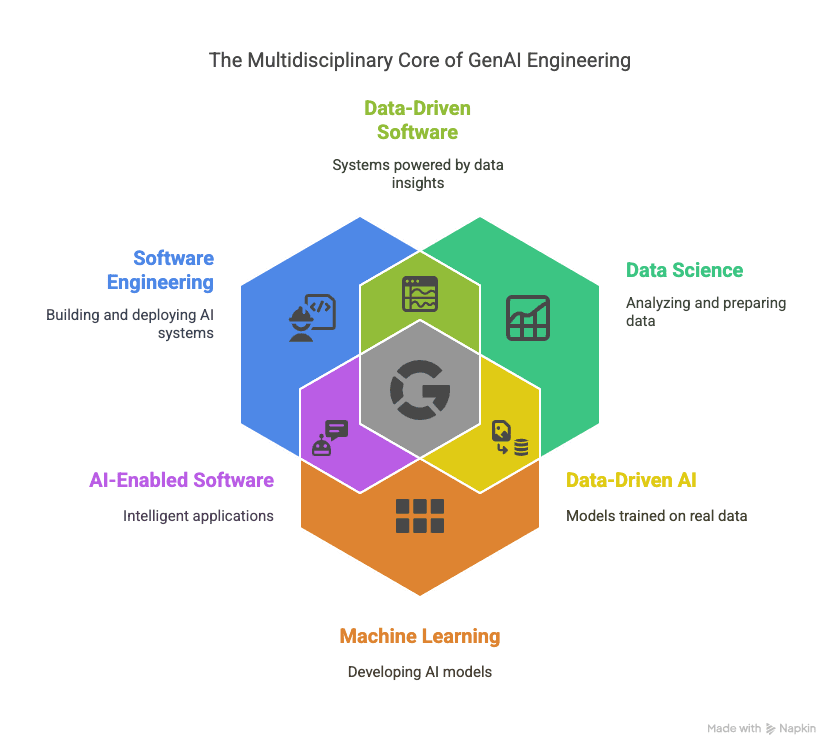
In a world that seems to be changing with artificial intelligence from creative design to coding, there is one fresh tech role that is taking the tech world by storm—the GenAI Engineer. But what does that even mean to you? Don’t worry if you are in the dark about that or if you have heard the title GenAI Engineer somewhere recently. GenAI, otherwise known as Generative AI, is an impressive technology that is no longer just about dazzling prompts or producing incredible art.
It is quickly impacting the way industries work, allowing for automation of work that is done by humans, and is truly the first step toward a new untouchable horizon of intelligent systems design.
A GenAI Engineer is much more than a software developer or a data scientist, they take deep knowledge of AI and blend it with creative problem-solving, and are responsible for building, optimizing, and scaling generative models that support virtual assistants, content-generating engines, medical diagnosis resources, and custom education resource platforms. If you’re considering a future-proof career, this role might just be your ticket to the top.
GenAI Engineer Skills You Need in 2025
If you want to not only be employable, but excel as a GenAI Engineer in 2025, you will need more than coding and programming skills. Being and GenAI Engineer requires both machine learning and an in-depth, experiential understanding of creating generative models with examples such as GPT, DALL·E, and Midjourney. GenAI engineers are not just programmers creating code. They are architects of intelligent systems that learn, create, and adapt.
Being a GenAI Engineer requires both technical depth and cross-domain agility. You might find yourself training a language model one day and integrating it into a user-facing product the next. Understanding AI ethics, prompt engineering, and model deployment strategies is critical in a world that expects responsible and real-time generative outputs.
Key GenAI Engineer Skills in 2025:
Proficiency in Python, TensorFlow, PyTorch, and JAX
Deep understanding of transformer architectures and LLMs
Model fine-tuning, retraining, and optimization techniques
Prompt engineering and human-AI alignment
Knowledge of ethical AI practices and safety standards
Familiarity with deployment tools like Docker, Kubernetes, and Hugging Face
Ability to interpret and explain model behaviour and limitations
How to Become a GenAI Engineer
The path to becoming a GenAI Engineer is not linear—but it is accessible to those with the right mindset and upskilling strategy. Whether you’re a computer science graduate or a mid-career software developer, the journey begins with developing a strong grasp of AI fundamentals and then advancing toward generative models.
You don’t need to build everything anew either. Today’s aspiring GenAI Engineers can also take advantage of platforms such as OpenAI, Cohere, or the Google Vertex AI to get real, practical experience. Working on open-source projects and contributing to model development are also great avenues for gaining visibility with top employers.
Step-By-step Guide on How to Become a GenAI Engineer:
Master the AI Basics: Learn linear algebra, probability, and Python programming.
Study ML & DL: Complete foundational courses in machine learning and deep learning.
Explore Generative AI: Work with GANs, VAEs, and transformers.
Build Projects: Create chatbots, content generators, and image synthesis tools.
Understand Ethics: Dive into fairness, bias mitigation, and interpretability.
Earn Certifications: Gain credentials from top universities or tech companies.
Network & Collaborate: Join GenAI communities on GitHub, Discord, or Hugging Face.
Exploring GenAI Job Opportunities in 2025
As of 2025, GenAI is no longer experimental—it’s mainstream. According to McKinsey’s 2024 report, over 45% of global enterprises have either adopted or are actively integrating Generative AI into their workflows. This boom has opened the door to thousands of job listings explicitly seeking GenAI Engineers.
Opportunities span across multiple industries: finance firms want automated report generation, healthcare is experimenting with AI-assisted diagnostics, while media companies need generative tools for content creation. And startups? They’re hiring GenAI Engineers to build their entire product stack around LLMs and multimodal models.
GenAI Job Opportunities by Sector:
Sector
Typical Role Title
Description
Healthcare
GenAI Specialist – Diagnostics
AI-driven medical imaging & data analysis
Media & Content
GenAI Content Engineer
Content generation & brand language tools
Fintech
NLP and GenAI Developer
AI-based customer service & reports
Education
AI Tutor Developer
Personalised, curriculum-aligned content
SaaS Startups
Full Stack GenAI Engineer
End-to-end GenAI product development
Mapping Your Generative AI Career Path
Going down the Generative AI career path means becoming a part of a tech journey that will change the world. You are not entering into a trend; you are entering a new pillar of intelligent computing. No matter if you are just starting or transferring roles, there is an upward trajectory for a GenAI Engineer, and it is lucrative.
As with many deep-tech careers, your career development will be determined by your portfolio, your contributions to the community in general, and your ability to adapt within new models as things develop. Over time, GenAI Engineers can transition to AI Product Manager, Research Scientist, or even CTO at GenAI-first startups.
Typical Generative AI Career Path:
AI/ML Intern → Junior GenAI Engineer → GenAI Engineer → Senior Engineer/Architect → GenAI Product Lead → AI Strategy Head
What to Expect from GenAI Engineer Salary in 2025
One of the biggest draws to this field is the lucrative GenAI Engineer salary in 2025. With demand outpacing supply, companies are offering competitive compensation packages to attract top GenAI talent. A senior GenAI Engineer in the US can command over $250,000 annually, with stock options, remote work, and research grants as added perks.
In India, where the GenAI boom is gaining momentum, entry-level salaries range between ₹12–18 LPA, with senior professionals earning upwards of ₹40–50 LPA depending on domain expertise and company scale.
Average GenAI Engineer Salary in 2025 (by region):
Certifications not only validate your skills but also enhance visibility on platforms like LinkedIn and Kaggle. With an increasing number of universities and tech giants offering GenAI-focused credentials, it’s never been easier to upskill.
Top GenAI certifications cover areas like transformer networks, ethics, deployment, and prompt engineering. Many of them are project-based, helping you build job-ready portfolios that recruiters love.
Top GenAI Certifications in 2025:
Google’s Generative AI Professional Certificate (Coursera)
OpenAI Developer Certification
DeepLearning.AI’s GenAI with LLMs Specialization
Stanford Online: Generative AI Principles
Microsoft AI Engineer Associate
Key Roles in Generative AI
A GenAI Engineer is just one of the many in-demand roles in generative AI. This booming ecosystem also includes AI product managers, data annotators, prompt engineers, and ethics officers. The diversity of roles means that even non-coders can enter this space with the right complementary skills.
Let’s explore some of the top roles in the GenAI space today.
Major Roles in Generative AI:
GenAI Engineer: Designs, builds, and deploys generative models
Prompt Engineer: Crafts and refines AI prompts for optimal outputs
AI Product Manager: Bridges tech and business for GenAI products
Generative AI Researcher: Conducts academic and applied research
AI Ethics & Safety Analyst: Ensures responsible AI development
A GenAI Engineer designs, trains, and deploys generative AI models like LLMs, GANs, or diffusion models. They optimize turn these models into productive work, such as content generation, coding help, or medical diagnoses, among others.
Q2. Do I need a PhD to be a GenAI Engineer?
A PhD is not necessary, although one should have an excellent grounding in AI/ML and hands on experience of generative models to be successful in this role.
Q3. What industries are hiring GenAI Engineers?
In 2025, GenAI roles are available in industries such as healthcare, fintech, edtech, media, e-commerce, and SaaS start ups.
Q4. What is the average salary for a GenAI Engineer in 2025?
For US salaries, senior roles may pay as high as $300,000, while experienced professionals in India will earn between ₹40-50 LPA.
Q5. How long does it take to become a GenAI Engineer?
With careful study and continuous engagement, taking up to 1.5 to 2 years to reach the role should be achievable.
Q6. What are the prerequisites to learn Generative AI?
Basic knowledge of Python, ML algorithms, linear algebra, and deep learning is recommended before diving into GenAI.
Q7. Is prompt engineering a real job?
Yes! Prompt engineering has become a highly sought-after niche, especially in enterprises heavily investing in LLMs and chatbot tech.
Q8. Are there any free resources to learn GenAI?
Yes, platforms like Hugging Face, Google AI, and OpenAI provide extensive open-source materials and tutorials.
Q9. Can I freelance as a GenAI Engineer?
Absolutely. Many startups and research labs hire freelance GenAI Engineers for model experimentation and integration tasks.
Q10. What are some common tools GenAI Engineers use?
They typically work with tools like Hugging Face Transformers, OpenAI API, Weights & Biases, PyTorch, JAX, and cloud platforms like AWS or GCP.
Key Takeaways
GenAI Engineer is the fastest-growing and highest-paid tech role in 2025.
Building the right GenAI engineer skills is crucial for long-term success.
Learn how to become a GenAI engineer through structured steps, projects, and certifications.
Explore the booming GenAI job opportunities across industries.
Your Generative AI career path can lead to leadership or research roles.
Understand the rewarding GenAI engineer salary 2025 trends globally.
Invest in top GenAI certifications to stand out to employers.
There are many evolving roles in generative AI beyond engineering.
Conclusion
The world is moving into a new era of intelligence.. and GenAI Engineers are set to be at the forefront. Whether you’re creating the next chatbot, transforming content generation workflows, or developing intelligent tutoring systems -your role will help shape how AI and humanity co-evolve. It’s an exciting, emerging & empowering space to be in. Equip yourself with the right skills, stay informed with the latest developments in the field – and step into one of the more fulfilling careers of our time with confidence.
If you are curious, creative, and ready to think differently here is your opportunity to be a GenAI engineer.
Future Finance Leadership: Adapting to Change and Driving Transformation
Skills for Modern CFOs: Blending Technology and Human Insight
Finance Executive Skills: Shaping the Future of Finance
CFO Competencies for the Future: Navigating Uncertainty with Confidence
Digital Skills for CFOs: The Tech-Driven Finance Leader
Leadership Skills in Finance: Building High-Performance Teams
Key Takeaways
FAQs
Conclusion
Introduction: The Future of Finance Is Now
In 2026, the finance industry is starting to make itself more adaptable, with exciting innovations being birthed from this evolution. And the CFO’s desk was much more than books of spreadsheets and quarterly reports. Today, the finance leaders are strategists, storytellers, and technology experimenters. The future of finance no longer stands to be considered the future for it is being played out right now, and the CFO role is fast changing. It is important for every finance professional & aspiring finance professional to be abreast of these changes and know how to stay ahead of the curve.
The future of finance is shaped by -fast-paced technological innovations, instability in the global markets & changing stakeholder expectations. The CFOs are not simply the custodians of financial, economic information. They are architects of business strategy, champions of the digital agenda and stewards of organisational resilience. Whether you are looking forward to 2026 or beyond, the skill set that CFO’s will be expected to possess is being developed, and at a dizzying pace, with complex demands for technical sophistication, digital wisdom, and leadership prowess.l
CFO Skills 2026: The Strategic New Imperative
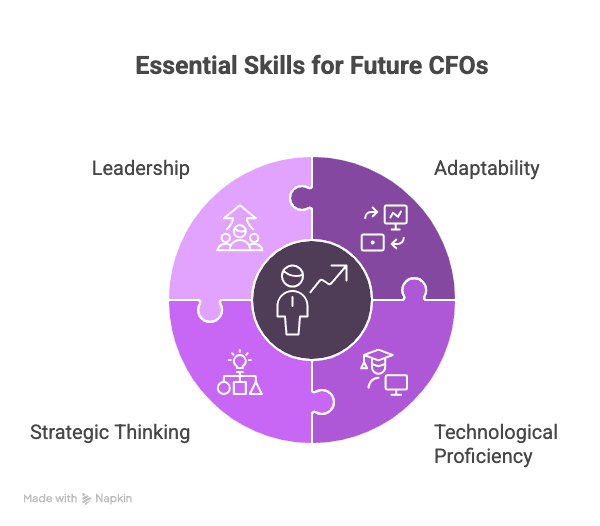
By 2026 -CFOs will need to be strategic allies of the CEO, driving business results and steering through intricate global issues. This requires the mastering of a wide range of skills, ranging from financial expertise to technologic alfluency and people leadership. Finance in the future requires CFOs to be adaptive, visionary, and obsessive in the search for value creation23.
Future Finance Leadership: Adapting to Change and Driving Transformation
Future finance leadership is all about change, innovation, and navigating uncertainty. The finance future will witness CFOs as drivers of transformation—advocating new technologies, business models, and sustainability drivers.
CFOs need to feel at ease with uncertainty and able to lead cross-functional teams in a high-speed world. They are supposed to accelerate digital transformation, deal with ESG priorities, and support financial resilience in uncertain market conditions147.
The Evolving Role of the CFO
From Scorekeeper to Strategist: CFOs are now required to drive business strategy, rather than simply report on results.
From Controller to Collaborator: Bridging connections with HR, IT, and operations to align financial and business strategies.
From Risk Averse to Risk Intelligent: Actively identifying opportunities and threats in today’s uncertain world.
Skills for Contemporary CFOs: Merging Technology and Human Acumen
Modern CFO skills are a combination of technical know-how and human-focused leadership. The future of finance will belong to those who know how to leverage the power of data, automation & artificial intelligence —while motivating employees and articulating a compelling vision.
Today’s CFOs must be proficient in financial technologies, ranging from predictive analytics platforms to robotic process automation (RPA) and artificial intelligence-powered forecasting platforms. Technology, however, is not sufficient by itself. The power to render sophisticated data into practical insights, move stakeholders, and guide change is what defines top-performing finance leaders.
Key Skills for Today’s CFOs
Advanced Data Analysis: Utilizing predictive analytics for strategic decisions.
Automation Expertise: Leveraging AI and RPA to automate finance functions.
Cybersecurity Awareness: Safeguarding confidential financial information in a more digital age.
Change Management: Guiding teams through digital and organizational transformation.
Effective Communication: Communicating financial analysis to a variety of stakeholders.
Top Skills for Contemporary CFOs
Mastering financial model and scenario planning
Data visualization and dashboarding skills
Strong knowledge of cloud-based finance systems
Critical thinking ability to assess and implement emerging technologies
Strong stakeholder and negotiation capabilities
Regulatory regimes expertise and compliance
High emotional quotient and empathy
Sustainability and ESG reporting experience
Crisis management and business continuity planning
Talent development and mentoring
Finance Executive Skills: Shaping the Future of Finance
Finance executive skills are central to the future of finance! With organizations being confronted by unprecedented challenges..ranging from digital disruption to regulatory complexity -CFOs need to develop a strong skill set that is well balanced between technical competency and strategic thinking.
The most sought-after finance executive competencies are advanced analytics, automation, cybersecurity, and strategic leadership. These competencies enable CFOs to accelerate efficiency, drive risk management, and generate value in a fast-changing environment56.
Top Finance Executive Skills for 2026
Skill Category
Description
Impact on Organization
Data Analytics
Turning data into actionable business insights
Informed, agile decision-making
Automation
Streamlining processes with AI and RPA
Cost savings, improved accuracy
Cybersecurity
Safeguarding financial and customer data
Reduced risk, regulatory compliance
Strategic Leadership
Inspiring and guiding teams through transformation
Stronger culture, better performance
Communication
Clearly conveying complex financial concepts
Enhanced stakeholder trust
Refer to ACARP for additional information on finance skills needed.
CFO Competencies for the Future: Resilience in Uncertainty
Future CFO competencies are characterized by flexibility, vision, and a willingness to learn continuously. The future of finance will pay dividends to those who are able to foresee change, shift rapidly, and guide organizations through uncertainty.
Future CFOs need to acquire stakeholder management, business strategy, and risk intelligence skills. They are likely to be advisor-in-chief to the CEO, offering guidance that informs direction and drives long-term growth126.
Core Competencies for Next-Generation CFOs
Strategic Agility: Pivoting in reaction to changing markets and new opportunities.
Forward-Looking Insight: Applying data and analytics to foretell trends and guide strategy.
Stakeholder Engagement: Fostering strong relationships with investors, regulators, and the board.
Ethical Leadership: Maintaining high standards of integrity and transparency.
Continuous Learning: Remaining current with new technologies, regulations, and best practices.
CFO Competencies for the Future
Strategic scenario planning and forecasting
Advanced risk management and mitigation
Expertise in mergers and acquisitions
Proficiency in global financial regulations
Strong digital and analytical skills
Ability to foster a culture of innovation
Experience in sustainability and ESG initiatives
High adaptability and resilience
Strong crisis and change management
Professionally committed to lifelong learning
Digital Skills for CFOs: The Tech-Driven Finance Leader
CFOs’ digital skills are non-negotiable in the future of finance. As automation, AI, and data analytics reshape the finance function, CFOs must become technology-driven champions of change.
Finance leaders with expertise in digital tools can unlock efficiency, enhance the accuracy of forecasts, and fuel business innovation. From installing cloud-based finance systems to using AI for predictive analysis, digital skills are the bedrock of future-proof finance leadership157.
Leadership Skills in Finance: Developing High-Performance Teams
Leadership skills in finance are essential to create teams that will succeed in the future of finance. CFOs need to: motivate, inspire, and enable their teams to change, innovate, and achieve results.
The best finance leaders are those who possess technical skills complemented by emotional intelligence, communications capabilities & a collaborative style. They build trust cultures, promote learning every day, and propel organizational performance through people235.
Key Leadership Skills for CFOs
Visionary mindset and strategic guidance
Leadership through change and ambiguity
Effective communication and storytelling capabilities
Talent development and succession planning
Cross-functional collaboration and influence
Conflict resolution and negotiation
Empathy and emotional intelligence
Commitment to diversity, equity, and inclusion
Leadership Skills for Finance Executives
Setting a clear vision and aligning teams to organizational goals
Building high-performing, diverse finance teams
Encouraging innovation and calculated risk-taking
Leading digital transformation projects
Mentoring and coaching future finance leaders
Managing stakeholder expectations and relationships
Navigating organizational politics with integrity
Fostering a culture of accountability and transparency
Driving continuous improvement and operational excellence
Promoting work-life balance and employee well-being
Key Takeaways
Dynamic, technology-driven, and demanding a new breed of CFOs with a blend of strategy, digital, and leadership skills.
CFO skills 2026 focus on analytics, advanced automation, stakeholder management, and continuous learning.
Leadership in future finance is about driving transformation, innovation, and shaping resilient organizations.
Digital skills CFOs must have their eye on to create value through AI, automation, and data analytics.
Leadership skills in finance must be utilized in building high-performing teams and driving organizational change.
FAQs
1. What skills will be most important for CFOs in 2026?
Chief Financial Officers (CFOs) will need: advanced data analytics skills, strategic thinking skills, digital transformation skills, stakeholder management skills, and good leadership skills; all critical for working in the future of finance.
2. How is the role of the CFO transforming in the future of finance?
The CFO role is shifting away from historical financial management & toward strategic business partnering that -promotes growth, innovation, and digital transformation within the organization.
3. Why are digital skills so important for CFOs?
Digital skills will be critical for CFOs since they will be the drivers of AI, automation, and data analytics that fuel efficiency, drive forecasting better, and provide insights for decision satisfaction in the future of finance.
4. What type of leadership skills do finance executives need?
Finance executive leadership skills involve visionary thinking, communication, talent management, effective teamwork across functions, and emotional intelligence to encourage and empower teams through change.
5. How do CFOs remain ahead of the curve in today’s changing finance environment?
CFOs can remain ahead by upskilling continuously, adopting new technologies, creating a spirit of innovation, and having good relations with stakeholders in order for the company to be agile and competitive.
6. What do automation and AI mean for the finance function?
Automation and AI simplify the mundane, minimize chances of error and enable finance teams to spend more time on strategic initiatives that add value to an enterprise.
7. How much will ESG matter in future finance leadership?
A future-oriented finance leadership becomes ever more focused on ESG (Environmental, Social, and Governance), with its investors and regulators insisting on enhanced transparency and accountability in sustainability practice.
8. What are the major issues CFOs will face in 2026?
Some important challenges are digital transformation, regulatory complexity, cybersecurity, ESG strategy, and supporting teams during uncertainty and change.
9. How do CFOs build future-proof skills?
Of course, CFOs should guarantee their future by keeping themselves abreast of the latest trends and best practices in finance through continuous learning, new experiences, and mentorship.
10. How can CFOs prepare for the future of finance?
Top-shelf resources are industry reports from PwC, IIC Partners, and Robert Half, webinars, professional development courses, and finance leaders to share insights and strategies.
Conclusion
The future of finance is unfolding at an unprecedented pace, demanding a new generation of CFOs who are strategic, tech-savvy, and people-oriented. As we move into 2026 and beyond, the most successful finance leaders will be those who embrace change, invest in continuous learning, and lead with vision and empathy. By developing the right blend of technical, digital, and leadership skills, CFOs can not only navigate the challenges ahead but also seize new opportunities to drive growth, innovation, and resilience in their organizations. The future of finance is bright—and it’s yours to shape.
Global Careers with ACCA: Pathways and Possibilities
ACCA Certified Professional Salary Breakdown
International Finance Jobs for ACCA Graduates
ACCA Qualification Benefits: Why It Matters
ACCA Scope Worldwide: Market Trends and Future Outlook
FAQs
Key Takeaways
Conclusion
Introduction
If you’ve dreamed of getting one of the top finance roles in London, Singapore, Dubai or New York, you are not alone! ACCA Certification is gaining practice with thousands of Indian finance students and finance professionals who are using it as a passport to global careers in accounting and audit, investment, and consultancy. Why? because the world is hiring ACCA professionals like never before. From Big 4 firms to global banks, companies seek ACCA talent for their deep financial expertise and international recognition. But what makes ACCA Certification so valuable? And how exactly does it open doors to high-paying international roles? Let’s break down everything you need to know.
Understanding ACCA Certification
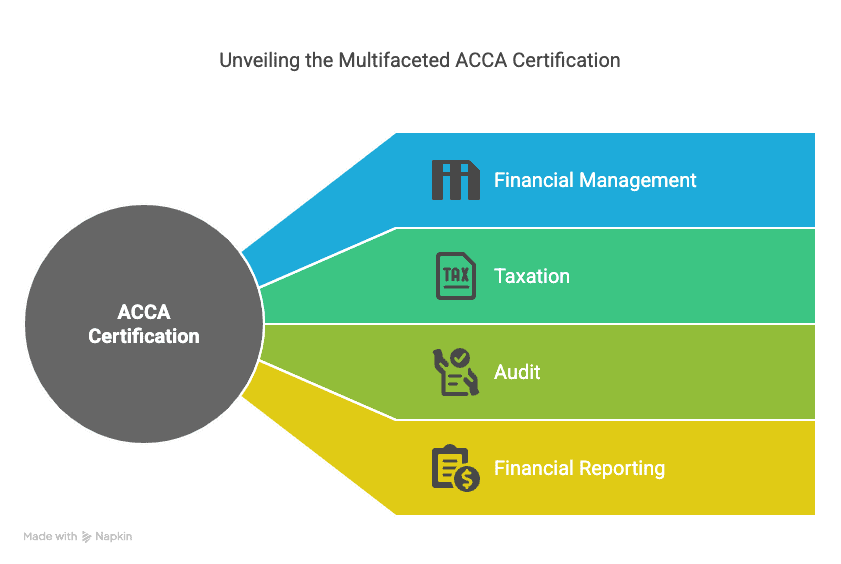
The ACCA (Association of Chartered Certified Accountants) represents the highest form of global certification in accounting and finance available today. It’s a comprehensive certification program with a full syllabus covering: financial reporting, taxation, audit, ethics, and strategic management—the top skills in demand around the world. ACCA Certification not only gives you global competitiveness, but will increase your employment opportunities in over 180 countries. It also has a flexible study model so Indian students can undertake this qualification while in college, or even while working, which makes it a great option for young professionals!
ACCA Job Opportunities Abroad
The world is your playground with an ACCA qualification. International employers actively seek candidates who understand global accounting standards, making Indian ACCA professionals a top choice.
With the growing demand for IFRS (International Financial Reporting Standards), many countries prefer hiring ACCA-certified professionals over local qualifications. That means better job mobility, visa approvals, and higher pay brackets.
Top Countries Hiring ACCA Professionals
Country
Common Roles
Estimated Salary (INR Equivalent)
UK
Financial Analyst, Audit Manager
45-70 LPA
UAE
Compliance Officer, Finance Manager
40-60 LPA
Singapore
Risk Analyst, Corporate Accountant
35-55 LPA
Canada
Internal Auditor, FP&A Specialist
38-65 LPA
Australia
Investment Analyst, Tax Consultant
40-60 LPA
ACCA job opportunities abroad are not just limited to traditional finance roles—they now include fintech, ESG reporting, and risk advisory too.
High Salary Jobs After ACCA
The earning potential with ACCA Certification is significant, especially when combined with global exposure. Employers value ACCA members for their analytical abilities, ethics training, and cross-border accounting knowledge.
Even in India, ACCA-qualified professionals are offered CTCs between INR 6–12 LPA at entry level, and this figure multiplies with global placement or after a few years of experience.
List of High-Paying Roles After ACCA:
Management Accountant
Internal Auditor
Tax Analyst (International Tax)
Financial Controller
Risk and Compliance Manager
Group Finance Manager
Treasury Analyst
Strategy Consultant
ESG Reporting Analyst
CFO (with experience)
High salary jobs after ACCA are possible because ACCA is not just a certificate—it’s a career multiplier.
Global Careers with ACCA: Pathways and Possibilities
One of the key advantages of the ACCA Certification is how it aligns with global frameworks. Whether it’s IFRS, global tax structures, or multinational regulations, ACCA prepares professionals to hit the ground running in any finance team worldwide.
Many multinational companies—including PwC, EY, KPMG, Deloitte, BDO, HSBC, Barclays, and Unilever—actively prefer or even mandate ACCA for global roles. It’s also accepted by over 7500 employers who are part of ACCA’s approved employer program.
Global careers with ACCA span the following industries:
Banking and Financial Services
Consulting and Advisory
FMCG and Retail Conglomerates
Oil & Gas
Public Sector and NGOs
Technology and FinTech
ACCA Certified Professional Salary Breakdown
Let’s explore how ACCA Certification can transform your earning potential. Whether you stay in India or go abroad, the salary jump is clear and compelling.
Salary Breakdown by Experience and Geography
Experience Level
India Salary Range
Global Salary Range (USD)
Entry-Level (0–2 yrs)
INR 6–10 LPA
$40,000 – $60,000
Mid-Level (3–7 yrs)
INR 12–25 LPA
$65,000 – $90,000
Senior-Level (8+ yrs)
INR 30–50 LPA
$100,000+
ACCA certified professional salary also includes bonuses, ESOPs, international allowances, and career growth perks that often exceed expectations.
International Finance Jobs for ACCA Graduates
The demand for internationally competent finance professionals has never been greater. ACCA Certification equips graduates with the necessary tools to take on leadership and strategic roles across sectors.
From global reporting to cross-border M&As and digital finance transformation, ACCAs are leading key projects in multinational environments.
International finance jobs for ACCA graduates often include:
Why are more Indian students choosing ACCA over traditional CA? Because the benefits are broader, faster, and globally recognised.
Unlike local finance certifications, ACCA Certification gives you access to both domestic and international markets. Its recognition by accounting bodies in UK, Australia, UAE, and Singapore boosts your professional credibility.
ACCA Scope Worldwide: Market Trends and Future Outlook
The future of global finance is digital, cross-border, and regulation-heavy. And ACCA Certification positions you at the center of all three.
With the rise of ESG finance, AI-enabled accounting, and international compliance frameworks, ACCA professionals are in growing demand.
Current Market Trends Supporting ACCA Scope Worldwide:
IFRS adoption is now standard in 140+ countries
ESG reporting is mandatory in EU and expanding globally
Fintech firms seek ACCAs for financial controls and ethics
Remote hiring for finance roles is on the rise, enabling global access
ACCA scope worldwide is expected to grow at over 6% CAGR in job demand across international finance roles in the next five years.
FAQs
1. Is ACCA a superior qualification to CA in India for international careers?
Yes, if you want to work internationally and have better recognition and a better mobility path, you will be more recognized with ACCA compared to CA qualification, especially if you want to go to the UK, UAE, Singapore etc.
2. Can I pursue my B.Com alongside studying for ACCA?
Yes, many students begin their ACCA journey while they are in their graduation. So, by the time they complete their college and graduation, they have made a head start in terms of their careers.
3. How long will it take me to finish ACCA?
Most students finish in about 2.5 to 3 years, especially those who passed multiple exams on each cycle and obtained their PER in parallel.
4. What is the total cost of doing ACCA from India?
Around INR 2.5 – 3.5 lakhs total (including tuition fees, registration & exam fees), it varies greatly depending on your choice of coaching and location of study.
5. Do Big 4 firms in India employ ACCA professionals?
Yes, all Big 4 firms hire ACCA members & affiliates for audit, advisory and international tax related profiles.
6. Will I be able to work in the UK or UAE with ACCA?
Yes, both countries recognize ACCA certification. They both actively recruit professionals with their requisite experience.
7. What is PER in ACCA?
PER stands for Practical Experience Requirement—36 months of relevant work experience under a mentor or approved employer.
8. What kind of job roles can I expect after completing ACCA?
Roles include Audit Associate, Finance Manager, Business Analyst, Internal Auditor, and more.
9. Is ACCA Certification valid in Canada or the US?
It is accepted in Canada and allows entry into advanced finance roles. In the US, it is not a CPA substitute but still recognised by MNCs.
10. Can ACCA professionals earn more than MBAs?
In finance-specific roles, especially with international exposure, experienced ACCA professionals often command higher salaries than generalist MBAs.
Key Takeaways
ACCA Certification is a globally accepted finance credential recognised in 180+ countries.
Students can land high-paying international jobs post-ACCA.
Roles span from audit and tax to fintech, M&A, and ESG reporting.
Big 4 firms and MNCs actively hire ACCA-qualified professionals.
Salaries abroad range from INR 35–70+ LPA depending on location and experience.
Conclusion
For Indian finance aspirants looking to go global, ACCA Certification is no longer an alternative—it’s a competitive edge. With global job prospects, great salary potential, and flexible learning, the ACCA qualifications are paving the way for a new era of finance professionals.
Whether your dream job is in the skyscrapers of Dubai or the boardrooms of London, it starts with your first ACCA paper.
So, what are you waiting for? An international finance career is just one decision away.
Early in their careers, most finance people are laser-focused on one thing: landing that first job. Could be an audit associate role, an analyst position, or maybe some kind of trainee spot. But talk to them a couple of years down the line, and the conversation is completely different. They’re not worried about getting in anymore. They want to know what comes next.
That’s really what ACCA Certification is for. It’s not just exam after exam. It’s a structure that takes you from the fundamentals through to actually applying what you’ve learned, and then on to thinking like someone who makes strategic business decisions. The 2026 syllabus is that entire journey; foundational stuff first, then practical skills, then strategic-level thinking.
This blog walks through the whole thing. Each level, what’s in it, some examples that make sense, and resources that might help. You could be a student figuring out which paper to take first, you’re switching into finance from another field, or you’re just trying to understand what ACCA actually is. Either way, this will cover it.
What is ACCA?
If you’re wondering what is ACCA stands for, let me break it down for you as I would for a student sitting across from me. The ACCA(Association of Chartered Certified Accountants) isn’t just another accounting certification you tick off your resume.
Think of it like training to become a professional pilot. You don’t just learn to cruise a plane; you learn how to read the skies, navigate unexpected turbulence, and make decisions that impact lives. In the same way, ACCA trains you to navigate the complex world of finance, business, and strategy.
Overview of ACCA Syllabus
The ACCA Syllabus 2026 is designed to do exactly that. It builds you up step by step. It starts with the Applied Knowledge level, where you get your fundamentals right, like understanding the instruments in a cockpit. Then comes Applied Skills, where you actually start flying in controlled environments, applying what you learned to real-world financial scenarios. Finally, the Strategic Professional level is where you’re handling the flight plan in full autonomy, making strategic decisions and leading teams.
Imagine running a small business. At the Knowledge level, ACCA teaches you how to read your accounts and understand the basics of taxes and management. At the Skills level, you start making budget decisions, analysing performance, and understanding legal obligations.
By the time you reach Strategic Professional, you’re not just running one business – you could advise multiple companies on strategy, sustainability, and global finance. That’s the power of the ACCA Syllabus: it takes you from knowing concepts to applying them, to thinking strategically like a CFO.
And it’s not just theory. The syllabus includes everything from digital finance trends, ESG reporting to leadership and ethics. So whether you want to work in a Big 4 audit firm, manage finances for an MNC, or become a global financial consultant, ACCA equips you with the toolkit to handle it.
Applied Knowledge → Your foundation. Think of this as learning the grammar of finance.
Applied Skills → Here, you move from grammar to fluency. You solve problems, work through case studies, and build practical expertise.
Strategic Professional → This is your leadership stage, where you integrate everything to solve complex business problems, often in boardroom-like scenarios.
So, in short, ACCA is your roadmap to a global finance career, and the ACCA Syllabus is your blueprint. If you approach it like a step-by-step journey rather than just exams to pass, it becomes one of the smartest career moves you can make.
Did you know? Over 241,000 ACCA members and 542,000 students worldwide attest to ACCA’s global recognition and relevance (ACCA Global).
Why the ACCA Syllabus Matters
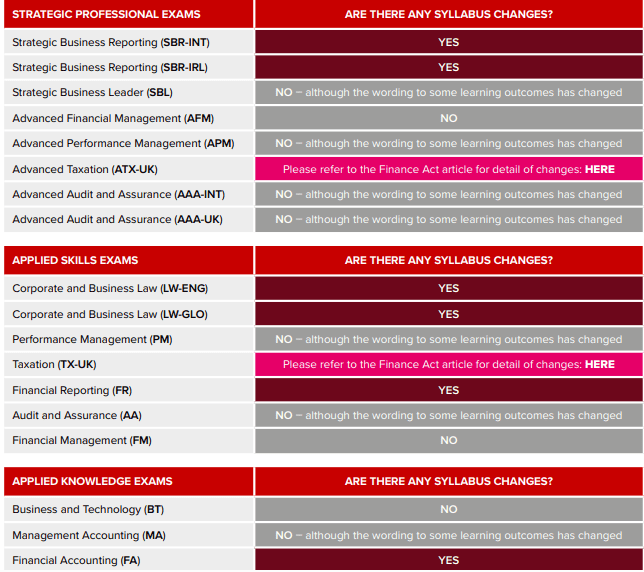
Every few years, the ACCA syllabus is updated to keep pace with how the finance world evolves. In 2026, there are subtle but meaningful ACCA syllabus changes across levels, from a sharper focus on digital finance to updated case study styles.
Understanding the syllabus isn’t just about ticking subjects off a list. It’s like reading a map before a road trip. If you know the terrain, you won’t get lost midway. According to ACCA Global, their syllabus is designed to build a “progressive development pathway” from fundamental accounting knowledge to strategic leadership skills.
Here is an overview of the key changes ACCA has incorporated into their syllabus for the session stretching from September 2025 to June 2026.
Applied Knowledge Level (Foundation)
Imagine building a house. You wouldn’t start with the roof; you’d first lay a solid foundation. That’s exactly what Applied Knowledge is: laying the groundwork that every future paper builds upon.
This level is ideal for:
12th pass students stepping into finance
Graduates from non-commerce backgrounds
Working professionals switching to finance
Subjects at the Applied Knowledge Level
The Applied Knowledge level lays the foundation for your ACCA journey. It covers the basics of business, management, and financial accounting, which are the essential building blocks you’ll use in real finance roles. The ACCA Syllabus ensures you get a clear understanding of these fundamentals before moving on to more complex, applied topics.
Paper Code
Subject Name
Core Focus Area
BT
Business and Technology
Understanding how businesses operate and the role of accountants in organisations
MA
Management Accounting
Fundamentals of costing, budgeting, and decision-making
FA
Financial Accounting
Core accounting principles, double-entry system, and preparation of financial statements
Before diving into these, here’s a candid truth: don’t rush through these subjects. Many students underestimate this level because it looks “basic.” But just like a weak foundation causes cracks later, gaps here can make Applied Skills feel overwhelming. 👉 Students who perform strongly in MA and FA often find ACCA’s later strategic papers easier, because they’ve already internalised core logic.
How to Approach Applied Knowledge Effectively
Think of this level as your finance gym. You’re not running marathons yet; you’re building strength. Here are a few strategies:
Start with BT, because it sets the context of business and technology – the environment in which all other topics operate.
Use MA to get comfortable with numbers and analytical reasoning. Practice small caselets daily.
For FA, imagine you’re maintaining the books of your own startup – this mental trick makes journal entries far less abstract.
If the Applied Knowledge level is your foundation, the Applied Skills level is where you start building the house. You’re no longer just learning concepts – you’re applying them to real business problems, often under time pressure.
Think of this stage like learning to drive in traffic after practising in an empty parking lot. You’ve got the basics, but now you have to stay alert, switch gears quickly, and make decisions that affect more than just yourself.
This level typically takes 9-12 months to complete and is the most intense stage for many students.
Subjects at the Applied Skills Level
At the Applied Skills level, the subject list is designed to strengthen your practical knowledge and prepare you for real-world finance challenges. The ACCA Syllabus covers areas like corporate law, performance management, taxation, financial reporting, audit, and financial management.
These aren’t just abstract topics — each paper teaches skills you’ll use on the job, whether it’s analysing financial statements, planning budgets, or ensuring compliance. This is where your foundation from the Knowledge level starts turning into actionable expertise that employers value.
Paper Code
Subject Name
Key Focus Area
LW
Corporate and Business Law
Legal framework of business operations, contracts, and governance
PM
Performance Management
Advanced costing, decision-making techniques, and variance analysis
TX
Taxation
Core taxation principles, computation of tax liabilities (country-specific)
FR
Financial Reporting
Deeper dive into financial statements, IFRS standards, and interpretation
AA
Audit and Assurance
Principles and processes of auditing, internal control, and risk assessment
FM
Financial Management
Investment appraisal, risk management, working capital, and sources of finance
Applied Skills is the transition stage where ACCA expects candidates to demonstrate both breadth and depth of knowledge. It’s also where most students face their first time-bound computer-based exams.
Many students hit a wall here because the subjects are both technical and time-consuming. Here are some candid strategies to navigate this phase smartly:
Cluster Subjects Intelligently: Don’t pair two heavyweight papers like FR and AA together in one session unless you have a lot of time. A smart combo is LW + PM or TX + AA, depending on your strengths.
Think in Business Scenarios: For example, when studying FR, imagine you’re part of the finance team at a large company like Infosys or Unilever, preparing financial statements that investors will rely on. This mental framing makes concepts stick better.
Mock Exams Are Non-Negotiable: Especially for PM, TX, and FR. These papers often test the application. Do timed mocks every 2–3 weeks.
Strategic Professional Level: The Leadership Phase
This is where the ACCA course can transform your career from a technical expert into a strategic leader. At this level, you’re expected to combine everything you’ve learned – accounting, law, strategy, ethics – and apply it to complex, ambiguous business situations.
Think of this as your boardroom simulation. You’re no longer solving textbook problems; you’re advising CEOs.
The Strategic Professional level consists of four papers – two essentials and two options.
Essentials (Compulsory)
The Essentials papers form the core of the Strategic Professional level. They focus on strategic thinking, leadership, and advanced financial reporting; skills you’ll rely on in senior finance roles. The ACCA Syllabus ensures these subjects build the judgment and decision-making abilities expected of experienced professionals.
Paper Code
Subject Name
Key Focus
SBL
Strategic Business Leader
Integrated case study exam testing leadership, strategy, governance
SBR
Strategic Business Reporting
Advanced reporting under IFRS, ethics, and integrated reporting
Options (Choose Any Two)
The Options papers let you tailor your ACCA journey to your career potential and goals. You can choose two subjects that align with your interests, whether it’s advanced taxation, audit, financial management, or performance management. The ACCA Syllabus uses this flexibility to help you specialise while developing strategic expertise for senior roles.
Strategic Tips for the Strategic Professional Level
Strategic Professional can be brutal. This section helps you figure out how to handle the worst of it, mainly Strategic Business Leader and Strategic Business Reporting. Case studies, revision planning, using examples properly, all that. Just practical stuff to make your prep less chaotic and more focused.
Start with SBL – It’s broad, strategic, and gives context to other papers. Many students also pair it with one optional paper.
Case Practice Is Everything – Unlike earlier levels, you can’t rely on question banks alone. Practise interpreting exhibits — just like a consultant would.
Leverage Global Case Studies – For SBR, read real IFRS-based financial statements (e.g., TCS, Nestlé) to build familiarity with disclosures and integrated reporting.
ACCA Exam Structure: What You’re Really Signing Up For
Before you dive into each paper, you need a big-picture map of the ACCA journey. Think of it like plotting a cross-country road trip – you need to know the milestones, pit stops, and detours to reach your destination efficiently.
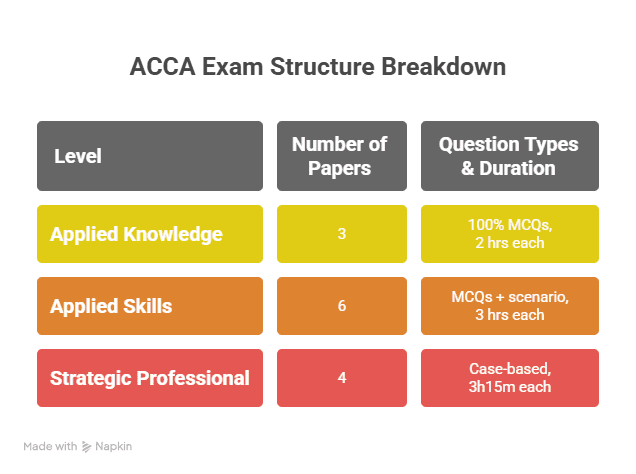
The ACCA qualification comprises 13 exams, spread across three progressive levels:
Level
No. of Papers
Exam Type Mix
Key Focus
Applied Knowledge
3
Objective-type, CBE (on-demand)
Fundamentals, concepts
Applied Skills
6
Objective + Constructed Response
Application, scenario-based problems
Strategic Professional
4 (2+2)
Integrated case studies, written
Strategy, leadership, advanced skills
Why This Structure Matters
Each level isn’t just harder, but it demands a different type of thinking.
At the Knowledge level, it’s about recognition and recall.
At the Skills level, it’s about application and analysis.
At the Professional level, it’s about evaluation and synthesis, i.e., making judgment calls like a real CFO or consultant.
ACCA Global designed this tiered structure to align with Bloom’s Taxonomy of Learning, which progresses from understanding to application to strategic decision-making. This ensures ACCA members are work-ready from day one.
This video provides a comprehensive overview of the ACCA Syllabus 2026, detailing the exam structure, subject updates, and key changes across all levels. It’s a valuable resource for candidates aiming to align their study plans with the latest syllabus revisions.
Paper-Wise ACCA Syllabus Breakdown
Here’s where we get tactical. Below is a comprehensive paper-wise breakdown of the ACCA Syllabus, including updates, difficulty pointers, and strategic notes.
Applied Knowledge
The Applied Knowledge level is your foundation. This is where you learn the core concepts of accounting, business, and finance — basically how organisations function and how financial data flows. Once you’ve got a good grip on these basics, the advanced topics in later levels won’t feel nearly as intimidating.
Paper
Subject
Key 2026 Focus
Exam Format
Difficulty Trend
BT
Business & Technology
Digital business models, governance
MCQs (CBE)
⭐
MA
Management Accounting
Data analytics intro, budgeting
MCQs (CBE)
⭐⭐
FA
Financial Accounting
IFRS Foundation, double entry
MCQs (CBE)
⭐⭐
Strategy Note: These are on-demand CBEs, so pace them according to your strengths. Many Indian students finish all three within 4–6 months.
Applied Skills
The Applied Skills level is where you start building real technical strength and putting those foundational concepts to work. This is where the syllabus gets into the practical stuff — taxation, audit, financial reporting, management accounting — all the skills you’ll actually use on the job. It’s the point where things shift from learning theory to figuring out how to use it, so you can tackle actual business problems with confidence.
Paper
Subject
2026 Focus
Exam Format
Difficulty Trend
LW
Corporate & Business Law
International law elements added
Objective + CR
⭐⭐
PM
Performance Management
AI in costing, ESG KPIs
Objective + CR
⭐⭐⭐
TX
Taxation
New global tax reforms
Objective + CR
⭐⭐⭐
FR
Financial Reporting
ESG disclosures, IFRS 18 updates
Objective + CR
⭐⭐⭐⭐
AA
Audit & Assurance
Risk frameworks, tech auditing
Objective + CR
⭐⭐⭐⭐
FM
Financial Management
Treasury tech, risk analytics
Objective + CR
⭐⭐⭐
Strategy Note: Papers like FR & AA are notorious for low pass rates — build your foundation early and practice mock papers under timed conditions.
Strategic Professional
The Strategic Professional level brings together everything from your earlier studies and tests how well you can apply it in practice. It’s less about recalling theory and more about using what you know to make decisions and solve complex problems.
The focus here is on strategic thinking and professional judgment — the skills you’ll actually need when you’re working in senior finance roles. This stage is really about closing the gap between academic knowledge and real professional capability.
Paper
Subject
2026 Focus
Exam Format
Difficulty Trend
SBL
Strategic Business Leader
ESG strategy, integrated case
4-hour case
⭐⭐⭐⭐⭐
SBR
Strategic Business Reporting
Sustainability reporting, ethics
Written + exhibits
⭐⭐⭐⭐
AFM/APM/ATX/AAA
Optional
Strategic application
Written, scenario-based
⭐⭐⭐⭐ to ⭐⭐⭐⭐⭐
Strategy Note: Treat SBL like a business simulation, not an exam. Practise reading exhibits quickly, like a consultant reviewing a board pack.
ACCA Preparation Timeline (Sample Plan)
One of the biggest mistakes students make is starting ACCA without a structured timeline. You wouldn’t start training for a marathon without a calendar, right? Same here.
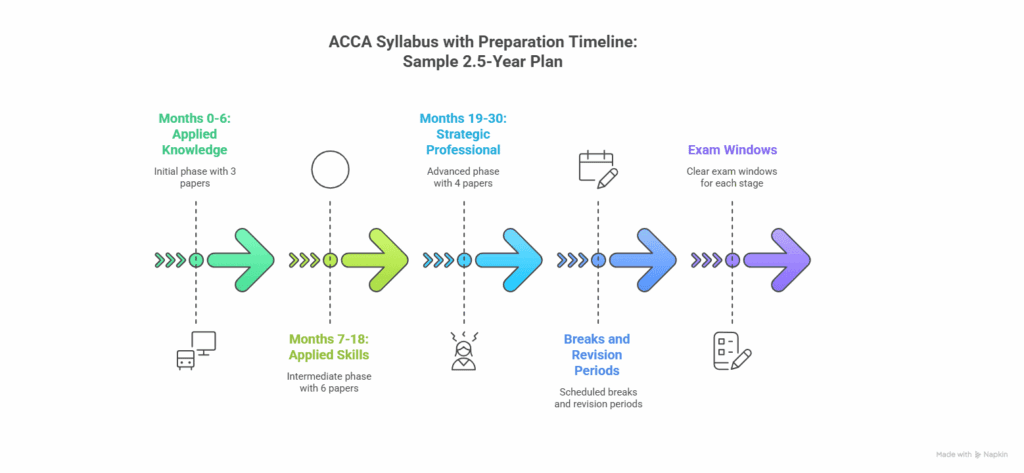
Below is a sample 2.5-year plan, assuming no exemptions and part-time study (10-15 hrs/week):
Timeline
Stage
Papers Covered
Milestone
Months 1-6
Applied Knowledge
BT, MA, FA
Build foundation
Months 7-18
Applied Skills
LW → FM
Apply concepts in real scenarios
Months 19-30
Strategic Professional
SBL, SBR + 2 Options
Master strategy & leadership
Pro Tips for Timeline Management
Stagger heavy papers – don’t take FR and AA together unless full-time.
Use exemptions smartly – commerce grads in India often skip the Knowledge Level.
Integrate the Ethics Module early – ACCA’s Ethics and Professional Skills Module (EPSM) boosts SBL readiness.
ACCA India reports that most students complete ACCA in 2.5-3 years, but timelines vary based on work commitments and exemptions.
This video shows how you can tackle the ACCA Syllabus effectively. It highlights the best free and affordable study materials, practical tips, and a smart study plan, giving you a clear roadmap to prepare efficiently, stay consistent, and maximise your chances of passing.
Key Takeaways Before You Start Your ACCA Journey
Before jumping into your ACCA studies, take a moment to get your bearings. This section gives you the essentials from the ACCA Syllabus — what matters most, what each level involves, and how to structure your prep. It’s not meant to replace the detailed study ahead, but rather to give you a clear starting point so you can begin with confidence and direction.
ACCA Syllabus is structured for progressive mastery — from understanding → application → strategy.
Use tables, timelines, and structured planning to keep your prep on track.
Leverage real-world business scenarios to make learning stick.
Treat Strategic Professional as a leadership bootcamp, not a memory test.
Before wrapping up, let’s clear up a few frequently asked questions about ACCA Syllabus that students have. If you’ve been wondering about eligibility, duration, exam difficulty, or how to plan your studies, this section will tie everything together for you.
What are the 13 papers in ACCA?
The ACCA Syllabus has 13 papers, and yeah, it sounds like a lot at first. You start with the basics: the first three papers teach you how businesses work and how to read financial statements. Pretty simple stuff, just getting your feet wet.
Then there are six papers where you actually learn to do things: budgeting, tax, audit, and management stuff. And finally, four big ones at the end, where you have to think like a finance leader. By the end, you’re not just passing exams; you actually know how finance works.
Can I finish ACCA in 2 years?
Yes, you can. You just need a plan and consistency. Exams happen multiple times a year, so you can space them out. If you’ve done CA Inter or a commerce degree, you might get exemptions too, which makes it faster. With focus, 2 – 2.5 years is doable.
What type of maths is in ACCA?
Don’t worry. It’s nothing crazy. Mostly percentages, ratios, simple algebra, and interest calculations. Stuff you’d use in real business situations. It’s about understanding numbers, not complex formulas. If you can do high school maths, you’ll be fine.
What is the hardest subject in ACCA?
Most people say SBL and AAA. Not because they’re impossible, but because you actually have to think and make decisions like a manager. It’s not about memorising. It’s about analysing situations, figuring out what to do, and writing it down under exam conditions. That’s the tricky part.
Can I do ACCA without math?
Yes, totally. You just need basic number sense. ACCA is more about logic and reasoning than anything else. Lots of students from arts or non-maths backgrounds pass ACCA. You just need to practice and stay consistent.
Which degree is best for ACCA?
Commerce, finance, or accounting degrees help because there’s an overlap. Makes it a bit easier. But really, any degree works. People from the arts, science, and anything have done ACCA. It’s more about how you study and stick to it.
What is the passing percentage for ACCA?
Usually between 40–55%, depending on the paper. Early papers are easier, later ones are harder. The trick isn’t memorising, but it’s understanding. Once you get the logic, passing becomes way simpler.
What is the salary of ACCA per month?
In India, fresh ACCA professionals usually get around ₹40,000–₹80,000 a month. Depends on the city and the company. Experience makes a big difference. With a few years of overseas exposure, it goes up a lot. ACCA skills are valued, so growth is natural.
Can ACCA earn ₹1 crore?
Yes, but not right away. Usually happens when you reach senior roles like CFO or Finance Director. ACCA gives you the skills, but real experience and smart career moves get you there.
Which country is best for ACCA?
The UK is the most obvious choice. ACCA started there, and the market’s big. But the UAE, Singapore, Australia, and Canada are all good too. It depends on where you want to work and grow.
How many exams are there in ACCA?
13 exams in total, split across three levels: basics, practical skills, and strategic thinking. You start with fundamentals, learn to apply them, then finish by thinking like a finance leader. By the end, you’re ready for real-world work.
Is ACCA harder than CA?
ACCA is comparatively easier than CA when it comes to the passing rate and flexibility. Generally, CA requires more time to clear the exams due to its rigid structure, less flexibility in exemptions and a low passing rate. ACCA, on the other hand, has a challenging syllabus, but is still considered manageable due to the flexible structure of exams, higher passing rates and exemptions based on prior professional qualifications.
Your Next Steps
ACCA isn’t just exams. It’s built to take you from knowing nothing to being able to work in senior finance roles. There are three levels. Applied Knowledge teaches you the basics. Applied Skills shows you how to actually use what you learned. Strategic Professional is where you learn to think like someone who runs things.
Finishing ACCA changes you. You don’t just know accounting. You can analyse situations and think strategically, which is what matters in real jobs.
The syllabus covers current stuff now: digital finance, ESG, AI, and international tax. So you’re not learning outdated material. For Indians specifically, ACCA works well because you get international recognition, but you already understand the local context. Makes it easier to work abroad or switch sectors.
You need a plan. Figure out when to sit each exam. Use exemptions if you qualify. Do loads of case studies. Try to relate everything to actual work. And remember, ACCA isn’t just technical. It’s about ethics, leadership, and solving big problems. That’s what gets you into senior jobs.
ACCA takes time and effort. You have to be consistent and plan properly. But it opens doors. Reporting, advisory, audit, management, whatever direction you go, people recognise the qualification. You’re not just passing exams. You’re building a career that works across countries and industries, with skills that companies actually want right now.
👉 If you want to approach the ACCA Syllabus with confidence and real-world readiness, this ACCA program, in collaboration with KPMG in India, is designed to do just that. With mentor-led guidance, a pass guarantee, and career support, including internships with firms like KPMG, it bridges the gap between learning and meaningful professional experience. Flexible learning options and a curriculum aligned with global standards ensure you’re not just exam-ready, but career-ready too.
Finance credentials today travel faster than job titles. What used to be regional qualifications, the kind that stayed confined to one country’s accounting board, have turned into global currencies. And few have crossed that border as elegantly as the CMA USA.
What began as a professional designation for management accountants in the U.S. has turned into a worldwide standard for analytical thinking, business judgment, and ethical leadership.
But with that expansion came an interesting misconception: CMA eligibility is complicated, gated, or limited to a certain academic background.
It isn’t. In fact, it’s one of the most inclusive finance credentials available today.
When students or professionals approach me with questions about eligibility, their doubts usually have less to do with policy and more to do with perception.
They think the CMA USA is a program designed for Americans, or that you need a finance degree even to be considered. Some even assume there’s an age barrier, that if you’ve crossed a certain point in your career, you’ve missed your chance.
In reality, the Institute of Management Accountants (IMA) built the CMA framework on flexibility. It was designed for people who are still becoming professionals
undergraduates, mid-career analysts, and even consultants shifting from operations into finance.
If you can demonstrate academic rigour, practical curiosity, and the willingness to commit to two exams, you already meet the spirit of the eligibility criteria.
In this piece, I’ll break down what that actually means in 2026: CMA Eligibility, the academic and professional requirements, the nuances of the CMA USA age limit, and how candidates in India and abroad can align their path to the global standards set by IMA.
What is CMA USA?
Whenever someone asks me what is CMA, really? I tell them it’s less of an exam and more of a mindset shift. It’s what happens when you stop looking at numbers as history and start reading them as strategy.
Certified Management Accountant or the CMA certification was born in boardrooms, not classrooms. Well, not literally, but here is what I mean.
Offered by the Institute of Management Accountants (IMA), the US CMA came from the need for finance professionals who could translate data into direction. Over time, that idea outgrew the U.S. and became a global qualification recognised in over 170 countries.
Today, when employers say they want a “CMA,” they’re not just hiring someone who knows accounting entries. They’re hiring someone who can forecast next quarter’s margins, question business models, and bring structure to decisions. It’s what makes the credential relevant from Mumbai to Dubai to New York.
Now, when it comes to CMA eligibility, people often expect rigid prerequisites. But that’s the beauty of this program: it was designed for accessibility. Whether you’re a finance graduate, an engineer who found joy in spreadsheets, or a mid-level professional looking for global recognition, the pathway stays open.
Now, if you’re caught between “should I or shouldn’t I” about the CMA, this quick watch breaks down what the US CMA can actually do for your career.
CMA USA Eligibility 2026: Who Can Apply?
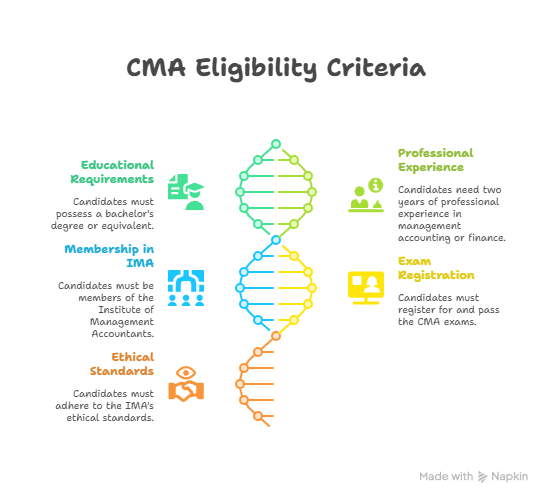
For the CMA USA program eligibility in 2026, candidates should fulfil some academic, age, and professional requirements as provided by IMA. They are:
1. Academic Qualifications
To fulfil the CMA USA academic requirements, candidates should have:
A Bachelor’s degree from a recognised institution (any stream)
Or a qualification equivalent to a degree as recognised by the IMA (e.g., CA, CS, etc.)
The degree need not be in finance or accounting, but the candidate with it may find the subject more meaningful.
2. Age Requirements
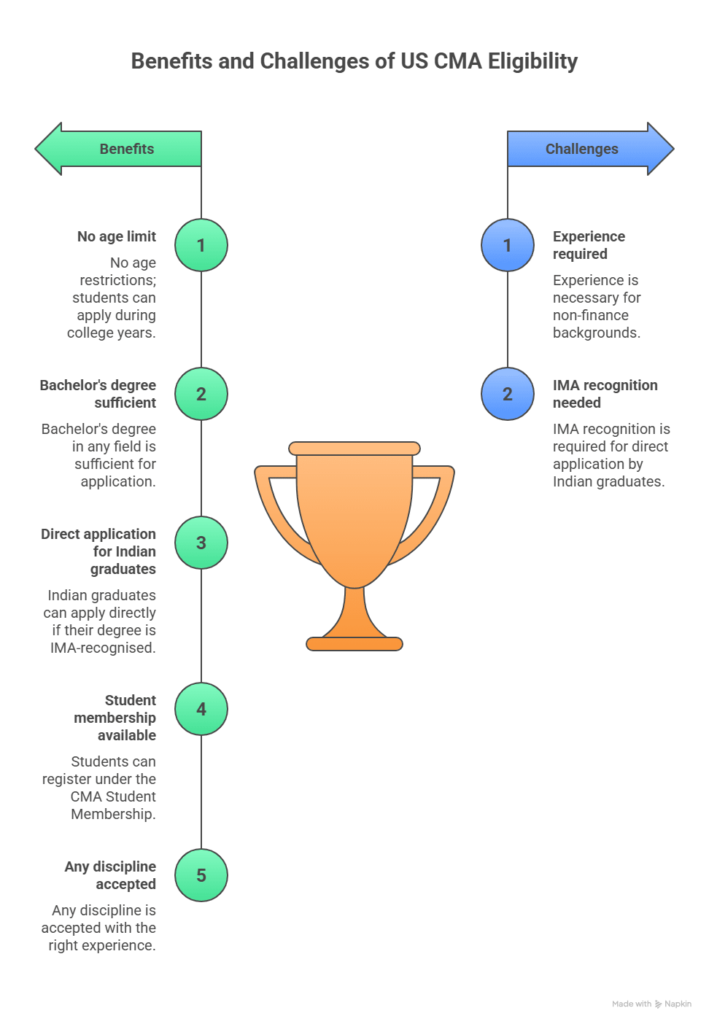
No age limit is mentioned. However, the majority of the candidates start preparation either in the final year of graduation or after gaining some experience at work. The program is appropriate for the following individuals:
Final-year undergraduate students
Working professionals in finance and accounting
This makes the CMA USA age and education qualification convenient and flexible.
3. Membership with IMA
Prior to writing the exam, the student needs to become a member of the Institute of Management Accountants (IMA). This provides them with access to resources, a network, and official registration for the exam.
4. Two Years of Professional Experience
To receive the CMA credential (after writing the exams), candidates need to have two years of professional experience in either management accounting or financial management. This can be achieved:
Before writing the exam
Or within seven years post-clearing the exam
5. English Proficiency
Since the CMA USA examinations are conducted in English, one has to be well-versed in the language. While no official test is required, effective communication and reading skills are essential.
Below is a visual overview of the US CMA Eligibility requirements, each of which we will discuss in the blog ahead in detail.
US CMA Exam Requirements
After fulfilling the eligibility requirements, you need to fulfil the US CMA exam requirements:
Become. IMA member
Enrol in the CMA program and remit the examination fees
Select an approved study partner such as Imarticus
Reschedule and appear for Part 1 and Part 2 examinations
Part 1 and Part 2 are each four hours long and consist of:
The eligibility criteria for CMA USA revolve around three primary pillars: academic qualification, professional experience, and IMA membership.
1. Educational Qualification
To meet the CMA eligibility requirements, candidates must possess a bachelor’s degree in any field from an accredited institution. The IMA does not restrict degrees to commerce or finance backgrounds, which makes the course inclusive for candidates from science, arts, or engineering streams.
However, students with commerce or management backgrounds should take preparatory training to bridge gaps in finance concepts.
2. Work Experience Requirement
IMA requires candidates to have at least two years of continuous work experience in management accounting, auditing, financial analysis, or budgeting. This experience can be completed before or within 7 years after passing the CMA USA exam.
Eligible Job Roles Include:
Financial Analyst
Cost Accountant
Internal Auditor
Budget Analyst
Corporate Finance Executive
Corporate Accountant
3. IMA Membership Requirement
To enrol for CMA USA, you must become a member of IMA. This membership unlocks:
Official exam registration
Access to IMA learning resources
Entry into the CMA candidate program
There are different membership categories:
Membership Type
Target Group
Approx. Annual Fee
Professional
Working professionals
$280
Student
Full-time students
$45
Academic
Professors or educators
$150
CMA USA Age and Education Criteria Simplified
The CMA USA isn’t built on complicated prerequisites; it’s built on common sense. If you look closely, every eligibility rule has one purpose: to ensure that whoever takes this exam can think like a management accountant: with structure, accountability, and a sense of financial cause and effect.
That’s why CMA USA eligibility feels less like a checklist and more like a framework for readiness. Here’s what it really takes to qualify in 2026:
Aspect
Requirement
How It Plays Out in Real Terms
Age
No official age limit
Whether you’re finishing college or shifting careers, you can begin anytime.
Education
Bachelor’s degree (any stream) from an accredited university
The course doesn’t favour one background; it’s designed for anyone comfortable with numbers and logic.
Students in the Final Year
Eligible to appear for exams before graduation
Many aspirants start early to fast-track their careers. Certification follows after completing their degree.
Work Experience
2 years in management or financial accounting (before or within 7 years post-exam)
CMA doesn’t just test theory; this step ensures you’ve applied it in practice.
IMA Membership
Mandatory before registration
This links you directly to IMA’s official resources, community, and exam access.
US CMA Eligibility for Indian Students
India has quietly become the backbone of the global CMA talent pipeline. Every year, thousands of Indian finance graduates enter the U.S. CMA ecosystem, not because the rules are lenient, but because the qualification aligns perfectly with how India’s commerce education system is structured.
Most Indian degrees already build the analytical foundation that the CMA USA tests for: management accounting, business economics, and financial reporting. So, when it comes to US CMA eligibility for Indian students, the process isn’t a new obstacle; it’s a matter of documenting what you already possess in a format the Institute of Management Accountants (IMA) recognises.
Indian professionals and students often ask, “Who can apply for CMA USA in India?” The answer is simple:
Graduates of any stream are eligible.
Institutes can initiate final year students.
Working professionals aspiring for an international career in accountancy or finance.
As job opportunities increase from MNCs, CMA course eligibility in India has witnessed increased interest from:
B.Finance, BBA, and MBA students
CA/CS hopefuls aspiring for international exposure
Working professionals aspiring for a promotion or international career opportunities
Education Requirements for Indian Students
Indian aspirants don’t need to worry about a “different rulebook.” If you hold a bachelor’s degree from a UGC-recognised university, you already meet the foundational educational criteria.
However, because the Institute of Management Accountants (IMA) is based in the United States, they need formal verification that your Indian degree aligns with the U.S. bachelor’s equivalency standard. That’s where WES (World Education Services) or an IMA-approved evaluation agency comes in.
Requirement
Details for Indian Candidates
Purpose
Degree Recognition
Bachelor’s degree in any stream (Commerce, Business, Accounting, Economics, or equivalent) from a UGC-approved Indian university
Establishes academic eligibility
Transcript Evaluation
Done through WES or other IMA-recognised credential evaluators like ECE or SpanTran
Confirms equivalence to a U.S. bachelor’s degree
Language Requirement
No separate IELTS/TOEFL required – Indian degrees are automatically accepted as proof of English proficiency
Simplifies documentation
Final-Year Students
Students in the final year of their degree may attempt the exam; certification is issued after graduation + work experience
Encourages early starters
What Indian Students Typically Submit
To register for the CMA USA exam as an Indian student, you’ll need:
Official degree certificate (or final-year proof of enrollment).
Academic transcripts issued by your university.
Credential evaluation report (from WES, ECE, or IMA-approved agency).
A government ID for identity verification (passport preferred).
IMA membership and CMA program registration confirmation.
Most IMA-approved evaluation agencies have now digitised the process. You can submit your transcripts directly from your university or in sealed envelopes, depending on their policy.
(Note: IMA no longer accepts self-attested or photocopied transcripts.)
Work Experience Pathways for Indian Candidates
Here’s where many Indian students get confused. You can attempt both CMA exam parts without prior work experience, but to get certified, you must complete two years of professional experience in management accounting or financial management roles.
This experience can come from:
Public accounting firms or Big 4s (like Deloitte, KPMG, PwC, EY)
Corporate finance roles in MNCs or Indian conglomerates
Roles like Financial Analyst, Cost Accountant, Budget Analyst, Internal Auditor, or FP&A Associate
If you’re working in India, you can get your supervisor or HR department to verify your role using the IMA experience verification form. That’s all the documentation required.
Why Indian Students Have an Advantage
Most Indian finance graduates have already studied cost accounting, management accounting, and basic financial reporting during their degrees. This makes the CMA USA syllabus, especially Part 1 (Financial Planning, Performance, and Analytics), much easier to grasp.
Moreover, the global demand for CMAs in India has surged, particularly in finance transformation, FP&A, and data-driven decision-making roles. The following companies have been known to hire US CMAs directly from India for global finance positions.:
Amazon
Accenture
Deloitte
IBM
Summary: CMA USA Eligibility for Indian Students
This table will help you summarise the eligibility for Indian students.
Criteria
Indian-Specific Guideline
Verification Method
Education
Bachelor’s from a UGC-recognised university (any stream)
WES / ECE / IMA-approved evaluation
Work Experience
2 years in accounting, finance, or management roles
IMA work verification form
Language
Automatically accepted for Indian degrees
No test required
Final-Year Eligibility
Yes, can attempt exams before completing graduation
Submit proof of enrollment
IMA Membership
Mandatory before exam registration
Join via IMA official site
Global Relevance
Recognised in 170+ countries
Valid for global placements
Let’s take an example: Suppose Aditi, a B.Com graduate from Delhi University, wants to pursue CMA USA. She doesn’t need to redo her degree or take any English test. She only needs to:
Apply to WES for her degree equivalence.
Register as an IMA member.
Enrol in the CMA program through a verified training partner such as Imarticus Learning.
Appear for Part 1 and Part 2 exams while in her final semester.
Complete 2 years of finance work (say, as a financial analyst).
Once she meets all those criteria, she officially earns her CMA USA certification, globally recognised and professionally respected.
How Long Does It Take to Become a CMA?
If you’ve ever tried planning for a marathon, you know it’s not the distance that’s tricky; it’s the pacing. The same logic applies to the CMA USA Eligibility journey.
While the exam is just two parts, the preparation and certification process involves multiple moving pieces: study time, exam windows, credential evaluations, and work experience verification.
On average, it takes 6–9 months of consistent preparation to pass both exam parts, but the total journey from registration to certification can stretch to 12–18 months, depending on your schedule, background, and study strategy. You can aid this journey by preparing with the best CMA review courses, the CMA Handbook, and top study materials provided by approved study partners.
Breaking Down the CMA USA Timeline
Stage
Avg. Time Required
What Happens Here
Step 1: Registration + IMA Membership
1–2 weeks
Apply for IMA membership, enrol in the CMA program, and get your IMA ID.
Step 2: Credential Evaluation
2–6 weeks
If you hold a non-U.S. degree (e.g., an Indian B.Com), get it evaluated through WES or ECE.
Step 3: CMA Exam Preparation
3–6 months per part
Study for Part 1 (Financial Planning) and Part 2 (Strategic Financial Management). Most learners attempt one part at a time.
Step 4: Appear for Exams
1–2 months
Choose from three global testing windows: Jan–Feb, May–Jun, or Sep–Oct.
Step 5: Experience Completion
0–24 months (parallel or post-exam)
Gain 2 years of relevant work experience to qualify for the CMA certificate.
CMA USA Exam Windows and Registration Deadlines 2026
One of the most practical aspects of cracking the CMA USA exam is its flexibility. Instead of fixed annual dates, the IMA offers three global exam windows every year, allowing students and professionals to schedule their attempts around academic or work commitments.
In 2026, the available testing periods are:
Exam Window
Testing Months
Registration Deadline
Ideal Time to Begin Preparation
Window 1
January – February
December 15, 2025
September 2025
Window 2
May – June
April 15, 2026
January 2026
Window 3
September – October
August 15, 2026
May 2026
Each window stays open for roughly two months, and exam slots fill up quickly, especially for international test centres. That’s why booking early is non-negotiable.
Registration typically closes one month before the exam window begins, but waiting until the last minute is risky. It’s best to finalise your slot once you’re 70–80% through your preparation.
A smart way to plan your journey is to treat each exam window like a “goalpost”, align your study calendar backwards from the window you aim for. For instance, if you’re targeting the May–June window, your ideal start date is January, giving you a comfortable four-month runway for one part. And as you plan the timelines, knowing the step-by-step breakdown of CMA course details makes the path clearer.
This strategic alignment ensures you’re never rushed and that your CMA USA exam registration syncs perfectly with your study rhythm.
Who Should Apply for CMA USA?
If you’re considering who can apply for CMA USA, the perfect candidates are:
Students pursuing or completing graduation in commerce, finance, or business administration who want a career that crosses borders.
Accounting and finance professionals aiming to deepen their technical and managerial expertise and transition into strategic roles.
Corporate analysts, auditors, or consultants seeking credibility in global markets.
Entrepreneurs and business owners who want sharper financial control and decision-making skills to scale efficiently.
The Pros and Challenges of Pursuing CMA USA
No global qualification is without its tests, and that’s what gives the CMA its worth. Here’s a realistic look at the pros and challenges so you can weigh your decision confidently:
Aspect
Pros
Challenges
Global Recognition
Recognised in over 170+ countries, the CMA USA opens doors to multinational companies, consulting firms, and Big 4s.
Competing with global peers means maintaining consistency and commitment across time zones and career demands.
Career Acceleration
CMAs often move into managerial or leadership roles faster due to their decision-oriented training.
Requires balancing professional commitments with study schedules, especially for working professionals.
Versatility
The qualification spans finance, analytics, and business strategy, valuable across industries like tech, manufacturing, consulting, and FMCG.
You need strong conceptual clarity; rote learning won’t help. The exam tests applied business reasoning.
Earning Potential
According to the IMA Global Salary Survey, CMAs earn 21% more globally than their non-certified peers.
Initial costs (exam, membership, and training) can feel heavy without a structured plan or employer support.
Time Efficiency
You can complete the certification in 12–18 months, unlike multi-year local alternatives.
Compressed timelines mean disciplined, consistent preparation is essential.
Here is a visual representation of the CMA benefits against the challenges that one may face:
Why Choose Imarticus Learning for Your CMA USA Journey
Meeting the CMA eligibility criteria is one thing, but mastering the exam with confidence is another. The right learning partner doesn’t just teach you accounting concepts; it builds your professional judgment, pace, and precision, the three traits that define successful CMAs.
That’s where Imarticus Learning stands apart. As an IMA Gold Learning Partner, Imarticus operates at the highest global standard set for training providers of the US CMA Course, ensuring your learning path mirrors international expectations and also guide you on sure shot ways to become a CMA.
What sets it apart isn’t the promise of passing, it’s the structure that guarantees readiness.
1. Guaranteed Outcome Framework
Imarticus is one of the very few institutes offering a Money-Back Guarantee if you don’t clear all exams. That level of confidence only comes when the system is proven, from instructor quality to curriculum depth. Every module is benchmarked against IMA’s learning outcomes and powered by Surgent Learning, one of the world’s most adaptive CMA prep engines.
2. Gold Learning Partner Status
Being an IMA Gold Partner isn’t a label; it’s a compliance mark earned through rigorous audits of student outcomes, faculty expertise, and content alignment. This ensures your learning hours, mock exams, and test simulations meet the same quality standards that IMA expects globally.
3. Real-World Career Readiness
Every CMA student at Imarticus gets hands-on industry experience through internships with KPMG and other leading firms. This bridges the gap between exam theory and actual financial problem-solving, an advantage that most training providers overlook. These internships aren’t just resume fillers; they demonstrate your ability to apply management accounting principles in real business contexts, a critical differentiator in placements.
4. One-on-One Mentorship from Industry Experts
The CMA curriculum is vast, and every learner has a different starting point. That’s why Imarticus assigns personal mentors, all of whom are qualified CMAs, CAs, or CPAs themselves. This ensures your doubts are addressed in context, not in theory.
5. Placement-Driven Learning
Imarticus’ ecosystem extends beyond training. With dedicated placement assistance, resume-building workshops, and mock interviews, the transition from CMA certification to your first role becomes structured. The institute’s alumni footprint across Big 4s, global consulting firms, and multinational corporations stands as evidence.
FAQs About CMA USA Eligibility
Still have questions about the CMA eligibility criteria and how it applies to your profile? This section clears the air. From academic prerequisites to work experience and age requirements, here are answers to the most frequently asked questions students have before registering for the CMA USA exam.
Is CMA easier than CA?
CMA Eligibility criteria are simpler than CA because you only need a bachelor’s degree and IMA membership to apply. However, the exam focus is conceptual and analytical, not lengthy like CA. Students who enrol with Imarticus Learning get structured mentorship to complete CMA within a year, whereas CA can span 4–5 years.
What are the CMA course fees?
Total CMA USA course fees range from ₹1.5 lakh to ₹2.2 lakh, depending on membership type and training partner. These fees cover IMA registration, exam charges, and coaching. Imarticus Learning offers flexible EMI options and money-back guarantees to ensure CMA Eligibility remains affordable.
Can I give CMA after 12th?
You can start preparing for the US CMA after 12th, but official CMA Eligibility requires a bachelor’s degree to earn the credential. Many students join Imarticus Learning during college so that they’re exam-ready as soon as they graduate.
Who is qualified for CMA?
Anyone meeting the CMA Eligibility criteria, a bachelor’s degree from a recognised institution and two years of relevant experience, qualifies. Indian students from BCom, BBA, and MBA backgrounds fit perfectly.
What is the CMA salary?
CMA-certified professionals in India earn around ₹8-10 LPA on average, while global median salaries cross $80,000. Holding CMA Eligibility not only boosts pay but also qualifies you for roles with performance bonuses and stock options.
Is CMA higher than MBA?
Both CMA and MBA serve different purposes. CMA Eligibility represents technical mastery in management accounting, whereas MBA focuses on business breadth. Many professionals combine the two for maximum career impact.
Can CMA earn 1 crore?
Yes, senior finance leaders with CMA Eligibility in multinationals and consulting often cross ₹1 crore CTC through bonuses and profit-sharing. Roles like CFO or Head of FP&A command that range.
Which type of degree is CMA?
CMA is not an academic degree but a professional certification. Your CMA Eligibility depends on holding a bachelor’s degree and meeting IMA experience requirements. It is globally equivalent to a master’s level credential in financial management.
Is CMA losing value?
Not at all. CMA Eligibility has grown sharply since the digital finance transformation accelerated post-2020. Companies now seek CMA-qualified leaders for automation and data-governance projects.
Will CMA be replaced by AI?
AI may handle repetitive tasks, but CMA Eligibility equips you to interpret and strategise using AI outputs. Imarticus Learning’s CMA program already integrates AI and analytics modules to keep graduates future-ready.
Your Next Step After Meeting the US CMA Eligibility Criteria
Every professional milestone begins with clarity: knowing where you stand, what qualifies you, and how far your effort can take you. The US CMA eligibility framework is precisely that checkpoint. It helps you see whether your academic foundation, work exposure, and intent align with what the global finance ecosystem demands.
The CMA USA qualification goes beyond exams and certificates. It trains you to interpret numbers with purpose, connect data with strategy, and make financial decisions that influence business outcomes. Once you’ve mapped your eligibility, the next question isn’t if you should pursue it; it’s how you’ll make it count.
If you’ve been exploring the CMA USA path this year, think of this as your starting line. Begin your journey with the CMA Course prep offered by Imarticus Learning and take your first step towards a global career built on skill, credibility, and confidence.
The CFA Program is not just an exam, it is a journey. The CFA Program consist of three levels of exams that focus on your understanding of the material, your ability to analyze problems, and your ability to apply that analysis to the scenarios posed by the exam questions. There is a significant degree of complexity in the material covered in each exam; the trick is to target the right topics. In this blog, we’ll break down the CFA Exam Topics that matter most for each level, offering you strategic insights, updated CFA exam topic weightage, and practical tips to prioritise your study plan effectively.
CFA Level 1 Important Topics
The first level of the CFA exam tests your foundational understanding of financial concepts. Think of it as the building block where theoretical knowledge plays a big role. CFA Level 1 important topics are more quantitative and definitions-heavy, ideal for recent graduates or finance beginners.
You’ll be introduced to core concepts like ethics, quantitative methods, economics, and financial reporting. It’s essential to grasp the ‘why’ behind formulas, not just memorise them. Since the exam includes 180 multiple-choice questions, time management and conceptual clarity are critical.
Level 1 Focus Areas
Ethical and Professional Standards: A high-weight topic and often considered the backbone of the CFA curriculum.
Quantitative Methods: Focus on time value of money, probability distributions, and hypothesis testing.
Economics: Covers micro and macroeconomics, and international trade.
Financial Reporting and Analysis: Learn about income statements, balance sheets, and cash flows.
Corporate Finance: Capital budgeting, cost of capital, and corporate governance.
Equity Investments: Understand market organisation, indices, and valuation techniques.
Fixed Income: Time value, bond pricing, and risk metrics.
Derivatives: Forwards, futures, swaps, and options basics.
Alternative Investments: Real estate, commodities, and hedge funds.
Portfolio Management: Basic principles of portfolio theory.
Table – CFA Level 1 Topic Weightage
Topic
Weightage (%)
Ethics
10-15
Quantitative Methods
5-10
Economics
5-10
Financial Reporting & Analysis
10-15
Corporate Finance
5-10
Equity Investments
10-15
Fixed Income
10-15
Derivatives
5-10
Alternative Investments
5-10
Portfolio Management
10-15
CFA Level 2 Key Subjects
The second level ramps up the complexity. CFA Level 2 key subjects require a deeper analytical mindset and involve extensive case-based questions. Unlike Level 1’s multiple-choice format, Level 2 presents item sets that demand thorough reading and concept application.
Ethics remains crucial, but Financial Reporting, Equity Valuation, and Fixed Income become dominant in this level. You’ll also start dealing with nuanced valuation techniques and financial statement analysis that test real-world applicability.
Level 2 Focus Topics
Ethics and Standards: Expanded scenarios requiring ethical reasoning.
Quantitative Methods: Linear regression, time-series analysis.
Level 3 is a different ballgame altogether. The exam format includes both constructed responses (essay questions) and item sets. The emphasis shifts from analysis to synthesis—how well can you apply what you’ve learned in real-life scenarios?
CFA Level 3 focus areas revolve heavily around portfolio management, ethics, and wealth planning. You’ll be expected to structure investment solutions, optimise portfolios, and adhere to ethical standards under practical constraints.
Level 3 Core Subjects
Ethical and Professional Standards: Heavy focus on application and nuanced ethical dilemmas.
Institutional Investors: Foundation, pension fund management.
Capital Market Expectations: Strategic asset allocation.
Asset Allocation and Related Decisions: Long-term portfolio structuring.
Fixed Income and Equity: Advanced valuation techniques.
Risk Management: VAR, scenario analysis.
Derivatives and Alternative Investments: Tail-risk hedging.
CFA Level 3 Topic Weightage
Topic
Weightage (%)
Ethics
10-15
Private Wealth Management
15-20
Institutional Investors
10-15
Capital Market Expectations
10-15
Asset Allocation
10-15
Fixed Income
10-15
Equity Investments
10-15
Risk Management
5-10
Derivatives & Alternatives
5-10
Most Tested CFA Topics: Exam Trends
Some topics appear frequently across all levels of the CFA exam. Identifying the most tested CFA topics allows candidates to align their preparation smartly. Ethics, Financial Reporting, Equity, and Portfolio Management are common favourites of examiners.
According to CFA Institute’s published performance summaries, candidates who perform poorly in ethics tend to fall just below the minimum passing score even if they do well in other areas.
The implication? Ethics isn’t just important—it’s a make-or-break subject.
Understanding CFA exam topic weightage can help you optimise study hours. Candidates often make the mistake of distributing equal time across all subjects. That’s inefficient. Let the topic weights guide you.
For instance, in Level 1, Ethics and FRA deserve more time than Derivatives. Level 2 requires special attention to Equity and FRA. In Level 3, Portfolio Management is your holy grail. Smart study is weighted study.
Every year, the CFA curriculum undergoes minor to significant changes to stay aligned with global finance trends. The 2025 updates focus more on data analytics, sustainability in finance, and behavioural finance—especially in Levels 2 and 3.
CFA curriculum highlights for 2025 also include a new module on AI and automation in investment management. This reflects the growing demand for tech-savvy analysts in Indian and global markets.
Important CFA Exam Subjects to Prioritize
Regardless of level, there are important CFA exam subjects that should never be taken lightly. These are areas where mastery significantly impacts your ability to solve questions accurately and swiftly.
Finance professionals in India, especially those working or aspiring to work in investment firms, should focus on:
Ethics
Equity Investments
Financial Reporting and Analysis
Portfolio Management
Fixed Income Instruments
Revisiting these subjects, even after clearing a level, ensures continuity of understanding.
Key Takeaways
CFA Exam Topics vary in depth and application across all levels.
Level 1 focuses on fundamentals and conceptual clarity.
Level 2 demands analytical rigour and financial statement mastery.
Level 3 is about application, synthesis, and portfolio design.
Ethics remains a top priority across all three levels.
Study smarter by prioritising topics based on weightage and complexity.
FAQs
Q1. What are the most important CFA Exam Topics for beginners?
For beginners or Level 1 candidates- the most important topics include Ethics, Quantitative Methods, Financial Reporting & Analysis, and Economics. These foundational areas help establish the groundwork for higher levels.
Q2. How often does CFA Institute update the curriculum?
CFA Institute updates the curriculum annually to reflect industry changes, emerging technologies, and global finance trends. Updates often include new readings or adjustments in topic weightage.
Q3. Is Ethics equally important across all CFA levels?
Yes, Ethics is not only consistently tested across all levels but also crucial for passing. Scoring poorly in Ethics can negatively impact your final result.
Q4. Are topic weightages the same every year?
While they remain largely stable, slight adjustments are made based on curriculum updates and industry demands. Always refer to the latest CFA Institute guidelines.
Q5. How can I manage time effectively for each topic?
Focus more hours on high-weight subjects like Ethics, FRA, and Equity. Use a time tracker or planner to distribute your preparation weeks smartly.
Q6. What is the hardest CFA level?
Most candidates find Level 2 the most difficult due to the depth of analytical skills required and the shift to item set questions.
Q7. Are calculators allowed in the exam?
Yes, but only specific models approved by CFA Institute like the Texas Instruments BA II Plus or HP 12C.
Q8. Can I pass CFA Level 1 without coaching?
Yes, but self-study requires discipline and smart strategy. Many Indian candidates succeed via a structured study plan, mock tests, and CFA prep materials.
Q9. How many hours should I study for each level?
CFA Institute recommends at least 300 hours per level – but depending on your background, this could vary.
Q10. Is CFA worth it for finance professionals in India?
Absolutely. CFA is globally recognised and opens doors in asset management, investment banking, and equity research roles in India and abroad.
Conclusion
Whether you’re just starting out.. or preparing for the final round of the CFA journey -knowing which CFA Exam Topics to focus on is essential for success. Use this guide as your strategic map to navigate each level efficiently. With smart preparation, understanding of CFA level 1 important topics, deep insights into CFA level 2 key subjects and mastery of CFA level 3 focus areas – your dream finance role is closer than you think. Keep learning, stay consistent, and good luck!
A Client Servicing Manager is a pivotal figure in the success of modern businesses, particularly in industries such as banking, finance, advertising, and IT. The work involves building close relationships with clients, ensuring their satisfaction, and fostering effective communication between clients and internal teams.
In today’s highly competitive market, client servicing is both challenging and rewarding. From managing deliverables to identifying opportunities for expansion in existing accounts, client servicing staff must balance effective communication, strategic planning, and empathy.
Client Servicing Job Description
The career description of a client servicing professional differs according to the sector. There are some general tasks that are still industry-independent:
Main Client Servicing Responsibilities
Be the internal team-client liaison.
Understand client objectives and translate them into workable actions.
Provide services or products on time.
Handle escalations, customer complaints, and the resolution of conflicts.
Prepare account performance reports and report to stakeholders.
Identify opportunities for upselling and account growth.
What Are the Main Client Servicing Tasks?
Daily Activities and Responsibilities
Client meeting and briefing sessions attendance
Project updates and client reports preparation
Internal department coordination to ensure deliverables
Accurate records of communication and agreements are kept
Offering solutions in advance to avoid problems from happening
Essential Client Servicing Skills
To be an effective Client Servicing Manager, one must exhibit a blend of technical, interpersonal, and analytical abilities:
Communication: Concise and clear communication and listening
Problem-solving: Being thoughtful under stress
Project management: Handling several deliverables simultaneously
CRM software knowledge: Packages like Salesforce or Zoho CRM
Negotiation and persuasion: Handling renewals, grievances, and upsells
What are the competencies required in client servicing?
Client servicing professionals require strong communication, problem-solving, and project management skills, as well as knowledge of CRM software and negotiation skills.
Industry Focus – The Banking Client Servicing Role
In the banking and financial services sector, client servicing managers handle high-value accounts, providing clients with timely information on investments, accounts, and other financial products.
Banking Responsibilities
Assisting with financial transactions and service inquiries
Interacting with relationship managers and operations staff
Guiding customers regarding new banking products and regulations
Ensuring regulatory compliance while handling inquiries
Market Snapshot
The combined market capitalisation of the top 20 Indian financial services companies stood at $680 billion in October 2024. Over 40% of this value was held by banks. HDFC Bank, ICICI Bank, and SBI dominated the list, demonstrating how the success of this sector lies in client experience. (Source)
Client Servicing Manager Salary: What to Expect?
Experience Level
Industry Average Salary (India)
Entry-level (0–2 years)
₹3.5 – ₹5.5 LPA
Mid-level (3–6 years)
₹6 – ₹10 LPA
Senior-level (7+ years)
₹11 – ₹18 LPA
The compensation of a Client Servicing Manager also varies based on the sector. For instance, those employed in banking and finance tend to earn more salaries due to the intensity and volume of client accounts.
Career in Client Servicing: What’s the Growth Path?
One of the biggest attractions of a client servicing career is its potential for vertical expansion. Many professionals transition into leadership roles or cross-functional functions, such as strategy or business development.
Typical Career Path
Client Servicing Executive
Assistant Manager – Client Relations
Client Servicing Manager
Account Director / VP – Client Experience
Head – Customer Success / Client Strategy
How to Become a Client Servicing Manager?
Education and Training
Bachelor’s in business, finance, or marketing
PG courses in customer relationship management or finance
Industry certifications like PRINCE2 (project management), or CRM software like Salesforce
Tip: Courses like the Postgraduate Program in Banking and Finance by Imarticus Learning are built to hone industry-specific client relationship skills and gain entry into leading firms.
The Importance of Client Relationship Management
Client servicing is more than servicing—it’s about trust. In banking or advertising, your ability to service relationships has the power to grow business and clients.
Why It Matters
Enhances client retention
Increases account value through upselling
Fosters referrals and positive reviews
Reduces churn and negative word-of-mouth
Tools Used in Client Servicing
Some of the most common tools that client servicing professionals use:
CRM platforms: Salesforce, HubSpot, Zoho
Project management: Trello, Asana, ClickUp
Communication: Slack, Microsoft Teams, Zoom
Analytics & Reporting: Google Sheets, Tableau
Top Industries That Are Hiring Client Servicing Professionals
Banking and Financial Services
Advertising and Media
IT and Software
Telecom
Insurance
10 Most Frequently Asked FAQs About Client Servicing
Q1: What does the job of a Client Servicing Manager entail?
They work as the interface between clients and the firm, ensuring deliverables are complete and satisfaction is achieved.
Q2: What industries are hiring Client Servicing Managers?
Banking, advertising, IT, telecom, and more.
Q3: What qualifications are needed?
A business, finance or marketing degree, along with experience.
Q4: Is client servicing stressful work?
It can be stressful due to deadlines, but it’s rewarding for those who love building relationships.
Q5: How does client servicing differ from sales?
Servicing is retention- and satisfaction-based, whereas sales are focused on new client acquisition.
Q6: What are essential client servicing skills?
Communication, CRM skills, time management, and problem-solving.
Q7: Are freshers welcome in this profession?
Yes, especially through formal programs like those offered by Imarticus Learning.
Q8: Is this position applicable in the digital era?
Yes, absolutely. As businesses expand digitally, client servicing guarantees human interfaces remain intact.
Q9: How much is the average salary in India?
Between ₹3.5 LPA and ₹18 LPA, depending on experience and industry.
Q10: Are there certifications to support my development?
Yes, certifications in project management and CRM tools can be beneficial.
Conclusion: Is Client Servicing the Right Option for You?
A Client Servicing Manager is the frequently unappreciated person behind most successful client relationships. With the correct balance of empathy, process discipline, and communications, the role offers ample opportunities to develop across all sectors.
Key Takeaways
Client Servicing Managers foster client trust and loyalty through active interaction and coordination.
Development is offered across industries like banking, advertising, and technology with fair salary ranges.
Courses like Imarticus Learning’s PGP in Banking and Finance make you transition into this role with confidence.
Are you ready to build a Career in Client Servicing?
Certified Investment Banking Operations Professional (CIBOP) certification is currently in fashion among career-oriented finance professionals who are ready to change their careers to investment banking operations. But how authentic is the program in portraying actual salaries in the corporate world? With the trendiness of phrases like CIBOP salary, banking salary trends, and finance certification salary, one thing comes out: Is the CIBOP certification worth it?
In this detailed guide, we’ll break down the salary outcomes, ROI, and long-term career value of CIBOP certification. From job assurance to salary growth, this blog explores whether the certification delivers on its promises.
What Is the CIBOP Certification?
The CIBOP certification is a market-recommended, experiential learning course by Imarticus Learning for young professionals and new graduates. Designed to develop advanced-level investment banking operations expertise, the course integrates technical expertise with actual case studies within three to six months.
Key Highlights:
100% Job Assurance
Average Salary: ₹4 LPA
Salary range of ₹9 LPA
85% Placement Percentage
Salary Boost of up to 60%
7 Interview Guarantees
1000+ Hiring Partners
50,000+ Learners
With over 1200 batches of successful completion and industry acclaim in the form of Best Education Provider in Finance Award at the 30th Elets Worlds Education Summit 2024, the worth of the investment banking certification cannot be underestimated.
CIBOP Salary: What to Expect?
Discussing the million-dollar question: What is the average CIBOP salary after certification? According to available data:
Average Salary: ₹4 LPA
Maximum Salary: ₹9 LPA or higher
Entry-Level Positions: Investment Banking Operations Analysts and Associates
These salary ranges set the CIBOP salary equal to, or even higher than, most other comparable entry-level finance positions. Given the short duration of the course, this is a fair investment return.
Is the CIBOP Certification Worth the Investment?
1. CIBOP ROI: Return on Investment
A 3 to 6-month investment is followed by instant placement opportunity and salary increases of up to 60%. The higher job placement percentage and interview assurance make the CIBOP ROI more attractive.
2. Finance Certification Salary Comparisons
Average entry-level salaries are compared as follows:
Certification
Avg. Salary (INR)
Duration
CIBOP
4-9 LPA
3-6 months
CFA Level 1
4-6 LPA
1-2 years
MBA (Tier-2)
5-8 LPA
2 years
Obviously, the CIBOP salary is better in comparison with much longer and costlier courses.
CIBOP Benefits That Impact Salaries
1. Job Assurance
Pride of CIBOP is 100% assurance of employment. This reduces the investment cost risk to a significant extent.
2. Access to 1000+ Hiring Partners
Top banks, NBFCs, and financial institutions recruit heavily from CIBOP pool of talent, with increased assurance of better pay.
3. Skill-Relevant Curriculum
Fundamental areas — AML, risk management, asset & wealth management, and securities processing — are high-reward professions that command premium wages.
Banking Salary Trends Post-CIBOP
Over 50,000 CIBOP-certified professionals placed, trends are on the firm growth path.
0-1 Years Experience: ₹3.5 – 4.5 LPA
1-3 Years Experience: ₹5 – 7.5 LPA
3+ Years Experience: ₹7 – 10+ LPA
The salary trends of banking are observing steady growth for CIBOP-certified professionals.
What Kind of Roles Can You Land with a CIBOP Certification?
Investment Banking Operations Analyst
AML Analyst
Securities Operations Associate
Trade Life Cycle Manager
Risk and Compliance Analyst
These are not only a good starting package but also set you on the course for mid- and senior-level positions within 3-5 years.
Who Should Consider the CIBOP Certification?
Ideal Candidates:
BCom, BBA, MBA (Finance) students
Finance Fresher with 0-3 Years Experience
Finance Career Transitioners
Aspiring Investment Banking Professionals
If your dream is to enter or advance in the banking and finance industry, CIBOP benefits are most suited to your dream.
CIBOP vs Other Finance Certifications
Speed of ROI
CIBOP: 3-6 months
Other Certs (CFA, MBA): 1-2 years or more
Placement Support
CIBOP: 7 Interviews Guaranteed
Others: No such systemised placement process
Industry Alignment
CIBOP: Day-one job readiness-oriented
Others: Higher theory and lesser immediate placement assistance
Success Stories and Testimonials
Most of the students reveal remarkable salary hikes, first-job appointment, and career guidance upon successful completion of CIBOP. Average 60% salary hike and feedback indicating immediate placement is clear through the numbers.
Is the CIBOP Salary Sustainable in the Long Run?
Yes. The program lays a strong investment banking operations career foundation. Professionals usually transition to better-paying jobs, especially after gaining 2-3 years of experience.
Long-Term Career Trajectory:
Operations Manager
Product Control Analyst
Senior Risk Analyst
Relationship Manager in Banks
FAQs on CIBOP Salary and Certification
Q1. What is the CIBOP salary for freshers?
A: An overwhelming majority of freshers are paid approximately ₹4 to ₹5 LPA straight away after the course.
Q2. Is the CIBOP certification value recognised globally?
A: Although CIBOP is India-specific, the knowledge gained is exportable overseas for banking activities.
Q3. Can I expect a salary hike after CIBOP?
A: Yes, 60% hikes in salary are achieved by the majority of the students upon certification.
Q4. How soon can I get placed after the course?
A: With 7 interview assurances and 100% job assurance, most of the students get placed within 2-3 months after course completion.
Q5. Is the CIBOP ROI better than an MBA?
A: CIBOP is faster and better ROI in terms of cost-to-placement and time-to-benefit compared to an MBA.
Q6. What are the long-term CIBOP salary prospects?
A: Risk, compliance, and middle-office professionals can look forward to ₹10 LPA or more after gaining experience.
Q7. Which companies hire CIBOP-certified professionals?
A: Large investment banks, NBFCs, and KPOs such as Goldman Sachs, Citi, JPMorgan, and Genpact hire frequently.
Conclusion: Is CIBOP Worth It?
With huge job assurance, profession-oriented curriculum, excellent salary returns, and least time investment, the worth of CIBOP certification cannot be overlooked. Being a fresher or a finance specialist looking for profession change, CIBOP provides one of the finest returns possible today in studying finance.
If you wish to accelerate careers earlier with high placement opportunities, industrial credibility, and lucrative initial CIBOP compensation, then this certification is absolutely worthwhile to pursue.
Entering the finance sector is no longer a limitless dream of freshers anymore. With systematic efforts and industry-focused mentoring, investment banking freshers’ careers today are an outstanding doorway to a successful career in finance. Not only as a career to earn a living, but even as a stepping-stone to create tomorrow’s leaders in the finance sector.
Why Investment Banking Jobs for Freshers Are in High Demand?
With a historically elitist and exclusive career, the wave of investment banking freshers’ lives brought roles to the ordinary citizen. Financial ecosystem globalisation, increasing digitalisation, and increasing demand for expert roles have opened new doors of entry.
These are not mere jobs — they are learning tasks that boost investment banking skills development as much as business skills. Organizations more and more proactively seek young freshers who can be shaped into strategic finance professionals.
Investment Banking Jobs for Freshers: Building a Foundation for Long-Term Success
The most appealing to the freshers is the learning process. These are jobs that are designed to shape you from ground zero with a focus on foundation-level investment banking skill-building such as:
Analytical thinking and financial modeling
Equity, debt, and derivatives markets understanding
Support to M&A planning and execution
Building client relationships
Regulatory compliance and risks
Apart from this, finance career training in India has also become a fast-rising phenomenon to fulfill this demand, where training centers are offering experiential learning through project-based learning and simulated market conditions.
What Makes Freshers the Perfect Fit for Investment Banking?
Newers do possess a unique combination of passion, adaptability, and learning desire. Proper job assurance banking course or counseling behind them, they smoothly change to stress cultures. These days, firms prefer hiring on potential and molding the skills.
This also illustrates the vision of most of the top investment banking schools that implement exposure learning and placement-focused finance program.
Career Progression: From Entry-Level to Leadership
The road from junior analyst to VP or senior associate in investment banking is narrow but highly rewarding. However, those who get in early enough discover that they see a lot quicker growth because of the well-checked investment banking career path left behind by industry legends.
Rookies’ jobs in investment banking introduce the applicants to deal-making, financial engineering, and advisory services from their very first day. All the initial hustle is worth it if it leads to a top-line job with multimillion-dollar portfolios.
Training and Courses Supporting Investment Banking Aspirants
It does not turn into a phenomenon of the overnight investment banking success. It is a result of a no-nonsense approach complemented by rigorous training and strict mentoring. The would-be candidates are opting more and more for:
Placement-based finance courses to acquire hands-on experience
Global financial regulation and compliance courses
Soft skill training and client management
Theory and practice mix is the norm now, with career readiness for freshers being significantly enhanced.
Industry Demand and Recruitment Trends
Indian and international investment banks are struggling with the increasing demand for talented analysts and associates. With increasing deal flows and growing capital markets, the need for new talent skilled in finance and technology never ends.
Some firms are going to specialized training schools and top investment banking institute to hire pre-screened talent. The organizations have strenuous learning patterns and rigorous boot camps that shape the students into professional working personalities.
Role of Certifications in Accelerating Career Success
Such a popular certification lends credibility and suggests that the applicant wishes to be an expert in the subject. The hiring managers place more value on certified professionals, especially from organizations providing:
Live exposure to equipment such as Bloomberg Terminal and Excel VBA
M&A simulation and IPO model projects
Compliance and ethics guidance
Such a high-impact program is Imarticus Learning’s Certified Investment Banking Operations Professional (CIBOP™).
What Sets CIBOP Apart?
Job Assurance: 7 guaranteed interviews with top-tier employers
High Placement Rate: 85% success rate with salaries up to ₹9 LPA
Flexible Durations: 3-month and 6-month options available
Prestigious Recognition: Winner of Best Education Provider in Finance at the 30th Elets World Education Summit 2024
With more than 1200+ batches completed and 50,000+ learners trained, CIBOP is a trusted name for those pursuing careers in investment banking.
What You’ll Learn?
The course offers a comprehensive study of investment banking activities with a glimpse into:
Money Laundering Schemes
Ethical Banking Practices
Compliance Rules
Trade-Based Money Laundering Methods
Career Opportunities Post CIBOP
The successful placements have been in roles such as:
Investment Banking Associate
Wealth Management Associate
Trade Surveillance Analyst
Collateral Management Analyst
Regulatory Reporting Analyst
KYC Analyst
Client Onboarding Associate
Imarticus Learning’s project-first approach allows students not just to graduate proficient, but with quantifiable skills. Career growth rather than job placement is focused on.
Added Value with Career Services
Your learning does not cease with certification. CIBOP takes you through:
Aptitude Training to outperform recruiter tests
Practice Interviews through mock interviews and professional guidance
Creating Profiles to differentiate oneself in a competitive market
FAQs on Investment Banking Jobs for Freshers
1. What qualifications are required for investment banking jobs for freshers?
Most of the jobs require a background in finance, commerce, or economics. But having a well-established certification or training scheme can improve your chances significantly.
2. How can I start my investment banking career immediately after graduation?
You can begin by enrolling in a placement-oriented finance course like CIBOP and subsequently hone your skills prior to making applications with leading investment banks.
3. What are the starting roles available for freshers?
Fresher jobs are certain of the most renowned jobs like investment banking analyst, settlement associate, and risk management consultant.
4. How important are certifications in investment banking?
Certificates bridge the gap between practice and theory. Certificates improve career opportunities and confidence.
5. Which is the best investment banking certification for freshers?
Programs such as Imarticus Learning’s CIBOP offer intensive training, live projects, and placement assurance, which is best suited for freshers.
6. Can a non-finance graduate go for investment banking jobs?
Yes, provided you would need to go through a intense training or certification program to equip yourself with the skills investment banking requires.
7. What salary can I get as a fresher in investment banking?
Freshers receive a fresher’s salary of ₹3-6 LPA based on the institute, job, and your certification. Top-performers and institutions can negotiate and get good packages.
Conclusion
New investment banker career is a scary but real aspiration for brilliant graduates of this generation. With well-timed training, certification, and mindset, you can be a beginner-to-maestro finance leader. CIBOP courses by Imarticus Learning not only teach you the investment banking fundamentals required but also offer unparalleled career guidance, placement support, and live projects that facilitate your investment banking transition and make it a success.
Go ahead, invest in yourself and let your career as a financial professional in India flourish like never before.
Why Choose Imarticus Learning’s Course for Your Investment Banking Career?
If you’re a fresher looking to break into the world of investment banking, the Certified Investment Banking Operations Professional (CIBOP) programme by Imarticus Learning offers the perfect starting point. It is a 100% job-assured training course tailored for finance graduates with 0–3 years of experience.