


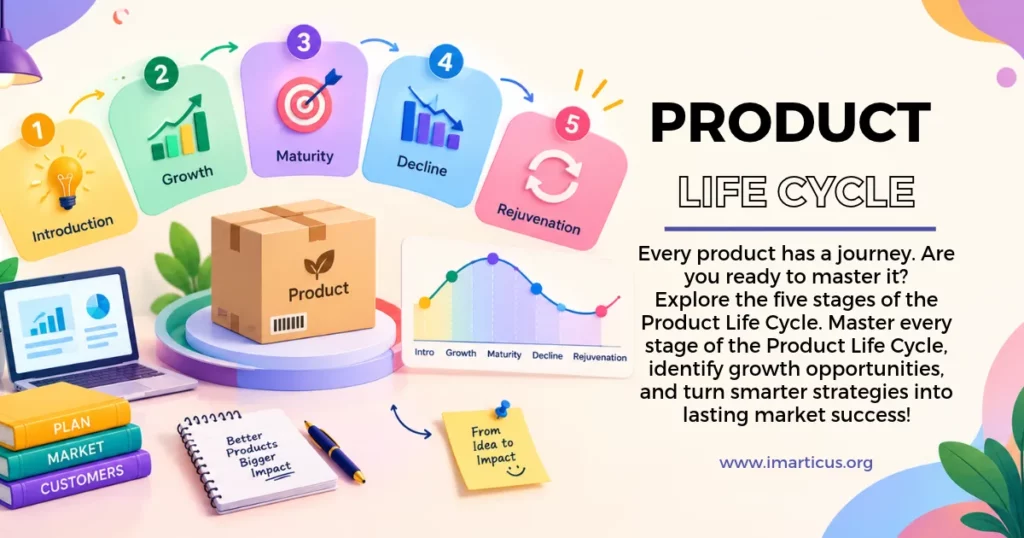
The product life cycle is the journey a product takes in the market, from its first idea to the day it is renewed, reinvented or retired. It is usually explained in five stages: development, introduction, growth, maturity and decline. Each stage has its own sales pattern, profit level, customer mood and marketing approach, which is why teams use the product life cycle to plan pricing, promotion, budgets and product updates. The product life cycle graph shows this journey as a curve of sales and profit over time. This guide explains the product life cycle theory, the stages with examples, the product development life cycle and product life cycle management in simple words, for students and working professionals alike.
When I first sat down to learn the product life cycle, I thought it was one more curve in a marketing textbook. Then I started looking at real products around me, a new phone, a streaming app, a snack on the shelf, and the curve suddenly made sense. Every product is somewhere on that curve right now, and knowing where it sits changes how you price it, promote it and improve it.
In this blog, I explain the product life cycle in plain language: what it means, the theory behind it, the five stages, the graph and diagram, real examples, product development and product life cycle management. I have written it for students who want clear concepts and for professionals who want to use them at work. Ready to take your product skills from theory to practice? Explore our Product Management Course and learn to guide products through every stage with confidence.
Product Life Cycle Definition
Have you ever noticed how some products stay popular for decades, while others arrive, shine for a season and make room for something new? That journey has a name, and it is far more useful than it first sounds. Let me start with the basics.
Don’t Let Our Best Advice Get Buried
Add Imarticus as a Preferred Source — see more of what we publish, every time you search.

Product Life Cycle Meaning
So, what is product life cycle in simple words? Think of a product as a living thing. It is born as an idea, takes its first steps in the market, grows quickly, reaches its best years and then slows down or changes shape. The product life cycle is just a clear way of describing that journey, so teams know what to expect and what to do next.
Product Life Cycle Definition
The product life cycle is the series of stages a product goes through from its first launch in the market until it is renewed, reinvented or withdrawn. At each stage, sales, profit, competition and customer behaviour change, so the marketing and product plan changes with them. That one idea sits behind pricing, advertising, budgets and product updates in almost every industry.
Explore the Stages of the Product Life Cycle
Every product follows a journey, from development and launch to growth, maturity and decline. Explore each stage below to understand how sales, customer behaviour and marketing strategies change, and what businesses should focus on at every step.
Every Product Has a Journey.
From a simple idea to a successful market presence, every product moves through different stages. Select a stage to explore its goals and strategies.
Illustrative sales pattern over time
01 · Development
Before launchProduct Life Cycle Theory and How It Developed
The product life cycle theory says that every product moves through predictable phases, and that each phase calls for a different strategy. Management thinkers began to popularise this idea from the 1960s, borrowing the logic of living things to explain how markets respond to a product over time. Here are the core ideas behind the theory:
- Every product has a journey. Sales do not stay flat forever, and that is a good thing, because it tells teams when to plan the next move.
- Sales and profit follow a pattern. Both rise, peak and settle at different points, which makes planning easier.
- Each stage needs its own plan. What works for a brand-new launch is not the best choice for a well-known product.
- Renewal is always possible. A fresh feature, a new market or a new use can start a new curve.
I like this theory because it gives teams a shared language. When a marketer, a designer and a finance lead all say “we are in the growth stage”, everyone instantly understands the priorities.
Did You Know?
The idea of a product’s journey is borrowed from biology, which is why words like “growth” and “maturity” feel so natural. (Source)
Product Life Cycle in Marketing
Marketing is where the product life cycle shows its practical power. Product life cycle in marketing helps teams choose the right message, price, channel and budget for the exact moment the product is in. Marketers lean on it in four everyday ways:
- Pricing: A new product may carry a premium or an introductory offer, while a mature product competes on value and bundles.
- Promotion: Early messages explain what the product is. Later messages explain why this product is the better choice.
- Place: Distribution starts in a few chosen outlets and widens as demand grows.
- Product: Features, variants and packaging are refreshed so the product stays interesting.
When I plan a campaign, the first thing I ask is which stage the product is in. That one answer shapes the budget, the creative and the channel mix more than anything else.
Also Read: A Comprehensive Guide on Product Management Lifecycle
Product Life Cycle Stages at a Glance
Before I go deep, here is a quick map. The table below shows the product life cycle stages side by side, so you can see how sales, profit and goals change as a product moves through the product life cycle’s 5 stages.
| Stage | Sales | Profit | Customers | Main goal |
| Development | No sales yet | Investment phase | Researchers and testers | Build the right product |
| Introduction | Low but rising | Building up | Early adopters | Create awareness |
| Growth | Rising fast | Rising steadily | A wider audience | Build market share |
| Maturity | At their highest and steady | Strongest | Mainstream and loyal | Protect share and delight customers |
| Decline | Gradual shift | Efficient and focused | Loyal niche | Renew or transition |
Use this table as a quick revision sheet. Each stage is explained in detail in the next section.
Product Life Cycle 5 Stages Explained
The classic model has four stages: introduction, growth, maturity and decline. Many teams add a development stage at the start, which gives the product life cycle 5 stages used in most courses and workplaces today. Let me walk through them one by one.
Development Stage in the Product Life Cycle
This is the quiet stage before launch. The product is still an idea, and the team is busy researching users, testing concepts and building a first version. There are no sales yet, but this is where the strongest foundations are laid.
- Main goal: Build the right product for a real need.
- Typical activities: User research, prototyping, testing and business planning.
- Key team members: Product managers, designers, engineers and researchers.
A product that starts with deep user understanding usually enjoys a smoother journey in every later stage.
Introduction Stage in the Product Life Cycle
The product reaches the market for the first time. Awareness is still low, so the focus is on helping people discover it and try it.
- Main goal: Create awareness and win the first loyal users.
- Typical activities: Launch campaigns, early-access offers, demos and feedback collection.
- Customers: Curious early adopters who love trying new things.
Early adopters become your best teachers at this point, because their feedback shapes the next version.
Growth Stage in the Product Life Cycle
Word spreads, and demand picks up fast. Sales rise, new customers arrive, and the product starts earning healthy profits. This is an exciting stage for any team.
- Main goal: Build market share and brand preference.
- Typical activities: New variants, wider distribution, stronger advertising and customer support at scale.
- Customers: A growing mainstream audience.
This is the stage where smart investment in quality and reach pays off the most.
Maturity Stage in the Product Life Cycle
The product is well known and trusted. Sales reach their highest and steadiest level, and the focus moves from winning new customers to keeping loyal ones happy.
- Main goal: Protect market share and keep customers delighted.
- Typical activities: Loyalty programmes, product refreshes, bundles and efficient operations.
- Customers: A large, loyal base that knows exactly what it wants.
Maturity is often the most profitable stage, and it gives teams the resources to fund new ideas.
Decline Stage in the Product Life Cycle
Over time, tastes and technology move on, and sales ease gradually. This is a natural stage, and it is full of smart choices.
- Main goal: Renew, reposition or transition with care.
- Typical activities: Relaunching with new features, serving a loyal niche, or guiding customers to a newer product.
- Customers: Loyal users who value what the product offers.
Many teams use this stage to reinvent the product, and a well-timed renewal can start a brand-new curve.
Pro Tip:
Note which stage your product is in every quarter. This simple habit keeps your strategy fresh.
Product Life Cycle Graph and Diagram
Seeing the journey on paper makes it stick. The product life cycle graph plots time on the horizontal axis and sales and profit on the vertical axis. The product life cycle diagram divides that curve into stages, so you can see the whole story at a glance.
Profit peaks a little before sales, which is why teams watch margins closely as the product moves into maturity. Here is how I read the curve:
- The start: The line begins low because development and launch need investment before sales arrive.
- The upward slope: Sales climb quickly in the growth stage, and profit follows.
- The peak: Sales flatten at their highest point in maturity, and profit is at its strongest.
- The gentle slope down: Sales ease in the decline stage, and a renewal can lift the line again.
You can draw your own product life cycle graph in four easy steps:
- Draw two axes, with time along the bottom and sales and profit up the side.
- Plot an S-shaped sales curve that rises, peaks and eases.
- Add a profit curve that rises a little earlier and peaks before sales.
- Mark the five stages with vertical lines and label each one.
Drawing it by hand for a product you know well is one of the best ways to practise.
Product Life Cycle Stages with Examples
Theory becomes easier when we match it with products we see every day. The table below shows product life cycle stages with examples from familiar categories, along with a smart move a team could make at each point.
| Product category | Likely stage | What is happening | Smart move |
| AI-powered smart glasses | Introduction | Early adopters are exploring the idea | Run demos and gather feedback |
| Electric vehicles | Growth | Demand and charging networks are expanding | Widen distribution and add variants |
| Smartphones | Maturity | Most buyers already know the category | Refresh features and build loyalty |
| Video streaming apps | Growth to maturity | Large audiences and many choices | Offer original content and bundles |
| Packaged breakfast cereals | Maturity | Familiar, trusted and steady demand | Launch new flavours and healthier options |
| DVD players | Decline | Viewing has shifted to streaming | Serve the loyal niche and apply the know-how to newer devices |
A single product can also sit at different stages in different markets. Renewal stories are just as inspiring: vinyl records and film cameras have found a fresh generation of fans, which shows that a thoughtful comeback can restart the curve.
Also Read: Managing Products Effectively
Product Development Life Cycle
The product development life cycle covers the work that happens before and up to launch. In other words, it builds the product that then enters the product life cycle. Many students mix the two up, so I like to keep them side by side. The product development life cycle is usually described in seven steps:
- Idea generation: Collect ideas from customers, teams and market trends.
- Idea screening: Choose the ideas that fit customer needs and business goals.
- Concept development and testing: Shape the idea into a concept and see how users respond.
- Business analysis: Estimate demand, costs and expected returns.
- Product development: Build a prototype and refine it.
- Test marketing: Release it to a small group and learn from real behaviour.
- Commercialisation: Launch it widely with a full marketing plan.
The table below compares the two cycles.
| Point | Product development life cycle | Product life cycle |
| Focus | Creating the product | Managing the product in the market |
| Starts with | An idea | Launch, or development in the 5-stage model |
| Ends with | Commercial launch | Renewal or retirement |
| Main concern | Building the right product | Managing growth and renewal |
| Main teams | Research, design and engineering | Marketing, product and sales |
Once the seventh step is done, the product moves into the introduction stage, and the two cycles join hands.
Product Life Cycle Management
Product life cycle management, often called PLM, is the practice of managing a product and all its information from the first concept to its final renewal or retirement. It brings people, data and processes together, so every team works from the same page. The PLM process usually flows like this:
- Conceive: Define the need, gather requirements and set goals.
- Design: Create specifications, prototypes and plans.
- Build and test: Develop the product and check its quality.
- Launch and support: Take it to market and look after customers.
- Improve: Use feedback and data to update the product.
- Renew or retire: Relaunch with new value or guide customers to what comes next.
Strong product life cycle management gives teams several advantages:
- Faster launches: Shared information reduces waiting and repeated work.
- Better quality: Issues are caught early, and fixes reach everyone.
- Smarter decisions: Data from every stage supports planning.
- Happier customers: Regular improvements keep the product relevant.
I have seen how a simple shared roadmap can change team conversations. Everyone sees the same stage, the same goal and the same next step.
Also Read: Understanding the Realm of Product Management
Marketing Strategies for Every Product Life Cycle Stage
Knowing the stage is half the work. The other half is choosing the right action. Here is how marketing choices usually change across the product life cycle stages.
| Stage | Pricing | Promotion | Distribution | Product focus |
| Introduction | Introductory offers or premium pricing | Build awareness and educate | A few chosen channels | Core features and quick feedback |
| Growth | Competitive pricing for wider reach | Build preference and show benefits | Expand to more outlets | New variants and quality |
| Maturity | Value pricing and bundles | Loyalty rewards and reminders | Widest reach | Refreshes and new uses |
| Decline | Focused offers | Messages for loyal users | Selective channels | Renewal or transition |
You will notice that the plan moves from explaining, to expanding, to retaining, to renewing. That flow is the heart of the product life cycle in marketing.
Importance of Product Life Cycle
Whether you are preparing for an exam, planning a launch or running a whole business, the product life cycle gives you a clear way of thinking. It turns a long, busy journey into five stages that anyone can follow, and it tells you what to focus on at each one. Here is how it helps students, professionals and businesses in practical ways.
Benefits for Students
- Clear concepts: The five stages give you a simple structure to remember for exams and case studies.
- Better answers: You can explain any product’s journey with the graph, the stages and examples.
- Career clarity: It introduces you to the thinking used in product, marketing and strategy roles.
- Stronger interviews: Saying where a product sits on the curve shows recruiters that you think in a structured way.
- Easier projects: Group assignments and presentations become simpler when you map a product to its stage.
If you are a student, try picking one product you use every day and placing it on the curve. It is a small exercise that makes the theory stay with you.
Benefits for Working Professionals
- Sharper planning: Roadmaps, budgets and campaigns match the stage of the product.
- Better teamwork: Teams share one language for priorities.
- Confident decisions: Stage-wise metrics show what to measure and when.
- Smarter budgets: Spending follows the stage, so money goes where it creates the most value.
- Faster career growth: Product, marketing and strategy roles all value people who can explain a stage-wise plan.
In my experience, professionals who talk in stages get heard in planning meetings, because their plans are easy to follow.
Benefits for Businesses and Teams
For a company, the product life cycle works like a health check for every product it offers. It shows where each one stands and what it needs next.
- Balanced portfolios: Leaders can see which products are growing, which are steady and which are ready for a refresh.
- Smarter launches: Teams time campaigns, pricing and distribution to the stage.
- Healthy cash flow: Steady, mature products help fund exciting new ideas.
- Customer-first updates: Regular improvements keep loyal customers happy for longer.
When everyone in the company reads the same curve, decisions become faster and conversations become friendlier.
Also Read: Product Manager Jobs
How the Product Life Cycle Helps Each Reader
The table below puts the benefits of the product life cycle side by side for the three groups we have discussed.
| Reader | How it helps | Where it shows up |
| Students | A simple structure to learn and revise | Exams, case studies and interviews |
| Working professionals | Stage-wise planning and clear priorities | Roadmaps, campaigns and reviews |
| Businesses and teams | A shared view of every product | Budgets, launches and portfolio planning |
The same five stages serve all three groups, which is what makes the idea so lasting.
Product Life Cycle in Everyday Product Work
Product managers look at different signals at each stage. Adoption and feedback matter early. Growth and conversion matter during expansion. Retention and satisfaction matter in maturity. AI tools now help teams read these signals faster, spot patterns in user behaviour and test ideas quickly, which makes every stage more exciting to manage. The table below shows what many teams keep an eye on at each stage of the product life cycle.
| Stage | What teams watch | Why it helps |
| Development | User research findings and prototype feedback | Confirms the idea solves a real need |
| Introduction | Awareness, trials and early reviews | Shows how quickly people discover the product |
| Growth | Sign-ups, conversion and market share | Guides investment in reach and quality |
| Maturity | Retention, loyalty and satisfaction | Protects and delights the loyal base |
| Decline | Core user activity and renewal ideas | Points to the best moment for a refresh |
Watching the right signal at the right time keeps every stage productive.
How to Start Using the Product Life Cycle Today
You do not need a big project to begin. These five small steps are enough to turn the product life cycle into a daily habit.
- Pick one real product that you use or manage.
- Place it on the product life cycle graph and name its current stage.
- Note the goal of that stage from the tables above.
- Choose one pricing, promotion or feature action that matches the goal.
- Review the stage every quarter and adjust the plan.
The more I work with these ideas, the more I see them as a map rather than a rule.
Also Read: Developing Products
Why Choose Imarticus for Product Management
Understanding the product life cycle is a wonderful start, and the next step is to practise it. The Product Management Course at Imarticus is built for exactly that, with hands-on learning across the full product journey, from research and execution to growth and go-to-market. It suits early product managers, IT professionals, analysts, project managers, designers and marketers.
| Feature | What you get |
| Product Studio™ | Hands-on teardowns, challenge labs and pivot challenges guided by industry mentors |
| IBM AI Product Manager Professional Certificate | Earn it along with 10 course-level certificates, in collaboration with IBM |
| Live and online classes | 100% live interactive classes in weekend batches over 6 months, with about 6 to 8 hours per week |
| AI-first curriculum | Hands-on practice with tools such as Mixpanel, Uizard and Notion AI |
| Tech for PMs | APIs, system design and tech handoffs explained simply |
| B2C and B2B portfolio | Build products for both consumer and enterprise users |
| 360-degree product learning | Research, execution, growth and go-to-market in one journey |
| Mentorship from real PMs | Feedback from active product leaders |
| Career Launchpad | Resume labs, mock interviews and pitch preparation |
| Capstone and Demo Day | Pitch your own product to industry mentors and leaders |
Learners also finish with a product they built themselves, which turns the product life cycle from a chapter into real experience. The programme has supported 550+ career transitions into product roles.
FAQs About Product Life Cycle
Students and professionals ask me the same handful of frequently asked questions about the product life cycle again and again. Here are clear, short answers you can use for revision, interviews and everyday product work.
What are the 5 stages of the Product Life Cycle?
The 5 stages of the product life cycle are development, introduction, growth, maturity and decline. Development builds the product, introduction launches it, growth expands it, maturity steadies it and decline leads to renewal or transition.
What are the 7 stages of Product Development?
The seven stages are idea generation, idea screening, concept development and testing, business analysis, product development, test marketing and commercialisation. Together, they form the product development life cycle that leads to launch.
What is the PLM Process?
PLM, or product life cycle management, is the process of managing a product from concept and design through launch, improvement and renewal or retirement. It keeps people, data and decisions connected at every stage.
What is the Product Life Cycle?
The product life cycle is the journey a product takes in the market, from launch to renewal or withdrawal. It is described in stages, and each stage has its own pattern of sales, profit and strategy.
What are the 7 Steps of Marketing?
The seven steps are commonly described as researching the market, segmenting the audience, choosing target customers, positioning the product, building the marketing mix, putting the plan into action, and measuring results. Knowing the product life cycle stage makes the marketing mix step much sharper.
Why is the Product Life Cycle Important to Know?
It helps teams plan pricing, promotion, budgets and updates for the right moment, and it gives students and professionals a clear framework to explain any product’s journey. We teach it through hands-on projects at Imarticus, so it becomes a working skill.
What are the Key Stages in the Product Life Cycle?
The key stages are introduction, growth, maturity and decline, with development coming before launch. Their goals are awareness, share, loyalty and renewal, in that order.
From First Idea to Fresh Start
At the start of this blog, I said that every product sits somewhere on a curve. After walking through the stages, the graph, the examples, product development and product life cycle management, I hope that curve now feels familiar. The next time you pick up a phone, open a streaming app or reach for a snack, you will probably smile and think about where it sits.
The big lessons are simple. Each stage has its own goal. Development leads to launch, growth rewards good decisions, maturity builds loyalty, and decline opens the door to renewal. Product life cycle management keeps every team aligned, and the best products always find a way to begin again.
If this guide made you curious, I would love to see you take the next step. Our Product Management Course helps you turn the product life cycle into confidence, a strong portfolio and a career you can be proud of.
Liked This? Follow Us Where You Already Search.
Preferred Sources is Google’s built-in follow button — no app, no login, just more Imarticus in your results.