


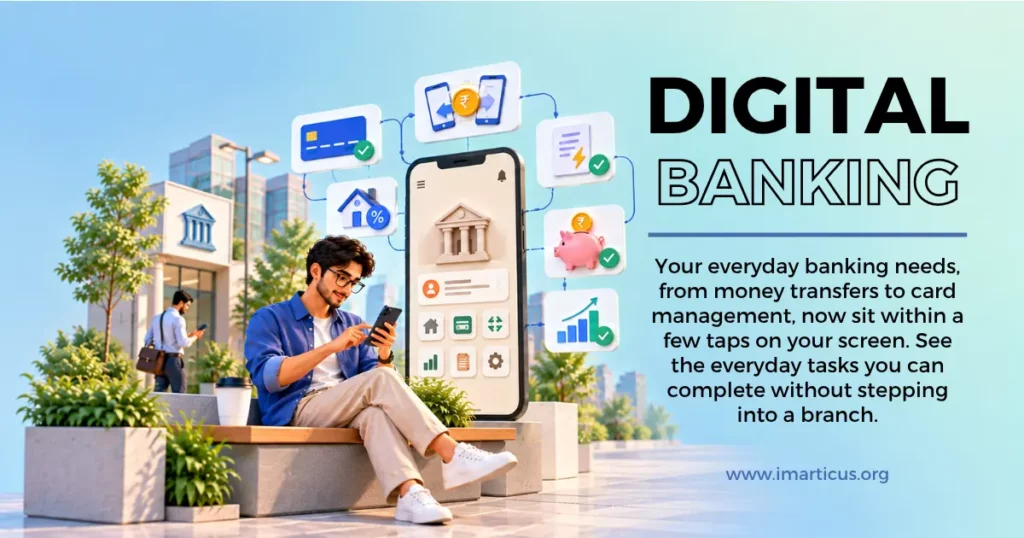
Digital banking is the delivery of banking products and services through digital channels such as mobile apps, websites, ATMs, APIs and connected financial platforms. It covers account management, digital payments, lending, deposits, customer service, fraud detection and automated financial processes. The main types include mobile banking, internet banking, digital-only or neobanking platforms, Digital Banking Units and business digital banking. In India, UPI, Aadhaar, AEPS, NACH and BBPS form important parts of the digital banking infrastructure.
Modern digital banking also relies on cloud systems, APIs, microservices, encryption, automated fraud checks and digital identity verification. Key benefits include 24/7 access, faster payments, automated services and reduced operating costs, while risks include cyber fraud, privacy concerns, technical failures and digital exclusion. Emerging trends include AI, open banking, CBDCs, cloud-native banking and advanced cybersecurity.
You probably use digital banking several times a day without giving it a second thought. You pay a bill, check whether your salary has arrived, move money to another account or freeze a card from your phone. It feels like one action. From the bank’s side, it can involve identity checks, payment rails, account systems, security controls and several other processes happening almost at once.
That is where the subject gets interesting. Digital banking is much bigger than internet banking or a mobile app. It has changed how banks open accounts, assess borrowers, move money, sell financial products and deal with customers. In India, UPI is an obvious example, but it is only one piece of the picture.
The subject matters even more when you look at the people building and managing these systems. Someone working in FinTech needs to understand more than technology. Someone in banking needs to understand more than products. Risk, compliance, customer behaviour, payments and finance still sit underneath the digital layer. That is why the right finance courses can be useful alongside an understanding of technology.
Don’t Let Our Best Advice Get Buried
Add Imarticus as a Preferred Source — see more of what we publish, every time you search.

In the sections ahead, I’ll look at what digital banking actually means, how the underlying systems work, the different types and services, its growth in India, the risks involved and the skills that are becoming relevant across modern financial services.
What Is Digital Banking?
Yesterday I opened my banking app, checked my balance, paid a vendor, and closed the app. Total time taken: six seconds. No token machines. No standing in line. No branch visit. When you tap a phone screen to send money, code handles the heavy lifting instantly. A simple QR scan fires requests through cloud servers, API gates, and core databases in milliseconds.
| Banking Setup | How Operations Run | Primary Customer Contact |
| Traditional Branch | Physical ledgers and branch staff | Teller counter windows |
| Standard Online Banking | Web portals tied to local branches | Computer web browsers |
| Neobanking Platforms | App-first setups on cloud servers | Mobile phone software |
| Full Digital Banking | Completely automated software cores | Mobile apps, sites, and kiosks |
| Kiosk Banking | Automated hardware terminals | Local ATMs and DBU kiosks |
Banks must settle payments instantly without letting fraudsters intercept user data. The table above shows how personal banking shifted from physical counters to software code over the years.
Did You Know?
Data published by the National Payments Corporation of India confirms UPI cleared over 24,000 crore payments in a single financial year. That volume keeps India right at the front of real-time digital payments worldwide. (Source)
What Is Digital Banking Meaning In Simple Words?
Forget corporate buzzwords for a moment. So, what is digital banking at its raw foundation? It means taking every job a bank handles, verifying customer identity, underwriting loans, recording ledger entries, and running it through automated software.
- No paper slips.
- No wet signatures.
- No waiting for a branch manager to stamp a document.
When a financial firm automates its back-end systems alongside its front-end apps, it runs as a full digital banking network.
| Daily Operation | Old Branch Method | Modern Digital Setup |
| Account Opening | Filling paper forms at a branch desk | Instant video KYC on your phone |
| Moving Funds | Paper slips and manual ledger entries | Real-time API transaction settlement |
| Customer Support | Standing in line at a counter | 24/7 automated support engines |
| Accessing Accounts | Visiting a local branch in person | Mobile apps and web portals |
| Risk Management | Manual audits after transactions clear | Instant automated fraud blocks |
Going digital replaces slow paper tasks with instant code execution. The breakdown above contrasts legacy branch routines against modern software setups.
Understanding the true digital banking meaning requires looking at the full system stack. It is not just a clean interface on your screen. It is an end-to-end setup where financial products run automatically, keeping transactions fast, safe, and open all day and night.
Also Read: How Can You Improve Your Financial Literacy?
Key Types of Digital Banking Platforms
Financial firms use several channels to deliver services. Looking at the types of digital banking operating today shows tools built for specific user habits, technical setups, and business goals.
| Platform Category | Underlying Architecture | Typical User Base |
| Web Portals | Encrypted browser dashboards | Desktop and corporate users |
| Mobile Banking Apps | Native smartphone applications | Everyday retail consumers |
| Neobank Setup | Digital-only cloud infrastructure | Tech-focused mobile users |
| Digital Banking Units | Physical outlets with self-service kiosks | Semi-urban and rural areas |
| Telephone Banking | Automated voice response setups | Basic feature phone users |
Banks build distinct channels because different users need different tools. The table above maps how specific platforms target distinct customer groups.
Internet Banking Portals
Web portals let you manage money using a browser on desktop computers. They work best for heavy financial tasks, such as uploading company payrolls, setting up trade credit lines, or scheduling high-value wire transfers.
Mobile Banking Apps
Installing a digital banking app turns a smartphone into a portable branch. It lets users check live balances, transfer funds, clear bills, and receive instant push notifications whenever account balances change.
Neobanks and Branchless Firms
Neobanks run without physical branches. They team up with licensed banks to offer sleek mobile apps, smart savings tools, and instant card controls right on your phone screen.
Self-Service Terminals and Automated Units
ATMs and cash deposit machines extend electronic banking into physical locations. They handle cash deposits, passbook updates, and balance checks without needing a teller behind a desk.
Dedicated Digital Banking Units
Regulators established dedicated digital banking units to expand access to paperless finance. These physical outlets feature touchscreens and kiosks so customers can handle banking tasks independently.
Understanding these channels helps financial teams build better tools for users across every digital screen.
Essential Features of Digital Banking and Financial Products
Customers expect fast apps and zero friction. Examining the essential features of digital banking reveals how engineering teams build software that keeps pace with everyday requirements.
- Video verification tools allow users to open accounts in minutes using government database checks.
- Instant payment networks move money using virtual payment IDs instead of long account numbers.
- Automated investment features let customers set up recurring deposits or mutual fund purchases easily.
- Built-in digital banking services give small business owners direct control over tax payments, electronic invoices, and vendor payouts.
- Security dashboards allow users to lock misplaced cards and block international charges with one tap.
- Instant credit engines analyse transaction history to disburse emergency loans within seconds.
- Electronic statement tools sort daily purchases into clean budget categories automatically.
| Product Type | Core System Function | Real Benefit to Users |
| Virtual Payment Cards | Instant digital card generation | Safe online shopping without plastic cards |
| Instant Micro-Loans | Algorithmic credit scoring | Emergency cash disbursed in seconds |
| Smart Savings Locks | Automated sweep-in interest engines | Earn higher returns on idle money |
| Bill Payment Hubs | Centralised utility bill routing | Never miss monthly electricity or water bills |
| Automated Portfolios | Algorithmic asset balancing | Low-cost wealth building for beginners |
Modern mobile software bundles these tools into a simple interface. When you tap a button on your digital banking app, background software verifies your identity, updates general ledgers, and transfers money in a split second. The continuous expansion of digital banking products ensures that retail customers and business owners always have tools built for their specific financial goals.
Interesting Insight → Official reports from the Reserve Bank of India state that over 100 specialised Digital Banking Units are now open across rural and semi-urban districts. They bring paperless banking access to areas that rarely saw branches before. (Source)
Advantages of Digital Banking and Core Consumer Benefits
Paper-based banking simply cannot compete with software execution speed. Looking closely at the actual advantages of digital banking shows why physical bank visits keep dropping every quarter.
Running payments through code cuts out human error and processing delays. When you move money electronically, software verifies balances, updates account ledgers, and logs records without waiting for office hours.
| Benefit Area | What Changes for You | How the Bank Operates |
| Service Access | Handle money 24/7 from anywhere | Systems run continuously without branch staff |
| Settlement Speed | Payments clear in seconds | No manual ledger posting or batch delays |
| Operating Costs | Lower account fees and better rates | Reduced branch rent and paper costs |
| Record Accuracy | Live digital statements on demand | Automated transaction logging in core databases |
| Card Controls | Freeze lost cards inside the app | Automated security blocks without phone calls |
Software automation brings huge efficiency gains to both customers and financial institutions. The table above highlights how those operational benefits split across both sides.
These practical benefits go far beyond personal convenience. When a market adopts digital banking services at scale, local businesses collect payments faster, accounting gets cleaner, and cash flows smoothly across the entire economy. The combined benefits of digital banking explain why businesses and retail users move away from physical cash and paper receipts.
The Landscape of Digital Banking in India
India built one of the most advanced digital payment setups anywhere in the world. Tracking the explosive growth of digital banking in India gives us a clear look at how public infrastructure can reshape financial markets.
The National Payments Corporation of India laid the groundwork for this shift. When they built the Unified Payments Interface (UPI), they eliminated the hassle of typing long account numbers and IFSC codes for simple daily purchases.
| System Layer | Main Job | Real World Example |
| Aadhaar System | Biometric identity verification | Paperless video account opening in minutes |
| UPI Network | Instant peer-to-peer and merchant payments | Scanning a QR code at a local store |
| AEPS Network | Fingerprint-based rural cash access | Micro-ATMs running in remote villages |
| NACH Infrastructure | High-volume scheduled payments | Automated monthly salary and dividend payouts |
| BBPS Platform | Centralised utility bill clearing | Clearing electricity and water bills automatically |
Public digital rails drive real-time financial transactions across Indian cities and villages alike. The breakdown above shows the core technologies keeping money moving daily.
Government initiatives pushed this transition even further. Setting up dedicated digital banking units in rural districts means farmers, local shop owners, and families get proper financial tools without traveling long distances to city bank branches.
Local payment innovations keep moving fast. As credit networks expand and central bank digital currencies roll out, India stays right at the front of global financial engineering.
Did You Know?
Data from the Reserve Bank of India confirms electronic payment volume grew exponentially over recent years, with digital channels handling over 98% of total payment volume nationwide. (Source)
Technology Stack Behind Modern Digital Banking Platforms
To understand how these platforms handle millions of transactions without crashing, we need to inspect the software architecture. Building a reliable digital banking platform requires a modern tech stack engineered for non-stop performance.
CLIENT LAYER
(Mobile Banking App / Web Portal / ATM Kiosk Interface)
↓
APPLICATION SERVICES LAYER
(Authentication / Payments Engine / Credit Scoring / Fraud Check)
↓
DATABASE & LEDGER LAYER
(Cloud-Native Database / Encryption Module / Encrypted Storage)
Modern banking software relies on modular microservices to process transactions safely. The diagram above traces how data moves from your phone screen down to central database ledgers.
The application services layer uses isolated microservices running in cloud environments. Instead of relying on one massive legacy mainframe, individual features like balance checks, bill clearing, and fraud scoring run independently so system outages stay extremely rare.
| Technical Layer | Software Component | Primary Security Role |
| User Interface | Native mobile apps and browser portals | Device binding and biometric logins |
| API Gateway | Encrypted request routers | Traffic control and request validation |
| Application Core | Independent microservice containers | Business logic and rule checking |
| Central Ledger | Distributed relational database | Immutable transaction record-keeping |
| Security Hardware | Hardware Security Modules | High-grade encryption key storage |
Banking software uses layered security to protect financial data at every step. The table above details how backend engineering components keep systems safe and stable.
Security sits right at the center of this tech stack. Every single transaction goes through multi-factor checks, device fingerprinting, and automated fraud scoring before any money moves inside the central database.
Building and maintaining these complex digital banking solutions takes skilled software teams, clean system architecture, and deep financial engineering expertise.
Also Read: What Are The Top Fintech Companies In India In 2026?
Future Trends and Digital Transformation in Banking
Financial technology moves fast. Looking closely at the future of digital transformation in banking highlights the technical tools, regulatory shifts, and core skill sets that will shape how banks operate over the next decade.
Artificial intelligence handles real-time risk checks and fraud tracking now. Instead of reviewing flagged accounts after cash leaves, machine learning engines spot irregular patterns instantly, stopping fraudulent transactions before they clear.
| Emerging Trend | Core Mechanism | What It Means for Banking |
| Agentic AI Workflows | Autonomous decisioning software | Instant credit scoring and custom budgeting |
| Sovereign Digital Currencies | Blockchain-based central bank money | Instant cross-border clearing without fees |
| Open Banking APIs | Secure inter-bank data pipelines | Third-party app integration for all accounts |
| Post-Quantum Security | Advanced cryptographic algorithms | Long-term defense against high-level cyber risks |
| Cloud Core Engines | Elastic cloud-native ledgers | Lower server costs and better system uptime |
New software frameworks keep modernising backend banking infrastructure. The table above outlines major technical shifts that will redefine financial products over the coming years.
Regulatory models keep changing alongside software. Open banking frameworks now let consumers share financial records safely with specialised third-party tools, driving healthy market competition and software innovation.
Did you know?
Reports published by the Bank for International Settlements show that over 90% of global central banks are currently testing or building Central Bank Digital Currencies (CBDCs) to streamline cross-border payments. (Source)
What Will Digital Banking Look Like In India?
India is unlikely to follow one single digital banking model.
- Large banks will continue building their own digital platforms.
- Fintech companies will keep creating specialised products.
- UPI will remain important to everyday payments.
- Digital Banking Units can support customers who need help using digital channels.
- Physical branches will continue to exist for products and situations where customers want human interaction.
The interesting part is the combination. The future is unlikely to be purely digital or purely physical. Customers will move between channels depending on what they are trying to accomplish.
Someone may open an account through a phone, speak to an employee about a loan, receive a digital approval and make repayments through an app. That is a much more realistic picture of where banking is heading.
Also Read: What Is Fintech And How Has It Changed Finance?
Why Study Digital Banking?
A digital banking course can be useful when you want to understand the connection between banking and technology rather than studying either subject in isolation.
It can help you make sense of payment systems, digital products, customer journeys, financial technology and risk. Your next step should depend on the career you want.
- CFA makes sense for a path centred on investment analysis and financial markets.
- Retail and Commercial Banking fits professionals interested in banking products, customers, credit and business finance.
- FinTech suits people drawn towards payment systems, digital products and technology-led financial services.
- Risk Management is relevant when you want to work around credit, market, operational or financial risk.
- Commercial banking certifications equip candidates for roles in business lending, trade credit, and corporate advisory.
- Specialised fintech programs focus on payment gateways, API banking, and financial software design.
These are different career directions. You do not need to force them into one path. Modern finance offers diverse specialisations across strategy, risk analysis, and software product management. The list above breaks down major functional domains open to trained candidates.
Staying ahead in this industry takes constant skill-building. Taking specialised finance courses helps professionals build solid ground in payment gateway architecture, financial engineering, and modern risk management.
| Career Path | Common Job Roles | Recognised Credentials |
| Investment Banking | Financial Analyst, IB Associate | CFA Charter, Financial Analysis Certification |
| Risk Analytics | Credit Risk Analyst, Enterprise Risk Manager | FRM Designation, Risk Certification |
| Fintech Management | Product Owner, Payment Systems Analyst | Certified Fintech Professional |
| Commercial Banking | Relationship Manager, Credit Officer | Banking & Finance Postgraduate Diploma |
| Corporate Planning | FP&A Manager, Financial Controller | CMA US, Strategic Finance Certification |
Investing in structured education provides the technical grounding and professional confidence required to build a lasting career in modern digital finance.
A degree gives you a solid foundation, but global finance roles often call for specialised knowledge and industry-recognised credentials. Adding the right certifications can strengthen your profile and open doors to wider career opportunities.
Why Imarticus Learning Stands Out For Finance Courses?
When you are choosing a finance course, the name of the institute matters less than what you are actually getting from it. Imarticus Learning has built its finance courses around specific areas of the financial services industry, from investment banking and accounting to FinTech, banking, capital markets and risk management. A few details on its finance portfolio are worth looking at closely.
- 15+ finance programmes across distinct career tracks: The portfolio covers Investment Banking, Global Accounting & Finance, Financial Planning and Analysis, Retail and Commercial Banking, FinTech and Risk Management, rather than putting every learner through the same broad finance curriculum.
- India’s first and only approved prep provider for four global accounting and finance programmes: This is one of the specific credentials highlighted on Imarticus Learning’s finance page and is particularly relevant for learners pursuing professional finance certifications.
- 100% job assurance on selected programmes: Imarticus lists job-assured programmes backed by career services, giving eligible learners a defined career-support component alongside the course itself.
- University-backed programmes sit alongside professional finance courses: The portfolio includes programmes associated with institutions such as IIM Lucknow, IIM Calcutta, IIM Indore and ISB, covering areas such as corporate and investment banking, applied finance, capital markets and CFO leadership.
- The faculty brings direct financial services experience: The listed faculty includes Nandita Nadig, with 15+ years in investment banking, Anshul Agarwal, with experience at Citi, Credit Suisse and Deutsche Bank, and Vikrant Tapaskar, who has worked with BNP Paribas and HSBC.
- A sizeable hiring network sits behind the finance portfolio: Imarticus states that more than 3,500 companies hire its learners, while the finance page separately lists 1,500+ hiring partners among its headline figures.
- Placement reports show 40,000+ students placed: Alongside this figure, Imarticus lists a ₹ 7 LPA average salary, ₹ 22 LPA highest salary, 60% salary hike and 1,500+ hiring partners as portfolio-level figures. These are institute-reported figures, so they should be read in that context.
- Its 2024 placement highlights report 6,000+ placements and 4,000+ career transitions: The same section reports a highest salary of ₹24 LPA, giving prospective learners a separate view of the outcomes reported for that placement period.
The useful part is that you can start with the role or finance specialisation you actually want and then work backwards to the programme. For someone considering a career in digital banking, FinTech, investment banking or risk, that makes the choice more specific than simply signing up for a general finance course.
FAQs About Digital Banking
From the role of UPI and ATMs to the difference between online and digital banking, these frequently asked questions clear up the practical doubts around how digital banking works, where it fits into everyday banking, and what its limitations are.
What Is Meant By Digital Banking?
Digital banking means delivering banking products and services through digital channels such as mobile applications, websites, ATMs and connected financial platforms. It covers payments, account management, lending, deposits and customer service.
What Is The Difference Between Online And Digital Banking?
Online banking mainly refers to banking through the internet. Digital banking has a wider scope and can include mobile applications, APIs, automation, digital onboarding, analytics and connected financial services.
Is ATM Digital Banking?
Yes. An ATM is a digital banking channel because it uses electronic systems to provide services such as cash withdrawals, balance enquiries and selected account transactions without requiring a traditional branch interaction.
What Are The Top 10 Digital Banks In India?
There is no single official list ranking the top 10 digital banks in India. Banks differ in their digital products, customer base and technology offerings. Imarticus Learning’s banking programmes cover the wider digital banking ecosystem.
What Are The Types Of Digital Banking?
The main types include mobile banking, internet banking, digital-only banking, Digital Banking Units and business digital banking. Imarticus Learning’s banking-focused programmes cover several functions connected with these models.
Is UPI A Digital Banking?
UPI is a digital payment system that enables account-linked payments. It forms an important part of India’s digital banking infrastructure, while banking itself covers a much wider set of products and services.
Is Digital Banking Good Or Bad?
Digital banking offers convenient access to financial services while introducing risks such as fraud, outages, privacy concerns and digital exclusion. Imarticus Learning’s FinTech and Risk Management programmes cover several of these areas.
What Are The Disadvantages Of Digital Banking?
Common disadvantages include cyber fraud, technical failures, privacy risks, limited digital literacy and reduced human interaction for complicated issues. Imarticus Learning’s FinTech and Risk Management programmes address related technology and financial risk concepts.
Where Digital Banking Takes Your Finance Career
Digital banking has become part of the day-to-day machinery of finance. A UPI payment, a loan application, a card block or a mobile investment can involve several systems working together behind the screen. That is the part worth remembering from this article. The app is only the visible layer.
The biggest mistake you can make with digital banking is treating it as a topic about mobile apps. It is really about how banking gets done. Money has to move. Customers have to be verified. Credit decisions have to be made. Transactions have to be recorded. Fraud has to be detected. Regulations have to be followed. Someone still has to take responsibility when a system fails.
For anyone starting out in finance, this creates room across FinTech, retail and commercial banking, risk, investment banking and financial analysis. You do not need to master every part of the digital banking ecosystem. Pick the area that interests you and build a solid understanding of the finance behind it.
That is also a sensible way to look at finance courses by Imarticus Learning has programmes across FinTech, Retail and Commercial Banking, Risk Management, Investment Banking and Global Accounting and Finance, giving students different routes into the wider financial services industry.
The technology will keep changing. The need to understand money, markets, customers, risk and financial decisions will not. That foundation is what makes your digital banking knowledge useful long after a particular app, platform or banking feature has changed.
Liked This? Follow Us Where You Already Search.
Preferred Sources is Google’s built-in follow button — no app, no login, just more Imarticus in your results.