


Last updated on September 22nd, 2026 at 04:27 pm
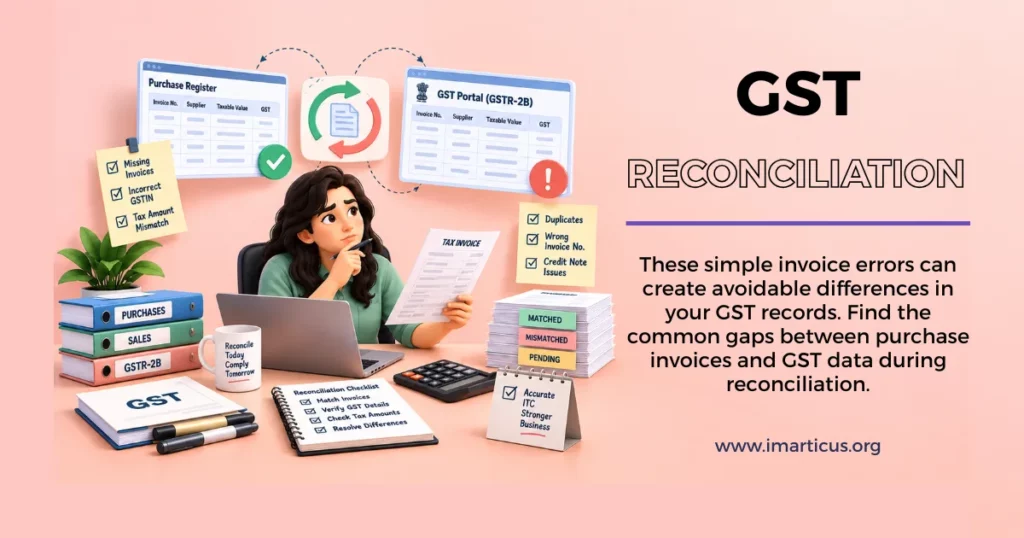
GST reconciliation is the process of matching GST records across your books, purchase and sales registers, and GST returns to identify and resolve differences. It helps verify input tax credit, spot missing or duplicate invoices, correct tax amounts and keep return data accurate. Common checks include purchase records against GSTR-2B, sales records against GSTR-1, and tax liability against GSTR-3B.
You can carry out GST reconciliation in Excel, Tally Prime or through a GST reconciliation tool, depending on the volume of transactions. A clear GST reconciliation format makes mismatches easier to trace, explain and resolve.
A GST mismatch can hide in plain sight. You may have the invoice in your purchase register. The amount may be recorded correctly in your books. The tax calculation may also look right. Then you check the GST data, and something does not line up.
That one difference raises a few very practical questions. Was the invoice reported by the supplier? Was the GSTIN entered correctly? Has a credit note been missed? Is this simply a timing difference? Or are you claiming input tax credit against an invoice that needs attention? This is where GST reconciliation becomes important.
When I look at reconciliation from an accounting perspective, I do not see it as a task where you simply match two columns and mark them as ‘OK’. The useful part starts when the numbers disagree. You need to trace the transaction, identify the reason for the difference and decide what needs to be corrected.
Don’t Let Our Best Advice Get Buried
Add Imarticus as a Preferred Source — see more of what we publish, every time you search.

For anyone studying accounting or building a career in finance, there is a useful lesson here. GST work gives you a very practical way to see how transactions move between business records, tax returns and financial data. You start noticing the small details that can change a final figure. That is a skill worth carrying into broader finance courses and professional finance roles.
So, what should you actually check? How do you do GST reconciliation without getting lost in hundreds of invoice lines? Which mismatches need immediate attention? And where does Excel, Tally Prime or a GST reconciliation tool genuinely save time? That is what this guide gets into, with the actual process, formats, examples and checks you can use in your own work. Because a clean GST record is not simply one where every number matches. It is one where you can explain every number that does not.
What Is GST Reconciliation?
When I explain what is GST reconciliation, I keep the definition simple. You compare the GST information in your books with the related information available through GST returns and statements. The GST reconciliation meaning becomes easier when you look at one invoice.
Say your books contain an invoice for ₹50,000 plus GST. Your supplier has also reported that invoice. You check the invoice number, GSTIN, date, taxable value and tax amount. When the details agree, you can mark the entry as matched. A difference needs a closer look. I would check these details first:
- I would match the supplier GSTIN because one incorrect digit can stop two records from matching correctly.
- I would check the invoice number because spaces, prefixes, suffixes and typing errors can create false differences.
- I would compare the invoice date because the same document can appear in a different return period.
- I would compare the taxable value because an amendment or credit note can change the amount reported.
- I would compare the tax amount because a difference here can affect the ITC or tax liability review.
The GST portal describes GSTR-2B as an auto-drafted ITC statement. It also advises taxpayers to reconcile the financial statements with their own records and books of accounts.
Why Is GST Reconciliation Important?
I find the value of GST reconciliation easiest to see when a business has many invoices. One small error can sit quietly inside a large spreadsheet.
Imagine a business with hundreds of purchase invoices. The accounts team records every purchase. Suppliers file their returns at their own end. The two sets of information then need to meet. A regular check can bring out:
- I can spot a purchase recorded in the books that does not appear in the available GST data.
- I can find a portal invoice that has not yet been recorded in the accounting books.
- I can identify duplicate entries before they affect the review of input tax credit.
- I can trace differences in taxable value, GST amount, invoice number or GSTIN to the source document.
- I can keep a written record of unresolved items so the same issue does not get checked again.
The GST portal specifically advises taxpayers to ensure that credit is not availed twice and that required reversals are made in GSTR-3B.
Also Read: What Are The Different Types Of Accounting And Their Uses?
Types Of GST Reconciliation
I prefer to split the work into separate checks. Each one answers a different question.
| Reconciliation Check | Records Compared | What I Check |
| Purchase reconciliation | Books and GSTR-2B | Invoice and ITC details |
| Purchase review | Books and GSTR-2A | Supplier-reported changes |
| Sales reconciliation | Sales register and GSTR-1 | Outward supply details |
| ITC reconciliation | GSTR-2B and GSTR-3B | Reported ITC figures |
| Invoice reconciliation | E-invoice and GST data | Invoice reporting |
| Liability review | GSTR-1 and GSTR-3B | Output tax figures |
This gives me a useful map before I start the detailed review. I can then focus on the records that answer the exact question I am trying to resolve.
Purchase Register Vs GSTR-2B
I use the purchase register as the starting point when the goal is to review input tax credit. The purchase register tells me what the business has recorded. GSTR-2B gives me the relevant GST data generated for that period.
Suppose the purchase register has 150 invoices and the relevant GSTR-2B contains 147 matching records. I would not simply mark three invoices as errors. I would check:
- Whether the supplier filed the invoice.
- Whether the invoice was reported for another period.
- Whether the GSTIN was entered correctly.
- Whether the supplier amended the document.
- Whether the invoice belongs to the business at all.
The GST portal says GSTR-2B should be used while determining the appropriate ITC in GSTR-3B. It also states that taxpayers must reconcile their own records with GSTR-2B.
Purchase Register Vs GSTR-2A
GSTR-2A can help when I need to investigate changes in supplier-reported information. The key point is timing. Supplier filings can change the information available to the recipient. So an older download may not show the same position as a later review.
I would keep the relevant download with the reconciliation working papers. That gives me a record of what I saw when the review was performed.
Sales Register Vs GSTR-1
When I check outward supplies, I compare the sales register with GSTR-1. I would review the customer GSTIN, invoice number, date, taxable value and tax amount. I would also check credit notes and debit notes.
A simple example helps. Your sales register shows an invoice for ₹1,00,000. GSTR-1 shows ₹90,000. I would open the invoice first. A credit note may explain the difference. A typing error may also explain it. The figure alone does not tell me the reason.
GSTR-1 Vs GSTR-3B
This check looks at the relationship between outward supply reporting and the tax liability reported in GSTR-3B. I would first establish the period. Then I would compare the relevant sales figures and tax amounts. Any difference should be traced to an adjustment, amendment or reporting issue. This is especially useful during return review because the two forms serve different reporting purposes.
GSTR-2B Vs GSTR-3B
Here I am checking the relationship between available ITC information and the ITC reported in the return.
GSTR-2B is not something I file. It is a read-only statement generated from relevant supplier and other GST data. The GST portal says it should be used to determine the appropriate ITC in GSTR-3B. I would still check eligibility separately. A figure appearing in GSTR-2B does not remove the need to apply the relevant GST rules.
E-Invoice Vs GSTR-1
For businesses covered by e-invoicing, I can also compare invoice records with GSTR-1 data. This helps when I need to trace an invoice from its source to its return reporting. It can also help me spot differences in invoice numbers, dates and values.
Also Read: How Do You Prepare A Profit And Loss Account?
How To Do GST Reconciliation Step By Step
When I think about how to do GST reconciliation, I break the task into a fixed sequence. The order matters because poor data preparation can create false mismatches.
Step 1: Collect The Records
I would first collect the records for the same tax period. That can include:
- I would collect the purchase register because it shows the transactions recorded in the books.
- I would collect the sales register because outward supplies need their own matching review.
- I would collect GSTR-1 and GSTR-3B data for the period under review.
- I would download GSTR-2B for the relevant period before checking ITC differences.
- I would keep e-invoice or e-way bill records available where they help trace the transaction.
Step 2: Clean The Data
This step can save a surprising amount of time. Take two invoice numbers:
INV/1256
and
INV-1256
A person can see that they may refer to the same document. A simple spreadsheet match may treat them as different values. I would standardise invoice numbers, dates and GSTINs before running the matching exercise.
Step 3: Match The Invoices
I would begin with the strongest identifying details. GSTIN, invoice number and invoice date give me a useful first layer. I would then compare taxable value and tax amounts.
| Invoice Field | Books | GST Data | Result |
| Invoice number | INV-1256 | INV-1256 | Match |
| Invoice date | 12 Aug 2026 | 12 Aug 2026 | Match |
| Supplier GSTIN | 27AAAAA0000A1Z5 | 27AAAAA0000A1Z5 | Match |
| Taxable value | ₹40,000 | ₹40,000 | Match |
| GST amount | ₹7,200 | ₹7,200 | Match |
This is the point where the GST reconciliation format starts becoming useful. I can see the transaction and its matching evidence in one place.
Step 4: Separate The Exceptions
I would then divide the records into practical groups.
| Status | What It Means | Next Action |
| Matched | Key details agree | Close the item |
| Books only | Entry appears only in books | Check supplier filing |
| Portal only | Entry appears only in GST data | Check accounting records |
| Mismatch | One or more values differ | Review source invoice |
| Duplicate | Same transaction appears twice | Check original records |
| Period mismatch | Reporting periods differ | Trace filing period |
This makes the review easier because I can deal with each type of issue in the right way.
Step 5: Investigate The Difference
I would open the original invoice next. That document can tell me whether the issue came from the books, the GST data, a supplier filing or a later amendment.
Step 6: Correct The Record
The action depends on the reason. I may need to update the books, follow up with a supplier or review the relevant GST reporting.
Step 7: Run The Check Again
I would never treat the first matching run as the final result. After corrections, I would run the review again and close the remaining exceptions.
GST Reconciliation Format
A useful GST reconciliation format should give me enough information to understand an invoice without moving between several files. I would include these fields:
| Invoice No. | Date | Supplier GSTIN | Taxable Value | GST Amount | Status |
| INV-101 | 05 Aug 2026 | 27AAAAA0000A1Z5 | ₹25,000 | ₹4,500 | Matched |
| INV-102 | 07 Aug 2026 | 27BBBBB0000B1Z6 | ₹40,000 | ₹7,200 | Mismatch |
| INV-103 | 09 Aug 2026 | 27CCCCC0000C1Z7 | ₹18,000 | ₹3,240 | Portal Only |
| INV-104 | 12 Aug 2026 | 27DDDDD0000D1Z8 | ₹55,000 | ₹9,900 | Books Only |
| INV-105 | 15 Aug 2026 | 27EEEEE0000E1Z9 | ₹30,000 | ₹5,400 | Matched |
I can extend the same GST reconciliation format with columns for portal value, difference, reason and action taken. That makes the file more useful when several people review the same records.
GST Reconciliation Format In Excel
When I move GST reconciliation into Excel, I want the sheet to answer three questions quickly. Which invoice am I checking? What does each source say? What should I do about the difference?
That is the job of a good GST reconciliation format in Excel. The sheet does not need to look complicated. It needs to keep the right information together.
Columns To Include In A GST Reconciliation Excel Sheet
I would start with the invoice details and then place the books and portal figures beside them.
| Field | Purpose | Example |
| Invoice Number | Identifies the document | INV-2050 |
| Invoice Date | Checks the period | 18 Aug 2026 |
| Supplier GSTIN | Identifies the supplier | 27AAAAA0000A1Z5 |
| Books Value | Shows recorded value | ₹60,000 |
| Portal Value | Shows reported value | ₹60,000 |
| Books GST | Shows recorded tax | ₹10,800 |
| Portal GST | Shows reported tax | ₹10,800 |
| Difference | Shows the gap | ₹0 |
| Status | Shows review result | Matched |
I would add a reason and action column when the file is used for monthly review. That gives me a proper audit trail for open items.
How To Do GST Reconciliation In Excel
If you are asking how to do GST reconciliation in Excel, start with separate source sheets. Keep the books data in one sheet. Keep the GST data in another. Use a third sheet for the actual matching work. I would follow this order:
- I would import the books data and GST data into separate sheets before making any changes to the source records.
- I would standardise invoice numbers and dates so formatting differences do not create false exceptions.
- I would check GSTINs and remove unwanted spaces or characters from the imported data.
- I would match invoices using the fields that identify each transaction with reasonable confidence.
- I would compare taxable values and tax amounts after the invoice match is established.
- I would create a status field so matched and unmatched transactions can be filtered quickly.
- I would review only the exceptions and trace each one to its source document.
- I would record the reason and action for every material difference before closing the review.
That is the basic GST reconciliation in Excel workflow. The spreadsheet handles repeated checks. I use the exception list for the work that needs judgement.
Useful Excel Checks
I would keep the formulas simple. A difference column can subtract the portal amount from the books amount. A zero result can show a match. A non-zero result can send the record into the review group.
I can also check for duplicate invoice numbers. A lookup can show whether an invoice exists in the other dataset. The exact formula will depend on the way your sheet is arranged. The method stays easy to follow when each check has one clear purpose.
GST Reconciliation Format In Excel Free Download
A GST reconciliation format in Excel free download can give you a starting point for the monthly review. I would make sure the template has:
- I would keep raw books data separate from the working sheet so the original records remain untouched.
- I would keep portal data in its own sheet so the source can be traced when an exception appears.
- I would include taxable value and tax difference columns so financial gaps are visible.
- I would add a status column that separates matched records from items needing attention.
- I would add an action column where I can record the final treatment of each exception.
A template is useful when it reduces setup time. I would still tailor the columns to the records used by the business.
How To Do GST Reconciliation In Excel
Enter the figures from your purchase register and GST data. The calculator will show you what matches and where a difference needs attention.
Purchase Register
Your books or Excel purchase record
GST Data
For example, the corresponding GSTR-2B entry
Try a ₹10,000 invoice
Use the same taxable value and GST amount on both sides to see a matched record. Change one figure and check how the result changes.
The Excel Logic Behind The Check
GST reconciliation is one part of working with financial data.
Strengthen your accounting, Excel and wider finance skills with Imarticus Learning’s finance courses .
GST Reconciliation In Tally Prime
When I look at GST reconciliation in Tally Prime, the main advantage is that the reconciliation can sit close to the accounting records.
Current TallyPrime documentation allows users to download or import GSTR-2B data and reconcile it against the books. The current report separates records into groups such as reconciled, unreconciled, mismatched, books only, portal only and return-period mismatch.
How TallyPrime Handles GSTR-2B
TallyPrime can download GSTR-2B data from the portal. It can also import a downloaded Excel or JSON file. Once the data is available, the GSTR-2B Reconciliation report lets you review the records by status. Tally’s current documentation also includes potential matches where key amounts agree but another field differs.
That matters in day-to-day work. Imagine the taxable value and tax amount agree. The invoice number differs by one digit. I would want that record to appear as a review item rather than disappear inside a large unmatched list. TallyPrime also has categories for transactions that appear only in the books or only on the portal.
Return Period Mismatches
A return-period mismatch deserves separate attention. Suppose the invoice date is in August. The supplier reports it in September. The invoice can then appear in a different GSTR-2B period from the one you expected.
TallyPrime’s current reconciliation report includes a separate mismatch-in-return-period category. Its documentation also explains that the effective date can be updated when the return period differs. I would always check the supplier filing period before changing the accounting record.
Potential Matches
Potential matches are useful when most of the transaction details agree. TallyPrime’s current documentation gives examples where the section, GSTIN or document number differs while the taxable and tax amounts match.
For example, the books may show a GSTIN with the letter O where the portal record contains the number 0. That looks like a small error. It can still stop the records from matching. The right response is to inspect the source and correct the actual record. I would not create a new transaction just to force a match.
Interesting Insight → GSTR-2B is a read-only statement, so taxpayers cannot manually add or change an invoice inside it. Differences have to be investigated against the underlying records.
GST Reconciliation Tool Vs Manual Review
A GST reconciliation tool becomes useful when the same checks need to be repeated across a large number of invoices. I would judge the method by the work involved rather than by the name of the software.
| Area | Excel Review | GST Reconciliation Tool |
| Small invoice volume | Easy to manage | May also work well |
| Large invoice volume | More manual effort | Better suited to repeated matching |
| Matching rules | Built with formulas | Often built into workflow |
| Exception handling | Filter and review | Usually grouped by status |
| Multiple GST registrations | Needs careful setup | Often easier to monitor |
| Monthly repetition | Requires repeated work | Can reduce repeated checks |
A GST reconciliation tool can reduce repetitive matching work. I would still review the exceptions myself because a system can identify a difference without knowing the commercial reason behind it.
Also Read: How Can Accounts Payable Improve Cash Flow?
GST Reconciliation And GSTR-2B
I treat GSTR-2B as a key source for the ITC review. The GST portal describes it as a static, auto-drafted statement generated from relevant supplier filings and other data. It contains information on available and unavailable ITC.
The portal also says taxpayers should reconcile GSTR-2B with their books. It specifically warns against claiming credit twice and requires relevant reversals under the GST rules.
That gives me a clear workflow. I compare the purchase records with GSTR-2B. Then I check the reason for each difference. After that, I assess the ITC position under the applicable rules. I would not treat the statement as a replacement for that final review.
GSTR-2A And GSTR-2B Reconciliation
- GSTR-2A and GSTR-2B have different roles.
- GSTR-2B gives a static statement for the relevant period. GSTR-2A can change as supplier information is added or amended.
That matters when I investigate an older mismatch. I need to know which statement I am using and which period it represents.
GST Reconciliation And IMS
The Invoice Management System adds another step to the supplier invoice review. The GST portal describes IMS as a facility where recipients can accept, reject or keep supplier records pending for the purpose of correctly availing ITC.
This changes the way I look at some invoice differences. The invoice may exist in the supplier’s filing, but its status in the recipient workflow still matters. TallyPrime’s current GSTR-2B reconciliation report also includes invoices rejected in IMS among its reconciliation categories. That gives the reconciliation process another useful checkpoint before the final ITC position is reviewed.
Did You Know?
Under the GST Portal’s Invoice Management System, recipients can accept, reject or keep supplier invoices pending to help determine the appropriate ITC treatment. IMS was launched on the GST Portal on 1 October 2024, with recipient actions available from 14 October 2024. (Source)
GST Reconciliation Example
I find a worked example useful because the numbers show where the review actually happens. Take five purchase invoices for one month.
| Invoice | Books Taxable Value | GSTR-2B Taxable Value | GST Difference | Review |
| INV-501 | ₹20,000 | ₹20,000 | ₹0 | Matched |
| INV-502 | ₹35,000 | ₹35,000 | ₹0 | Matched |
| INV-503 | ₹42,000 | ₹40,000 | ₹360 | Investigate |
| INV-504 | ₹18,000 | ₹0 | ₹3,240 | Investigate |
| INV-505 | ₹25,000 | ₹25,000 | ₹0 | Matched |
The books contain the invoice, while the GSTR-2B figure is absent. I would check the supplier’s filing and the return period.
- INV-501, INV-502 and INV-505 need no further mismatch review.
- INV-503 needs a source check. The taxable values differ by ₹2,000. I would look for an amendment or credit note first.
- INV-504 needs a different check.
That small example shows why GST reconciliation needs more than a simple yes or no result. The useful information sits inside the exception.
Also Read: What Are The Main Types Of Accounting Ratios?
GST Reconciliation Statement
I would use a GST reconciliation statement as the final summary of the review. It can be simple. It needs to tell me what period was checked, how many records were reviewed, how many matched and what remains open.
| Field | Example | Purpose |
| Tax Period | August 2026 | Identifies the period |
| Books Invoices | 500 | Shows source volume |
| Portal Invoices | 498 | Shows available records |
| Matched | 490 | Shows resolved items |
| Unmatched | 10 | Shows open items |
| Action Taken | Supplier follow-up | Shows next step |
I would keep the detailed invoice-level file with this GST reconciliation statement. The summary tells me the position. The detailed file tells me why that position exists.
Also Read: How Is A General Ledger Used In Accounting?
Common GST Reconciliation Mismatches
When I review a mismatch, I start with the source document. The reason often becomes clear once the invoice and reporting period are visible together.
- Missing Invoices: A purchase can sit in your books while the related GST record is absent from the available statement. I would first check the supplier filing. Then I would check the GSTIN and reporting period.
- Duplicate Invoices: A duplicate can enter the books through repeated data entry or an import issue. I would check the invoice number, supplier GSTIN, date and value before treating two entries as separate transactions.
- Incorrect GSTIN: One wrong character can stop a match. This is why I would validate GSTINs before running the main reconciliation. It is easier to prevent a false mismatch than to explain hundreds of them later.
- Invoice Number Differences: Invoice numbers can differ because of prefixes, suffixes, spaces or typing errors. Current TallyPrime guidance includes options for handling some document-number differences during reconciliation.
- Taxable Value Differences: A taxable value difference needs the source invoice. I would check whether an amendment, credit note or debit note explains the change. I would also check whether the books contain the same document as the portal.
- Tax Amount Differences: A tax difference can come from the rate, taxable value or a correction. I would compare the original invoice before changing the books. That keeps the correction tied to the source record.
- Return Period Differences: The same invoice can be recorded in the books during one period and appear in GST data for another. The GST portal explains that documents reported by suppliers can appear in the next relevant open GSTR-2B rather than the month shown on the invoice itself. That point is easy to miss when you only compare invoice dates.
GST Reconciliation Checklist
A checklist can keep the monthly review from becoming a memory exercise. I would use these checks before closing the period:
- I would confirm that the books and GST data belong to the same GST registration and reporting period.
- I would check invoice numbers and GSTINs before relying on the matching result from a spreadsheet or system.
- I would compare taxable values and tax amounts after confirming that the underlying invoice has matched correctly.
- I would review credit notes and debit notes because they can change the value of an earlier transaction.
- I would investigate book-only invoices to see whether supplier filing or another timing issue explains their absence.
- I would investigate portal-only invoices to confirm whether they belong in the accounting records.
- I would review return-period differences before changing invoice dates or accounting entries.
- I would record the reason for material differences so another reviewer can follow the decision.
- I would run the reconciliation again after corrections and close only the items that have been properly resolved.
The checklist becomes more useful when I keep it with the monthly closing file. It then becomes part of the process rather than an extra task at year-end.
Common Mistakes To Avoid During GST Reconciliation
The same small errors can appear again and again when the review process is rushed.
- Checking Only Invoice Numbers: An invoice number alone does not prove that two records are the same. I would also check the GSTIN, date, taxable value and tax amount. A matching invoice number can still carry the wrong financial figures.
- Ignoring Credit Notes: A credit note can change the value linked to an earlier invoice. I would always check related credit notes when the portal and books show different amounts.
- Treating Every Difference As An ITC Problem: A mismatch can have several causes. It may come from timing. It may come from an amendment. It may come from an incorrect GSTIN. It may also come from a simple accounting entry error. I would find the cause before deciding what the difference means for ITC.
- Using Old Portal Data: I would always record when the GST data was downloaded. This gives me a clear reference point when a later filing or amendment changes the information.
- Claiming ITC Only Because It Appears In GSTR-2B: The GST portal makes this point clear. GSTR-2B supports the ITC review, but taxpayers still need to check the applicable eligibility conditions. The portal also states that some situations where ITC may not be available are not fully captured by the system.
That makes the final review an important part of the process.
Why Imarticus Learning Stands Out For Finance Courses
When you are choosing a finance course, the course list alone does not tell you much. I would look at what sits behind the programme too. Imarticus Learning has built its finance courses around specific career tracks, industry partnerships and job-focused programmes. Its finance page currently lists 15+ programmes across investment banking, accounting and finance, financial analysis, banking, fintech, capital markets, wealth management and risk management. Here are the features that make the Imarticus finance offering worth considering:
- 15+ finance programmes cover distinct career paths, including Investment Banking, Global Accounting and Finance, Financial Planning and Analysis, Retail and Commercial Banking, FinTech and Risk Management.
- India’s First and Only Approved Prep Provider for 4 Global Accounting and Finance Programs is one of the specific credentials highlighted on the finance portfolio page.
- Industry partnerships are built into the finance portfolio, with programmes linked to institutions such as KPMG in India, IIM Lucknow, IIM Calcutta and ISB.
- ACCA, US CMA, CFA and US CPA programmes are part of the finance portfolio, giving learners access to globally recognised accounting and finance certification pathways.
- 100% job assurance is available on selected programmes, backed by Imarticus Learning’s career services. This applies to specific job-assured programmes rather than every finance course.
- Career support includes practical preparation, with services such as résumé workshops, LinkedIn support, networking sessions and interview preparation available across its career-focused programmes.
- The finance portfolio includes dedicated programmes for practical skills, such as Financial Modelling Demystified, Mastering Excel for Finance, Accounting Fundamentals Certification and Financial Modelling and Valuations Analyst certification.
- Imarticus reports 40,000+ placements and 1,500+ hiring partners on its finance page, alongside a reported 7 LPA average salary and 22 LPA highest salary across the figures displayed there. These are institute-reported figures, so they should be read in that context.
For someone reading about GST, accounting and reconciliation, the most relevant aspect here is the breadth of the finance pathway. You can start with a practical accounting skill and then build towards areas such as financial analysis, accounting, banking, risk or investment banking through a structured finance programme.
FAQs About GST Reconciliation
A mismatch does not always mean an error, and a matched figure does not always mean the work is finished. The useful doubts are often about what you compared, why a difference appeared, and what you should do with it. These frequently asked questions cover those practical decisions around GST reconciliation, from Excel and GSTR-2A to GSTR-3B and reconciliation rules.
What Is Meant By GST Reconciliation?
GST reconciliation means comparing GST data in your accounting records with the related data reported through the GST system. The review helps you find missing invoices, duplicate entries, wrong values and differences in tax or ITC.
How To Reconcile GST In Excel?
Start with separate sheets for books and GST data. Clean invoice numbers and GSTINs, match the records, compare values and filter exceptions. You can then record the reason and action for each difference.
How To Reconcile GST Accounts?
Bring the purchase, sales and GST return records for the same period together. Match the relevant transactions, investigate differences and document the action taken. Imarticus Learning’s finance courses can help build the wider accounting skills used in such work.
What Is GSTR 2A And 3B Reconciliation?
GSTR-2A contains supplier-reported information that can change as filings are added or amended. GSTR-3B reports summary tax and ITC figures. Comparing relevant records helps you investigate differences before finalising the return position.
How To Do GST Reconciliation Step By Step?
Collect the records, clean the data, match transactions, separate exceptions, investigate the cause, correct the records and review them again. Imarticus Learning’s finance courses can support broader skills in accounting, taxation and financial operations.
What Are The Three Types Of Reconciliation?
Three common checks are purchase records against GST data, sales records against GSTR-1 and ITC data against GSTR-3B. Each check covers a different part of the GST reporting process.
What Is The Format For GST Reconciliation?
A practical format can include invoice number, date, GSTIN, taxable value, tax amount, portal value, difference, status, reason and action. You can adapt the columns to suit the records used by your business.
What Are The Rules For GST Reconciliation?
The process should follow the current GST provisions that apply to the transaction. You should reconcile relevant records, review ITC eligibility and investigate differences before finalising the related figures.
Turn GST Reconciliation Into Better Finance Skills
GST reconciliation becomes far less confusing when you know exactly what you are checking and why you are checking it. You match your records with the relevant GST data, trace the differences, correct genuine errors and keep a record of what you have resolved. That is really what this entire process comes down to.
For a student, there is another useful takeaway here. The work involved in GST reconciliation gives you practice with accounting records, Excel, tax data and financial controls. Those are useful skills to carry into wider accounting and finance roles.
That is where formal finance training can add value. Imarticus Learning has finance courses covering areas such as Accounting Fundamentals, Mastering Excel for Finance, Financial Modelling, ACCA with KPMG in India, US CMA with KPMG in India, CFA with KPMG in India and US CPA. You can choose a programme that matches the finance skills you want to build next.
The goal is simple: get comfortable with the numbers, question the mismatches, and build the finance skills that help you work with those numbers confidently.
Liked This? Follow Us Where You Already Search.
Preferred Sources is Google’s built-in follow button — no app, no login, just more Imarticus in your results.