


Last updated on September 22nd, 2026 at 04:28 pm
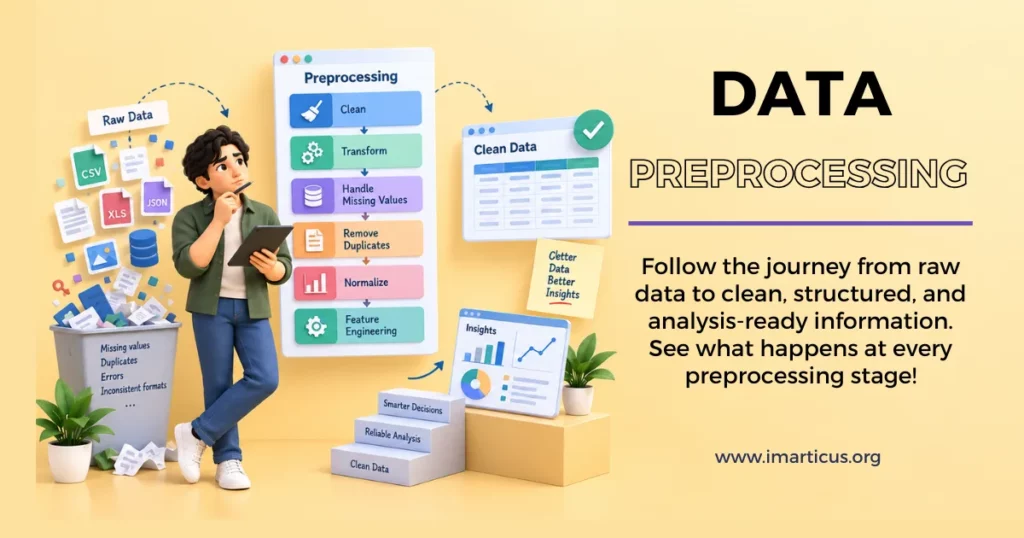
Data preprocessing is the work you do on raw data before you analyse it or feed it into a model. You check what you have, remove duplicates, fill or drop missing values, fix inconsistent formats like Mumbai and MUMBAI, look into unusual values, turn categories into numbers and bring features onto a similar scale.
In Python, Pandas handles most of the cleaning, and scikit-learn handles imputing, encoding and scaling. For machine learning, split the data before you fit any of those steps. Fit them on the whole dataset and your test scores will look better than they are.
Good data analysis can go wrong before the analysis even begins. A spreadsheet may have blank cells, duplicate records, inconsistent formats or values that simply do not make sense. Feed that data straight into a model, and you may get a perfectly calculated answer that is still wrong. That is the practical reason data preprocessing matters.
It is the stage where raw data is checked, cleaned and reshaped so that it is actually suitable for analysis. Sometimes that means filling missing values. Sometimes it means removing duplicates, treating outliers or converting categories into a format a model can use.
But there is a judgement call behind almost every step. Should an unusual value be removed or investigated? Is a missing value safe to replace with an average? Could scaling the features change the model’s results? These decisions become especially important in data preprocessing in machine learning, where the quality and format of your input data can affect what the model learns.
Don’t Let Our Best Advice Get Buried
Add Imarticus as a Preferred Source — see more of what we publish, every time you search.

If you are building these skills for a career, this is also where learning preprocessing alongside SQL, Python, visualisation and statistics through a professional data analytics course can give the topic much more context. This guide covers the key data preprocessing techniques, steps, tools and Python examples, along with how the process differs across data science, data mining and machine learning.
What Is Data Preprocessing?
When you ask what is data preprocessing, the simplest answer is this: you take raw data and prepare it for the job you want it to do. You may need to remove duplicate records. You may need to fill missing values. You may also need to change categories into numbers or bring different numerical fields onto a similar scale. The work depends on the dataset and the final goal.
For example, a sales report may only need cleaning and standardisation. A machine learning model may also need encoding, scaling, feature selection and a careful train-test split. I would therefore treat data preprocessing as a process rather than one fixed task.
What Does Data Preprocessing Do?
When you prepare a dataset, you want each value to have a clear meaning. You also want the structure to suit the next stage. Take a customer table with these entries:
| Customer | Age | City | Orders | Income |
| C101 | 29 | Mumbai | 4 | 45000 |
| C102 | 34 | Mumbai | 6 | 52000 |
| C103 | Missing | Delhi | 3 | 48000 |
| C104 | 41 | Delhi | 5 | 61000 |
| C104 | 41 | Delhi | 5 | 61000 |
| C105 | 37 | MUMBAI | 2 | 39000 |
You can already see several issues. Customer C104 appears twice. Age is missing for C103. Mumbai appears in two different forms. You would deal with these issues before drawing conclusions from the table. The same principle applies to larger datasets. You may need to:
- Check missing values before you calculate averages, build charts or train a model from the affected fields.
- Remove genuine duplicates after checking which columns define a unique record in your particular dataset.
- Standardise dates, names, units and categories so that similar values are treated consistently.
- Review unusual values because an extreme number may be an error or a genuine business event.
- Convert categories into suitable numerical forms when your chosen analytical method needs numerical inputs.
- Scale numerical features when the model can be affected by large differences between feature values.
The goal is a dataset you can work with confidently.
Why Is Data Preprocessing Important?
Your final result depends on the information you put into the process. A duplicate transaction can increase reported sales. A missing value can change an average. An inconsistent category can split one group into two. A poorly handled outlier can pull a statistical result away from the pattern seen in most records.
The issue becomes even more important when you use machine learning. A model learns from the data you provide. If you prepare that data badly, the model can learn patterns that do not hold outside the training set. That is why data cleaning and preprocessing deserve careful attention.
You should also keep the original data unchanged. Work from a copy and record major changes. That gives you a clear trail if you later need to check a result.
Did You Know?
IBM reports that only 29% of technology leaders in its 2024 research strongly agreed that their enterprise data met the quality, accessibility and security standards needed to scale generative AI efficiently. IBM also notes that data quality problems can affect AI and ML systems. (Source)
Data Preprocessing Workflow
A useful data preprocessing workflow gives you an order of work. You can adapt it to the project instead of forcing every dataset through every possible technique. A practical flow is:
Raw Data → Profiling → Cleaning → Integration → Transformation → Feature Engineering → Reduction → Splitting → Validation → Analysis Or Modelling
You can also use this as your data preprocessing diagram:
Raw Data
↓
Profile
↓
Clean
↓
Combine
↓
Transform
↓
Create Or Select Features
↓
Reduce Unnecessary Data
↓
Split Where Required
↓
Validate
↓
Analyse Or Model
The order matters in machine learning because some transformations learn information from the data. You should fit those transformations using the training data rather than the full dataset. Scikit-learn supports this approach through pipelines and composite estimators.
Also Read: How Can I Transition to a Career in Data Analytics?
What Are The Steps In Data Preprocessing?
The data preprocessing steps you need will depend on your data. I would still use a clear sequence because it makes mistakes easier to spot.
1. Data Profiling And Assessment
Start by looking at what you have. Check the number of rows. Check the columns. Review data types. Count missing values. Look at unique categories. Check the minimum and maximum values. You can also inspect a small sample of records.
This first check often reveals problems before you make any changes. For a salary column, look at the range. For a date column, check the earliest and latest dates. For a city column, check how many different spellings appear. You should answer one basic question at this stage:
Does each field contain the type of information I expect?
If the answer is no, fix the definition or source before moving forward.
2. Data Cleaning
Cleaning deals with errors and inconsistencies. You may remove duplicate records. You may correct invalid values. You may standardise formats. You may also decide how to handle missing information.
The important part is the reason behind each decision. You should not delete every row with a blank value simply because the blank looks untidy. You may remove useful information that way.
3. Handling Missing Values
Missing data needs context. You can remove a row when only a small number of records are incomplete and removing them will not affect the analysis. You can also fill a missing numerical value with a suitable statistic such as the median. For categories, you may use the most common category. In some cases, you may need a more advanced method.
| Missing Data Situation | Possible Method | Point To Check |
| A few incomplete records | Remove selected rows | Check whether removal creates bias |
| Numeric field with moderate gaps | Median or mean | Check the distribution first |
| Categorical field with few gaps | Most frequent value | Check whether one category dominates |
| Important field with complex gaps | Model-based imputation | Check whether the method adds assumptions |
| Field with very high missingness | Remove or redesign field | Check its business value |
| Missingness has meaning | Keep a missing indicator | Check whether absence itself carries information |
There is no single best method. Your choice should follow the amount of missing data, its cause and the role of that field.
4. Removing Duplicate Records
Duplicate rows can affect totals and counts. First identify what makes a record unique.
An order ID may identify a purchase. A customer ID may identify a customer. A combination of customer ID, date and transaction type may identify an event.
Do not remove similar-looking rows without checking their meaning. Two transactions from the same customer on the same day can be valid separate records.
5. Correcting Inconsistent Values
You should also check values that mean the same thing but use different formats. For example:
Mumbai, MUMBAI, mumbai
These values may represent one city. A system can still treat them as separate categories.
The same problem can appear in dates, currencies, product names, gender fields and measurement units. Standardisation makes later analysis much cleaner.
6. Handling Outliers
An outlier sits far from the usual range of values. You may find one transaction worth ₹20,000 when most transactions are below ₹5,000. That number needs investigation. You should first check the source.
- Was the value entered incorrectly?
- Was the currency different?
- Was the transaction genuine?
Only then should you decide whether to keep, transform, cap or remove it. Removing an outlier simply because it looks unusual can damage the dataset.
7. Data Integration
You often need information from more than one source. A company may keep customer details in one system and transaction data in another. Before combining them, you need matching keys and consistent definitions.
Check field names. Check data types. Check units. Check duplicate records.
You also need to watch for conflicting values. If one system lists a customer as active and another lists the same customer as inactive, you need a rule for resolving that conflict. Good data preprocessing keeps these decisions visible instead of hiding them inside a final table.
Data Integration And Data Quality
When you combine sources, the quality of each source affects the final dataset. A clean table joined to a poor table can still produce poor results. I would therefore check three things before a large merge:
- Identity: Do both sources refer to the same person, product or transaction?
- Structure: Do the fields use compatible formats?
- Meaning: Do the fields actually describe the same thing?
These checks are simple. They can prevent difficult problems later.
Also Read: What Are the Essential Skills for Data Analytics?
Data Preprocessing Techniques
The main data preprocessing techniques solve different problems. You should select them based on what you find during profiling.
| Technique | Problem It Handles | Common Use |
| Imputation | Missing values | Fill selected numeric or categorical fields |
| Deduplication | Repeated records | Keep one valid record |
| Standardisation | Inconsistent formats | Align dates or category names |
| Outlier treatment | Extreme values | Investigate unusual observations |
| Encoding | Categorical fields | Convert categories for modelling |
| Scaling | Different numeric ranges | Prepare scale-sensitive models |
| Feature selection | Unhelpful variables | Keep useful inputs |
| Dimensionality reduction | Too many related features | Reduce feature space |
You do not need every technique in every project. A small sales report may need only cleaning. A machine learning dataset may need most of the steps listed above. A good process starts with the problem in the data. The technique comes after that.
Data Transformation
After cleaning and integration, you may need to change the form of your data. This is where transformation becomes important. You may need to change a date into useful parts. You may need to convert categories into numbers. You may need to scale numerical fields. The choice should follow the task.
Feature Scaling
Suppose you have two fields:
Age: 18 to 80
Annual income: ₹2 lakh to ₹40 lakh
The income values are much larger. Some algorithms can give that field too much influence because of its scale.
You can use methods such as standardisation or min-max scaling to bring features onto a more suitable scale. Scikit-learn provides separate tools for standardisation, normalisation, non-linear transformation, encoding and imputation.
Encoding Categorical Data
You may have categories such as:
Basic, Standard, Premium
If those categories have an order, ordinal encoding may make sense. For categories such as:
Mumbai, Delhi, Pune
there is no natural ranking. One-hot encoding is usually more suitable. The choice matters because a poor encoding method can add a relationship that was never present in the original data.
Feature Engineering
Feature engineering gives you new useful fields from information you already have. A transaction date can give you:
- Day of week
- Month
- Quarter
- Weekend status
- Days since the previous purchase
You have not created new raw information. You have changed the way you represent it. This becomes important in data preprocessing in machine learning because useful features can make patterns easier for a model to detect. Feature engineering is also recognised as a core part of practical model preparation.
Data Reduction
You may also have more information than you need. A customer dataset can contain internal IDs, notes, timestamps, system flags and many other fields. Some may have no value for the question you are trying to answer. You can reduce the dataset through feature selection, sampling, aggregation or dimensionality reduction.
| Reduction Method | What You Remove Or Change | Suitable Use |
| Feature selection | Less useful columns | Reduce unnecessary inputs |
| Sampling | Some records | Work with very large datasets |
| Aggregation | Fine-level detail | Create monthly or yearly summaries |
| PCA | Original feature dimensions | Compress related numerical features |
| Column removal | Irrelevant fields | Remove IDs or unused metadata |
| Row filtering | Unsuitable records | Exclude invalid business records |
The point is to reduce unnecessary complexity while keeping information that matters.
Also Read: What Are the Applications of Machine Learning in Data Analytics?
Data Splitting
When you use data preprocessing in machine learning, you need to think about when each transformation happens. A common mistake is to prepare the entire dataset first and split it afterwards. That can allow information from the test data to influence the training process.
Take standardisation. The method learns values such as the mean and standard deviation. If you calculate those values using the complete dataset, the test set has already influenced the transformation. The safer order is:
Split → Fit On Training Data → Transform Training Data → Transform Test Data
Scikit-learn’s Pipeline is designed to chain these steps and helps prevent test information from leaking into the training process.
See How Data Splitting Works
Change the dataset size or split ratio to see how records are divided between training and testing data.
What is happening? The model learns patterns from the training data. The testing data remains separate and is used afterwards to check how well the model performs on data it has not seen during training.
Practical point: An 80/20 split is a common starting point when you have enough data, but the right split depends on the dataset and modelling task.
Data Validation
After transformation, check the result again. You should confirm that the values still make sense. Check missing values. Check ranges. Check categories. Check the number of rows.
For a machine learning project, also check that training and test data have the same structure. You can create simple validation rules such as:
- Age must fall within a sensible human range for the population being studied.
- Transaction value should not fall below zero unless refunds or credits are stored in that field.
- Dates should fall within the period covered by the source system.
- Required IDs should remain present after cleaning and transformation.
- Encoded fields should contain only the values expected by the selected model.
These checks make data preprocessing safer because you are testing the output rather than assuming every transformation worked.
Can You Trust This Data?
Click a validation check to see how simple rules can catch common data problems before they reach your analysis or model.
| Record | Age | Order ID | Status | Why? |
|---|
What is data validation? It is the process of checking whether data follows the rules you expect before you use it.
Think of it as a quality check: Validation helps catch problems early instead of letting incorrect data flow into your analysis.
These are simplified examples for illustration. Real validation rules depend on the dataset, business requirements and the purpose for which the data will be used.
Data Preprocessing In Machine Learning
Data preprocessing in machine learning needs more care than a basic cleaning exercise. Your model uses the prepared data to find patterns. The preparation can affect those patterns. Different algorithms also respond differently to the same data.
Preprocessing For Different Machine Learning Algorithms
You do not need to scale every dataset before every model.
| Algorithm | Scaling Need | Category Handling | Key Check |
| Linear Regression | Often useful | Encode categories | Check influential values |
| Logistic Regression | Often useful | Encode categories | Check class balance |
| K-Nearest Neighbours | Usually important | Encode categories | Check feature scale |
| Support Vector Machine | Usually important | Encode categories | Check feature scale |
| K-Means | Usually important | Encode where needed | Check distance effects |
| Decision Tree | Usually unnecessary | Encode categories | Check missing values |
| Random Forest | Usually unnecessary | Encode categories | Check missing values |
| Neural Network | Usually important | Encode categories | Scale numerical inputs |
This gives you a starting point. Your final choice should still depend on the dataset and the model configuration.
Data Preprocessing Techniques In Machine Learning
The main data preprocessing techniques in machine learning include imputation, encoding, scaling, feature selection and dimensionality reduction. You can also deal with class imbalance when one outcome appears far less often than another.
For example, a fraud dataset may contain many legitimate transactions and relatively few fraudulent ones. A model that predicts the common class most of the time can still show high accuracy while missing the cases you care about. That is why you should look beyond one score when evaluating the model.
1. Missing Value Imputation
You can use a mean or median for some numerical fields. The median can be useful when the values are strongly skewed.
You can also use more advanced methods when the missing pattern calls for them. The important rule is simple: fit the imputation method using training data when you are building a predictive model.
2. Categorical Encoding
One-hot encoding works well for many unordered categories. Ordinal encoding suits categories with a genuine order.
You should avoid assigning arbitrary numbers to categories when those numbers suggest a ranking that does not exist.
3. Feature Scaling
Min-max scaling maps values to a chosen range. Standardisation centres values around zero and scales them using the spread of the training data.
Robust scaling can be useful when extreme values are likely to affect ordinary scaling. The scikit-learn documentation covers these methods and also provides tools for combining them across different column types.
4. Feature Selection
You may have 100 available fields but only a smaller set that helps your model. Feature selection can remove weak or irrelevant inputs. It can also make the final model easier to understand.
5. Dimensionality Reduction
When many features overlap, you can reduce them into fewer dimensions. Principal Component Analysis, or PCA, is one common method. It creates new components from the original features. You should use it with care because the new components may be harder to explain than the original fields.
Also Read: What Is Machine Learning and How Does It Work?
Data Preprocessing In Data Mining
Data preprocessing in data mining focuses on preparing data so that useful patterns can be found. The classic approach includes:
Cleaning → Integration → Transformation → Reduction
These four areas remain useful when you study data mining. You may have millions of purchase records. Before searching for buying patterns, you need to remove obvious errors, combine relevant sources and reduce unnecessary complexity.
1. Data Cleaning In Data Mining
Cleaning can remove duplicates, correct inconsistent values and handle missing information. The aim is to reduce noise that could lead to misleading patterns.
2. Data Integration In Data Mining
Integration combines information from different sources.
For example, you may connect customer records with purchase records and product information. The joining key needs careful attention. A poor join can create repeated rows and inflate counts.
3. Data Transformation In Data Mining
You may convert numerical fields, group values into ranges or aggregate records.
For example, you could turn individual transactions into monthly customer totals. That new structure may make a buying pattern easier to identify.
4. Data Reduction In Data Mining
A large dataset can contain many records that add little value to the particular mining task.
Sampling, aggregation and feature selection can reduce the workload. The goal is to keep the information needed for useful pattern discovery.
Data Preprocessing In Data Science
Data preprocessing in data science sits between raw information and analysis. A typical project can move through:
Question → Data Collection → Preparation → Exploration → Feature Engineering → Modelling → Evaluation
You may move backwards when you find a problem. Exploratory analysis can reveal a strange value. Model evaluation can show that a feature needs another treatment. That makes preparation part of the wider data science process.
You should also think about the final user of the analysis. A model may need scaled values. A business dashboard may need clean labels and consistent dates. A statistical analysis may need a different treatment for extreme values. The same raw dataset can therefore need different preparation for different purposes.
Data Preprocessing Workflow For A Machine Learning Project
For a predictive project, I would use a tighter workflow:
Profile → Split → Fit Training Transformations → Transform Data → Train → Validate → Evaluate
This sequence helps keep the test set separate from decisions made during training. DataCamp also covers missing data, training and test sets, class imbalance, standardisation and feature engineering as connected parts of model preparation. The important point is the order. You should decide which transformations belong inside the training process before you calculate values from the data.
Data Preprocessing Diagram For Machine Learning
You can represent the process in a simple diagram:
Raw Dataset
↓
Train-Test Split
↓
Training Data → Fit Imputer / Encoder / Scaler
↓
Transform Training Data
↓
Transform Test Data Using The Same Fitted Rules
↓
Train Model
↓
Evaluate On Test Data
This data preprocessing diagram is useful because it shows where many leakage errors happen. The test set should remain unseen while you fit the preparation rules.
Data preprocessing is only one part of building a machine learning model. If you want to see how cleaning and feature engineering fit into the wider journey from raw data to model deployment, this complete roadmap provides a useful next step.
Data Cleaning And Preprocessing In Practice
When you work through a dataset, I would keep three questions beside you:
- What is wrong?
- Why is it wrong?
- What will change if I fix it?
Those questions make the process more disciplined. A missing age may need imputation. A missing customer ID may make the record unusable. A large transaction may be a genuine purchase. A duplicate row may be an error or a repeated event.
The same treatment cannot safely be applied to every problem. That judgement is what makes data preprocessing useful in real analytical work.
Data Preprocessing In Data Warehouse
Data preprocessing in data warehouse environments focuses heavily on consistency across sources. You may receive sales data from a point-of-sale system, customer information from a CRM and payment details from another platform.
Each source can follow different rules. You may need to standardise names, map field types, resolve duplicate customers and check whether dates use the same format. A simple warehouse flow can look like this:
Source Systems → Extract → Clean → Transform → Integrate → Validate → Warehouse → Reporting
Common Data Warehouse Preparation Tasks
You may need to:
- Standardise dates so reports can group records correctly across different source systems and reporting periods.
- Align units so values from separate systems can be combined without creating misleading totals.
- Match customer records so one person does not appear as several separate customers in the warehouse.
- Apply business rules before data reaches reporting tables where incorrect values can affect many downstream reports.
- Validate transformed records so errors do not move from operational systems into management dashboards.
The same principles apply when you prepare data for analytics outside a warehouse.
Also Read: How Do I Start Learning Python for Data Science?
Data Preprocessing In Python
You can handle much of data preprocessing in python with Pandas and scikit-learn. Pandas works well for tables and cleaning. NumPy supports numerical operations. Scikit-learn provides many tools for transformations and model preparation.
The library documentation includes tools for scaling, encoding, imputation, discretisation and feature construction. A simple workflow is:
Load → Inspect → Clean → Split → Transform → Validate → Model
Handling Missing Values In Python
You can use an imputer for missing numerical values.
For example, scikit-learn provides SimpleImputer for common strategies such as median imputation. The important point is when you fit it. If you are building a predictive model, fit it using the training data. Then use the fitted rule to transform the other datasets.
Encoding Categories In Python
You can use OneHotEncoder for many unordered categories.
If your data contains:
Mumbai, Delhi, Pune
the encoder can create separate indicator columns. That gives the model a numerical representation without creating a false ranking between the cities.
Scaling Data In Python
You can use StandardScaler, MinMaxScaler or RobustScaler depending on the dataset and model.
Scikit-learn also provides ColumnTransformer, which lets you apply different preparation rules to different columns. That is useful when your dataset contains both numerical and categorical fields.
Building A Python Pipeline
A pipeline can keep your preparation steps together.
For example:
Numerical Columns → Imputation → Scaling
Categorical Columns → Imputation → Encoding
Both → Model
Scikit-learn’s Pipeline is designed for this type of chained workflow. It can also help prevent leakage because the transformation steps are fitted within the training process. This is one of the most useful habits to develop when you practise data preprocessing in python.
Once you start using Python for data preprocessing, concepts such as loops, OOPs and visualisation become much more useful in practice. A quick refresher on these fundamentals can make the transition from basic Python to working with real datasets much easier.
Data Preprocessing Using Python: A Practical Structure
You can use the following structure for a customer churn dataset.
| Column | Type | Preparation |
| Age | Numerical | Impute and scale if required |
| Income | Numerical | Check outliers and scale if required |
| City | Categorical | Encode categories |
| Visits | Numerical | Review extreme values |
| Plan | Categorical | Encode categories |
| Churn | Target | Keep separate from input preparation |
Start by separating the target from the input fields. Then split the dataset into training and test data. Fit the preparation rules on the training set. Transform the training data. Apply the same fitted rules to the test data. This gives you a repeatable data preprocessing workflow that you can carry into a model.
The useful lesson is that preparation can be designed around the actual structure of your dataset. You do not need to force every column through the same operation.
Did You Know?
Scikit-learn’s current documentation includes a complete example where numerical features are imputed and standardised while categorical features are one-hot encoded before being passed into a prediction pipeline. Scikit-learn demonstrates this mixed-column approach.
Common Data Preprocessing Challenges
You will face different problems as datasets grow. One common issue is missing data. Another is inconsistent information from different sources. Large datasets can also contain too many fields or records for a simple workflow.
You may also face class imbalance, high-cardinality categories and changing data over time. A production model adds another concern. The data arriving next month may follow a different pattern from the data used during training. That means you should review your preparation rules over time.
Data Leakage
Data leakage deserves special attention. It happens when information that should be unavailable during training enters the model-building process.
A common example is scaling the full dataset before the train-test split. The model may never see the test labels directly. Yet the transformation has already used information from the test features.
That can make evaluation look better than it should. The scikit-learn pipeline approach is designed to keep these transformations within the correct training process.
Class Imbalance
Suppose 95% of your records belong to one class and 5% belong to another. A model could predict the common class for almost every record and still show high accuracy. You therefore need to check the class distribution and choose suitable evaluation measures.
Changing Data
Your source data can change. A company may add a new category. A system may change its date format. A business rule may alter how refunds are recorded. Your old preparation rules may then produce unexpected results. You should review important data checks whenever the source system changes.
Common Data Preprocessing Mistakes To Avoid
You can avoid many problems with a few simple checks.
- Do not fit imputers, scalers or encoders on the complete dataset before you create your training and test sets.
- Do not delete every unusual value until you have checked whether it represents a genuine event.
- Do not use arbitrary numbers for categories when those numbers could create a false order between unrelated groups.
- Do not drop rows with missing information when doing so could remove an important part of the population.
- Do not keep identifiers as model features unless they have a clear reason to contain useful predictive information.
- Do not judge an imbalanced model using accuracy alone when the less common class matters to your business problem.
- Do not change the original source file because you may need it later to trace an unexpected result.
- Do not apply different preparation rules to training and future prediction data because the model then receives inconsistent inputs.
These checks make data preprocessing more reliable without adding unnecessary complexity.
Best Practices For Data Preprocessing
I would keep your process simple enough to explain and strict enough to repeat.
- Start with profiling.
- Record what you find.
- Make each transformation for a clear reason.
- Keep your original data untouched.
- Save the cleaned version separately.
- For machine learning, split the data before fitting transformations.
- Use a pipeline when several steps need to happen together.
You should also validate the final dataset.
| Best Practice | Why It Matters | Simple Action |
| Profile first | Reveals problems early | Inspect types and missing values |
| Keep raw data | Preserves the source | Save an untouched copy |
| Split early | Reduces leakage risk | Create train-test sets first |
| Use pipelines | Keeps steps consistent | Chain transformations |
| Document changes | Makes work traceable | Record important decisions |
| Validate output | Catches errors | Check ranges and missing values |
| Review source changes | Protects workflows | Recheck formats after updates |
| Monitor production data | Finds new patterns | Compare current data with training data |
You can use these rules across analytics and machine learning projects. They give you a stable base without forcing every dataset into the same mould.
Data Preprocessing Vs Data Cleaning Vs Data Wrangling Vs Feature Engineering
These terms often appear together, but they describe different kinds of work.
| Term | Main Focus | Example |
| Data Cleaning | Fix data quality issues | Remove duplicate orders |
| Data Preprocessing | Prepare data for a task | Scale model inputs |
| Data Wrangling | Reshape and organise data | Join and reshape tables |
| Feature Engineering | Create useful inputs | Calculate purchase frequency |
| Data Transformation | Change data representation | Standardise numerical values |
| Data Validation | Check the result | Test allowed value ranges |
You may use all of them in one project. Knowing the difference helps you describe your work clearly and choose the right technique.
Data Preprocessing Tools
You have several options when choosing tools.
- Pandas is useful for tabular cleaning and transformation.
- NumPy handles numerical operations. Scikit-learn gives you a broad set of machine learning preparation tools.
- SQL is also important when your data sits inside a database or warehouse.
Your choice should follow the job. For a small CSV file, Pandas may be enough. For a database workflow, SQL may do much of the early preparation. For a predictive model, scikit-learn pipelines can bring several steps together. The best setup is usually the one you can repeat, test and maintain.
Take Your Skills Beyond Data Preprocessing With Imarticus Learning
If data preprocessing has made you curious about what comes next, the natural step is to build the wider skill set used across real data roles. That could mean adding SQL, Python, visualisation, statistics or GenAI to the skills you already have.
This is where Imarticus Learning’s Data Analytics Course fits particularly well. Its current programme brings the technical and practical sides of analytics together, rather than treating individual tools as standalone skills.
Why Imarticus Is Worth Exploring
- 35+ tools and projects give you hands-on exposure across analytics, data science and GenAI, including Python, SQL, Excel, Power BI, Pandas and Seaborn.
- 6 months on weekdays or 10 months on weekends gives you the option to build these skills around college, work or other commitments.
- 100% Job Assurance + 10 guaranteed interviews puts career support at the centre of the programme, not as an afterthought.
- 1,400+ placements and 500+ career transitions in FY2026, with 1,200+ companies hiring learners, give you a clearer picture of the programme’s career focus.
- ₹22.5 LPA highest salary is another current outcome, although your own result will depend on your skills, experience and role.
For someone reading about data preprocessing today, the bigger question is what you can do with that knowledge tomorrow. If you want to build towards a career in data analytics or data science, Imarticus gives you a route to connect preprocessing with the wider tools, projects and career skills the field demands.
FAQs About Data Preprocessing
Got doubts about cleaning, transforming and preparing datasets for analysis? These frequently asked questions cover the practical basics of data preprocessing, from its purpose and key steps to common techniques, tools and applications in machine learning.
What Is Data Preprocessing?
Data preprocessing means preparing raw information for analysis, reporting or modelling. You may clean errors, handle missing values, transform fields, encode categories or scale numerical features before using the data.
What Are The 7 Types Of Data?
The seven commonly discussed types are qualitative, quantitative, discrete, continuous, nominal, ordinal and binary data. You can use these categories to understand how information is represented and which analysis methods may suit it.
What Are The 7 Steps In Data Mining?
The seven commonly taught stages are data cleaning, integration, selection, transformation, mining, pattern evaluation and knowledge presentation. Data preprocessing mainly supports the early preparation stages before you search for useful patterns.
What Is The Difference Between Data Processing And Preprocessing?
Data processing covers the wider handling of information to produce a useful result. Data preprocessing prepares raw information before analysis or modelling. Imarticus Learning teaches related data and analytics skills through practical learning programmes.
Why Do We Use Data Preprocessing?
We use data preprocessing to improve consistency, quality and suitability before analysis or modelling. Imarticus Learning connects these skills with practical analytics tools such as Python, SQL and visualisation.
What Are The Four Types Of Data Processing?
The four broad types are batch processing, real-time processing, online processing and distributed processing. Data preprocessing can happen before these methods when raw information needs cleaning or transformation.
What Are The Different Types Of Data Preprocessing Techniques?
Common data preprocessing techniques include cleaning, imputation, encoding, scaling, transformation, feature selection, dimensionality reduction and integration. Imarticus Learning provides practical learning routes for related analytics skills.
What Are The Best Data Preprocessing Tools?
Pandas, NumPy and scikit-learn are useful for Python workflows, while SQL is valuable for database and warehouse preparation. Data preprocessing works best when your chosen tools support repeatable and well-documented steps.
Take Your Data Skills A Step Further
The quality of your analysis depends a lot more on the data you start with than most people realise. A model cannot tell you that a column was entered incorrectly, that two records refer to the same customer, or that half the values in a field are missing. You have to catch those things first.
That is what makes data preprocessing such an important part of working with data. The tools and techniques may change from one project to another, but the thinking stays the same: check what you have, question anything that looks wrong and make changes that actually make sense for the problem.
If you are learning this as part of a move into data analytics or data science, it is worth building beyond preprocessing too. SQL, Python, statistics, visualisation and machine learning all come into play once you start working with real datasets. Imarticus Learning’s Data Analytics Course covers these areas through its broader curriculum and hands-on projects, so it can be a useful option to consider if you want structured training rather than learning each skill separately.
The next useful step is to take a messy dataset and work through it yourself. That is where data preparation starts becoming a professional skill. There is no shortcut to knowing whether data is ready for analysis. You get better at it by working with different datasets and learning to question what you see.
Clean data helps. Good judgement matters even more.
Liked This? Follow Us Where You Already Search.
Preferred Sources is Google’s built-in follow button — no app, no login, just more Imarticus in your results.