


Last updated on September 4th, 2026 at 05:42 pm
A house price, a fraudulent transaction, a spam email and a customer likely to churn may look like completely different problems. But behind each prediction can be the same basic idea: teach a machine learning model using examples where the correct answer is already known. That is supervised learning – and the algorithm you choose determines how that learning happens.
When I first think about supervised learning, I don’t think about an abstract machine learning definition. I think about a simple question: Can I show a model enough examples with the right answers that it can make a good prediction on something it hasn’t seen before?
That is the basic idea behind supervised learning. The training data contains inputs as well as known outputs, or labels, and the algorithm learns the relationship between them. If I give a model historical house sizes and their actual selling prices, for example, I can train it to predict the price of another house. If I give it emails labelled “spam” and “not spam,” I can train it to classify a new email. Regression and classification are the two broad problem types most commonly associated with supervised learning.
What’s interesting is that there isn’t one best supervised machine learning algorithm for every problem. All algorithms learn from labelled data, but they approach prediction differently. These fundamentals are hardly becoming irrelevant in the age of generative AI, and that makes them worth understanding.
Don’t Let Our Best Advice Get Buried
Add Imarticus as a Preferred Source — see more of what we publish, every time you search.

In this guide, I’ll break down seven supervised learning algorithms, explain a practical example of each, show whether it is primarily used for classification or regression, and help you understand when one approach may make more sense than another.
Fact!
88% of respondents said their organisations were regularly using AI in at least one business function, although only about one-third said their organisations had begun scaling AI across the enterprise (McKinsey’s 2025 global survey)
Supervised Learning Algorithms List
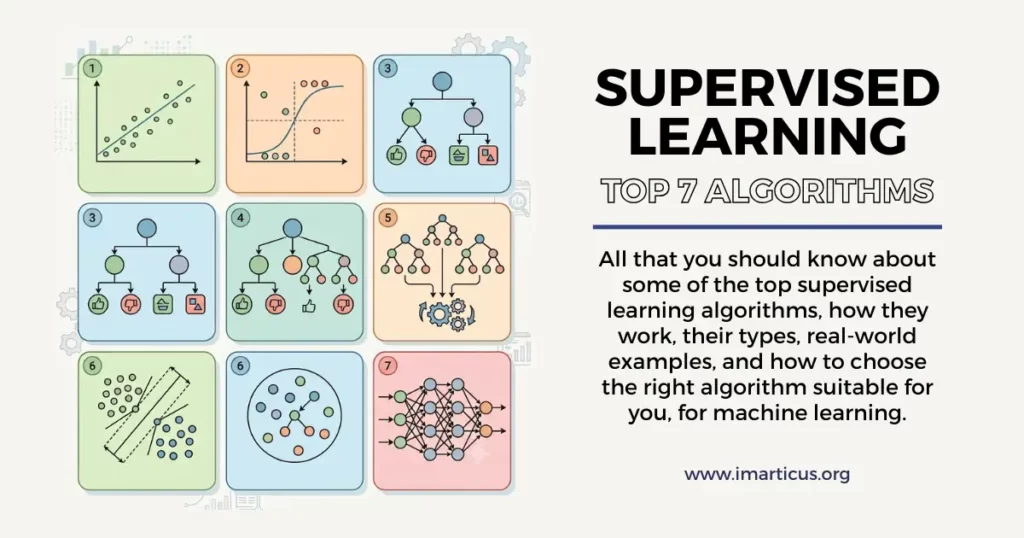
Let’s look at seven important supervised learning algorithms examples: Linear Regression, Decision Trees, Support Vector Machines (SVM), Logistic Regression, K-Nearest Neighbours (KNN), Naive Bayes and Random Forest.
They cover some of the most common approaches used for supervised classification and regression. IBM’s machine learning documentation, for example, includes decision trees, linear and logistic regression, neural networks, support vector machines and Bayesian methods among supervised modelling techniques, while widely used machine-learning libraries provide a broader range of supervised estimators.
| Algorithm | Type | A simple supervised learning example |
| Linear Regression | Regression | Predicting house prices |
| Decision Tree | Classification / Regression | Predicting loan default |
| SVM | Classification / Regression | Classifying documents |
| Logistic Regression | Classification | Predicting customer churn |
| KNN | Classification / Regression | Classifying a new customer based on similar customers |
| Naive Bayes | Classification | Detecting spam emails |
| Random Forest | Classification / Regression | Detecting fraudulent transactions |
Reinforcement learning is different from supervised learning. Why? Because the model isn’t simply trained on labelled input-output examples. Instead, an agent interacts with an environment, takes actions and receives feedback such as rewards or penalties gradually learning a policy for choosing actions. This makes reinforcement learning useful for sequential decision-making problems and distinct from the classification and regression problems discussed in this article.
What Are Supervised Learning Algorithms?
Supervised learning algorithms are machine learning methods that learn from labelled examples to predict an outcome for new data. The “supervision” comes from the fact that the desired output is already known in the training data. The algorithm compares its predictions with those known outcomes and learns a model that can generalise to unseen examples.
The two most important types of Supervised learning algorithms are classification and regression. Classification predicts a category-for example, whether a transaction is fraudulent or legitimate-while regression predicts a numerical value, such as a property’s price or next month’s sales. Some algorithms can be adapted for both types of problems.
So, if you’re searching for a supervised learning algorithm example, a simple one is Linear Regression predicting house prices from historical labelled data. A classification example would be Logistic Regression predicting whether a customer is likely to churn.
| Type of supervised learning | What it predicts | Example |
| Classification | A category or class | Spam vs not spam |
| Regression | A numerical value | House price |
| Binary classification | One of two classes | Fraud vs legitimate |
| Multiclass classification | One of several classes | Classifying an image as a cat, dog or bird |
This gives you types of supervised learning without creating an unnecessary section.
Fact!
→ $2.59 trillion in worldwide AI spending is projected for 2026, up from 47% in 2025
→ $26.4 billion in spending on AI platforms for data science and machine learning is expected in 2026, up from $19.4 billion in 2025 (Gartner).
Linear Regression
If you know the values of several inputs and the corresponding outcomes from historical data, you can use Linear Regression to estimate the outcome for a new observation. Linear Regression is one of the simplest supervised learning algorithms, as it uses known relationships between variables to predict a continuous numerical outcome.
Example of Linear Regression
Let’s consider an example of you working for a real-estate company, and that you want to estimate the selling price of a house. You have historical data containing the property’s size, number of bedrooms, location and actual selling price. The first three variables become inputs, while the selling price is the target the model needs to learn.
Once trained, the model can use the characteristics of a new house to estimate its likely selling price. That is a straightforward example of supervised learning because the training dataset contains both the features and the known answer. Linear Regression is particularly useful when the outcome you’re trying to predict is continuous rather than a category.
You might also use Linear Regression for problems such as sales forecasting, demand estimation or predicting revenue. Its biggest advantage is that the model is relatively easy to understand and interpret. Its limitation is that a simple linear relationship won’t capture every complex pattern in real-world data.
Decision Tree
A Decision Tree approaches prediction by repeatedly splitting data according to features until it reaches an outcome. I find it one of the easiest supervised learning algorithms to explain because its logic resembles a series of questions, and each answer sends the observation down a different branch of the tree:
Is income above this level?
Is existing debt below this level?
Has the applicant missed previous payments?
Example of a Decision Tree
Consider a bank deciding whether to approve a loan. The model can learn from historical applications where the outcome (approved, rejected or defaulted) is already known. During training, it identifies features that help separate the different outcomes. When a new application arrives, the model follows the relevant branches and produces a prediction.
This makes a Decision Tree a useful supervised learning algorithm example for classification. Decision Trees can also be used for regression when the target is numerical. IBM lists decision trees among established supervised modelling techniques for predicting known outcomes.
The biggest appeal is interpretability: compared with many more complex models, it is easier to see how a tree arrived at a prediction. The downside is that a single tree can become overly complex and fit the training data too closely, which is why techniques such as pruning or ensemble methods are often considered.
Support Vector Machine (SVM)
Support Vector Machine (SVM) is a supervised learning method that tries to find a decision boundary that separates observations belonging to different classes. The interesting part is that SVM doesn’t simply look for any boundary; its objective is to find a boundary that provides a useful margin between classes. Kernel methods can also allow SVMs to model more complex relationships. SVM methods can be used for both classification and regression.
Example of SVM
Suppose I have a large collection of documents that have already been labelled according to their category. An SVM can learn from those labelled examples and classify a new document based on the patterns represented by its features. A similar approach can be applied to other high-dimensional classification problems, including certain image and text tasks.
SVM is therefore a good example of a supervised learning algorithm when the task involves learning a boundary between known classes. It can be particularly useful in high-dimensional settings, although model training and tuning can become less convenient as datasets become extremely large.
Logistic Regression
Despite its name, Logistic Regression is mainly used for classification rather than ordinary continuous-value regression. Instead of predicting something like a house price, it estimates the probability that an observation belongs to a particular class. It is commonly used for binary classification and can also be extended to multiclass problems.
Example of Logistic Regression
Consider a subscription business that wants to predict customer churn. I could train the model on historical customer records containing factors such as tenure, usage, complaints and previous interactions, together with the known outcome-whether each customer eventually churned.
The trained model can then estimate the probability that a new customer will churn. A business could use that prediction to decide which customers may need a retention offer or intervention. This is a particularly intuitive supervised learning example because the model learns from historical customers whose outcomes are already known.
Logistic Regression remains popular because it is relatively simple, fast and interpretable, especially when I need to understand how features relate to the predicted outcome. Its limitation is that it may not capture highly complex nonlinear relationships without additional feature engineering.
K-Nearest Neighbours (KNN)
K-Nearest Neighbours, or KNN, makes predictions based on similarity. Instead of learning a complex equation in advance, the algorithm looks at observations that are closest to a new data point and uses their known outcomes to make a prediction. That makes KNN one of the most intuitive supervised learning methods to understand.
Example of KNN
Imagine an online retailer has historical customer data and has already grouped customers according to a known outcome, such as whether they purchased a particular product. When a new customer arrives, KNN can look at the customers most similar to that person based on selected features. If most of the nearest neighbours belong to a particular class, the model can use that information to classify the new customer.
The same basic idea can be used for other classification and regression problems. KNN can work well when similarity between observations is meaningful, although it can become computationally expensive as datasets grow and is sensitive to how features are scaled.
Naive Bayes
Naive Bayes is a family of supervised classification algorithms based on probability. The algorithm uses the features observed in the training data to estimate how likely an observation is to belong to each possible class. The “naive” part comes from a simplifying assumption about how the features relate to one another.
Example of Naive Bayes
Spam filtering is a classic supervised learning example. I can train a Naive Bayes model using thousands of emails that have already been labelled as spam or legitimate. The model learns how features of those emails are associated with the different classes. When a new email arrives, it estimates the probability of the possible categories and assigns the message to the most likely one.
Naive Bayes is particularly attractive for classification tasks where speed matters and can be effective for many text-based problems. Gaussian Naive Bayes, which appears in the existing article, is only one variant of the broader Naive Bayes family. It should therefore be presented as a variant rather than as though “Gaussian Naive Bayes” and “Naive Bayes” are interchangeable terms.
Random Forest
Random Forest is an ensemble supervised learning algorithm that combines the predictions of multiple Decision Trees. Instead of relying on one tree to make the final prediction, Random Forest builds many trees and aggregates their outputs. That makes it considerably more robust for many structured-data problems than relying on a single decision tree.
Example of Random Forest
Consider a bank trying to identify potentially fraudulent transactions. Historical transactions can be labelled as legitimate or fraudulent, giving the model examples from which to learn. A Random Forest can then use multiple decision trees to identify patterns associated with fraud and combine their predictions when evaluating a new transaction.
This is one of the clearest supervised machine learning examples because the model learns from historical transactions where the outcome is already known. Random Forest can be used for both classification and regression, and it is widely used because it can model nonlinear relationships without requiring the same kind of linear assumptions as Linear Regression.
Its trade-off is interpretability. While an individual Decision Tree can be relatively easy to follow, a forest containing many trees is much harder to explain in its entirety.
Supervised Learning Algorithms in Python and MATLAB
If you’re implementing these algorithms rather than just learning the theory, Python and MATLAB both provide established machine-learning tools. In Python, scikit-learn provides implementations and interfaces for many supervised learning methods, including linear models, support-vector machines, nearest-neighbour methods, decision trees, ensemble methods and Naive Bayes.
MATLAB also provides supervised learning workflows covering methods such as classification and regression trees, discriminant analysis, Naive Bayes, SVMs, KNN, ensemble methods and neural networks.
For someone learning machine learning today, I would focus first on understanding why an algorithm is appropriate for a problem, and then learn how to implement and evaluate it in the tool of your choice.
Supervised Learning Algorithms Examples: Which Algorithm Should You Use?
Looking at the algorithms individually is useful, but the bigger question is usually: which algorithm should I actually use? There isn’t a universal answer. The appropriate choice depends on the type of prediction, the size and structure of the data, the complexity of the relationship you’re trying to model, how important interpretability is, and how much computational capacity you have.
For a relatively straightforward continuous prediction problem, Linear Regression can be a sensible starting point. For classification, Logistic Regression provides a simple and interpretable baseline, while Decision Trees can capture nonlinear relationships in a way that’s relatively easy to explain. Random Forest can provide a stronger ensemble approach for many structured datasets. SVM and KNN have their own strengths for particular datasets, while Naive Bayes can be especially useful for fast classification tasks such as text categorisation.
In real machine learning projects, I would rarely choose an algorithm simply because a blog calls it the “best.” I would train and evaluate several suitable candidates against the same validation criteria and then consider the trade-off between predictive performance, interpretability, speed, memory requirements and operational complexity. That is also consistent with established guidance on supervised model selection.
Comparison table of Supervised Learning Algorithms
| Algorithm | Best suited to | Example | Main advantage | Main limitation |
| Linear Regression | Regression | House price prediction | Simple and interpretable | Limited for complex nonlinear patterns |
| Decision Tree | Classification / Regression | Loan decisions | Easy to understand | Can overfit |
| SVM | Classification / Regression | Text classification | Effective in suitable high-dimensional data | Can be harder to scale/tune |
| Logistic Regression | Classification | Churn prediction | Interpretable probabilities | Limited for complex nonlinear patterns |
| KNN | Classification / Regression | Similar-customer classification | Intuitive and simple | Prediction can be expensive at scale |
| Naive Bayes | Classification | Spam detection | Fast and effective for many text tasks | Relies on simplifying assumptions |
| Random Forest | Classification / Regression | Fraud detection | Strong general-purpose ensemble | Less interpretable |
Why Supervised Learning Algorithms Still Matter in 2026
It would be easy to assume that supervised learning has become less important because the AI conversation is now dominated by generative AI and AI agents. I don’t think that’s the right conclusion.
The technology landscape is changing rapidly, but businesses still need systems that can predict outcomes, classify transactions, score risks and make decisions from structured and labelled data. In fact, the broader AI investment numbers suggest that organisations are moving from experimentation towards much larger-scale deployment.
The important caveat is that AI adoption does not automatically mean successful AI deployment. McKinsey’s 2025 research found that 88% of respondents reported regular AI use in at least one business function, but only about one-third said their organisations had started scaling AI across the enterprise. Only 39% reported any enterprise-level EBIT impact from AI.
That gap between experimenting with AI and creating measurable value is exactly why fundamentals matter. Organisations need people who understand the data behind a model, know how to choose an appropriate algorithm, understand evaluation metrics and can tell whether a model is actually solving the business problem.
The trend is also likely to continue into 2027 and beyond. Gartner expects total AI spending to rise to roughly $3.49 trillion in 2027, with AI infrastructure remaining the largest spending category. I wouldn’t interpret that as a prediction that traditional algorithms will replace newer AI models. Rather, it points to a broader AI ecosystem in which understanding the fundamentals of machine learning remains useful-even as the models and applications around them evolve.
Supervised Learning Algorithms vs Unsupervised Learning Algorithms
The simplest distinction between supervised and unsupervised learning is whether the training data contains known answers. Supervised learning uses labelled data, so the model learns to predict an outcome that is already defined. Unsupervised learning works with data that doesn’t have predefined labels, with the goal of finding useful patterns, structures or groups within that data.
For example, if I have thousands of customer records labelled “churned” and “retained,” I can use a supervised learning algorithm to predict which new customers are likely to churn. If I have customer data but no predefined groups, I could instead use an unsupervised method such as clustering to discover naturally occurring customer segments.
So, when someone searches for supervised vs unsupervised learning examples, the most useful comparison isn’t simply a list of applications. It is understanding that supervised learning predicts a known target, while unsupervised learning discovers structure without a known target.
Comparison table
| Factor | Supervised learning | Unsupervised learning |
| Training data | Labelled | Unlabelled |
| Main goal | Predict a known target | Discover patterns or structure |
| Example | Predict fraud/not fraud | Find unusual transaction patterns |
| Common methods | Regression, classification | Clustering, dimensionality reduction |
| Example algorithm | Random Forest | K-Means |
Supervised and Unsupervised Learning Examples
A useful way to remember the difference is to look at what I know before training the model. If I already know the outcome I want the model to learn, I have a supervised learning problem. If I don’t know the groups or patterns in advance and want the model to discover them, I’m looking at an unsupervised problem.
Take customer data as an example. If previous customers are labelled according to whether they churned, I can train a supervised model such as Logistic Regression or Random Forest to predict churn for new customers. If I have customer behaviour data but no predefined customer categories, I could use an unsupervised clustering algorithm to discover groups with similar characteristics.
The same distinction appears in fraud detection, marketing, recommendation systems, image analysis and many other areas. The important difference is not the industry; it is whether the learning problem has a known target.
Supervised and Unsupervised Learning in AI
Supervised and unsupervised learning are two of the foundational approaches within machine learning, which itself sits inside the broader field of artificial intelligence. They are not competing versions of AI; they solve different kinds of problems.
In practical AI systems, supervised learning can be used when organisations have labelled historical data and want to predict outcomes, while unsupervised learning can help uncover patterns or groups that were not defined in advance. Modern AI systems can combine these approaches with deep learning, generative AI and other techniques depending on the application.
This distinction remains relevant as AI adoption expands. Stanford’s AI Index 2026 reports that organisational AI adoption reached 88%, while global corporate AI investment more than doubled in 2025. As more organisations move AI into operational workflows, understanding the underlying machine-learning approaches becomes less about memorising terminology and more about knowing which method fits which problem.
Types of Supervised Learning
The two main types of supervised learning are classification and regression. Classification predicts discrete categories, such as whether a transaction is fraudulent or legitimate. Regression predicts continuous numerical outcomes, such as property prices, sales or demand. Some supervised algorithms, including Decision Trees, Random Forest and SVM-based methods, can be used for both classification and regression.
Frequently Asked Questions About Supervised Learning Algorithms
From choosing between model simplicity and raw accuracy to decoding how machines learn from labeled data, these answers tackle the real-world trade-offs, edge cases, and mechanics of supervised learning algorithms.
Conclusion
There is no magic “best” supervised learning algorithm-there is only the algorithm that makes the most sense for the problem you’re trying to solve. Linear Regression can be a strong starting point when the goal is to predict a continuous value, Logistic Regression can work well for classification, Decision Trees offer an intuitive decision-making structure, and Random Forest can provide a more robust ensemble approach. SVM, KNN and Naive Bayes each have their own strengths for particular datasets and use cases.
What I would take away from these seven supervised learning algorithm examples is not a list of names. It is the relationship between the data, the target and the algorithm. Once you understand why a particular method fits a particular problem, machine learning becomes much less about memorising formulas and much more about making informed modelling decisions.
And that foundation remains relevant even as AI evolves. With Gartner forecasting worldwide AI spending of $2.59 trillion in 2026 and McKinsey reporting that 88% of surveyed organisations already use AI in at least one business function, the challenge is increasingly moving from simply experimenting with AI to building systems that deliver measurable results.
If you’re building a career in machine learning or AI, learning these algorithms is a starting point-not the finish line. The real advantage comes from being able to choose, implement, evaluate and explain the right model for a real-world problem.
Ready to Move From Machine Learning Concepts to Real Projects? Understanding algorithms is the first step. The next is learning how to apply them to real datasets, build models, evaluate their performance and turn your analysis into practical AI solutions. Explore Imarticus Learning’s AI and Machine Learning programmes to build hands-on skills through structured learning and real-world projects.
Liked This? Follow Us Where You Already Search.
Preferred Sources is Google’s built-in follow button — no app, no login, just more Imarticus in your results.