


Last updated on July 27th, 2026 at 11:22 pm
Every single pound, dollar, or rupee moving through a multi-billion-pound enterprise passes through the exact same structural pipeline as a corner coffee shop’s daily cash register summary. Have you ever wondered why some corporate finance teams wrap up their monthly closes in two days flat while others drown in spreadsheet chaos for two full weeks? The difference rarely comes down to working harder. It hinges on how well a business commands its core reporting workflow.
When you look past the dense textbook jargon, what is accounting cycle mechanics really about? It is the quiet, disciplined rhythm of corporate survival. At its heart, to define accounting cycle processes is to understand how a business transforms raw, chaotic financial events into trustworthy financial statements. Every unverified invoice, unrecorded vendor debt, or misplaced debit creates a blind spot for leadership. If the underlying data is flawed, even the most sophisticated financial modelling falls apart.
Understanding how an accounting cycle starts with raw physical or digital records and progresses into audited board reports is the ultimate baseline skill for any ambitious professional. Whether you are stepping into a junior ledger role or aiming for senior executive seats, mastering this accounting life cycle bridges the gap between basic bookkeeping and strategic decision-making. Enrolling in practical, industry-aligned finance courses can dramatically accelerate this transition, turning static academic concepts into real-world career authority.
If you want to truly explain accounting cycle operations to peers, spot hidden reporting errors before auditors do, or simply understand how modern ERP systems handle month-end pressure, you need a clear blueprint. Let us break down the entire workflow step by step, unpack where traditional textbook methods fall short, and explore how modern finance teams execute a flawless close.
Don’t Let Our Best Advice Get Buried
Add Imarticus as a Preferred Source — see more of what we publish, every time you search.

Did You Know?
Research from APQC shows that average finance teams take 6 to 8 days to close their books each month. Slow teams take over 10 days because they manually fix errors. Fast teams finish the whole process in under three days by using automated tools.
What Is Accounting Cycle? Definition and Core Purpose
Every business needs a basic system to keep track of its money. The accounting cycle is a step-by-step routine that helps you record every transaction during a set timeframe. It begins when a sale or purchase happens. It runs all the way until you lock your books at month-end.
Learning what is accounting cycle makes business finances much easier to follow. Your main goal is simple. You want to track money accurately, follow basic tax rules, and show your true profit. This accounting life cycle gives business owners and investors clear numbers to make smart choices. Without this set order, your company’s money records become a big mess very fast.
| Accounting Cycle Phase | Core Objective | Key Output | Primary Tools Used |
| Transaction Recording | Write down every daily sale or purchase | Source records and basic journal lists | Software apps, card readers, paper receipts |
| Ledger Summarisation | Sort transactions into specific account buckets | Updated main ledger balances | Business software and automatic entry tools |
| Trial Balance Verification | Make sure total debits equal total credits | Unadjusted trial balance draft | Basic spreadsheets and balance reports |
| Period-End Adjustments | Match costs and revenue to the correct dates | Adjusting journal entries | Expense schedules and depreciation logs |
| Financial Statement Prep | Build official reports on health and performance | Final balance sheet and income statements | Reporting software and presentation files |
| Account Reset & Close | Clear short-term balances for the new period | Clean post-closing balance report | Automatic system locks and closing tools |
The accounting life cycle runs non-stop alongside daily business activities. Budgets look ahead to guess future spending, but this process looks back at actual spending. It records cash, customer bills, and unpaid vendor invoices so you never lose track of a single penny.
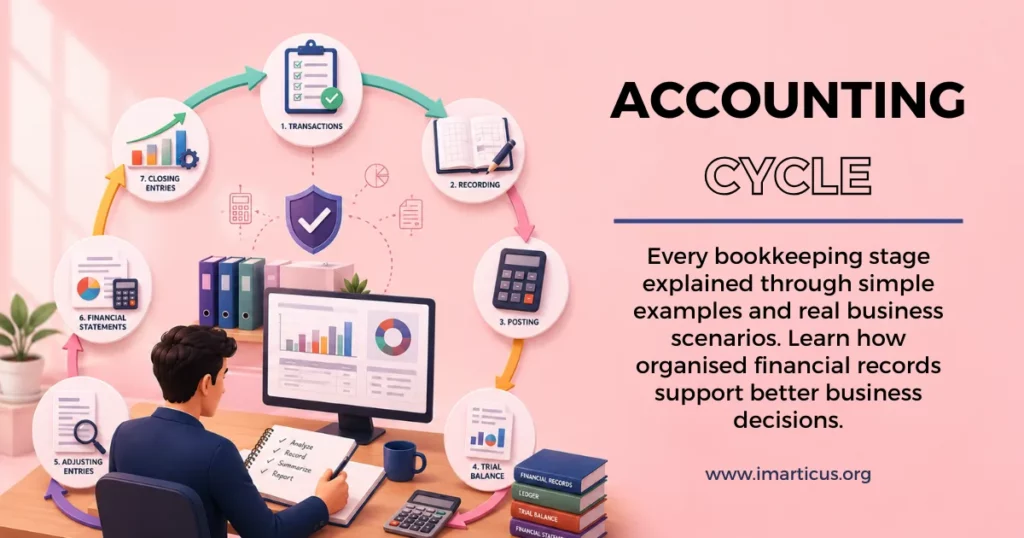
The Accounting Cycle Chart: A Visual Map of the Workflow
A quick chart helps you see how financial information flows. An accounting cycle chart maps out the journey from raw receipts to final profit reports. Data enters at the start, passes through quick checks, and turns into easy reports at the end.
| RAW DATA | PROCESSING STAGE | FINAL OUTPUT |
| Sales Receipts | General Journal Entries | Income Statement |
| Vendor Invoices | General Ledger Posting | Balance Sheet |
| Payroll Run Data | Trial Balance Checks | Cash Flow Statement |
Spotting mistakes gets easier when you follow this visual path. A simple accounting cycle chart shows eight clear steps that every record goes through. When I explain accounting cycle concepts to new business owners, showing them this simple picture helps them understand where their numbers come from.
How Many Steps Are in the Accounting Cycle?
If you ask different bookkeepers about the steps of accounting cycle, you will hear different numbers. Some people say there are 6 steps. Others say 7, 8, or 10 steps. This is not a mistake. It just depends on how closely a team breaks down their review work.
In a nutshell→
STEP-COUNT FRAMEWORK COMPARISON
6-Step Framework
Grouped Analysis → Ledger → Adjust → Reports → Close
8-Step Standard
Identify → Journal → Ledger → Unadjusted Trial Balance → Adjustments → Adjusted Trial Balance → Financial Statements → Close
10-Step Extended
8-Step Framework + Worksheets + Reversing Entries
Small shops often use accounting cycle 6-step models to save time by combining checks together. Big companies prefer 10 steps so they can double-check every single detail. The table below shows how these different lists fit the exact same work.
| Standard Framework Stage | 6-Step Model Grouping | 7 Steps of Accounting Cycle Variation | 8-Step Industry Standard Model | 10-Step Detailed Enterprise Model |
| Initial Input | Check Transactions | Find and Review Data | Step 1: Identify Transactions | Step 1: Source Paper Check |
| Primary Entry | Write Journal Items | Create Journal Lists | Step 2: Record Journal Entries | Step 2: Write Main Journal |
| System Posting | Update Ledger | Post to Main Accounts | Step 3: Post to Ledger | Step 3: Update Account Books |
| Initial Verification | Combined in Next Step | First Balance Check | Step 4: Unadjusted Trial Balance | Step 4: First Balance Check |
| Worksheet & Review | Left Out | Left Out | Included in Step 5 | Step 5: Fill Draft Worksheet |
| Period Adjustments | Fix Late Entries | Save Fix Entries | Step 5: Record Adjustments | Step 6: Write Adjusting Lines |
| Second Verification | Left Out | Second Balance Check | Step 6: Adjusted Trial Balance | Step 7: Second Balance Check |
| External Reporting | Make Reports | Build Profit Reports | Step 7: Financial Statements | Step 8: Build Profit Reports |
| System Reset | Close the Books | End Period Work | Step 8: Close Temporary Accounts | Step 9: Final Balance Check |
| Next Period Prep | Left Out | Left Out | Left Out | Step 10: Set Up Next Month |
All these lists reach the exact same goal. The 7 steps of accounting cycle options cover all basic needs, but most modern software uses the 8-step setup for better safety.
Step-by-Step Breakdown: Steps 1 to 3
You start this process with physical or digital proof of buying and selling. You cannot record any business activity without a real paper trail.
Step 1: Identify and Analyse Transactions
Your work begins when a real business event happens. The accounting cycle starts with collecting bills, paper receipts, sales slips, and bank records. You check these papers to see what was traded, the total cash amount, and which accounts change. For example, getting an electric bill creates a debt right away, even if you pay it next month.
STEP 1 TO 3 TRANSACTION PIPELINE
Invoice / Receipt
↓
Analyse Impact
↓
Journal Entry (Debit/Credit)
↓
General Ledger Update
Step 2: Record Transactions in the General Journal
After checking your paper receipts, you write down each event by date in a main journal. You use double-entry bookkeeping here. This rule means every item needs matching debit and credit amounts so your math stays even.
Traditional Journal Entry
Journal Entry
Debit: Office Supplies Expense …………… £1,200
Credit: Accounts Payable ………………… £1,200
(To record purchase of office supplies on 30-day vendor terms)
Step 3: Post Entries to the General Ledger
Next, you copy these records over to your general ledger. Your journal lists items by date, but the general ledger groups them by account name. Think of the ledger as separate folders for Cash, Rent, Inventory, and Bills. Copying numbers to these folders updates your account totals immediately.
Mastering these starting steps shows you how simple daily sales build entire business records. Next, we look at fixing balances, writing statements, and closing out the month.
Adjustments, Financial Statements, and Period-End Close
After you post daily sales and bills to your ledger accounts, the second part of the process begins. Here, you double-check your balance totals, fix timing gaps, and build your final business reports.
VERIFICATION & ADJUSTMENT PHASE
| Stage | Activity |
| 1 | Unadjusted Trial Balance |
| 2 | Review account discrepancies |
| 3 | Post accruals and deferrals |
| 4 | Prepare the Adjusted Trial Balance |
| 5 | Generate the Financial Statements |
| 6 | Reset temporary accounts (Closing Entries) |
Step-by-Step Breakdown: Steps 4 to 8
This middle phase turns raw account numbers into clean reports for bosses, tax agencies, and bank managers.
Step 4: Prepare an Unadjusted Trial Balance
At the end of the month, you write down every account name with its current balance. This list is your unadjusted trial balance. You run this check to make sure your total debits match your total credits. If the totals do not match, you probably typed a number wrong or missed a ledger update.
UNADJUSTED TRIAL BALANCE CHECK
| Item | Value |
| Total Debit Balances | £450,000 |
| Total Credit Balances | £450,000 |
| System Status | Balanced (Proceed to Adjustments) |
Step 5: Analyse the Worksheet and Record Adjusting Entries
Even if your totals match, your numbers might still miss timing details. Standard accounting says you must match earnings and spending to the exact dates they happen. In this step, you fix unrecorded items like staff pay, prepaid insurance, and machine wear. You save these updates as adjusting entries.
| Adjustment Type | Economic Trigger Event | Example Accounting Scenario | Debit Account Type | Credit Account Type |
| Accrued Expense | Work done, payment pending | Unpaid power bill at month end | Operating Expense | Current Debt |
| Accrued Revenue | Job finished, bill pending | Finished job awaiting payment | Current Asset | Sales Revenue |
| Deferred Revenue | Cash taken, job pending | Software paid months early | Current Debt | Sales Revenue |
| Prepaid Expense | Cash paid, service future | Office rent paid six months early | Operating Expense | Asset |
| Depreciation | Equipment wear over time | Monthly usage of delivery vans | Depreciation Expense | Accumulated Asset Reduction |
Step 6: Prepare an Adjusted Trial Balance
You copy your adjusting entries to the ledger and run another balance list. This adjusted trial balance proves your numbers still match after adding late updates. It gives you safe, accurate numbers for building final reports.
Step 7: Prepare Financial Statements
Now you build your official business reports using the verified balance numbers in this set order:
- Income Statement: Subtracts costs from sales to show your net profit or loss.
- Balance Sheet: Lists your assets, debts, and owner’s cash to show overall health today.
- Statement of Cash Flows: Shows real money coming in and going out across operating, buying, and funding work.
Step 8: Close Temporary Accounts and Post Post-Closing Trial Balance
Finally, you reset temporary sales and cost accounts to zero so they do not mix into next month. You move their net totals into Retained Earnings on your balance sheet. Permanent accounts like Cash and Debt stay open. You run a final check to prove only balance sheet accounts remain open.
TEMPORARY ACCOUNT CLOSE
| Account Type | Closing Treatment |
| Temporary Accounts (Revenues & Expenses) | Reset to £0 and transfer the net difference to Retained Earnings. |
| Permanent Accounts | Carry forward the closing balances to the next accounting period’s Balance Sheet. |
Knowing how to close books cleanly gives you total control over company finances. Building strong skills in this field opens great job paths. Taking targeted finance courses helps you master these practical tasks, from balancing general ledgers to reading corporate reports.
A standard B.Com degree lays the ground rules, but adding specialised global certifications gives you the practical edge needed to land top finance roles in today’s competitive job market.
Modern Accounting: Manual vs Automated Workflows
The main rules of double-entry bookkeeping have not changed for hundreds of years, but our modern tools have changed completely. Enterprise software like NetSuite, QuickBooks, and SAP has changed how accounting teams work every day.
| MANUAL VS AUTOMATED WORKFLOW FLOW | Workflow |
| Manual Workflow | Paper Invoices → Hand Entry → Physical Ledger → Manual Spreadsheet |
| Automated Workflow | Optical Capture → Auto-Posting → Real-time General Ledger → AI Reconciliation |
In old paper systems, accountants spent long hours typing invoices and copying numbers into big paper books. Modern tools capture receipts, sort categories, and update balances automatically through bank links.
| Process Dimension | Traditional Manual Accounting Workflow | Modern Automated Cloud-ERP Workflow | Strategic Advantage |
| Data Ingestion | Typing physical receipts by hand | Automatic picture scanning and bank sync | Stops manual typing mistakes |
| Ledger Posting | Hand copying items to ledger books | Instant updates across all account groups | Shows live balance totals |
| Reconciliation | Line-by-line manual paper checks | Rule-based automatic matching rules | Saves days during month end |
| Error Detection | Manual balance checks at month end | Instant automatic balance mismatch alerts | Catches balance errors right away |
| Audit Trails | Paper boxes and manual file cabinets | Safe digital history with user records | Makes audits simple and fast |
Automation does not replace accountants. It just changes their daily focus. Instead of typing numbers all day, finance workers spend time solving problems, helping cash flow, and planning business growth.
Let’s look at a quick real-world story to see how this works. Think of a local IT support business, Horizon Tech, wrapping up its March records.
HORIZON TECH MARCH CLOSE TIMELINE
| Date | Activity | Outcome |
| 15 Mar | Client invoiced (£10,000) | Recorded in the Sales Journal |
| 28 Mar | Software bill (£2,400) | Recorded as a Prepaid Asset |
| 31 Mar | Unadjusted Trial Balance | Verified as balanced |
| 31 Mar | Adjusting Entry Posted | £200 monthly software amortisation recorded |
| 02 Apr | Financial Statements generated | Net income transferred to Equity |
On 15 March, Horizon Tech finishes a job and bills a client £10,000. The accountant writes a journal entry adding £10,000 to Accounts Receivable and £10,000 to Revenue. This item moves to the ledger right away. On 28 March, the business pays £2,400 upfront for a full year of software. This is recorded as a Prepaid Expense asset, not an immediate cost.
On 31 March, the accountant checks the trial balance. They realise the team used one month of that software. They write an adjusting entry taking £200 (£2,400 divided by 12 months) out of Prepaid Expenses and adding £200 to Software Expenses.
They run the final adjusted balance list and build the monthly reports. Lastly, they clear out sales and expense balances to Retained Earnings, leaving cash and asset balances ready for April.
Strategic Mastery, Optimisation, and Expert Recommendations
Doing your accounting accurately is essential, but doing it quickly without mistakes is what makes a business run smoothly. Delays during month-end slow down decisions and frustrate business leaders.
CLOSE OPTIMISATION ARCHITECTURE
| Optimisation Initiative | Business Benefit |
| Continuous Reconciliation | Cuts idle waiting periods during the financial close. |
| Standardised Controls | Prevents rework caused by adjusting entries. |
| Accelerated Board Reporting | Delivers faster executive insights for decision-making. |
Common Errors in the Accounting Cycle and How to Prevent Them
Even skilled teams run into small mistakes that delay their work. Finding these trouble spots early keeps your accounting records clean and reliable.
PREVENTING COMMON CLOSE ERRORS
| Common Risk | Recommended Remedy |
| Omitted Accruals | Automated recurring schedules |
| Transposition Errors | Mandatory automated batch balancing |
| Incorrect Classification | Standardised account code rules |
One big problem is forgetting late expenses. If you receive vendor services in March but get the bill in April, missing the March entry makes your profit look bigger than it really is. Using simple recurring reminders keeps these late entries on track.
Another frequent problem is flipping numbers, like writing £5,400 instead of £4,500. Modern accounting software flags these math errors immediately. Finally, picking the wrong account category—like listing a new company van as everyday gas expense— skews your reports. Using clear account rules stops this from happening.
Strategic Optimisation: Reducing Close Time
Finishing your monthly work faster gives management quick access to helpful business trends. Moving from a 10-day timeline down to a 3-day timeline takes a few simple routine upgrades.
- Check Accounts Daily: Do not leave bank checks until the end of the month. Matching records daily keeps your workload small and stress-free.
- Lock Sales Registers Early: Set firm cut-off times for monthly sales and vendor bills. Locking sub-ledgers on the last day stops late bills from messing up your work.
- Use Ready Entry Templates: Create saved templates for regular updates like depreciation and prepaid rent to speed up period-end entries.
- Keep a Clear Task Calendar: Use a basic shared checklist to show who handles each task and when it is due. Clear deadlines keep the team moving fast.
These easy changes transform a messy end-of-month scramble into a smooth, quiet routine.
While a B.Com degree covers basic accounting theory, pairing your degree with globally recognised credentials like CFA, ACCA, CMA, or FRM unlocks high-paying corporate finance roles faster.
What Makes Imarticus Learning Stand Out For Finance Courses
Studying accounting theory gets you through exams, but landing a top role takes practical proof that you can handle corporate work on day one. Most traditional degrees stop at textbook rules. The finance courses offered by Imarticus Learning build a direct bridge between classroom concepts and high-paying finance careers by focusing on real tools, live deal structures, and direct hiring access.
- Over 40,000 Proven Job Placements: A solid track record of placing fresh graduates and young professionals into core finance roles across top global companies.
- Network of 1,500+ Active Hiring Partners: Direct relationships with major investment banks, global accounting firms, and fintech companies that recruit directly from their programs.
- Measurable 60% Average Salary Hike: Learners consistently see strong income growth after completing these programs, with top career packages reaching up to ₹22 LPA.
- Guaranteed Interview Opportunities: Key tracks like CIBOP backup their training with up to 7 guaranteed interview calls to help you secure a job quickly.
- Training Built Around Practical Tools: You learn by working on real trade lifecycles, financial modelling, AML checks, and Power BI dashboards rather than just reading slides.
- Flexible Learning Formats: Choose between live interactive online classes or structured offline classroom sessions in major city centres.
- Complete Interview Preparation: Dedicated career coaches guide you through resume building, LinkedIn optimisation, and live technical mock interviews with industry leaders.
Learning these practical skills gives you a massive advantage when moving into competitive financial roles. You can explore real student stories and career journeys in these Imarticus Learning Banking and Finance Course Reviews to see how this practical approach helps professionals pass tough interviews.
FAQs About Accounting Concepts
Clear answers to complex doubts make all the difference when you are balancing general ledgers, setting up month-end schedules, or studying for professional exams. Here is a straight-to-the-point look at how the accounting cycle works in real business environments, resolving frequently asked questions around step counts, sequences, and reporting frameworks.
What are the 5 stages of the accounting cycle?
The 5 stages group the standard steps into checking receipts, writing journal items, updating ledgers, adjusting balance lists, and making final financial reports. Following this set order keeps your accounting cycle clean, safe, and accurate across every single month.
What are the 7 cycles of accounting?
The 7 core business cycles include sales, spending, payroll, production, funding, investing, and general reporting tasks. Each daily operational flow feeds valuable records straight into the main accounting cycle so you can build accurate financial reports.
What are the 10 steps of the accounting cycle?
The 10 steps cover transactions, journalising, posting, unadjusted trial balance, worksheet review, adjusting entries, adjusted trial balance, reports, closing, and reversing items. Learning how to manage these steps is easy with programs at Imarticus Learning.
What is full cycle accounting?
Full cycle accounting means managing every single financial step from reading raw paper receipts to closing out books at year-end. Practical training at Imarticus Learning gives you the real skills needed to handle all these tasks confidently.
Why is the accounting cycle important?
Following this set process ensures your business records are accurate, fully compliant with tax laws, and free from silly typing mistakes. Developing strong practical skills through Imarticus Learning helps finance teams protect overall company health.
Can you explain the accounting cycle in a simple way?
It is a simple repeating checklist that takes everyday sales slips and vendor bills and turns them into clean profit reports. New finance students can learn these step-by-step methods easily through courses at Imarticus Learning.
How many types of accounting cycles are there?
The main steps stay the same, but companies run this process across monthly, quarterly, or yearly timelines based on their needs. Gaining hands-on practice through Imarticus Learning helps you manage each of these different timelines smoothly.
What is the proper sequence for the accounting cycle?
The exact order moves from checking receipts to writing journals, updating ledgers, reviewing trial balances, posting adjustments, creating reports, and closing temporary accounts.
Leverage Your Accounting Cycle Skill in High-Growth Finance Roles
At its core, managing an accounting cycle comes down to consistency, control, and clarity. Tracking daily transactions, balancing trial ledgers, and running period-end adjustments might feel routine, but these foundational tasks form the heartbeat of every financial institution. When you understand how these steps connect, reading balance sheets and spotting business risks becomes second nature.
Learning how to record journal entries, update ledgers, and balance trial accounts gives you a solid start in business. But building a great career in today’s market takes more than basic bookkeeping. Companies need people who can look at these numbers and help make big business decisions.
Even if you already have a college degree or a CA title, picking up modern practical skills is what helps you land top jobs. Joining industry-focused finance courses gives you the hands-on experience employers look for today. While textbook definitions give you a solid starting point, real corporate growth happens when you apply these concepts using modern ERP tools, real-time data feeds, and global compliance frameworks. Transitioning from basic record-keeping to strategic decision-making is what sets top accounting and finance professionals apart.
Practical options like the Certified Investment Banking Operations Professional (CIBOP) program, alongside global credentials like ACCA and CFA, help you master financial analysis, business valuation, and investment choices. Taking these learning steps helps you turn basic book skills into a strong, high-paying finance career.
Liked This? Follow Us Where You Already Search.
Preferred Sources is Google’s built-in follow button — no app, no login, just more Imarticus in your results.