


Last updated on May 15th, 2026 at 03:04 pm
In the data-driven economy of today, businesses rely on data to make informed business decisions. From productising marketing campaigns, to forecasting customer behavior, or optimising operations, data analysts are at the forefront of turning raw data into insights that can be acted upon.
If you will be working as a data analyst or simply wish to advance your skills, you must master a collection of skills needed in data analysis. This blog discusses critical skills for data analysts, such as main methods, software skills that you should know, and improving data analysis proficiency.
What is Data Analysis
Basically, data analysis is the act of gathering, cleaning, organising, and interpreting data for meaningful conclusions. Companies apply data analysis to streamline processes, improve customer experience, and increase profitability.
There are two kinds of data employed in analysis:
Don’t Let Our Best Advice Get Buried
Add Imarticus as a Preferred Source — see more of what we publish, every time you search.

- Structured Data – Data organised in databases, spreadsheets, and tables.
- Unstructured Data – Text, pictures, audio, and video that need special methods such as machine learning to analyze.
The Rising Significance of Data Analysis
Data analysis is an essential element of all businesses today. Firms employing data analytics perform better than their competitors by 20% or more in profitability (McKinsey).
Where Data Analysis is Applied Across Sectors:
- Banking and Finance – Fraud detection, risk assessment, stock price prediction.
- Medicine and Healthcare – Disease prediction, hospital resource planning, patient tracking.
- Online trade – Customer segmentation, recommendation customization, stock management.
- Marketing – Sentiment tracking, campaign performance, audiences targeting.
- Supply Chain – Cost reduction, demand forecasting, logistics planning.
As the need for data-driven decisions has grown, data analysis skill experts for novices and professional data methods are needed.
Key Data Analysis Techniques
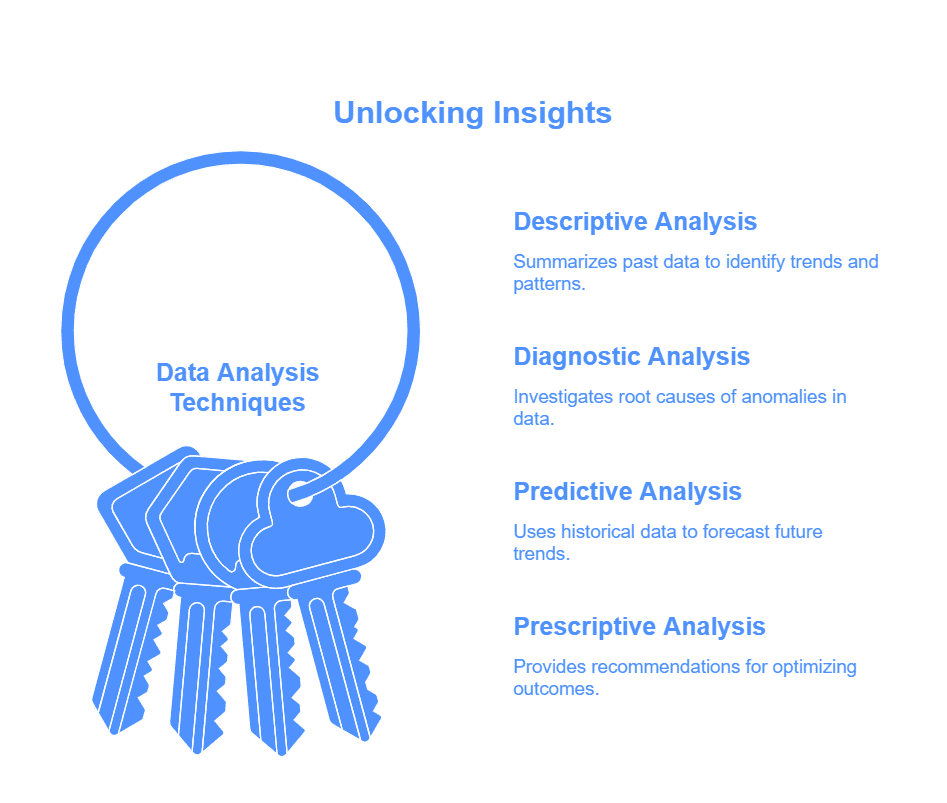
Data analysts apply a variety of main data analysis methods to manage and analyse data in the right way. The four most common ones are explained below:
1. Descriptive Analysis – What Happened?
Descriptive analysis helps summarise past data to find trends and patterns. It is typically the starting point for data analysis.
Example Applications:
- Retail companies analysing past sales data to find out shopping times.
- Web site owners analysing visitor traffic over time.
- Firms analysing customer churn rates.
2. Diagnostic Analysis – Why Did it Happen?
Diagnostic analysis analyses information to uncover the root causes of anomalies and trends.
Example Applications:
- Determining the reason for a surge in web traffic.
- Deciding the reason why one ad campaign generated better results in one area compared to another.
- Investigating the reason behind products with higher return rates.
3. Predictive Analysis – What’s Next?
Predictive analytics employs statistical and machine learning algorithms to predict future trends.
Example Applications:
- Predicting stock market based on historical facts.
- Estimating past sales volumes from historic customer behavior.
- Estimating the probability of customer churn.
4. Prescriptive Analysis – What Should We Do?
Prescriptive analysis makes recommendations on the basis of learning from data.
Example Applications:
- Showing product demos to one-off users in e-commerce.
- Optimisation of price strategy against competitive trends.
- Suggestion of best ROI marketing channels.
Key Skills Required for Data Analysis
To succeed as a data analyst, you must have technical skills as well as soft skills. Here’s a rundown of the most important competencies:
1. Statistical Knowledge
Statistics is the backbone of data analysis. The understanding of statistical techniques in the correct manner equips analysts with the ability to interpret data.
Most Important Statistical Concepts to Master:
- Descriptive Statistics – Mean, median, standard deviation, variance.
- Inferential Statistics – Hypothesis testing, probability distributions.
- Regression Analysis – Finding relationship between variables.
- Probability Theory – Needs to be studied for risk and machine learning models.
2. Data Cleaning and Preparation
It is reputed that 80% of a data analyst’s time is occupied with cleaning and getting data ready for analysis. (Source)
Common Data Cleaning Operations:
✅ Removal of duplicate and redundant data.
✅ Management of missing values by using imputation methods.
✅ Normalising data types in an effort to achieve consistency.
✅ Outliers detection to avoid biased analysis.
3. Programming and Query Languages
Programming enables analysts to manipulate data programmatically and do sophisticated calculations.
Key Programming Languages for Data Analysts:
- Python – For data processing (Pandas, NumPy) and machine learning (Scikit-learn).
- R – Statistical computing and data visualisation master.
- SQL – To query big data in relational databases.
Introduction to Deep Learning: Unlocking the Power of AI | Module 01
4. Data Visualisation
Data analysts need to communicate insights in an understandable way. Data visualisation enables stakeholders to make quick, well-informed decisions.
Best Data Visualisation Tools:
- Tableau – best for interactive dashboards and business intelligence.
- Power BI – the ease of integration with Microsoft products.
- Matplotlib & Seaborn – Python libraries for static plots and interactive plots.
5. Machine Learning & AI
Machine learning algorithms make an analyst better at predicting trends and identifying patterns.
Important Machine Learning Topics:
- Supervised Learning – decision trees, logistic regression.
- Unsupervised Learning – clustering, anomaly detection.
- Deep Learning – Neural networks for image and speech recognition.
6. Business Acumen
Analysts must understand the business context of their data so that they can make sound recommendations.
Example: A marketing analyst must understand customer behavior trends so that they can optimize digital ad spend.
7. Problem-Solving & Critical Thinking
Data analysts must be able to:
- Ask the right questions prior to analysis.
- Find patterns and relationships in data.
- Creating actionable insights that lead to business success.
8. Communication & Data Storytelling
Presenting findings as briefly as analyzing is as crucial.
Best Ways to Present Data:
- Use dashboards and infographics.
- Minimise unnecessary jargon.
- Present differently to technical vs. non-technical audiences.
Table: Data Analyst Essential Skills
| Skill | Importance | Tools Used |
| Statistics | Critical for interpreting data | R, Python (SciPy, StatsModels) |
| Data Cleaning | Ensures accuracy of the data | Pandas, OpenRefine |
| Programming | Makes analysis easier | Python, SQL, R |
| Visualisation | Aids in communicating insights | Tableau, Power BI |
| Machine Learning | Facilitates predictive analytics | TensorFlow, Scikit-learn |
| Business Acumen | Facilitates effective use of insights | Excel, BI Tools |
| Communication | Facilitates clarity | Google Slides, PowerPoint |
FAQs: Top Questions About Skills Required for Data Analysis
1. What are the key skills required for data analysis?
The most important skills include statistical analysis, data cleaning, SQL, Python or R programming, data visualisation (Tableau or Power BI), and strong business acumen.
2. What data analysis skills should beginners focus on first?
Beginners should start with Excel, basic statistics, SQL, and simple data visualisation tools like Google Data Studio. Python and Tableau can be added as they progress.
3. Do I need to know programming to become a data analyst?
Yes, basic programming knowledge in Python or R is highly recommended. It helps automate tasks, analyse large datasets, and build predictive models.
4. How can I improve my data analysis proficiency?
You can improve by working on real-world datasets, taking online courses, solving Kaggle challenges, and mastering tools like Python, SQL, and Tableau.
5. What are the most commonly used tools for data analysis?
The most widely used tools are Python, R, SQL, Tableau, Power BI, Microsoft Excel, and data cleaning platforms like OpenRefine and Alteryx.
6. Is data analysis a good career choice in 2025?
Absolutely. With businesses relying on data for nearly every decision, skilled data analysts are in high demand. Job growth and salaries in this field are strong globally.
7. What industries hire the most data analysts?
Industries like finance, healthcare, retail, technology, marketing, and logistics consistently hire data analysts to drive decisions and optimise operations.
8. What certifications can help me become a data analyst?
Certifications such as Google Data Analytics, IBM Data Science, Microsoft Power BI, and the Imarticus Postgraduate Program in Data Science & Analytics can strengthen your profile.
9. How long does it take to learn data analysis?
With focused effort, you can gain foundational skills in 3–6 months. Achieving professional proficiency typically takes 9–12 months of hands-on practice and coursework.
10. What’s the average salary of a data analyst?
In the UK, entry-level data analysts earn around £30,000–£40,000 per year, while experienced analysts can make up to £65,000 or more depending on skills and location.
Conclusion: Becoming a Skilled Data Analyst
Mastery of data analysis skills for beginners and advanced techniques paves the way to lucrative career prospects.
Key Takeaways:
- A good data analyst is one who has both technical and business acumen.
- Tools like Python, SQL, and Tableau are of utmost significance when it comes to analysis.
- Practice with actual datasets is the key to improving.
What’s Next?
Dreaming of a data analytics career? Enrol in the Postgraduate Program in Data Science & Analytics and embark on the journey to become a data guru!
Liked This? Follow Us Where You Already Search.
Preferred Sources is Google’s built-in follow button — no app, no login, just more Imarticus in your results.