



Last Updated on 3 weeks ago by Imarticus Learning
Completed your graduation and wondering what’s next in finance? You’re fully eligible to pursue FRM – regardless of your degree or percentage. Whether you come from commerce, engineering, economics, or another stream, FRM can position you for roles in risk management, banking, treasury, and financial analytics. If you want a globally recognised credential that strengthens your employability, this is the right time to start.
Risk today influences every major financial decision. From established global banks to ambitious fintech startups, managing financial risk has moved from being a support function to a strategic priority. As markets become more interconnected and unpredictable, companies are actively looking for professionals who can interpret risk models, understand financial systems, and help maintain stability. That’s where the FRM certification starts to stand out.
If you’re considering a serious career in risk management, banking, fintech, or global finance, a couple of questions naturally come up: What is the FRM course eligibility? Am I even eligible for FRM? And honestly, that’s the smartest place to begin.
Before you invest months into preparation, pay exam fees, or enrol in coaching, you want clarity. You want to know whether your academic background qualifies. You want to understand if prior work experience is compulsory. And you want to be confident that your current profile aligns with the FRM pathway.
Here’s the reassuring part – FRM is much more accessible than most people think.
Understanding FRM course eligibility is simply about getting your facts straight before you begin. It helps you:
→Decide the right time to attempt Part 1
→Plan your work experience timeline
→Align your long-term career goals with certification requirements
→Avoid confusion or misinformation about eligibility rules.
In this guide, I’ll break everything down in a clear way. You’ll understand:
→The educational requirements and whether a finance degree is actually mandatory
→The work experience rule and how it works in real life
→Whether students can register and sit for the exam
→What FRM course eligibility in India looks like for CA, CFA, MBA, engineering, commerce, and other backgrounds.
By the end, you won’t just know whether you’re eligible. You’ll know how to position yourself strategically – and whether FRM genuinely fits your career direction.
Interesting Insight:
FRM does not mandate a specific degree to register. You don’t need to be a commerce or finance graduate. Engineering, mathematics, economics, or even non-finance backgrounds can apply. This makes it one of the most accessible high-value finance certifications globally.
What is FRM and Why Eligibility Matters
Many students begin their FRM Journey by first searching for “What is FRM?” The Financial Risk Manager (FRM) certification is offered by the Global Association of Risk Professionals (GARP). It is globally recognised and focuses on financial risk management, quantitative analysis, and market understanding. So eligibility isn’t just about appearing for an exam – it’s about qualifying for a globally respected designation. FRM is divided into two parts:
- FRM Part 1
- FRM Part 2
You must pass both exams and complete the required work experience to earn the certification. But before all that, let’s address the key question: What are the FRM course eligibility criteria?
One of the biggest advantages of FRM is its flexibility. Unlike many finance certifications, the FRM course eligibility does not require a specific degree or academic background.
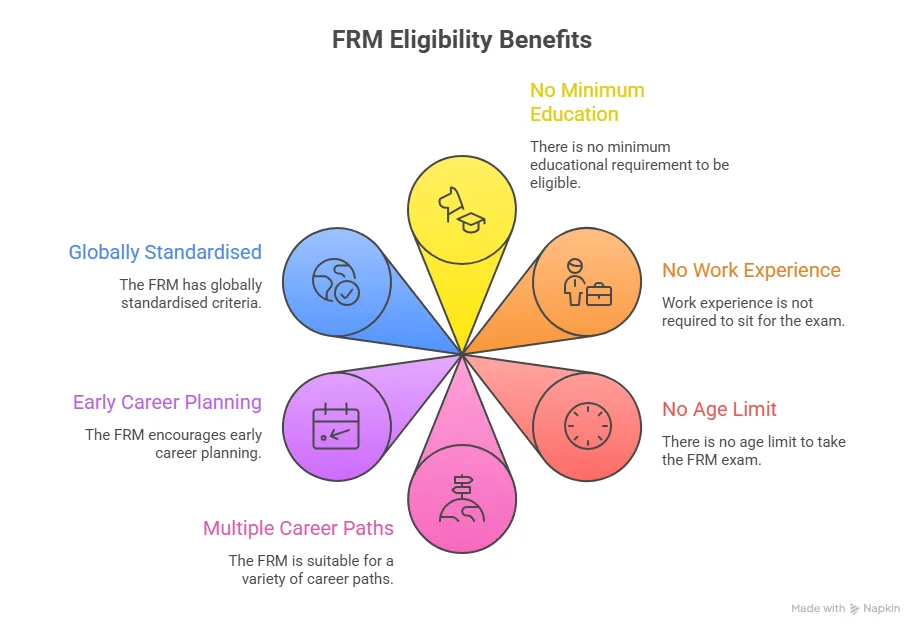
Here’s what you need to know: There’s no minimum Educational Qualification required to pursue FRM. There is no mandatory degree requirement to register for the FRM exams. That means:
- Undergraduate students can apply.
- Postgraduate students can apply.
- Working professionals can apply.
- Even final-year students can register.
This makes FRM highly accessible. The FRM syllabus is concept-heavy and analytical. It is not impossible without financial knowledge, but preparation becomes more demanding.
If you’re planning to pursue the FRM certification, the video below offers a clear and comprehensive walk-through of what you’ll study, how the exams are structured, and how the course equips you for risk management roles.
FRM Course Eligibility at a Glance
If you’re planning to build a career in risk management, understanding FRM course eligibility is the first step. Below is a quick overview of the FRM eligibility criteria to help you determine whether you qualify.
| Criteria | Details |
| Minimum Education | No mandatory educational qualification is required to register for the FRM exam. |
| Recommended Qualification | A bachelor’s degree in finance, commerce, economics, mathematics, engineering, or related fields is preferred. |
| Work Experience Requirement | No work experience is needed to appear for the exams. However, 2 years of relevant full-time work experience are required to earn the FRM certification. |
| Eligible Candidates | Undergraduate students (final year), graduates, working professionals, and finance aspirants can apply. |
| Certification Awarded By | Global Association of Risk Professionals (GARP). |
| Skills Recommended | Strong understanding of quantitative analysis, financial markets, risk management, and analytical skills. |
Also Read: How FRM boosts your salary growth.
FRM Course Eligibility in India: What You Should Know
When discussing FRM course eligibility in India, the rules remain the same because FRM is a global certification. However, here’s how it typically applies in India.
Many students register for FRM:
- During the final year of graduation
- During MBA
- After B.Com or BBA
Starting early gives you a strong risk management foundation before entering the job market.
FRM is popular among working professionals in India, typically in:
- Banking professionals
- Investment banking analysts
- Risk and compliance professionals
- Treasury and finance managers
For professionals, FRM adds global credibility and can accelerate career growth.
Also Read: Essential components of FRM fees you should know before registering for the FRM course.
Who Can Pursue FRM?
No matter your background – commerce, engineering, management, accounting, or investment banking – FRM can add a strong layer of specialised expertise to your profile. It helps you move beyond general finance knowledge and build deeper capability in financial risk, market behaviour, and regulatory frameworks.
FRM course eligibility isn’t restricted to a single academic stream or job role. If you’re looking to move into areas like risk management, treasury, banking, consulting, or financial analytics, FRM can act as a strategic upgrade. It signals to employers that you understand how risk impacts real financial decisions – not just in theory, but in practical application.
Below is a quick overview of who can pursue FRM and how the certification complements different professional backgrounds:
| Designation | Why FRM Is Beneficial |
| 12th Pass | Early exposure to risk management helps build a strong foundation before entering finance careers. |
| Commerce Graduates | Strengthens practical risk, credit, and market knowledge beyond academic theory. |
| Non-Commerce Graduates | Provides a structured pathway to enter finance and risk management roles. |
| Engineers | Leverages quantitative and analytical skills for high-demand risk analytics careers. |
| MBA | Adds global risk expertise that complements management and finance specialisation. |
| CFA | Deepens specialisation in risk management alongside investment expertise. |
| CPA | Expands career scope from accounting into financial risk and regulatory roles. |
| CMA | Enhances understanding of market and financial risk beyond cost management. |
| ACCA | Strengthens global finance credentials with advanced risk management knowledge. |
| CA | Diversifies career opportunities into banking, treasury, and enterprise risk roles. |
| Investment Banker | Improves expertise in credit, market, and structured product risk assessment. |
If your long-term goal involves risk, banking, consulting, or financial analysis, FRM makes strategic sense. If you are unsure, structured FRM coaching can help bridge conceptual gaps. The key is discipline and consistent study.
Did you know?
Final-year undergraduate students can register and appear for the FRM exams. That means you can begin building a risk management profile before even graduating – a strong differentiator in campus placements.
FRM Course Eligibility After Graduation
FRM course eligibility is designed to be inclusive – but succeeding requires commitment. If you’re serious about building a career in risk management, investment banking, treasury, or financial analytics, the barrier to entry is low. The bar for excellence is high.
Graduates from commerce, economics, engineering, mathematics, or any other discipline can pursue FRM without restrictions. There is no minimum percentage requirement to register. FRM is ideal for graduates looking to build a specialised career in risk management, banking, financial markets, or investment analysis.
FRM Course Eligibility After Professional Courses
When discussing FRM course eligibility, one area that creates the most confusion is work experience. Many candidates assume they must have years of prior experience before even registering for the exam. That’s not accurate.
Unlike several professional certifications that have rigid entry requirements, FRM is structured to be inclusive. Professionals from different backgrounds can pursue it. Even experienced practitioners use FRM to specialise further in risk management. You don’t need a “perfect” resume to get started.
Candidates who have completed professional qualifications such as CA, CFA, MBA, CPA, CMA, or ACCA can also pursue FRM. The certification complements existing finance and accounting expertise by adding advanced knowledge in market risk, credit risk, and financial risk management.
Understanding how relevant work experience fits into FRM course eligibility is important because it affects your long-term certification timeline – not your ability to sit for the exams.
Relevant Work Experience Required for FRM
Eligible work experience for FRM Certification includes roles in:
- Risk management
- Credit analysis
- Market risk
- Investment research
- Treasury
- Trading
- Financial analytics
It doesn’t have to be strictly titled “Risk Manager.” The scope is wider than many candidates assume.
Also Read: Plan your study schedule effectively by understanding the FRM course duration.
FRM Part 1 Vs FRM Part 2 Eligibility Criteria
Before registering, many candidates want clarity on the FRM course eligibility requirements for both exam levels. Understanding the difference between FRM Part 1 and Part 2 eligibility will help you plan your certification journey more effectively.
| Criteria | FRM Part 1 Eligibility | FRM Part 2 Eligibility |
| Educational Qualification | No minimum qualification required; open to students and graduates from any stream. | No additional qualification required beyond passing Part 1. |
| Work Experience Requirement | Not required to appear for the exam. | Not required to appear, but 2 years of relevant full-time work experience are needed for certification. |
| Exam Prerequisite | No prior exam required. | Must pass FRM Part 1 before registering. |
| Ideal Candidates | Students, fresh graduates, finance aspirants, career switchers. | Candidates who have cleared Part 1 and want advanced risk specialisation. |
| Certification Award | Passing Part 1 alone does not grant the FRM designation. | The FRM designation is awarded after passing Part 2 and completing the work experience requirement. |
One of the biggest mistakes students make in understanding the FRM course eligibility is mistaking accessibility for simplicity. The curriculum is quantitatively demanding, and the FRM exam tests a deep understanding of financial markets, risk models, valuation techniques, and regulatory frameworks. This balance – easy entry but high academic standards – is what gives the FRM designation its global credibility and career value.
Choosing to pursue the FRM certification is a big decision, and it’s one you shouldn’t take lightly. To give you the clearest perspective, here’s a video that breaks down exactly why FRM still matters in 2026, what kind of skills it builds, and the real career value it offers.
How to Apply for the FRM Course?
So, you’ve checked the FRM course eligibility and confirmed you can apply. Good. Now let’s walk through what actually happens next – step by step, so there’s no confusion.
Create an Account on GARP’s Official Website
The FRM certification is awarded by the Global Association of Risk Professionals (GARP). Your first step is to create a candidate account on their official website. This is where you’ll manage registration, exam scheduling, and future certification updates.
Register for FRM Part 1
Once your account is set up, you’ll register for FRM Part 1. Choose your exam window carefully. Give yourself realistic preparation time – this is not an exam you “try.” It demands commitment.
Pay the Registration and Exam Fees
You’ll have to pay a one-time enrollment fee – this is specifically for first-time candidates. Plus the Part 1 exam fee. Early registration usually costs less, so planning saves money.
Prepare and Appear for the Exam
Now the real work begins. FRM Part 1 focuses on quantitative analysis, financial markets, valuation, and risk foundations. Structured study and consistent revision are critical.
Clear FRM Part 2
After passing Part 1, you can register for Part 2. This level goes deeper into market risk, credit risk, operational risk, liquidity risk, and risk management practices.
Submit Two Years of Relevant Work Experience
Passing both exams isn’t the final step. To earn the official FRM designation, you must complete and submit proof of two years of relevant full-time work experience in risk management or related roles.
Also Read: What can you expect FRM salaries in India at different stages of your career?
FRM Eligibility Criteria for Scholarship
If you’re considering applying for an FRM scholarship, it’s important to understand how eligibility works. Many candidates assume scholarships are only for toppers or finance graduates – that’s not true.
The FRM scholarship program is designed to support students and early-career professionals who demonstrate academic merit, a strong interest in risk management, and financial need.
Here’s what typically matters:
| Eligibility Factor | Requirement |
| Student Status | Must be a full-time undergraduate or postgraduate student (as per scholarship guidelines). |
| Institution Participation | Some scholarships require nomination through a participating university or college. |
| Prior Registration | Should not have previously registered for the FRM exam. |
| Application Window | Must apply within the official scholarship deadline. |
| Academic Merit | Strong academic performance and interest in risk management improve selection chances. |
If you’re serious about FRM but concerned about costs, applying for a scholarship is absolutely worth considering. It can significantly reduce the financial burden and make the certification more accessible early in your career.
Did you know?
Academic performance, demonstrated interest in risk management, recommendation letters, and personal essays often matter more than just GPA.
Common Myths About FRM Course Eligibility
When it comes to FRM course eligibility, there’s a lot of confusion floating around. Many aspirants assume the certification is only for finance graduates or that extensive work experience is mandatory before applying.
In reality, FRM has flexible entry requirements, but the academic rigour is what truly sets it apart. Before you decide whether you qualify, it’s important to separate facts from myths – so you can make an informed and confident career decision.
| Common Myths | Reality | Facts You Should Know |
| You need a finance degree to apply | ❌ | FRM has no mandatory educational requirement. Candidates from engineering, commerce, management, and other backgrounds can register. |
| Work experience is required before sitting for the exam. | ❌ | Work experience is not required to take Part I or Part II. Two years of relevant experience are only needed to earn the FRM certification after passing both exams. |
| Only bankers can apply for FRM. | ❌ | FRM is open to students and professionals from finance, consulting, IT, accounting, and other domains who meet basic registration criteria. |
| There is an age limit for FRM. | ❌ | There is no minimum or maximum age limit to register for the FRM exams. |
| FRM is globally accessible | ✅ | The FRM certification is internationally recognised, and candidates from around the world can register and take the exam at approved centres. |
Did you know?
There is no upper age restriction under the FRM course eligibility. Whether you’re a 21-year-old graduate or a mid-career banking professional, you can pursue FRM to pivot into risk management.
Why Imarticus is the Right Learning Partner for FRM
Understanding the FRM course eligibility can make a huge difference – not just in choosing the coaching or passing the exams, but in how confidently you enter the world of risk management. With so many options out there, you want a partner who doesn’t just teach you the syllabus but helps you think like a risk professional and prepares you for real-world finance roles.
Here’s what sets Imarticus Learning’s FRM Certification Course apart:
- Expert-Led Training Across Both Levels – Imarticus offers structured, expert-led guidance for both FRM Part 1 and Part 2, aligned with the official GARP curriculum. This means you’re not just memorising concepts – you’re understanding them in a way that helps you apply them in exams and real risk scenarios.
- Complete Study Resources Included – The program includes comprehensive study material and practice questions from trusted providers, helping you build confidence through exposure to real exam-style content.
- Practical, Industry-Relevant Focus – Their sessions often include case studies, simulations, and practical insights that mirror real risk management problems, which helps bridge the gap between theory and actual job expectations.
- Personalised Support & Mentorship – A key benefit of this FRM coaching is the personalised support from faculty and mentors. Doubt clearing, concept reinforcement, and consistent guidance help you throughout your preparation.
- Flexible Learning Options – Whether you’re a working professional or a student, Imarticus provides flexible learning modes – including live online classes, recordings, and support resources – so you can plan your study around your schedule.
- Focus on Career Outcomes – Beyond exam success, Imarticus emphasises career readiness. The training helps you build skills that are valuable for risk roles in banks, consulting firms, and financial organisations – turning certification into real-world opportunities.
- Structured Preparation Roadmap – With a clear timeline, milestones, and regular mock tests, you’re guided through your FRM journey step by step. This kind of structure is especially helpful given the rigorous nature of the FRM exams.
Imarticus isn’t just another coaching provider – it’s a partner that helps you go from being uncertain about the FRM process to feeling prepared, confident, and ready for a global finance role. If you want structured guidance, practical understanding, and support that goes beyond just lectures, Imarticus Learning’s FRM program makes that journey clearer and more achievable.
FAQs About FRM Course Eligibility
When it comes to FRM course eligibility, most doubts arise from assumptions about educational requirements, work experience, age limits, and background eligibility. This frequently asked questions section helps you move forward with clarity and confidence.
What is the FRM course eligibility?
FRM is open to almost everyone. There is no mandatory degree requirement, no minimum percentage, and no prior work experience needed to register for the FRM exams. Whether you’re a final-year student, a graduate from any stream, or a working professional, you can apply. While FRM course eligibility is flexible, the syllabus is rigorous.
Can I become a financial risk manager after an MBA?
Yes, absolutely. In fact, FRM complements an MBA (especially in Finance) very well. An MBA builds managerial and strategic knowledge, and FRM adds deep technical expertise in risk models, market risk, credit risk, and financial analysis. If you’re targeting roles in banking, treasury, consulting, or global finance teams, FRM can significantly strengthen your profile.
Can I become a financial risk manager after doing engineering?
Yes. Engineers are actually well-suited for FRM because the syllabus is quantitative and analytical. If you’re comfortable with mathematics, probability, and data analysis, you already have an advantage. You may need to build foundational finance knowledge, but many engineers successfully clear FRM and transition into risk analytics, fintech, and quantitative roles.
Can a CA pursue a financial risk management qualification?
Definitely. As the FRM course eligibility is flexible, Chartered Accountants often pursue FRM to move beyond accounting into risk management, banking, treasury, or enterprise risk roles. CA gives you strong financial reporting and compliance knowledge. FRM adds specialised risk expertise, which is a powerful combination for leadership roles in finance.
Can a CMA pursue a financial risk management qualification?
Yes. As the FRM course eligibility is quite inclusive, CMAs are eligible to pursue FRM. CMAs focus on cost management and financial planning, while FRM focuses on market, credit, and operational risk. If you want to expand your career beyond management accounting into financial risk, banking, or global finance roles, FRM can diversify your opportunities.
Can a CFA pursue financial risk management?
Yes, and many do. CFA builds strong investment and portfolio management expertise, while FRM dives deeper into risk measurement and risk modelling. If your career involves asset management, investment banking, or portfolio risk analysis, combining CFA and FRM makes your profile highly specialised and globally competitive.
Can I do FRM without CFA?
Absolutely. FRM and CFA are independent certifications. The GARP does not require CFA as a mandatory qualification for FRM course eligibility. FRM is focused specifically on risk management. If your goal is to work in risk, compliance, treasury, or quantitative finance, you can directly pursue FRM without CFA.
What is the FRM course eligibility for an accounting professional?
Accounting professionals – including CAs, CPAs, CMAs, and ACCAs – are fully eligible for FRM. There are no additional FRM course eligibility requirements for them. FRM helps accounting professionals transition into risk advisory, financial risk analysis, regulatory compliance, and banking roles. It adds a forward-looking, risk-focused dimension to what is otherwise a reporting-heavy profile.
Turn FRM Course Eligibility into Opportunity
The FRM course eligibility is straightforward, but the journey itself requires seriousness and focus.
You don’t need a specific degree. You don’t need years of experience before sitting for the exam. The FRM eligibility criteria are flexible enough to welcome students, working professionals, and even career switchers. That’s the easy part. The real question isn’t “Am I eligible?” It’s “Am I ready?”
FRM is demanding. It requires discipline, consistency, and a genuine interest in understanding how financial risk works in the real world. If you’re willing to put in the effort, the certification can open strong opportunities in banking, consulting, fintech, and global finance.
Understanding FRM course eligibility gives you clarity about where you stand, but your success will depend on how committed you are to the preparation process. So take a moment and think about your long-term goals. If risk management and financial strategy are areas you want to grow in, this could be a smart move for your career.
Your journey toward becoming a globally recognised risk professional doesn’t start with the exam – it starts with the decision to begin. And when you’re ready, take that first step towards the FRM course with confidence.
