


Last Updated on 3 months ago by Imarticus Learning
Data sits everywhere now. In invoices, apps, machines, websites, customer calls, and spreadsheets that no one opened after the month-end. Most of this data stays unused, not because it lacks value, but because very few people know how to work with it properly.
That gap is exactly where the skills of the Data Science and Analytics Course start to matter.
In real workplaces, analytics does not begin with charts. It begins with confusion. A sudden drop in sales. A campaign that worked last quarter but failed this time. A process that feels inefficient, but no one can prove why. These moments arrive without clean questions and without clear answers.
The people who step in confidently during these moments are not always the ones who know the most tools. They are the ones who know how to think with data.
Imagine being handed a spreadsheet with thousands of rows and being asked one simple question:
“What should we do next?” At that point:
→ The data is incomplete
→ The question is vague
→ The decision is urgent
This is where data analytics skills reveal their real value. Not in perfect datasets, but in imperfect ones. Not in ideal conditions, but in pressure-filled situations.
When people ask what data analytical skills are, they often expect a neat checklist. In reality, skills in data analytics behave more like a system than a list. Each skill connects to another, and the value shows only when they work together inside a real business problem.
At its core, the skills in data analytics refer to the ability to collect data, prepare it for analysis, explore patterns, draw conclusions, and communicate findings in a way that influences decisions. This process applies whether the data comes from a simple spreadsheet or a distributed big data environment.
This blog explains data analytics skills in a clear and practical way, focusing on how these skills are actually used in real jobs. It walks through the analytics process from understanding data to communicating insights, covers technical and big data skills, and shows how these abilities evolve across career stages.
Why Data Analytics Skills Decide Who Gets Hired
Every day, data is being created quietly in the background. Sales transactions, app clicks, supply chain movements, customer complaints, sensor readings. On its own, this data does nothing. The value only appears when someone knows how to work with it properly.
That is where data analytics skills come in.
I see many people confuse data analytics with dashboards or tools. In real work, analytics looks very different. A manager wants to know why revenue dipped in one region. A product team wants to understand why users stopped engaging. A finance team wants to forecast demand without overstocking. None of these problems arrives with clear instructions. They arrive as uncertainty.
The ability to reduce that uncertainty using data is what defines a strong analytics capability.
A Simple Question That Changes Everything
Before going any further, it helps to pause and ask one question:
When someone hands you a dataset, what do you actually do with it?
- Do you know which data matters and which does not?
- Can you spot errors before they distort conclusions?
- Are you comfortable explaining insights to someone who does not work with data?
- Can you connect numbers to real business actions?
If any of these feel unclear, that gap is not about tools. It is about skills.
Why Data Analytics Skills Are Discussed So Much Right Now
Analytics roles exist today in almost every industry. Finance, healthcare, retail, technology, logistics, and education. The demand is not limited to people with “analyst” in their title.
The reason is simple. Decisions are becoming faster and more data-driven.
Data analytics skills help teams:
- Understand what is happening right now
- Identify patterns before problems grow
- Measure performance with clarity
- Support decisions with evidence
This is why analytics skills now appear in job descriptions that did not include them a few years ago.
A Quick Reality Check Before We Begin
The table below highlights a common gap between perception and reality in analytics work.
| Common Assumption | What Happens at Work |
| Analytics is mostly dashboards | Most time goes into data preparation |
| Tools create insights | Thinking creates insights |
| Results speak for themselves | Insights need explanation |
| Skills are fixed | Skills evolve with responsibility |
Understanding this gap early helps make sense of everything that follows.
A Practical View of the Data Analytics Skill Set
Before going deeper, it helps to frame the full data analytics skill set in a way that mirrors how work actually happens.
Below is a simplified flow that most analytics tasks follow.
This table explains how different skills are activated at each stage of an analytics task. It helps readers understand how skills connect instead of existing in isolation.
| Stage of Work | Skill Applied | Why It Matters |
| Defining the problem | Business understanding | Aligns analysis with real goals |
| Collecting data | Data sourcing | Ensures reliable inputs |
| Cleaning data | Data preparation | Prevents misleading results |
| Exploring patterns | Analytical thinking | Surfaces insights |
| Modeling | Statistical reasoning | Tests assumptions |
| Communicating | Data storytelling | Drives action |
This flow forms the backbone of most data analytics job skills. Every role, whether junior or senior, touches these stages in different proportions.
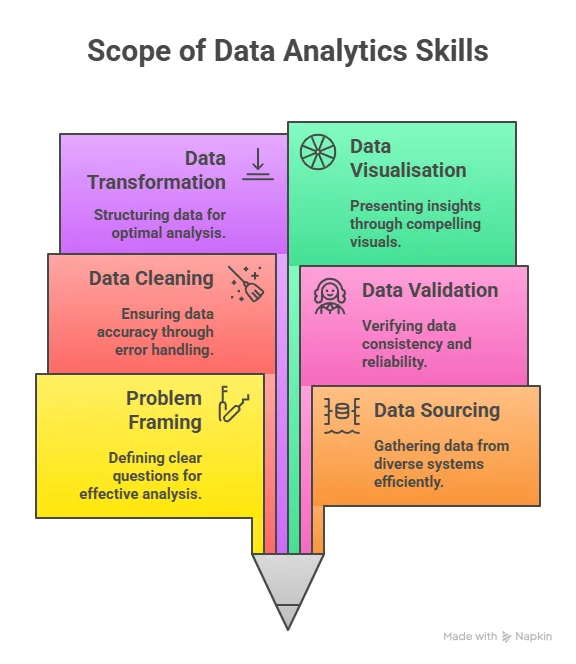
The scope of data analytics skills continues to widen as data-driven decision-making becomes central to everyday work across industries. These skills now extend beyond analysis into areas such as planning, performance tracking, forecasting, and strategic support, shaping how teams understand problems and act on information:
Why Employers Look Beyond Tools
Many learners assume that mastering tools alone defines skills in data analytics. Tools matter, but they are only the surface layer. Employers usually assess whether someone understands when and why to use a tool, not just how to run it.
For example, SQL is widely used, but its real value appears when someone knows how to write queries that answer business questions accurately. Python becomes powerful when it is used to automate analysis or test scenarios, not just write scripts.
This is why data analytics requires skills that include both technical ability and judgment. Hiring teams often test this through case-based discussions rather than tool-specific questions.
Did You Know?
According to a report by the World Economic Forum, data-related roles remain among the fastest-growing job categories globally, driven by digital transformation across industries. This trend has steadily increased the demand for structured data analytics skills in both technical and non-technical teams.
Core Categories Within Data Analytics Skills
To make sense of the wide skill landscape, I find it useful to group skills into four functional categories. This structure keeps the learning path clear and practical. The points below explain how different skill categories contribute to real analytics work.
- Analytical Thinking Skills: These include problem framing, hypothesis testing, and logical reasoning. Without these, even strong technical ability leads to weak insights.
- Data Handling Skills: This covers data cleaning, transformation, and validation. These are often underestimated, yet they consume a large portion of real analytics work.
- Technical Execution Skills: These form the data analytics technical skills layer and include SQL, spreadsheets, Python, R, and visualisation tools.
- Communication Skills: Insights have little value if they cannot be explained clearly. This includes presenting findings, building narratives, and aligning insights with stakeholder needs.
Together, these categories form the skill set required for data analytics across roles and industries.
A Closer Look at Technical Foundations
From here, it helps to understand the technical base that most roles expect. The following list outlines commonly expected data analytics technical skills without overwhelming detail.
- SQL for querying structured data
- Excel or spreadsheets for quick analysis
- Data visualisation tools for reporting
- Basic statistics for interpreting results
- Scripting languages for automation
These technical elements appear repeatedly across job descriptions. They form the entry point into the broader data analytics skills list.
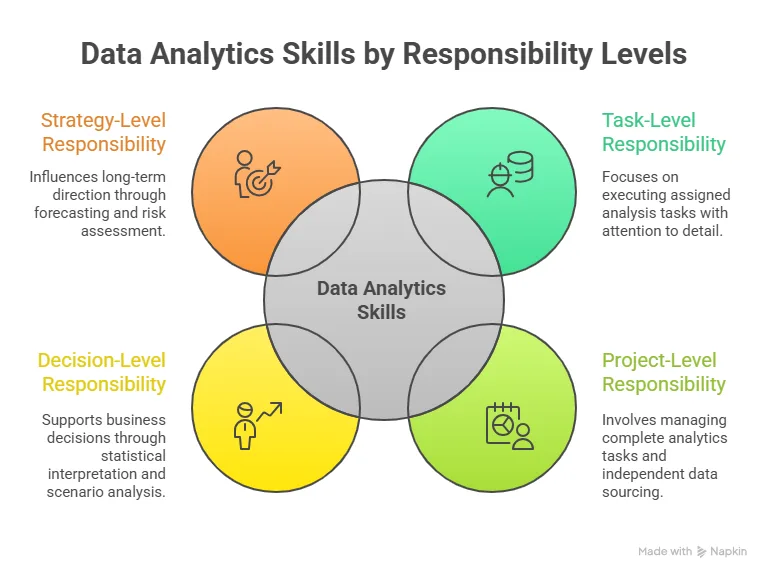
Data analytics skills vary with the level of responsibility involved in a role. As ownership increases, the focus moves from executing defined tasks to guiding decisions and shaping direction, reflecting how analytics capability grows with accountability:
Data Analytics Skills in Entry-Level Roles
In early roles, the focus stays on execution. Entry-level analysts often spend time preparing reports, cleaning datasets, and supporting senior analysts.
At this stage, data analytics skills in demand typically include attention to detail, consistency, and the ability to follow analytical workflows accurately. The goal is reliability. Mistakes in the early stages ripple through the entire analysis.
Did You Know?
A study by IBM estimated that poor data quality costs businesses trillions of dollars annually due to inefficiencies and bad decisions. This highlights why data preparation skills remain among the most valued data analytics job skills, even if they receive less public attention.
Understanding Big Data Analytics Skills at a Conceptual Level
Big data analytics skills focus on applying familiar analytics thinking to much larger and more complex datasets. The principles of analysis stay the same, but the environment in which data is handled changes. This section outlines what actually shifts when analytics moves from small to large-scale data.
Key ideas behind big data analytics skills:
- Data volumes grow from thousands of records to millions or billions.
- Data is often stored across multiple systems instead of one location.
- Queries must be written with efficiency to avoid slow performance.
- Processing happens in parallel rather than in a single system.
- Accuracy and consistency become harder to maintain at scale.
Skills commonly involved in big data analytics work:
- Working with data warehouses and cloud-based storage.
- Understanding how distributed data systems function.
- Writing performance-aware queries for large datasets.
- Handling structured and semi-structured data together.
- Applying the same analytical thinking used in smaller datasets.
At a conceptual level, big data analytics skills do not change how analysts think about problems. They change how analysts manage scale, speed, and reliability while keeping insights accurate and usable.
How Skill Progression Naturally Happens
As professionals grow, their role in the analytics flow shifts. They move from executing tasks to shaping questions and guiding decisions. This progression sets the stage for advanced data analytics skills, which focus on prediction, optimisation, and strategic insights.
For now, the key takeaway is simple. Data analytics skills grow by layering a deeper understanding onto a stable foundation rather than by collecting disconnected tools.
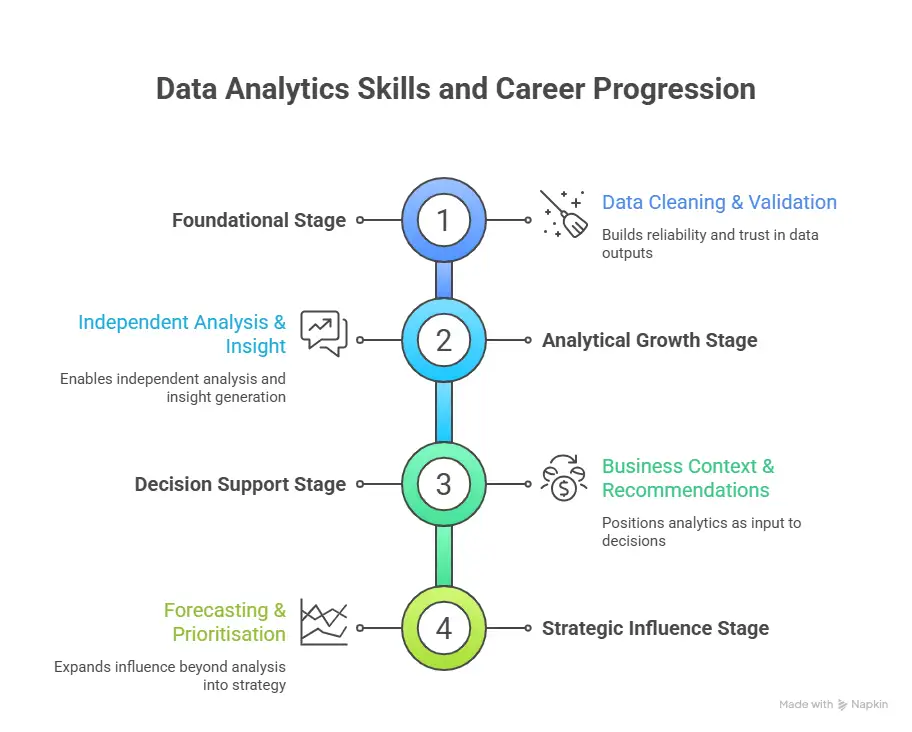
Data analytics skills support career progression by expanding the level of responsibility a professional can handle over time. As these skills deepen, the work shifts from task execution to decision support and strategic influence, creating steady growth across analytics-driven roles:
From Technical Execution to Advanced Data Analytics Skills
Technical ability is where most data analytics roles begin to show real differentiation. At this stage, data analytics skills stop being theoretical and start shaping how efficiently work gets done.
In real projects, technical execution usually starts with pulling raw data from multiple sources. These sources can include transactional databases, CRM systems, cloud storage, or third-party APIs. The ability to combine and prepare this data correctly defines the strength of the data analytics skill set far more than the choice of tools.
I often see analytics outcomes improve sharply when professionals understand how technical choices affect data quality. Simple decisions such as filtering data early or structuring queries efficiently can change timelines, accuracy, and trust in results.
Core Technical Skills Used Across Analytics Roles
The following table explains how commonly used technical skills support specific types of analytics tasks. This framing helps connect tools with outcomes.
| Technical Skill | Typical Use Case | Business Impact |
| SQL | Data extraction and joins | Faster access to clean data |
| Excel or Sheets | Quick analysis and validation | Speed and flexibility |
| Python or R | Automation and modelling | Scalable analysis |
| Visualization tools | Dashboards and reports | Clear communication |
| Statistics | Testing assumptions | Reliable insights |
These data analytics technical skills appear consistently across job descriptions and remain relevant even as roles become more advanced.
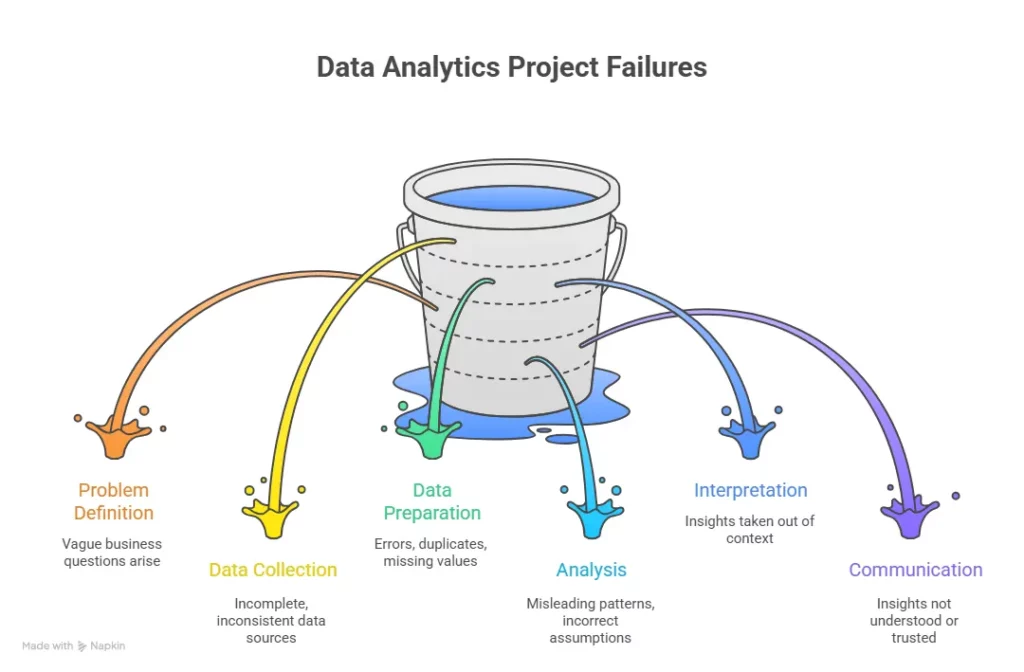
Data analytics project failures often trace back to gaps in skills rather than gaps in data. When problem framing, data preparation, or insight communication is weak, even well-intended analysis struggles to deliver outcomes, highlighting why strong data analytics skills matter at every stage:
SQL and Query Logic as a Foundation Skill
SQL deserves special attention because it sits at the centre of most analytics workflows. Query logic determines what data enters the analysis pipeline. Poor queries often lead to misleading insights, even if later steps are done well.
In many teams, SQL proficiency separates analysts who simply run reports from those who guide decisions. This is why SQL remains part of almost every data analytics skills list shared by employers.
Programming Skills and Analytical Depth
Programming languages such as Python or R expand what analysts can do with data. They allow automation, advanced modelling, and custom analysis.
However, advanced data analytics skills emerge only when programming is paired with analytical reasoning. Writing code that cleans data is useful. Writing code that tests scenarios, evaluates risk, or forecasts outcomes adds strategic value.
This shift explains why mid-level roles emphasise problem-solving and modelling over basic scripting. It also explains why data analytics skills in demand increasingly include the ability to interpret outputs rather than just generate them.
Did You Know?
According to Stack Overflow’s Developer Survey, Python has consistently ranked among the most commonly used languages in data-focused roles due to its flexibility and strong analytics ecosystem.
Understanding Big Data Analytics Skills in Modern Teams
Big data analytics skills become relevant when datasets grow beyond what traditional tools can handle efficiently. This usually happens in large enterprises, tech companies, and organisations dealing with real-time data.
In such environments, analysts work with distributed systems, cloud data warehouses, and streaming data pipelines. Skills required for big data analytics include understanding how data is stored, processed, and queried at scale.
The list below highlights common capabilities expected when working with large datasets.
- Comfort with cloud-based data platforms
- Understanding of distributed data storage
- Performance-aware querying
- Handling unstructured or semi-structured data
- Awareness of data security and governance
These skills needed for big data analytics often build on the same foundations discussed earlier, just applied in larger and more complex systems.
The Role of Data Modelling and Statistics
As professionals move into more advanced roles, statistical reasoning becomes more central. It supports forecasting, experimentation, and decision-making under uncertainty.
Data analytics required skills at this stage include understanding probability, distributions, confidence intervals, and basic modelling techniques. These concepts help analysts explain not just what happened, but how likely outcomes are to repeat or change.
Many organisations now expect analysts to support A/B testing, scenario planning, and performance measurement. This is where advanced data analytics skills directly influence strategy.
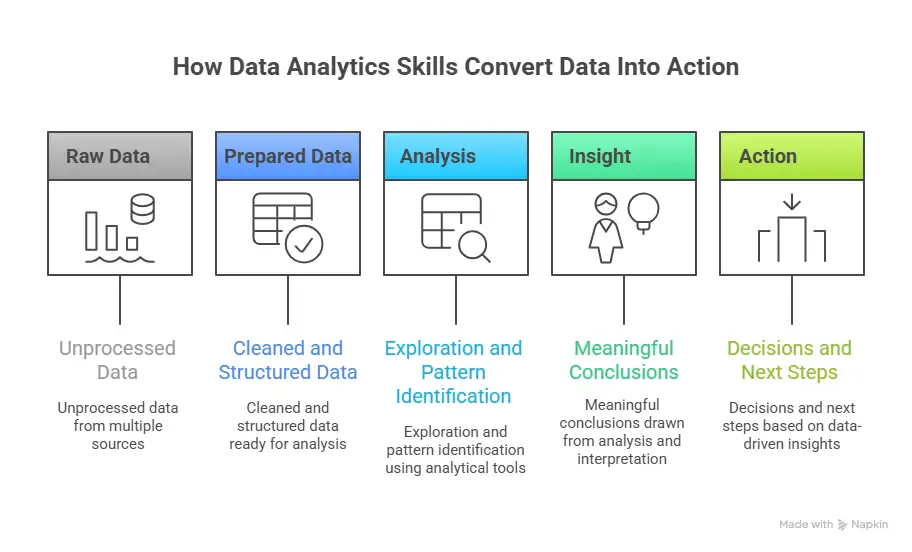
Data analytics skills play a key role in turning raw information into clear decisions. By structuring data, identifying patterns, and translating insights into practical recommendations, these skills help organisations move from observation to meaningful action with confidence:
Communication as a Technical Skill
Although often labelled as a soft skill, communication plays a technical role in analytics. Translating complex findings into simple narratives requires structure, clarity, and context.
In practice, communication includes choosing the right chart, framing insights in business language, and anticipating follow-up questions. This ability directly affects how analytics work is perceived and adopted.
Hiring teams increasingly test this through data analytical skills interview questions that focus on explanation rather than calculation.
Did You Know?
Research by Gartner shows that poor data storytelling remains a key reason why analytics initiatives fail to deliver value, even when technical analysis is sound.
How Hiring Teams Read Data Analytics Skills on a Resume
When recruiters scan a resume, they rarely read it line by line. They scan for signals. This makes the way data analytics skills are presented just as important as the skills themselves.
A strong resume does not list tools in isolation. It connects skills to outcomes. Instead of stating that someone knows SQL or Python, effective resumes show how those skills were used to solve problems, improve processes, or support decisions.
The table below explains how raw skills translate into resume-ready statements.
| Skill Area | Weak Resume Entry | Strong Resume Entry |
| SQL | SQL queries | Built SQL queries to consolidate sales data across regions |
| Visualization | Dashboards | Created dashboards to track weekly performance trends |
| Analysis | Data analysis | Analysed customer data to identify churn patterns |
This approach strengthens a data analytics skills resume because it shows applied thinking, not just exposure.
Aligning Skills With Real Job Descriptions
Most job descriptions follow a predictable structure. They list responsibilities, expected skills, and desired outcomes. Matching your resume language to this structure improves shortlisting chances.
Data analytics job skills often appear under phrases such as reporting, insights, forecasting, and decision support. Mapping your experience to these phrases helps recruiters see alignment quickly.
This alignment is especially important for roles where analytics supports other functions like marketing, finance, or operations.
Common Data Analytical Skills Interview Questions and What They Test
Interviews are designed to test how candidates think, not just what they know. Data analytical skills interview questions often focus on scenarios rather than formulas.
Examples include questions about handling missing data, explaining insights to non-technical teams, or choosing between two analytical approaches. These questions assess judgment, clarity, and structure.
The list below explains what interviewers usually evaluate.
- Problem understanding
- Logical approach to analysis
- Tool selection reasoning
- Communication clarity
- Awareness of limitations
Strong answers connect technical steps to the business context, reinforcing the depth of data analytics skills.
Data analytics careers follow structured learning and skill-building paths that evolve with industry needs. Exploring how roles, tools, and preparation steps fit together over time offers a useful perspective on how modern finance and business careers are shaped by data-driven thinking.
How Imarticus Learning Accelerates Your Data Analytics Career Growth
Developing strong data analytics skills is one thing; knowing how to apply them across real problems and organisational contexts is another. Many learners struggle not because they lack interest, but because they lack structured exposure to real tools, projects, and industry expectations.
A well-designed certification program can help bridge this gap by combining technical depth with practical application. For example, a comprehensive postgraduate program in data science and analytics offered by Imarticus Learning has more than isolated lessons on tools such as Python, SQL, Power BI, and Tableau. It pairs these with hands-on learning experiences, real business challenges, and project work that reflect the kinds of problems analysts face in the workplace.
- 300+ learning hours across analytics tools such as Python, SQL, Power BI, and Tableau.
- Hands-on learning with real-world datasets and case studies that mirror actual analytics challenges.
- Capstone projects to apply data analytics skills end-to-end from problem definition to insight communication.
- Exposure to 10+ industry-relevant tools used in workplace analytics workflows.
- Dedicated job support and placement assistance, including curated interview opportunities with partner organisations.
- Structured roadmap from fundamentals to applied analytics, helping translate skills into real work outcomes.
FAQs on Data Analytics Skills
This section answers the most frequently asked questions around data analytics skills, explaining how these skills are used in real analytics work, how they are evaluated by employers, and how they support career growth across different roles and industries.
What are the 4 types of data analytics?
The four types of data analytics are descriptive, diagnostic, predictive, and prescriptive analytics. Each type builds on core data analytics skills to answer different kinds of questions.
- Descriptive analytics explains what happened using historical data.
- Diagnostic analytics explores why it happened by identifying patterns and relationships.
- Predictive analytics uses statistical and machine learning techniques to estimate future outcomes.
- Prescriptive analytics recommends actions based on data-driven scenarios.
Together, these approaches form a complete view of how data analytics skills support decision-making across industries.
Is SQL enough for a data analyst?
SQL alone is not enough to cover the full range of data analytics skills required in modern roles. SQL plays a critical role in data extraction and preparation, but effective analytics also requires data cleaning, analysis, visualisation, and communication. Many training pathways offered by Imarticus Learning emphasise SQL as a foundation while building complementary skills that help analysts perform end-to-end analysis.
What are the three key skills required for a data analyst?
Three core data analytics skills required for a data analyst are analytical thinking, technical execution, and communication. Analytical thinking helps frame problems and interpret results. Technical execution allows analysts to work with data using tools like SQL, spreadsheets, and programming languages. Communication ensures insights are understood and acted upon.
What skills to put on a data analyst resume?
A strong data analytics skills resume highlights skills that show impact rather than just tools. These include data cleaning, analysis, visualisation, statistical reasoning, and stakeholder communication. Listing examples of how skills in data analytics were used to solve problems strengthens credibility. Including project outcomes, metrics, or insights demonstrates real-world application, which recruiters value highly when reviewing resumes.
What are the 4 pillars of data analytics?
The four pillars of data analytics are data collection, data preparation, analysis, and communication. Each pillar relies on specific data analytics skills to function effectively.
- Data collection ensures relevant data is available.
- Preparation focuses on cleaning and structuring data.
- Analysis extracts insights and patterns.
- Communication delivers those insights to decision-makers.
Learning programs offered by Imarticus Learning are structured to strengthen these pillars together, helping learners apply analytics skills across the entire workflow rather than in isolation.
What are the 7 steps of data analysis?
The seven steps of data analysis include defining the question, collecting data, cleaning data, exploring data, analysing patterns, interpreting results, and communicating findings. Each step activates different data analytics skills, from technical execution to critical thinking. Following this structure helps analysts maintain clarity and consistency across projects, regardless of data size or industry.
What are the 5 C’s of data analytics?
The five C’s of data analytics are context, clarity, consistency, correctness, and communication. These principles guide how data analytics skills are applied responsibly. Context ensures relevance. Clarity improves understanding. Consistency maintains reliability. Correctness protects accuracy. Communication ensures insights lead to action. Together, they shape high-quality analytics work.
What skills do I need for data entry?
Data entry roles require basic data analytics skills such as attention to detail, data validation, and familiarity with spreadsheets or databases. While these roles focus on input rather than analysis, they form an important foundation for broader skills in data analytics. Imarticus Learning help learners gradually expand these foundational skills into more analytical and decision-oriented capabilities over time.
Where Data Analytics Skills Take You Next
Data analytics skills do not exist in isolation. They show up quietly in everyday work, shaping how problems are understood, how decisions are made, and how outcomes improve over time. Throughout this guide, the focus has stayed on how skills connect, evolve, and support real analytics work rather than how they look on paper.
By now, it should be clear that building a strong analytics capability is not about collecting tools or memorising techniques. It is about learning how to think with data.
As analytics roles continue to expand across industries, professionals who understand how to apply data analytics skills in context tend to move faster and with more confidence.
For those looking to formalise this learning path, guided programs that combine technical training with applied projects and industry-aligned workflows can help bridge the gap between theory and execution. The Postgraduate Program in Data Science and Analytics offered by Imarticus Learning is designed to offer that structure, helping learners translate analytics knowledge into job-ready capability.
Wherever you are in your analytics journey, the skills discussed here form a foundation you can keep building on. With the right approach, data stops being overwhelming and starts becoming a reliable guide for better decisions.
